






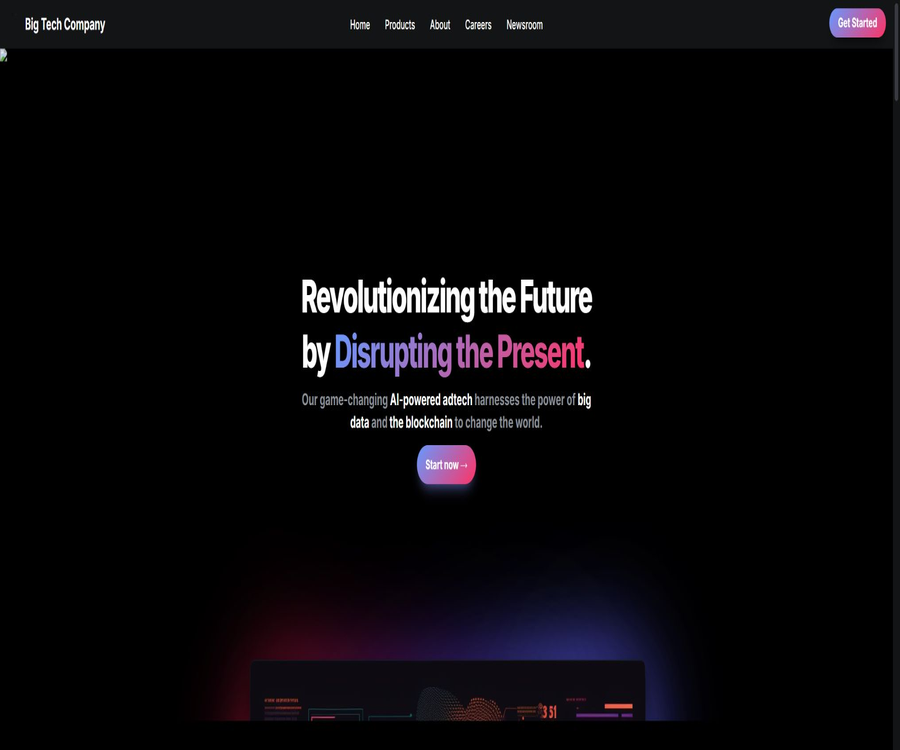
Big Tech Company
A big tech company that specializes in intelligent tools for improving AI efficiency.
Tags:AI improves efficiencyA one-sentence summary
Big Tech Company is a satirical tech website that imitates the style of companies from Silicon Valley; it uses fictional AI products to expose the risks associated with advertising manipulation, surveillance, false information, algorithmic discrimination, and an overemphasis on growth.
Project Overview
The website presents itself as a technology company with a complete range of products, a news center, a job board, and sales channels, but the company information, data, products, and executive profiles featured on it are part of an ironic portrayal. It is not a real AI software platform that allows users to register, make payments, or request demonstrations.
The footer identifies the company as a Big Tech Company under the umbrella of Ethical Marketing, while the creator’s page is managed by Alec Foster. The website uses deliberately absurd corporate language to show readers how the tech industry wraps ethical issues in terms of innovation, growth, and efficiency.
Why it is easily mistaken for a real product
- It adopts the complete visual design and navigation structure of the official corporate website.
- Create brand names, trademark symbols, and demonstration buttons for fictional products.
- Use business terms such as AI, big data, blockchain, collaboration, and disruption.
- It presents fictional figures for customers, investments, employment, and income.
- The news center uses a formal press release tone.
- The recruitment page imitates real job descriptions and corporate culture.
- Absurd content is mixed with real technology companies and social issues.
The core ironic theme
| Theme | Website expression style | Corresponding to real-world problems | Key points of the discussion |
|---|---|---|---|
| information cocoons | Only content that aligns with existing positions is recommended. | Polarization, transmission distortion, and recommendation bias | Should the platform focus on optimizing participation or on creating public value? |
| Advertising-driven search | All search results turn into advertisements. | Commercial sorting and user manipulation | How to distinguish between ads and organic results |
| Data monitoring | Collect search, microphone, and behavior data | Excessive data collection and precise profiling | Whether the consent is genuine and valid |
| Algorithm governance | Use scores to determine life opportunities. | Automated discrimination and lack of appeal mechanisms | Who defines the metrics and thresholds? |
| Automation as a replacement | Present layoffs as a means of improving efficiency | Employment shocks and responsibility shifting | How are the efficiency gains allocated |
| AI security | To compete, dangerous systems are released in advance. | Competition pressure and insufficient testing | Entry requirements and responsible parties |
| Growth first | Emphasizing financing and expansion even when revenue is zero | Vanity metrics and unsustainable growth | Does growth equal value? |
Fictional product description
EchoChamber
EchoChamber is described as a social platform that shows only content that aligns with the user’s existing beliefs, aiming at maximizing polarization and tribalism. It criticizes recommendation systems for amplifying biases and false information in order to boost engagement.
AdSearch
AdSearch designs search engines to display only ads, and uses personal data and device information for micro-targeting. It is used to criticize the replacement of natural search results with commercial ones as well as excessive tracking.
RugPull
RugPull is presented as a platform designed to help users create fake cryptocurrency projects in order to steal their funds. Its pages serve to satirize speculation, false endorsements, and the lack of regulation, rather than offering genuine blockchain tools.
VoteBot
VoteBot claims to vote on behalf of users in elections, reducing citizen participation to an automated process. This approach raises absurd questions regarding the boundaries between political autonomy, informed decision-making, and automatic decision-making.
ThoughtPolice and Baton
ThoughtPolice and Baton serve as satirical representations of thought surveillance based on facial recognition and predictive policing, respectively. The descriptions of punishments, weapons, and suppression on those pages do not reflect any actual capabilities of such services.
Loom and LifeScore
Loom views keeping users in an unhealthy state as a way to increase their lifetime value, while LifeScore reduces an entire life to a single score. They criticize business incentives for undermining users’ well-being and scoring systems for determining opportunities.
TrustBot 3000 and MindMeld
TrustBot 3000 relies on predictive assessment to identify users who might pose risks related to excessive automation in trust-related security systems, while MindMeld takes the practice of influencing people’s thoughts without their consent to extreme levels. Both approaches raise issues related to surveillance, misjudgments, and individual autonomy.
Aurora and Chime
Aurora reveals that the so-called AI assistants may rely on low-paid labor, while Chime presents smart home monitoring and data sales as a convenience. They urge readers to pay attention to the labor conditions in the supply chain, to anthropomorphic design elements, and to household privacy.
Product matrix comparison
| Fictional products | Surface positioning | The actual target of satire | Is it truly usable? |
|---|---|---|---|
| EchoChamber | AI social platforms | Information cocoons and polarization | No |
| AdSearch | Advertising search engine | Search for commercialization and tracking | No |
| RugPull | Blockchain platform | Financial scams and speculation | No |
| VoteBot | Automatic voting tool | Citizen autonomy and political automation | No |
| ThoughtPolice | AI monitoring system | Face recognition and thought censorship | No |
| Baton | Predictive unmanned systems | Weaponized AI and suppression | No |
| Loom | Nutritional applications | Retention metrics harm users’ interests. | No |
| LifeScore | Life scoring system | Social scoring and algorithmic discrimination | No |
| TrustBot 3000 | Trust security system | Predictive bans and false positives | No |
| MindMeld | Brain-Computer Advertising Platform | Thought manipulation and unsolicited marketing | No |
| Aurora | Virtual assistant | Hide manual and digital labor | No |
| Chime | Smart speakers and security systems | Home surveillance and data sales | No |
Content of the News Center
The news center releases more fictional stories in the form of corporate press releases, including open letters on AI security, the hurried introduction of chatbots, corporate ethics assistants, term generators, and tools for turning data into revenue. The exaggerated tone of these releases shows how companies repackage failures, risks, and ethical issues as stories of growth.
- JargonMaster satirizes the use of trendy terms to conceal the lack of substance in a product.
- Ethics-sistant satire treats ethics as an efficiency obstacle that needs to be bypassed.
- ChatMaster3000 was released as an AI that had not been thoroughly tested, under the pressure of a satire competition.
- DataMine sarcastically treats user data as a source of profit.
- CashBurner is a satirical term for a business model that relies solely on investment funds without any real increase in revenue.
- iScapegoat satirizes companies that look for scapegoats in times of scandal.
- The AI Pause open letter satirizes companies that use security as a pretext to gain time in order to catch up with their competitors.
The purpose of the recruitment page
The recruitment page criticizes the labor practices of technology companies by highlighting aspects such as an extreme corporate culture, unpaid internships, excessive working hours, mandatory arbitration, superficial diversity measures, and unlimited vacation days. The job positions and benefits listed on it are part of a fictional scenario and should not be considered as genuine recruitment information.
Why can’t website data be cited?
- The figures regarding employment automation are fictional and exaggerated.
- Listing the financing amount alongside zero income is an ironic expression.
- The founder’s background and stories about superpowers are part of the fictional character design.
- Investment firms, executives, and clients are not verifiable business relationships.
- There are no real-world tests, user reviews, or technical documentation regarding the product’s performance.
- The phone numbers and sales statements in the press release are narrative elements.
How to browse correctly
- Treat the website as a work of satire rather than a product catalog.
- Choose a fictional product and identify the real business model it imitates.
- Use growth, efficiency, innovation, and personalization messaging to label pages.
- Analyze the neglected user rights, public interests, and affected groups.
- Compare with the privacy, algorithms, and business models of real technology products.
- Discuss which exaggerated elements are approaching reality and which are purely absurd.
- When quoting, clearly indicate that it is fictional and satirical in nature.
Classroom teaching tutorials
- Explain to students the basic concepts of satire, irony, and corporate mimicry.
- Divide the students into groups, and each group selects a fictional product.
- The team is asked to list the product promises, business incentives, data inputs, and potential harms.
- Find a real-world example for comparison, but avoid unverified claims.
- Have students redesign a responsible version of the product and its governance mechanisms.
- Present the design results and discuss the structural issues that cannot be resolved solely through technology.
- Finally, check whether the students can clearly distinguish between fake websites and genuine evidence.
Process for discussing AI ethics
- Select topics related to the organization’s business, such as recommendations, ratings, monitoring, or automation.
- Use the corresponding fictional product as an extreme failure scenario.
- Identify the objective functions, data sources, and decision-making authorities in real-world systems.
- List the risks that users, employees, society, and vulnerable groups may face.
- Design mechanisms for manual review, appeal, transparency, and shutdown.
- Convert the results of the discussions into inspection items prior to the product’s launch.
- It is reviewed jointly by legal, policy, security, and affected community teams.
Media literacy analysis methods
- Check whether the page provides verifiable company registration details, technical documentation, and customer information.
- Identify numbers that appear precise but lack a source.
- Distinguish between product feature descriptions, value judgments, and absurd exaggerations.
- Check whether the button actually leads to the product, purchase, or documentation process.
- Check the footer, associated creators, and project positioning.
- When sharing screenshots, include sufficient context to avoid further misinterpretations.
Which users are it suitable for
- AI Ethics Teacher: Used to explain the harm caused by algorithms and commercial incentives.
- Media literacy courses: train students to identify satire, fiction, and corporate rhetoric.
- Product manager: Use fictional failure scenarios in risk discussions.
- Policy and governance professionals: analyze monitoring, scoring, and automation boundaries.
- Marketers: Reflect on exaggerated marketing, dark modes, and data abuse.
- Designer: Studies interface credibility and ethical discrepancies.
- Journalists and researchers: Observing technological criticism as a cultural artifact.
- General readers: Understand the controversies in the tech industry in a humorous way.
Which needs it is not suitable for
- Look for available AI-based social platforms or search engines.
- Purchase enterprise software or request a demonstration of the actual product.
- Call the API or download the SDK.
- Apply for genuine positions or verify job opportunities.
- Find accurate data on financing, customers, and revenue.
- Using fake press releases as a basis for facts.
- Collect performance test results for real AI products.
Typical use cases
- Use of case studies in AI ethics courses.
- Discussion of failure scenarios for corporate responsible AI workshops.
- Class exercises on algorithmic bias and the topic of social scoring.
- Training on marketing ethics and privacy design.
- Exercises for identifying satire in news dissemination.
- Research on technology and culture as well as analysis of creative web pages.
- Warnings about extreme risks in product red team exercises.
Project advantages
- Enhance the sense of irony through a fully functional corporate website.
- It covers topics such as recommendations, advertising, finance, elections, surveillance, healthcare, and labor.
- The products, press releases, and job pages complement each other.
- Use humor to lower the barrier to entering the complex ethical issues related to AI.
- It is suitable for converting abstract risks into product scenarios that can be discussed.
- Most of the content can be read without registration.
- Visuals and text can support analysis in classes and workshops.
Usage restrictions and precautions
- The project relies on English puns, American tech culture, and the Silicon Valley background.
- Some of the content deals with weapons, politics, discrimination, exploitation, and vulgar expressions.
- Exaggerated characters may be mistaken for real by readers who lack context.
- It can raise questions, but it does not provide a complete governance framework or legal solutions.
- The real company names mentioned on the page are used for satire and do not reflect any factual determination.
- The temporal context of the content focuses on specific technological controversies, and some memes lose their relevance over time.
- Real sensitive information should not be submitted through sales forms or recruitment portals.
- The link to the public privacy policy currently points to a non-existent page.
- Websites are not suitable as a source for product prices, performance details, or company information.
Prices and packages
Big Tech Companies do not have any actual software packages, payment pages, or purchase processes. The free trials, demonstrations, financing options, and revenue figures listed on their websites are meant as satire and cannot be considered as commercial pricing.
| Project | Actual status | Price | Explanation |
|---|---|---|---|
| Website reading | Accessible | Free | Browse fictional products and articles |
| Product demonstration | There is no actual demonstration. | None | Buttons are part of narrative design. |
| Free trial | There is no real trial version. | None | The sales copy is sarcastic. |
| Business packages | Not provided | None | No software or contracts |
| API services | Not provided | None | There is no developer platform. |
Sales forms and privacy
The Get Started page includes a section that mimics a sales submission form, with a note stating that the responses will be stored in an unencrypted format within an old computer spreadsheet. This description is an example of black humor, but it serves to illustrate that users should not enter their names, company details, phone numbers, or any other sensitive personal information.
- Do not enter real customer, employee, or business information.
- Do not submit passwords, payment details, internal documents, or personal identification information.
- Do not consider the form’s success page as a commitment to make a sales contact.
- Fully fictional sample data is used during classroom demonstrations.
- The current privacy link does not provide an explanation regarding the actual processing of data.
- Use public contact channels when reaching out to the creator, and keep the information to a minimum.
Platform support
| Platform | Support status | Uses |
|---|---|---|
| Web | Support | Browse all the main contents of the project |
| Windows and macOS | Browser access | There is no desktop client. |
| iOS and Android | Access via mobile browser | There are no standalone applications. |
| Public contact entry point | It’s not a product account system. | |
| Browser extensions | None | No additional features available. |
| API | None | There is no programmed access. |
API, GitHub, and open-source status
The project does not provide public APIs, SDKs, developer documentation, or an official GitHub repository. Searches on GitHub reveal no source code belonging to any Big Tech Company that can be verified through the project’s official website or the information of its associated creators.
The fact that a webpage is publicly accessible does not mean it is open source; a copyright notice should remain in the footer. The open source status in the catalog should be marked as \"no\", unless the creator explicitly releases the source code and license in the future.
Basic information
| field | Content |
|---|---|
| Project Name | Big Tech Company |
| Nature of the project | The tech industry and websites focused on the ethics of AI |
| Footer attribution | Projects under Ethical Marketing |
| Associated creators | Alec Foster |
| Main content | Fictional products, press releases, recruitment, and corporate culture |
| Is it a genuine AI tool? | No |
| Price pattern | Free viewing; no actual subscription plans available. |
| Is registration required? | It’s not necessary. |
| Primary language | English |
| API | None |
| GitHub | No official warehouse can be confirmed. |
| Is it open source? | No |
| Main platforms | Web |
Recommendation score
As an example related to AI ethics and media literacy, it receives a comprehensive rating of 4.3 out of 5 points. It uses a coherent fictional corporate universe to transform concepts such as algorithmic manipulation, surveillance, automation, and growth incentives into scenarios that are easy to discuss.
If evaluated as an AI productivity tool, its recommendation score is close to zero, as it lacks any real software capabilities. When displaying the catalog, the ‘satirical product’ should be placed in a prominent position to prevent users from thinking that they can actually purchase it.
Frequently Asked Questions
Is Big Tech Company a real company?
No, it is a satirical project that imitates technology companies; the company stories and products listed on the page are all fictional.
Can EchoChamber be registered for use?
No, EchoChamber is merely a fictional product created to satirize the concept of information bubbles.
Are the AI products on the website genuine?
It’s not true; the product name, features, customers, and metrics are all part of an ironic narrative.
Is the “Request a demo” button real?
It is not a real software demonstration; genuine company or personal information should not be submitted.
Is the website free?
Browsing is free; there are no real paid members or software packages.
Is it suitable for use in the classroom?
It is suitable for courses on AI ethics, media literacy, and marketing ethics, but teachers should pre-screen for political, military, and vulgar content.
Can press releases be considered a channel?
No, they are fictional press releases; they can only be used as satirical texts or for the analysis of cultural works.
Is an API provided?
Not available; the project does not have a developer platform, keys, or SDK.
Is the project open source?
It is not open source, and no verifiable official source code repository has been found.
Who created this project?
The footer assigns the item to Ethical Marketing, and the related page is managed by Alec Foster, a professional in the fields of AI governance and marketing.
Why are there real company names?
These names are used to create an ironic context and evoke real-world associations; they do not indicate any product or investment relationship between the website and the associated companies.
Is it safe to submit forms?
The page stores jokes in an unencrypted format as a warning to users, and there is no privacy policy available at the moment; therefore, one should not submit any real or sensitive information.
Tools similar to those of Big Tech Companies



 Guigong Network Security Registration No. 45132202000164