






Best Ambient AI Medical Scribe for any EHR
The best ambient AI medical scribe for any EHR – an intelligent tool focused on enhancing efficiency through AI.
Tags:AI improves efficiencyA one-sentence summary
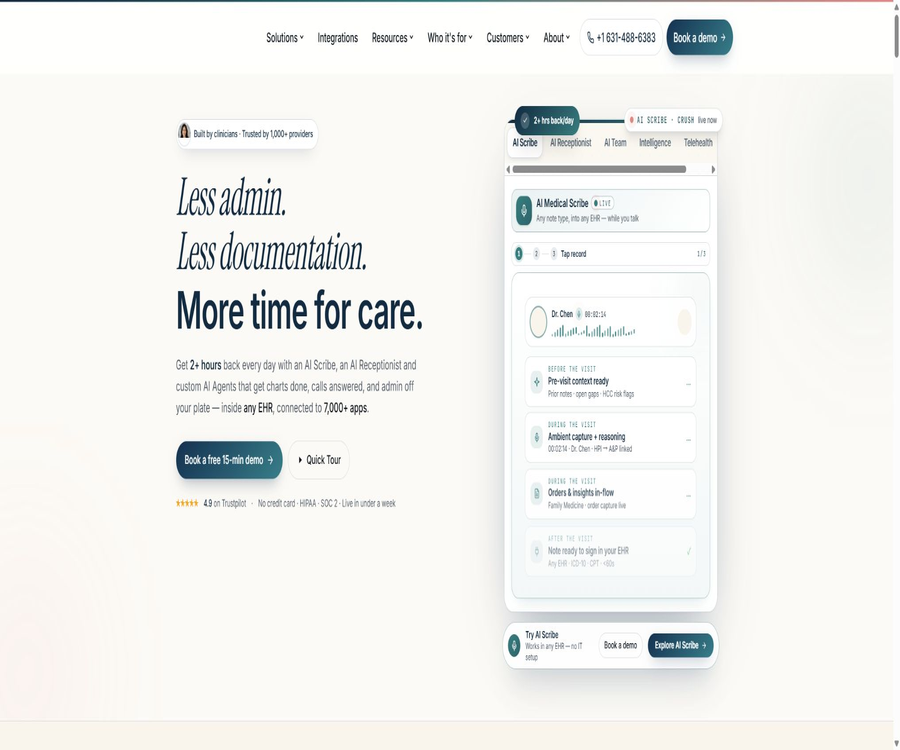
S10.AI is an environmental AI-based medical transcription and clinic automation platform designed for clinical use; it enables the conversion of doctor-patient conversations into structured notes, coding suggestions, and EHR fields.
Tool Introduction
S10.AI is operated by S10.AI Inc.; its core medical transcription product is called CRUSH. Doctors can engage in natural conversations during face-to-face meetings, telephone calls, or remote consultations, and the system captures these conversations in the background to generate clinical records that need to be reviewed.
The platform also offers an AI front desk, customized medical intelligents, compliance assistance, and telemedicine modules. This article focuses on CRUSH, the ambient medical transcription solution that is most relevant to the original topic, while also explaining the integration options for the team version and its price range.
Main functions of CRUSH
Environmental-based medical record
CRUSH can continuously record conversations throughout the patient’s consultation, without requiring the doctor to speak each sentence aloud or use a foot pedal. The official support page lists mobile phones, tablets, web browsers, and desktop environments, stating that on mobile devices recordings can be made offline before being synchronized.
Structured clinical notes
- Generate structured clinical notes suitable for EHR review based on the conversation.
- It supports SOAP, DAP, BIRP, GIRP, narrative formats, and organization-specific formats.
- The chief complaint, medical history, assessment, and plan can be entered in the corresponding fields.
- Doctors are allowed to edit, add, or delete inaccurate content before signing.
- Different templates can be used depending on the specialty and type of consultation.
Organization of information before seeking medical care
Once the connection to the EHR is established, the system can display relevant medical history, any unmet care needs, and risk alerts prior to a consultation. This functionality depends on the permissions granted by the institution, the level of integration, and the range of data that can be accessed.
Assistance from ICD-10 and CPT codes
CRUSH generates coding suggestions for ICD-10, CPT, E/M, and HCC based on clinical conversations and notes, along with supporting text. The resulting codes still need to be reviewed by qualified clinical or billing professionals and cannot be used as the final basis for submission.
Preprocessing of prescription and laboratory order instructions
The official feature page describes the process of identifying drugs and examination intentions from conversations, as well as of prepping medical orders and incorporating safety checks. Whether these orders can be added directly to the order queue depends on the EHR system, the permission settings, and the regulations in the respective region.
Quality inspection before signing
The system can alert the user to missing elements, quality metrics, and potential coding opportunities before signing. It serves as a tool to assist with documents, and it does not assume any responsibilities related to diagnosis, treatment, or clinical decision-making.
Templates and personalization
- Pre-set templates covering multiple clinical specialties are available.
- It is possible to import existing macros, institutional standards, or individual doctor templates.
- It supports using natural language to request the addition, deletion, or reordering of note sections.
- Doctors can save different record styles and terminology preferences.
- The team can share a template library and manage templates by site or role.
- It supports setting default formats for different types of consultations within the same institution.
Language and specialized support
The official product page claims to support over 60 languages and more than 50 specialized fields, but the public page does not list all of these languages in detail. Chinese, dialects, accents, bilingual switching, and the accuracy of terminology in specialized fields should be tested using real but anonymized samples first.
| Ability | Official public scope | Key points for verification during selection |
|---|---|---|
| Language | Over 60 kinds | Confirm the target language, accent, and bilingual dialogue. |
| Specialized field | Over 50 | Test real templates, terms, and types of consultations. |
| Note format | SOAP, DAP, BIRP, GIRP, and custom | Verify field structure and organizational standards |
| Clinical template | Specialized template and personal template | Confirm import, sharing, and permission management. |
| Medical coding | ICD-10, CPT, E/M, and HCC categories | Accuracy and compliance are verified by professionals. |
Integration of EHR with business systems
S10.AI claims to offer ready-made connections for over 100 different EHR systems, and it can make use of FHIR, HL7, and clinical RPA to handle older systems that lack proper interface standards or that rely solely on screen-based operations. It is able to read the context of authorized medical records, and it can also write notes, codes, medical orders, and tasks back into the corresponding fields.
Common EHR ranges
- Large medical systems such as Epic, Oracle Cerner, and MEDITECH.
- Outpatient systems such as AthenaHealth, eClinicalWorks, NextGen, and AdvancedMD.
- Practice management environments such as DrChrono, Practice Fusion, ModMed, Greenway, and Tebra.
- OpenEMR, OpenMRS, as well as regional or specialty EHRs.
- Systems without standard interfaces can have their RPA screen automation evaluated, but additional testing is required to assess stability.
Communication, calendar, and storage
- It can be connected to SIP, telephone, SMS, and virtual fax services.
- It is possible to participate in remote medical consultation environments such as Zoom, Teams, Meet, and Doxy.me.
- It supports two-way synchronization with Google and Microsoft calendars.
- Records and attachments can be routed to common cloud storage services.
- The Team Agent page also covers integration with Zapier, Make, REST APIs, and Webhooks.
Complete workflow
- Privacy confirmation by the institution, patient consent, business partnership agreements, and requirements regarding local medical records.
- Select EHR and complete authentication, granting only the minimum permissions required to complete the task.
- Map target fields such as medical history, assessments, plans, coding, and medical orders.
- Import an institutional template or set a default note format for each doctor.
- First, use test patients or anonymized data to verify the reading, generation, and writing-back processes.
- Initiate environmental recording during actual consultations, while allowing doctors to maintain normal communication.
- After the consultation, check the notes, diagnosis, medications, codes, and any missing information item by item.
- Modifications, signatures, and subsequent actions are carried out by authorized clinical personnel.
Tutorial for personal doctors
- Register for a trial and select the Solo plan, making sure that your institution permits the use of third-party medical transcription services.
- Connect the scheduling system to the EHR, or first try it out in a testing environment without writing any official medical records.
- Select a specialty template and add the chapters, macros, and terms that you use frequently.
- With the patient’s consent, recording can begin via mobile phone, web page, or desktop.
- After the consultation, wait for the draft to be generated, and pay close attention to negative words, drug dosages, dates, and numerical values.
- Check whether the ICD-10 and CPT recommendations have sufficient clinical basis.
- Edit and sign the notes, then verify that the information is entered in the correct patient and consultation records.
Tutorial for Deploying Medical Institutions
- Establish an evaluation team composed of clinicians, compliance officers, information security specialists, medical record managers, and billing staff.
- Confirm with the supplier the data flow, sub-processors, retention period, model training policies, and incident response procedures.
- Sign the applicable business partnership agreement and review the current security certification documents.
- Select a small number of specialized specialties and doctors for piloting, and define metrics such as accuracy, the amount of modifications made, and time saved.
- Configure minimum permissions, single sign-on, audit logs, and template governance for each role.
- Complete tests for EHR field mapping, failover, offline synchronization, and protection against incorrect patients.
- Doctors are trained to review AI-generated records, and automatic inclusion of such records in the final medical records without proper approval is prohibited.
- After meeting the requirements in the pilot phase, it will be rolled out in phases, with ongoing random checks on the quality of documents and code.
Which users are it suitable for
- Independent practitioners: Hope to reduce the need for manually filling out medical records after consultations.
- Multi-Doctor Clinic: Requires shared templates, a management backend, and usage analysis.
- Multi-specialty groups: It is desired to allow each department to maintain its own note structure.
- Telemedicine team: It is necessary to create records during video or telephone consultations.
- Healthcare system: SSO, audit logs, a dedicated environment, and deep integration with EHRs are required.
- Billing and Coding Team: Use the AI-generated coding suggestions as a starting point for manual review.
- Clinic operator: I would like to consolidate dictation, front-office tasks, and some repetitive processes on the same platform.
Typical use cases
- A structured draft of the medical record ready for signing is automatically generated after the outpatient visit.
- Behavioral health sessions generate records in DAP or BIRP format.
- Specialized diagnosis and treatment involve organizing the medical history, tests, and treatment plan according to the institutional template.
- Phone calls and remote consultation records are linked to the correct patients’ visits.
- Coding candidates are proposed based on clinical conversations and submitted to professionals for confirmation.
- Compile the relevant medical history and matters related to ongoing care before the consultation.
- Write the notes and attachments back into the EHR according to the rules, or route them to an approved storage location.
Product advantages
- It covers the entire documentation process, from preparation before the consultation, through data collection during the consultation, to completion of documents after it.
- It supports various clinical note formats and doctor-specific templates.
- It can be integrated with a wide range of EHR environments through standard interfaces or RPA.
- Integrate structured fields and coding recommendations into existing clinical workflows.
- Billing is transparent and based on the provider; the differences between the Solo and Practice plans are clear.
- The mobile version supports offline capture followed by synchronization, making it suitable for situations with unstable network connections.
- The Team version offers backend analysis, template management, and more comprehensive support services.
Usage restrictions and precautions
- Medical notes may contain omitted, misheard, or incorrectly associated information, and doctors must review them before signing.
- Negative words, drug dosages, allergy history, numerical values, left/right sides, and homophonic terms are considered high-risk items for examination.
- AI-generated coding suggestions cannot replace qualified coders or the compliance processes of organizations.
- The depth of EHR write-back varies depending on the product, version, interface permissions, and institutional settings.
- RPA relies on the interface structure; after an upgrade of the old system, it may be necessary to remap and verify it.
- The number of languages does not mean that each language has the same level of accuracy in all specialized fields.
- The processing of patient recordings and sensitive health information must comply with the laws of the relevant region as well as the policies of the institutions involved.
- Different pages on the official website provide varying descriptions of the SOC 2 Type II status; it is necessary to obtain the current certification at the time of purchase.
- The accuracy rates, time savings, and business benefits mentioned on the marketing pages are claims made by the manufacturer; they need to be verified through trials conducted by our organization.
- S10.AI is used for document-related tasks; it does not provide medical advice, diagnoses, or treatment recommendations.
Prices and packages
The prices listed below were checked on August 20, 2026, on the official pricing page; they represent the monthly fees calculated by the service providers. Taxes, contracts, region, scope of services, and the final amount shall be as indicated on the settlement page or in the sales quotation.
| Package | Price | Billing method | Core rights and interests | Suitable for users |
|---|---|---|---|---|
| Solo | $ | Monthly payment, can be canceled at any time | CRUSH: no restrictions on visits, over 60 languages, automatic coding, templates for all specialties, email support | Independent doctor |
| Practice | $ | For group clinics | All Solo features, plus 1,000 calls per month with BRAVO, insurance verification, custom templates, management analytics, and introductory support. | Multi-Doctor Clinic |
| Enterprise | Custom quote | By scale and contract | Use all of Practice’s functions, including AI Team, SHINE, deep EHR integration, SSO, audit logs, dedicated tenants, and exclusive support. | Healthcare systems and large institutions |
Trial and annual payment
- The official pricing page offers a 14-day free trial.
- The trial version is labeled as having full functionality and does not require a credit card.
- Officials state that there is no setup fee; entry, template customization, and EHR integration are included.
- The monthly plan has no minimum duration and can be canceled according to the rules.
- The annual plan indicates a 15% savings; the final contract amount still needs to be confirmed.
- The price per unit for Practice is lower than that of Solo, but it is intended for group clinics; therefore, it cannot be assumed that individual accounts can purchase it directly.
Suggestions for package selection
| Demand | Suggested solution | Reason for selection | Confirmation is needed. |
|---|---|---|---|
| Individual clinical dictation | Solo | Includes CRUSH and main templates | Target EHR write-back depth |
| Multiple doctors and automated front desk services | Practice | Add phone agents, management analytics, and basic support. | Calculation method for 1,000 calls |
| Large medical systems | Enterprise | Offers SSO, logging, dedicated tenants, and deep integration. | Security certifications, SLAs, and data residency |
| Verify the accuracy first. | 14-day trial | No credit card is required, and all functions can be tested. | Test data and patient consent |
Platform support
| Platform | Support status | Explanation |
|---|---|---|
| Web | Support | It allows for the creation of medical records, use of templates, and management tasks. |
| iOS | Support | Officials state that it is possible to capture data offline and synchronize it once connected to the network. |
| Android | Support | Officials state that it is possible to capture data offline and synchronize it once connected to the network. |
| Desktop version | Support | The specific installation method and system version need to be confirmed in the account. |
| Telemedicine | Support | It can be connected to certain video and telephone platforms. |
| EHR | Widespread support | Standard interfaces, ready-made connections, or RPA methods |
APIs, SDKs, and automation
The integration page of S10.AI’s AI Team covers REST API, Webhook, as well as TypeScript and Python SDKs; it also states that more applications can be connected using Zapier and Make. The official website does not provide a complete API reference that can be viewed directly, nor information on the names of the SDK packages, self-service key interfaces, or clear rate limits – details regarding integration requirements should be obtained from the sales or implementation team.
- Check whether the API is included in the package purchased.
- Request authentication details, permission scopes, sandboxes, and versioning policies.
- Check whether additional protocols are required for the interfaces used to read and write patient data.
- Learn about the default rate limits, batch processing, and prices for dedicated infrastructure.
- Require webhook signing, replay protection, audit logs, and instructions for error retries.
- Complete security assessments and minimum privilege testing before proceeding with production deployment.
GitHub and the open-source status
S10.AI has a public account on GitHub whose homepage is the company’s website; however, all four repositories currently contain no files at all – there are no source codes, SDK files, or open-source licenses. The company’s official website also does not list these repositories as the source code for its products, so it is not possible to classify S10.AI or CRUSH as open-source projects.
The product terms specify that the website, applications, and original features are intellectual property of S10.AI Inc. Even though customers have access to REST APIs and SDKs, this does not mean that the medical transcription platform, models, or clinical automation engines are available in open-source form.
Privacy and data processing
The current privacy policy states that the service may handle names, contact information, voice recordings, text notes, and medical history collected with explicit consent. The data is used to provide and improve the service, as well as to transcribe and organize clinical information; it should not be used for providing medical advice, making diagnoses, administering treatment, or taking decisions.
- Officials state that protected health information will not be used to train foundational models.
- Determine whether it is necessary to sign a business partnership agreement based on the medical data relationships.
- Understand the retention periods for recordings, transcriptions, drafts, audit logs, and backups.
- Verify the cloud region, data location, cross-border transfers, and sub-processors.
- Patients and users may apply, in accordance with the applicable rules, to access, correct, delete, or withdraw their consent.
- After the service is completed, it is necessary to verify the processes for data export, deletion, and backup removal.
- There is no absolute security in Internet transmission and electronic storage, so organizations still need to establish protocols for responding to incidents.
Security and compliance verification
| Project | Statement on the official page | Purchasing suggestions |
|---|---|---|
| HIPAA | Claim to meet the requirements and can provide a BAA. | Review the BAA and scope of responsibilities before signing. |
| GDPR and PIPEDA | Privacy frameworks explicitly listed as supported | Verify the suitability of the institution for the patient’s location. |
| Encryption | Publicly mention the encryption of transmitted and static data | Request information on architecture, keys, and backup procedures. |
| SOC 2 Type II | Different pages display those that are already supported and those that are currently under review. | Request the latest audit report or certification |
| ISO 27001 | The integrated page states that it is authenticated. | Main body, scope, and validity period of the nuclear verification certificate |
| Auditing and SSO | Provided by Enterprise | Verify log retention, export, and identity source compatibility. |
Clinical audit checklist
- Verify that the draft corresponds to the correct patient, the correct date, and the correct consultation.
- Check the chief complaint, duration of symptoms, negative findings, and past medical history.
- Check the drug name, dosage, frequency, allergy information, and details regarding discontinuation of the drug.
- Review the test results, vital signs, values, units, and the left and right sides.
- Ensure that the evaluations and plans reflect the doctor’s genuine judgment, rather than being supplemented by AI.
- Review the ICD-10, CPT, E/M, and HCC recommendations item by item.
- Remove any content that is unrelated to this consultation, has not been discussed, or cannot be verified.
- Before signing, confirm that all medical instructions and subsequent tasks will be carried out by authorized personnel.
Basic information
| field | Content |
|---|---|
| Tool name | S10.AI |
| Core products | CRUSH AI Medical Scribe |
| Development company | S10.AI Inc. |
| Tool type | Environmental AI-based medical transcription and clinic automation |
| Price pattern | Monthly payments from providers, annual contracts, and corporate quotes |
| Free trial | 14 days, no credit card required |
| Language | Officials say there are over 60 types. |
| Specialized field | Officials say more than 50. |
| EHR | Officials say there are over 100 ready-made connections. |
| API | REST APIs and Webhooks are provided; the available documentation is limited. |
| SDK | Official introduction to TypeScript and Python SDKs |
| Is it open source? | No, the public GitHub repository does not contain any code or license. |
| Main platforms | Web, iOS, Android, and desktop environments |
Recommendation score
The comprehensive recommendation score is 4.2 out of 5 points. S10.AI integrates environmental documentation, structured templates, coding suggestions, and EHR updates into a single clinical workflow, making it suitable for doctors and institutions that wish to reduce the administrative burden associated with medical records.
The main factors that result in deductions are high prices, limited availability of public API information, and inconsistent statements regarding security and compliance on relevant pages. Medical institutions should first carry out pilot tests, conduct security reviews, and verify the contracts before deciding whether to implement this solution on a larger scale.
Frequently Asked Questions
What is S10.AI?
It is an AI platform designed for clinical facilities; its core CRUSH module can convert doctor-patient conversations into structured medical notes ready for review.
Is S10.AI free?
There is no publicly available permanent free plan, but the current pricing page offers a 14-day free trial, with no credit card required.
How much is S10.AI?
Solo offers $199 per month for each provider, Practice provides $159 per month per provider, while Enterprise offers customized quotes.
Why is the price per unit for Practice lower than that for Solo?
Practice is aimed at group clinics, and the unit price is usually determined by the terms of bulk purchasing. The minimum number of participants, as well as any contracts and discounts, should be confirmed with the sales team.
Can it be automatically written into the EHR?
Structured content can be written back into EHR fields within the supported integrations, but the extent to which this is possible depends on the specific system, interface permissions, and implementation settings.
Is it possible to use it offline?
According to the official CRUSH FAQs, it is possible to capture notes offline on both iOS and Android, with the notes being synchronized once the device is back online.
Is Chinese supported?
Officials claim support for over 60 languages, but no complete list of these languages is available on the current public page. For Chinese language and bilingual medical consultations, testing should be conducted using actual accents and specialized terminology.
Can medical records generated by AI be signed directly?
It should not be signed directly; the doctor needs to verify the patient, the facts, the medications, the values, the diagnosis, the treatment plan, and the codes before giving approval.
Will S10.AI use medical data to train models?
Although the current official pricing and the information on the product page state that protected health information will not be used to train the underlying models, organizations should still include this commitment in the contract and verify the sub-processing procedures.
Is an API provided?
The AI Team page explains REST API, Webhooks, as well as TypeScript and Python SDKs, but it does not show the complete official documentation or the interface for generating self-service keys.
Is S10.AI open source?
It is not open source; the repositories on the GitHub account do not contain any code or open-source license.
Has SOC 2 Type II been completed?
The official pages provide inconsistent information; some pages indicate support, while the footer states that the review is still in progress. The purchaser should request an up-to-date, independent audit certificate.
Which institutions are suitable?
It is suitable for independent doctors, multi-physician clinics, telemedicine teams, and medical systems that require advanced EHR integration; however, a compliance review and pilot phase must be completed first in each case.
Tools similar to Best Ambient AI Medical Scribe for any EHR


 Guigong Network Security Registration No. 45132202000164