






BaseRock AI
BaseRock AI: an intelligent tool focused on improving the efficiency of AI.
Tags:AI improves efficiencyWhat is BaseRock AI?
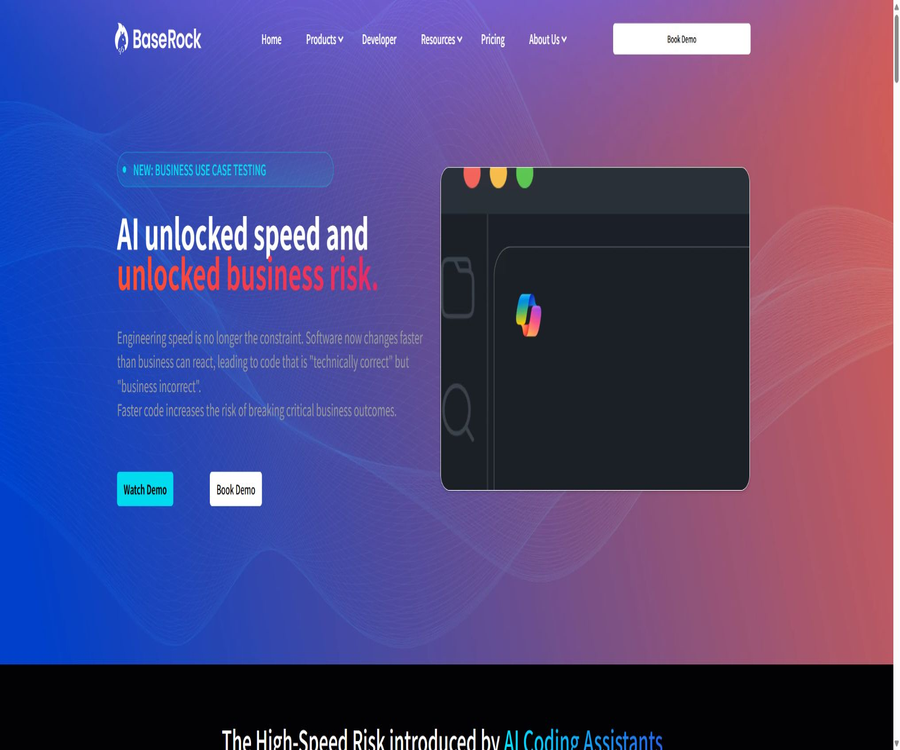
BaseRock AI is an Agentic QA platform designed for development, testing, and quality engineering teams. It can read source code, product requirements, Jira tickets, and interface documentation, automatically identify server endpoints, and generate executable test cases as well as Playbooks.
The platform’s current focus is on Business Use Case Testing, abbreviated as BUCT. It not only checks whether the interfaces return a successful status, but also verifies that cross-service processes such as registration, ordering, payment, inventory management, invoicing, and notifications actually achieve the desired business outcomes.
Which teams are suitable for BaseRock?
- Backend development team: Automatically discovers interfaces from the code and generates integration tests.
- QA Automation Team: Reduces the workload associated with writing and maintaining test scripts.
- Microservices team: Verify end-to-end business processes across multiple services.
- AI programming team: Establishes quality safeguards for the rapid generation and modification of code.
- Platform engineering team: Incorporate test suites into the CI/CD and deployment processes.
- Finance and e-commerce teams: Focus on protecting payment, order, and revenue processes.
- Companies with high compliance requirements: Execute tasks in a private environment and retain the audit results.
- Teams with legacy systems: expanding coverage without having to rewrite the entire testing framework.
Main functions
- Code discovery: Scans the codebase to identify API endpoints, schemas, and dependencies.
- Integrated test generation: Test cases are automatically created based on the service code, documentation, and guidelines.
- Business use case testing: Extract business processes and desired outcomes from PRDs or BRDs.
- Playbook generation: Converting natural language test intentions into executable steps.
- Local Agent execution: Running tests on the customer’s machine, VPC, or work node.
- Cross-service orchestration: Call multiple microservices in the order required by the business process and verify the overall result.
- Test maintenance: Tests are automatically adjusted in response to changes in the code and requirements.
- Manual review: Examine and edit the specific actions generated by AI before execution.
- CI/CD integration: Run test suites based on smoke testing, regression testing, labels, or endpoints.
- Centralized reporting: View results at both the use case and business process levels.
What is Business Use Case Testing?
Traditional testing often checks whether individual interfaces, status codes, and schemas are functioning properly, but it may fail to detect logical errors that occur across different services. BUCT connects product requirements with code implementation, and continuously monitors those business outcomes that truly affect customers, revenue, and compliance.
| Comparison items | Traditional technical testing | BaseRock BUCT |
|---|---|---|
| Core issue | Are the code and interfaces correct? | Have the business objectives been truly achieved? |
| Primary target | Units, interfaces, status codes, and schemas | Cross-service processes, rules, and revenue streams |
| Common findings | Crashes, format errors, and interface failures | Silent logic errors such as successful payment but no invoice issued |
| Source of demand | Testers write scripts and assertions. | PRD, BRD, Jira, code, and domain rules |
| Coverage area | Often split by service or component. | End-to-end verification from user actions to downstream results |
The workflow of BaseRock
| Phase | Enter | Platform processing | Output |
|---|---|---|---|
| Discovery | Git repository or local code | Identify endpoints, schemas, and dependencies. | Real-time interface map |
| BUCT | PRD, BRD, Jira, and domain rules | Extract business use cases and map them to code | Business processes and validation objectives |
| AI Generation | Endpoint knowledge and business context | Generate use cases and Playbooks | Normal, boundary, and negative scenarios |
| Execution | Environment, service address, and test configuration | Executed by local Agent | Pass, fail, and execution logs |
| Reporting | Test results and business mapping | Centralized organization of coverage and failures | Technical reports and business reports |
Supported data sources
- GitHub, GitLab, and Bitbucket code repositories.
- The source code on the developer’s local machine.
- PRD, BRD, and plain-text business rules.
- Requirement management systems such as Jira tickets, Confluence, Notion, etc.
- API documentation, example request responses, and interface specifications.
- External contexts such as Atlassian and MongoDB provided by the MCP server.
- The natural language instructions entered directly by the tester.
Code connection to repository
- GitHub Cloud: Reading code via OAuth authorization.
- GitLab: Supports OAuth login and repository connection.
- Bitbucket Cloud: Can be used as a remote code repository.
- Bitbucket Data Center: Documentation is listed as a supported method.
- Local code: Services can be created without connecting to a remote repository.
- The first OAuth connection usually requires approval from the repository administrator.
- The official documentation states that the permissions for remote source code are read-only.
Supported programming languages and architectures
The official documentation states that it is possible to connect to code libraries written in Java, Python, Go, or other major programming languages; the focus is on identifying interfaces through routing, controllers, and service structures. This platform is suitable for both microservices and monolithic applications.
| Project type | Configuration method | Key points of testing |
|---|---|---|
| Microservices | Each service is connected separately and establishes its own dependencies. | Interface contracts and cross-service business flows |
| Standalone application | Organize services by module, code path, route, or controller. | Module boundaries and end-to-end processes |
| remote repository | OAuth read-only connection | Automatically detect and follow code changes |
| Local projects | Services are created from local source code by the BaseRock Agent. | The code does not need to be connected to an external Git platform. |
Interface and protocol testing
- REST: Generates tests based on methods, paths, request bodies, and response rules.
- GraphQL: A protocol type that can be used as part of the Agent execution suite.
- Kafka: It can be filtered and executed according to protocols within the suite.
- Multi-step interface: Save previous response variables and pass them to subsequent steps.
- Authentication prerequisite: Perform login or token acquisition before the official testing.
- Cleanup after testing: Delete the generated data or restore the environment once the testing is complete.
- Dynamic values: Processing IDs, timestamps, and variables generated during execution.
How to get started with BaseRock
- Contact BaseRock Sales to request an account and access rights to the control plane.
- Choose between SaaS control plane or enterprise self-hosted deployment.
- Invite team members and assign project roles.
- Configure the model keys for OpenAI, Anthropic, Azure, Bedrock, or Vertex.
- Connect to the code repository via OAuth, or prepare local code.
- Add the first service and verify the discovered endpoints.
- Upload interface specifications, PRDs, or BRDs as needed to add business context.
- Install and start the BaseRock Agent, then run a small number of test cases in the testing environment.
- After reviewing the generation steps and results, they are incorporated into the CI/CD process.
Includes its own large model keys
BaseRock adopts a Bring Your Own LLM approach; enterprises are required to provide API keys for the supported model services. The platform uses these models to understand code, requirements, and business context, and then generates test cases and playbooks.
| Model source | Access method | Points to note for procurement |
|---|---|---|
| Anthropic | Direct API key or enterprise environment | Bear the cost of model calls alone |
| OpenAI | Direct API key | Confirm data retention and enterprise privacy settings |
| Azure | Enterprise Azure Model Services | Verify regions, quotas, and network access. |
| Amazon Bedrock | Models in the enterprise cloud account | Verify models, regions, and IAM permissions. |
| Google Vertex AI | Google Cloud Model Services | Verify items, regions, and service accounts. |
How to connect to the first service
- Click Add Service on the control plane.
- Select the repository and target branch, or use local source code.
- Specify the module code path, route, or controller for a standalone project.
- Check the endpoints and cross-service dependencies identified by the system.
- Optionally, you can upload interface instructions in TXT or PDF format, up to 10MB in size.
- Provide domain hints, or let the platform generate tests automatically based on the code.
- Add environmental addresses, authentication, context variables, and data cleaning rules.
- After generating the Playbook, examine each specific action step by step.
Integration test generation
- Infer endpoints, parameters, request, and response structures from the source code.
- Identify additional rules and examples by combining optional specification documents.
- Define business boundaries and verification requirements based on domain guidelines.
- Generate test cases for normal paths, boundary conditions, and invalid inputs.
- Establish steps for authentication, data preparation, and cleaning.
- Convert natural language Playbooks into deterministic execution actions.
- View individual interfaces and test results in the service-level report.
Business use case testing process
- Create the business processes that need to be protected in the Business Flows section.
- Upload BRD, PRD, or business rules in TXT or PDF format.
- Let AI extract specific business use cases from documents.
- Associate each use case with the services that are already in use.
- Map business use cases to interface testing and add verification steps.
- Generate business Playbooks that cover normal, boundary, and negative scenarios.
- The entire process is executed across services by local agents.
- View the results from the Test Case View and the Use Case View respectively.
Example of business process
| Business scenarios | Cross-service steps | Key verification |
|---|---|---|
| Place an order on e-commerce platforms | Account verification, order creation, payment, inventory, notifications, and shipping | Order confirmation, deduction, inventory reduction, and message sending |
| Subscription renewal | Accounts, billing, benefits, and notifications | Successful deduction, permission extension, and fallback in case of failure |
| Refund | Orders, payments, inventory, and finance | The refund amount matches the order status and account details. |
| User registration | Identity, information, emails, and permissions | The account has been created, verified, and its initial permissions are correct. |
| Invoice generation | Payments, orders, finance, and notifications | After payment, the invoice is available and the amount matches. |
What is a Playbook?
A Playbook is a structured testing procedure described in English; the AI converts the natural language instructions into executable workflows. A Playbook typically consists of three phases: preparation, execution, and cleanup.
- Service-level Playbook: A set of tests specific to a particular service.
- Endpoint-level Playbook: Validation is organized around a single interface.
- Test case Playbook: Execute specific normal or abnormal scenarios.
- Business Process Playbook: Verify the final business outcomes across multiple services.
- The statuses include processing, ready, and error.
- It can be adjusted using natural language, and requests and logic can also be edited directly.
Manual review and editability
- View all the steps of the AI inference before execution.
- Check the target interface, request headers, load, and parameters.
- Confirm how the response variable is saved and transmitted.
- Verify the status codes, Schema, and business assertions.
- Modify the Playbook using natural language while keeping the intent aligned.
- If necessary, modify the load and logic directly on the workflow interface.
- High-risk environments must be operated only after obtaining approval from personnel.
BaseRock Agent
The BaseRock Agent runs in the customer’s environment; it is responsible for establishing connections to the control plane, receiving test instructions, and invoking the actual services. It can be deployed on the developer’s own machine, within a VPC, on physical servers, or on dedicated CI work nodes.
- Execute a single test case from the web interface.
- Run a set of tests through the command line.
- Trigger smoke and regression suites from the CI/CD pipeline.
- Access the service from local code; there is no need to connect to a remote repository.
- The execution logs and failure results are sent to the control plane.
- Keep production traffic and sensitive operational data within the customer’s environment.
CI/CD integration
- Run tests by service name and target environment.
- Specify the base address of the testing service.
- Filter using REST, GraphQL, or Kafka protocols.
- Execute by test case ID, tag, or endpoint.
- Distinguish between normal scenarios and negative scenarios.
- Combine test suites by version, method, or regression scope.
- Use failure as a gate for merging, publishing, or deploying.
Deployment method
| Deployment method | Control plane | Execution Agent | Suitable for teams |
|---|---|---|---|
| SaaS | Hosted by BaseRock | Runs on the customer’s machine or environment | Teams that want to get started quickly |
| Private cloud or VPC | Deployed at the cloud boundary approved by the customer | Run within the same private environment | Companies with requirements regarding data boundaries |
| Local deployment | Internal self-hosting by the enterprise | Local or physical work nodes | Strict compliance and isolated environment |
Pricing and procurement methods
BaseRock does not disclose any fixed monthly subscription plans; the official pricing page states that the cost is calculated based on the number of services being tested, with quotes provided for both SaaS and self-hosted options. Companies also have to bear the costs associated with using their own large models, cloud resources, and internal computing environments.
| Cost items | Billing or impact method | Confirm before purchasing |
|---|---|---|
| BaseRock platform | The quote is customized based on the number of services to be tested. | How is service defined, and how are monolithic modules calculated? |
| Deployment method | SaaS or self-hosted | Are there additional fees for initial implementation, upgrades, and maintenance? |
| LLM invocation | Use the customer’s own model key. | Model tokens, region, and concurrency fees |
| Infrastructure | Agents, control plane, logging, and storage resources | Who provides and maintains it |
| MCP and system integration | It may involve custom configuration. | Costs for standard connectors and custom interfaces |
| Support services | According to the corporate agreement | Response time, training, and dedicated support |
It needs to be confirmed before purchasing.
- The criteria for calculating the number of services to be tested and the minimum contract size.
- Price differences between SaaS, self-hosted, and private clouds.
- Responsibilities for the control plane, Agent upgrades, and connector maintenance.
- Are the costs associated with calling the model entirely borne by the customer?
- Are there limits on concurrent tasks, the number of users, as well as storage and logging?
- Are piloting, implementation, training, and ongoing support included in the quote?
- Methods for exporting test assets, Playbooks, and reports after the contract is terminated.
Typical use cases
- Interface integration testing: Normal and error scenarios are generated automatically from the code.
- Microservice regression: Verify the contracts and interactions among multiple services after an upgrade.
- Revenue stream protection: Continuous monitoring of orders, payments, subscriptions, and refunds.
- AI-generated code governance: Automatically creates tests to keep up with rapidly changing code.
- Release access control: Run smoke and business-critical suites in CI/CD.
- Requirement consistency: Check whether the code behavior is in line with the PRD and Jira.
- Modernization of legacy tests: Replacing some fragile scripts with natural language Playbooks.
- Compliance audit: Retain test results and records of business rule verification.
Product advantages
- Result-oriented in business operations: It not only checks the interfaces but also verifies the customer and revenue processes.
- Automatic code discovery: There is no need to manually maintain complete specification documents first.
- Cross-service orchestration: suitable for complex microservices and monolithic modules.
- Natural Language Playbook: Reduces the barriers to writing test scripts.
- Built-in models: Enterprises can use existing cloud model protocols and keys.
- Local execution: The Agent keeps the traffic within the customer’s network.
- Flexible deployment: Offers SaaS, self-hosted, and private environment options.
- Manually controllable: It is possible to check and edit the specific actions before execution.
- Ongoing maintenance: Tests are automatically adjusted in response to changes in the code and requirements.
Usage restrictions
- No public price available: It is necessary to contact sales for a quote based on the volume of services required.
- Account activation is required: This is not a tool that can be registered and used immediately by individuals.
- Model key is required: The costs associated with LLMs and the relevant data terms are managed separately by the enterprise.
- First-time access is complex: warehouse permissions, an appropriate environment, as well as configuration of agents and services are required.
- AI may misinterpret business requirements: the generated use cases and Playbooks still need to be reviewed by experts in the relevant field.
- Test data risks: Incorrect configurations may alter the test or production systems.
- Increased reliance on MCP: External demands and connections to data sources require additional governance.
- Self-hosting involves operational costs: upgrades, monitoring, resources, and security are all the responsibility of both parties, with clear divisions of tasks.
Security and data boundaries
The official pages and documentation indicate that BaseRock meets the requirements of SOC 2 Type II; it offers encryption, role-based access controls, isolation of customer environments, and audit logs. Remote repository connections are set up with read-only permissions, while local agents are used to carry out tests within the customer’s environment.
- Use warehouse OAuth and service accounts with the minimum required permissions.
- Process sensitive code and requirements in a VPC or local environment.
- Set restrictions on enterprise data retention and training for third-party models.
- Limit the network targets and execution environment for the Agent.
- By default, destructive testing is prohibited in production environments.
- Set retention periods for test data, logs, and reports.
- Regularly review the permissions for roles, warehouses, MCPs, and model keys.
Security deployment recommendations
- First, validate the platform in an independent testing repository and a non-production environment.
- Create read-only code connections and dedicated test accounts for BaseRock.
- Configure the network allowlist and minimum system permissions for the Agent.
- Synthetic data is used to avoid copying sensitive information from real customers.
- Check the write, delete, payment, and notification actions in the Playbook.
- Add manual approval and environmental protection rules for hazardous operations.
- Rotate warehouses, models, and MCP credentials, and monitor for abnormal access.
- Prepare procedures for emergency shutdown, rollback, and manual takeover.
Privacy considerations
BaseRock handles account, usage, and diagnostic data; enterprise projects also involve source code, requirements, and testing metadata. When third-party large models are used, the data relevant to a particular task may be sent to the corresponding model provider, with the exact handling method determined by the enterprise’s agreements and deployment settings.
GitHub and the open-source status
BaseRock has made the documentation and example applications available on GitHub, but the Agentic QA control plane, as well as the Agents and the core generation system, are not labeled as open source. The availability of documentation in a public repository does not mean that the source code of the commercial product is also available; it should also not be confused with the Baserow database project.
API and scalability
BaseRock achieves scalability through warehouse connections, MCP servers, model providers, command-line agents, and CI/CD parameters. The public documentation focuses on enterprise integration and the operation of agents, rather than providing general SaaS APIs for third-party developers to use in testing.
Basic information
| field | Content |
|---|---|
| Tool name | BaseRock AI |
| Development company | BaseRock AI Inc. |
| Tool type | Agentic QA and business use case testing platform |
| Test level | Service-level integration testing and application-level BUCT |
| Code source | GitHub, GitLab, Bitbucket, and local code |
| Model approach | Customers bring their own keys for OpenAI, Anthropic, Azure, Bedrock, or Vertex. |
| Deployment method | SaaS, self-hosted, private cloud, or VPC |
| Price pattern | The quote is customized based on the number of services to be tested. |
| Is registration required? | The account needs to be opened by the team. |
| Is it open source? | The core platform is not open source, while the repositories containing documentation and examples are available publicly. |
| Main extensions | MCP, Agent, CLI, and CI/CD |
Recommendation score
The comprehensive recommendation score is 4.5 out of 5 points. BaseRock is suitable for development teams in companies that have complex interfaces and critical business processes, but it requires resources for integration, model development, environment setup, and business validation; it is not appropriate for individual projects that only require basic unit tests.
Frequently Asked Questions
What is BaseRock AI mainly used for?
It generates, executes, and maintains integrated tests as well as tests for cross-service business processes, based on code and requirements.
What does BUCT mean?
It is Business Use Case Testing, which focuses on verifying business outcomes rather than merely checking the status of interfaces.
Which coding languages are supported?
Officials state that support is provided for Java, Python, Go, and other major languages.
Which code repositories are supported?
It supports GitHub, GitLab, and Bitbucket; it is also possible to connect using local code.
Do you need your own model key?
It is necessary; BaseRock uses the customer’s own large-model keys.
Is self-hosting supported?
Supported; it is also possible to choose SaaS, private cloud, or VPC deployment.
How much is BaseRock?
Quotations are customized based on the number of services to be tested and the method of deployment; no fixed packages are available on the official website.
Can CI/CD be added?
Yes, the Agent can run suites based on service, environment, tags, protocol, and test category.
Is BaseRock open source?
The core platform is not open source; GitHub only makes the documentation and example projects available.
Will the source code be modified?
The official documentation states that remote repository connections are granted read-only permissions.
Can I test it in the production environment?
Technically, it is possible to configure a target address, but it is not recommended to carry out automated tests that may write or delete data in a production environment.
Is it suitable for personal projects?
It is generally more suitable for businesses and teams; for individual projects, it’s better to start with lighter testing tools.
Tools similar to BaseRock AI


 Guigong Network Security Registration No. 45132202000164