






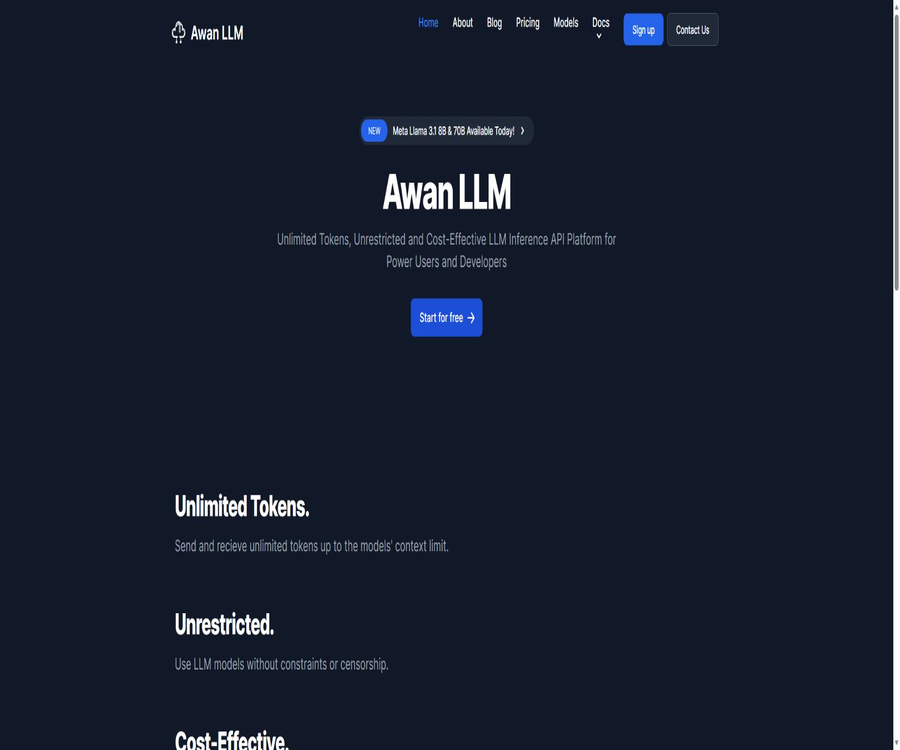
Awan LLM
Awan LLM, an intelligent tool focused on improving AI efficiency
Tags:AI improves efficiencyWhat is Awan LLM?
Awan LLM is an API platform for large language model inference, designed for developers and AI application teams. It offers chat completion and text completion functions through a unified interface, with a focus on a fixed monthly fee, no limit on the number of tokens that can be generated within that quota, and few restrictions on prompts.
The platform runs the models on its own servers, and imposes restrictions on the usage through limits on the number of requests per minute and per day. The term “unlimited tokens” does not mean unlimited context or unlimited calls; each input and output is still subject to the context window of the specific model as well as the interface parameters.
Who is Awan LLM suitable for?
- Independent developers: Use lower fixed costs to test chatbots, content tools, or automation scripts.
- AI Application Team: Connects to Llama models of various scales through standardized interfaces.
- Agent developers: Handle planning, summarization, and tool orchestration tasks that require multiple model calls.
- Role-playing users: Used for creating stories, virtual characters, and applications for long conversations.
- Data processing team: Performs batch summarization, categorization, rewriting, or extraction of non-sensitive text.
- Programming tool developers: Provide the backend models for code completion, interpretation, and documentation generation.
- Teaching and experimental users: Learn about REST APIs and streaming responses within the free quota.
Main functions
- Chat completion: Uses role-based messages to organize system commands, user questions, and assistant responses.
- Text completion: Submit the concatenated prompt to generate the subsequent text.
- Streamed return: Results are received continuously during the generation process, reducing the wait time associated with long responses.
- Sampling control: Configure temperature, Top P, Top K, repetition penalty, and stop words.
- Advanced decoding parameters: Supports options such as dynamic temperature, Min P, Mirostat, and Beam Search.
- Parallel requests: When the package permissions permit it, multiple tasks can be initiated simultaneously to increase overall throughput.
- Unified authentication: The identity of the caller is verified using an API key in Bearer format.
- Model switching: Select models with different sizes and context lengths under the same interface structure.
The difference between chat completion and text completion
| Interface type | Input method | Suitable scenarios | Precautions |
|---|---|---|---|
| Chat completion | system, user, assistant message arrays | Q&A assistant, multi-turn dialogue, agent | Some models may not accept system messages. |
| Text completion | Prompt organized according to the model template | Continuation writing, role-playing, traditional fill-in client | The prompt format required by the target model must be used. |
Supported models and contexts
The official model page currently divides models into two categories: Small and Large, and lists the fine-tuned models developed by Meta Llama and Awan LLM. The list of models may change depending on computing resources and operational needs; the models that are available for use should be those that can be accessed through the control panel.
| Model example | Scale classification | Context | Officially recommended directions |
|---|---|---|---|
| Meta-Llama-3.1-8B-Instruct | Small | 131,072 | General tasks and long contexts |
| Meta-Llama-3-8B-Instruct | Small | 8,192 | General text generation |
| Awanllm-Llama-3-8B-Dolfin | Small | 8,192 | The instructions follow those applicable to low rejection scenarios. |
| Awanllm-Llama-3-8B-Cumulus | Small | 8,192 | Story writing and role-playing |
| Meta-Llama-3.1-70B-Instruct | Large | 131,072 | More complex general tasks |
| Meta-Llama-3-70B-Instruct | Large | 8,192 | High-quality generic generation |
Explanation of generation parameters
- Temperature: The lower the value, the more stable it is usually; the higher the value, the more diverse it tends to be.
- top_p and top_k: They restrict the range of candidate Tokens, serving to control randomness.
- max_tokens: Sets the maximum number of tokens that can be generated in this instance; it should not exceed the limit allowed by the model.
- repetition_penalty: It reduces repetitive content, but an excessive value may harm the naturalness of the language.
- presence_penalty and frequency_penalty: Adjust subsequent word selections based on occurrence and frequency.
- stop and stop_token_ids: Stop generation when the specified text or Token is encountered.
- seed: Helps reproduce experimental results when the model and other conditions are consistent.
- stream: When enabled, the generated content is returned in segments, and the client is responsible for processing this data stream.
How to get started using Awan LLM
- Register an account on the platform and log in.
- Go to the account area to create an API key, which should be stored securely only on the server side.
- Open the model page to select a model, and note down its exact name as well as the contextual constraints.
- First, use a chat-based example to send a minimal request in order to verify that authentication and the response structure are correct.
- Set the maximum output, temperature, shutdown conditions, and flow-based return according to business requirements.
- Record the error codes, response time, and daily usage volume before deciding whether to upgrade the package.
API integration process
- Configure the base address as the versioned API entry for Awan LLM.
- Set the JSON content type and Bearer API key in the request header.
- Messages are used for chat tasks, while prompt is used for regular completion tasks.
- Enter the model name, sampling parameters, and maximum generation length.
- Check the response status and error messages, and implement backoff retries for rate limiting and temporary failures.
- In the stream mode, the output is parsed block by block; once processing is complete, the blocks are combined to form the final text.
- Before going live, set up usage statistics, key rotation, and alerts for abnormal expenditures.
Configure in the existing client.
The official quick start page provides guidance on how to configure Hugging Face Chat UI and SillyTavern. When integrating these tools, it is usually necessary to enter the base address of the compatible interface, the API key, the model identifier, as well as the corresponding prompt templates.
- Chat UI: Suitable for creating web-based chat interfaces for use within teams or by individuals.
- SillyTavern: Suitable for users who need character dialogue and custom prompt templates.
- Custom front-end: Suitable for products that require a branded interface, an account system, and integration with business data.
- Backend scripts: suitable for batch processing, scheduled tasks, data extraction, and content pipelines.
Comparison of package prices
Awan LLM adopts a model that combines a fixed monthly fee with a quota for requests; currently, payments can only be made via PayPal. The prices and quotas shown on the website at the time of verification are the ones in effect, but it is still necessary to check the payment page and the details related to the models before making a purchase.
| Package | Monthly fee | Requests per minute | Small daily requests | Daily requests on Medium | Large daily requests |
|---|---|---|---|---|---|
| Lite | Permanently free | 20 | 200 | 10 | 10 |
| Core | 5 dollars | 20 | 5,000 | 3,000 | 10 |
| Plus | 10 dollars | 50 | 10,000 | 6,000 | 2,000 |
| Pro | 20 dollars | 100 | 80,000 | 40,000 | 30,000 |
| Max | 80 dollars | 200 | No restrictions | No restrictions | No restrictions |
| Enterprise | Contact for a quote | No restrictions | No restrictions | No restrictions | No restrictions |
How to choose among different packages
- Lite: Suitable for testing interfaces, learning development, or running low-frequency personal experiments.
- Core: Suitable for lightweight personal projects that primarily use small and medium-sized models.
- Plus: Suitable for content and role applications that require more calls to large models.
- Pros: Suitable for teams with high usage volumes, parallel tasks, and the need to develop production prototypes.
- Max: Suitable for small businesses that make frequent calls but whose volume is still within the handling capacity of public platforms.
- Enterprise: Suitable for large-scale businesses that require SLAs, guaranteed speeds, custom models, or fine-tuning.
How to understand infinite tokens?
The term \"unlimited tokens\" as mentioned in the package means that the platform does not charge based on each individual input and output token. Users are still subject to limits regarding the number of requests per minute, the number of requests per day, the available models, and the context window for each model.
Parallel requests cannot bypass the maximum number of calls per minute specified in the package, and the actual throughput will vary depending on the load on the platform. The values indicated on the model page for single-request and parallel processing speeds are estimates only, and they do not constitute a service level guarantee.
Typical use cases
- AI customer service prototype: Generates responses to common questions based on business prompts.
- Content creation: generating outlines, rewriting text, summarizing materials, and developing creative ideas.
- Agent workflow: Responsible for planning, organizing information, and handling text before and after invoking tools.
- Role-playing: Maintaining character traits, the story’s world view, and multiple rounds of interaction.
- Document processing: Summarizing, categorizing, and structuring extracted information from long, non-sensitive texts.
- Code assistance: explaining code, generating comments, completing code snippets, and organizing technical documentation.
- Batch data processing: Uniformly clean, label, or convert formats for large quantities of short texts.
Product advantages
- Fixed monthly fee: It is easier to estimate the cost of invoking the model for tasks with high output volume.
- Free plan: It is possible to verify the availability of the interface without having to make a purchase first.
- Simple interface: Chat completion and text completion are suitable for common development frameworks.
- Model selection is clear: the official source lists the context, speed, and recommended uses.
- Rich in parameters: Developers can fine-tune randomness, repetition, and termination conditions.
- Stream output: suitable for dialogue interfaces and the generation of long texts.
- Proprietary inference infrastructure: Official documentation states that the model runs on internal servers.
- No logging of prompts: The privacy policy states that prompts and the generated content are not recorded.
Usage restrictions
- Limited model range: The available models depend on the platform’s current setup, and not all open-source models can be used directly.
- The request limit is quite clear: the daily quota for large models in the lower-priced packages is limited.
- The speed will fluctuate: Official estimates indicate that the throughput is affected by the current user load.
- Few payment options are available: the pricing page currently states that only PayPal is supported.
- No public SLA available: Regular plans do not offer any guarantees regarding availability or generation speed.
- Parameter compatibility varies: some models do not support system messages or all decoding parameters.
- The content still needs to be reviewed: A low threshold does not mean that the generated content is accurate, legal, or suitable for direct publication.
- Risk concentration among suppliers: Production systems need to have plans in place for delays, traffic restrictions, and service disruptions.
Privacy and data processing
The privacy policy states that the platform does not record users’ input prompts or the results generated, but it does keep track of the number of requests and their frequency, in order to implement rate limiting and to monitor usage. The platform also stores the account identification information provided by users, and uses cookies to maintain sessions.
This statement does not mean that all data will not be processed by servers. Medical, legal, commercial secrets, and personal sensitive data still need to have their sensitive information removed first, and it must be determined whether they can be sent based on the organization’s compliance requirements.
Content rights and acceptable use
The terms of service consider the results generated by the model from user inputs as user-generated content; however, actual use is subject to the licensing terms of the underlying models, third-party rights, and local laws. Users are not allowed to share, transfer, or sell their accounts, nor may they use the service to carry out illegal activities, harmful actions, send spam, or deploy malware.
Suggestions for safe use
- Do not include API keys in website code, public repositories, screenshots, or client installation packages.
- Create keys separately for development, testing, and production environments, and rotate them regularly.
- Delete ID numbers, account details, trade secrets, and unnecessary personal information before sending.
- Add fact-checking, content review, and manual verification steps to the output process.
- Set limits on concurrency, define timeouts, implement exponential backoff, and use circuit breaking to prevent the escalation of failures.
- It logs request metadata rather than sensitive content, which facilitates the identification of performance and quota-related issues.
- Prepare alternative models or suppliers to mitigate the impact of disruptions to a single service.
Performance testing methods
- Select a fixed test set whose length and language are similar to those of the actual business data.
- Test short responses, long responses, single requests, and multiple requests in parallel.
- Record the delay of the first token, the total time taken, the generation speed, and the error rate.
- Gradually increase the level of concurrency and monitor the per-minute request limit as well as any fluctuations in service performance.
- Check the quality of the content, the stability of the format, and the differences between various models.
- The monthly fee, available requests, and operational costs are combined to calculate the actual cost per task.
Comparison of Awan LLM and self-hosting
| Comparison items | Awan LLM | Self-hosted open-source models |
|---|---|---|
| Startup cost | Just register and configure the API. | A GPU, an inference framework, and monitoring are required. |
| Billing method | Fixed monthly fee plus request limit | Hardware, cloud resources, electricity, and operational costs |
| Model control | Use the models and parameters provided by the platform. | It allows for independent selection, quantification, fine-tuning, and upgrading. |
| Data path | The request is sent to the service provider’s server. | It can be processed in an environment with organizational control. |
| Scaling and operation maintenance | The platform is responsible for public infrastructure. | The team is responsible for capacity, failures, and security. |
| Suitable for | Developers and small teams looking for quick access | Organizations with needs for computing power, compliance, or customized solutions |
Open source and GitHub status
The Awan LLM inference service is not an open-source product, and its official website does not provide access to any verifiable GitHub repository containing the source code. Although there are third-party packages and example projects available on the internet, this does not mean that the platform can be considered open-source; nor can such third-party codes be regarded as official SDKs.
Some of the underlying models called upon by the platform come with their own open weights and licenses, and this is a separate matter from whether the API hosting platform is open-source. When deploying, redistributing, or using these models for commercial purposes, it is necessary to check the respective model licenses separately.
API and SDK status
Awan LLM offers public REST APIs as well as example requests in Python, Shell, and TypeScript; however, no complete SDK that is independently released and maintained by the official team exists. Developers can use general network request clients to connect to it, and they can implement their own solutions for authentication, retry handling, stream-based parsing, and monitoring.
Basic information
| field | Content |
|---|---|
| Tool name | Awan LLM |
| Tool type | Large Language Model Reasoning API Platform |
| Key capabilities | Chat completion, text completion, stream generation, and parallel requests |
| Model direction | Meta Llama and Awan LLM fine-tuned models |
| Billing mode | Free plan, fixed monthly fee, and corporate quotes |
| Main limitations | Requests per minute, requests per day, and model context |
| Payment methods | The official pricing page currently states that only PayPal is supported. |
| Is registration required? | It is necessary. |
| Whether API is provided | Yes |
| Is an official SDK provided? | No independent official SDK was found. |
| Is it open source? | The platform is not open source. |
Recommendation score
The comprehensive recommendation score is 4.0 out of 5 points. Awan LLM is suitable for developers who prioritize a fixed monthly fee, a large number of generated tokens, and quick API access; however, for production projects it is important to evaluate factors such as the frequency of model updates, request limits, payment options, stability, and the risks associated with the supplier.
Frequently Asked Questions
Is Awan LLM free?
A permanent free Lite plan is available: the small model allows 200 requests per day, while the medium and large models allow 10 requests per day each, with a limit of 20 requests per minute.
Is Awan LLM truly unlimited in terms of tokens?
It does not charge on a per-token basis, but it is still subject to limits on the number of requests per day and per minute, as well as constraints related to the model context and the maximum length of the output.
How much is the cheapest paid plan?
The Core package currently costs $5 per month and is suitable for individual users who use it infrequently.
Which API types are supported?
It supports chat completion and text completion, and can provide results in a streaming manner.
Can requests be made in parallel?
Parallel requests are supported, but permissions and overall frequency are still determined by the selected package.
Are the prompts recorded?
The official privacy policy states that prompt texts and generated results are not recorded, but the number of requests and their frequency are logged.
Is it compatible with all model parameters?
Not necessarily; since the capabilities of different models vary and the templates differ as well, some models may not be able to accept system messages or certain advanced parameters.
Is Awan LLM open source?
The hosting platform is not open-source, and no official GitHub repository listed on its website was found.
Is there an official SDK?
The official sources provide examples of multilingual requests, but no complete official SDK that is released separately has been found.
Can it be used in commercial projects?
It can be evaluated for commercial use, but it is necessary to check the terms of service, the licenses for the underlying models, and the compliance requirements related to the target business as well.
How should costs be controlled?
Select a package based on the model category and the actual daily request volume, and set parameters for concurrency, retries, and usage alerts.
Is it suitable for handling sensitive data?
Compliance cannot be determined solely on the basis of a statement that prompts are not being recorded; sensitive data must be masked and subjected to the organization’s security and legal evaluations.
Tools similar to Awan LLM


 Guigong Network Security Registration No. 45132202000164