






Aptori
Aptori, an intelligent tool focused on improving AI efficiency.
Tags:AI improves efficiencyWhat is Aptori?
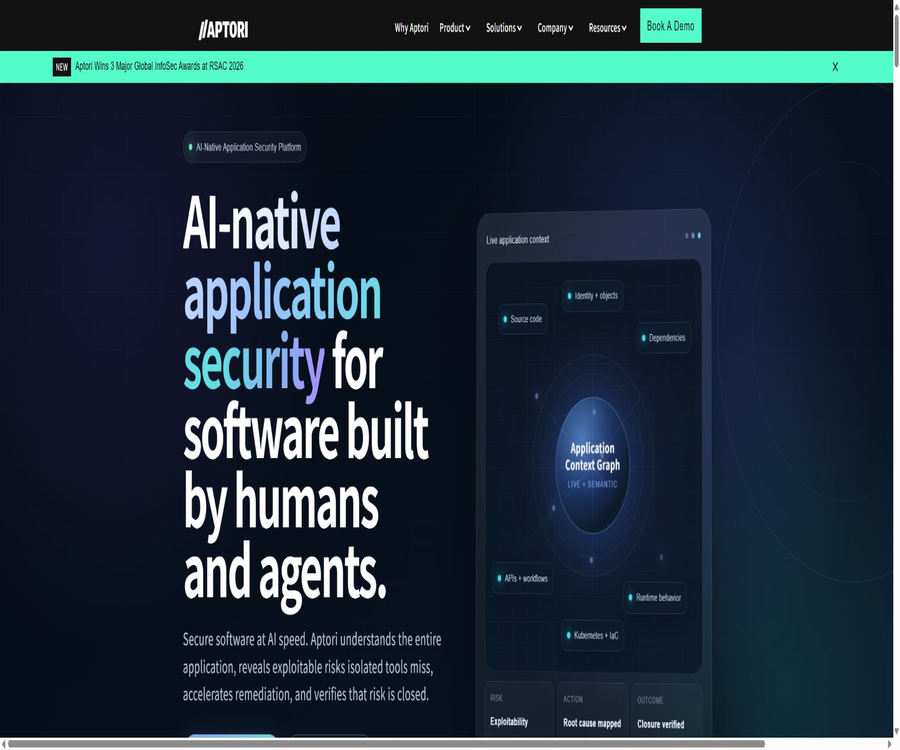
Aptori is an AI-driven application security platform designed for enterprise teams that need to continuously validate code, APIs, dependencies, cloud-native environments, and runtime behaviors within a fast development pace.
The platform integrates deterministic security checks, semantic models, runtime evidence, and controlled AI agents within the same application context; its focus is not on generating numerous alerts, but rather on verifying whether vulnerabilities are indeed exploitable and facilitating a closed-loop process for their correction.
Product positioning
- Application security testing and risk management platform
- Software developed for both humans and AI agents.
- Covers development, CI/CD, testing, and deployment phases
- Teams for service security, R&D, platforms, risk management, and auditing
- Supports SaaS, dedicated, self-managed, and isolated deployment modes.
Core competencies
AI SAST and secure code review
The SMART capability understands control flow, data flow, and application logic through semantic analysis, thereby identifying security issues in both manually written code and code generated by AI.
- Identify code-level vulnerabilities and insecure logic
- Reduce invalid alerts by taking into account the application context.
- Analyze the root causes and generate repair suggestions for developers.
- Provide feedback in advance during the submission and pull request stages
API security and semantic runtime validation
The Sift engine understands the relationships between API operations, generates tests based on business workflows, and verifies authorization, object access, and business logic in real or simulated environments.
- Test REST, GraphQL, gRPC, and complex API workflows
- Issues with BOLA, IDOR, and role-based permission control were identified.
- Verify identity, objects, tenant boundaries, and state transitions
- Simulate injection attacks such as SQL, NoSQL, command, and XML attacks.
- Repeat the authorization tests using different virtual user roles.
Software supply chain and cloud-native security
The platform enables the integration of open-source dependencies, SBOMs, licenses, keys, containers, Infrastructure as Code, and Kubernetes configurations into a unified risk view.
- Identify vulnerable or expired dependencies
- Organize component and software bill of materials
- Check container, IaC, and Kubernetes risks
- Link supply chain issues to practical feasibility and business impacts
Autonomous penetration testing
DART makes use of controlled agents to explore applications, sequence requests, switch identities, and verify attack paths; it is suitable for complementing periodic manual testing with continuous, proactive verification.
Closed-loop vulnerability management and remediation
Aptori connects discovery, context, runtime evidence, root causes, fixes, and retesting into an evidence chain to help the team determine whether the risk has truly been eliminated.
- Prioritize based on accessibility, availability, and business context.
- Assign the issue to the corresponding application and responsible person.
- Push the repair context to the R&D workflow
- Re-test the same attack path after making the modifications.
- Retain audit evidence from discovery to closure.
AI Security Engineer
The AI Security Engineer is positioned as an autonomous security partner that can assist in detecting, prioritizing, explaining, and fixing vulnerabilities, while carrying out security workflows within controlled parameters.
- The Blue Team agent is used for risk classification and recommendation for actions to take.
- The Purple Team agent is used to generate fixes and verify closures.
- The Red Team agent is used to explore and demonstrate attack paths.
- Deterministic checks still serve as a stable control baseline.
- Companies can restrict models, data flow, and agent permissions.
What use cases are suitable?
- Check the newly generated code in AI-assisted programming.
- Establish release security gates within the CI/CD pipeline
- Test the authorization boundaries of multi-role, multi-tenant APIs
- Business logic vulnerabilities that are difficult to detect through static scanning were identified.
- Unified management of codes, dependencies, APIs, and runtime risks
- Maintain ongoing documentation for standards such as PCI DSS, SOC 2, and ISO 27001.
- Adopt dedicated or isolated deployment in a regulated environment
Main advantages
- Covers SAST, SCA, API testing, and runtime verification.
- Reduce alert noise through verification of actual availability.
- Capable of understanding identities, objects, workflows, and business logic.
- The repair suggestions are aimed directly at the way developers work.
- Supports a closed-loop management process from discovery to retesting.
- Meeting the needs of both cloud services and controlled private deployments
- Test results can be output in machine-readable formats such as JSON and SARIF.
Usage restrictions and precautions
- The official website does not provide a standard subscription price that can be purchased directly.
- A comprehensive assessment usually requires an appointment for a demonstration and sales discussion.
- The Sift test requires a platform key and project configuration.
- Runtime testing requires an accessible target environment.
- Active testing may write to or modify business data.
- The production environment should first have a security mode and test boundaries configured.
- Complex authorization processes require the creation of virtual users and dynamic credentials.
- AI suggestions still need to be reviewed by security personnel and developers.
- The platform’s core products are not open-source software.
Pricing and Versions
Aptori is intended for corporate sales; the official website does not list any fixed packages or a mechanism for monthly self-purchase, and quotes are usually provided following demonstrations, trials, and needs assessments.
| Method of acquisition | Public price | Suitable for | Explanation |
|---|---|---|---|
| Product demonstration | Free reservation | Evaluation team | Used to understand capabilities, deployment, and integration solutions. |
| Trial account | Contact the authorities. | Technical validation team | The requirements for activation and the applicable limit are determined by the authorities. |
| Enterprise solutions | Custom quote | Medium to large organizations | The price is related to applications, APIs, users, deployment, and the scope of services. |
| Aptori Pro annual license | $ | Companies that make purchases through cloud marketplaces | The market page displays annual contracts on a per-user and per-API basis; it is necessary to check the current terms before finalizing the transaction. |
Market prices available publicly can only serve as a reference for single procurement scenarios; they do not represent the terms of contracts with all companies, nor should they be directly converted into the uniform prices listed on the official website.
Deployment and data control
| Deployment mode | Features | Suitable scenarios |
|---|---|---|
| Hosted SaaS | Cloud services are provided by the platform. | Teams that wish to go live quickly |
| Exclusive environment | Provide isolated resources for organizations. | Enterprises that require stronger isolation |
| Self-management | The enterprise controls the operating environment. | There are requirements regarding internal platforms and data control. |
| Isolated deployment | It can operate in an environment isolated from the public network. | Strict regulation or scenarios involving highly sensitive data |
In a regulated environment, companies can also route AI workloads to approved local or hosted models, and control where application data goes as well as the permissions of agents.
How Aptori Sift works
- Reads API definitions, platform configurations, and information about the target environment.
- Establish semantic models for API operations, objects, identities, and business workflows.
- Generate test paths based on different virtual users and permissions.
- Send controlled requests to the target application and observe the actual responses.
- Identify risks related to authorization, business logic, configuration, and injection.
- Upload the evidence, severity level, and repair recommendations to the platform.
- After the repair, run the same tests again to verify that it has been turned off.
Tutorial for first-time users
- Schedule a product demonstration and confirm the target application, APIs, and deployment boundaries.
- Create a project in the platform, then add the APIs that need to be tested.
- Generate the platform key and store it securely; it will be displayed only once after it has been created.
- Create a Sift configuration in the interface, or prepare YAML or JSON configuration files.
- Configure the target address, API definition, authorization method, and virtual users.
- Run the initial analysis from the command line or within a container.
- Check the findings, evidence of attacks, and repair suggestions in the platform.
- After confirming the false alarm and its impact on business operations, testing will be integrated into the continuous integration process.
CI/CD Integration Tutorial
- Place the Sift configuration in the project’s dedicated configuration directory.
- Save the platform key as a pipeline key; do not commit it to the code repository.
- Set the configuration ID, target environment, and submission information as variables or tags.
- Run the Sift container or command after building and launching the test application.
- Export SARIF and upload it to the code scanning results.
- Set alerts, work orders, or access controls based on the risk level.
- Re-run the tests in the repair submission and save the verification evidence.
GitHub and open source
Aptori provides a public Sift GitHub Action; development teams can integrate the Sift CLI with GitHub Actions and connect the SARIF results to the code scanning process.
| Project | Open-source status | Uses |
|---|---|---|
| Aptori platform | Closed-source commercial products | Application security, risk management, and continuous compliance |
| Sift engine and CLI | An Aptori account and platform key are required. | Semantic API security testing |
| Sift GitHub Action | MIT License | Call Sift in GitHub Actions to generate SARIF. |
The open-source nature of GitHub Actions merely means that the integration code can be viewed and reused; it does not imply that the Sift engine, the AI models, or the Aptori platform as a whole are open source.
Supported standards and compliance directions
- OWASP Top 10 and OWASP ASVS
- PCI DSS 4.0
- SOC 2 and ISO 27001
- HIPAA and HITRUST
- NIST Secure Development Framework
- NIS2, the EU Cyber Resilience Act, and the UK’s telecommunications security requirements
Basic information
| Project | Content |
|---|---|
| Tool name | Aptori |
| Tool type | AI-native application security platform |
| Core competencies | AI SAST, SCA, API security, runtime verification, and vulnerability management |
| Main components | SMART, Sift, SGen, DART, and AI Security Engineer |
| Primary users | Security team, R&D team, platform team, and auditors |
| Usage method | Web platform, CLI, containers, and CI/CD integration |
| Deployment method | SaaS, dedicated, self-managed, and isolated deployment |
| Price pattern | Custom quotes for businesses |
| Is registration required? | Yes |
| Is it open source? | The platform is not open-source; the official GitHub Action uses the MIT license. |
Recommendation score
The comprehensive recommendation score is 4.4 out of 5 points. Aptori is suitable for enterprise teams that need to manage code, APIs, dependencies, and runtime risks in a unified manner; it is particularly appropriate for multi-tenant APIs, AI-assisted development, and scenarios requiring continuous compliance.
Frequently Asked Questions
What problem does Aptori mainly address?
It is used to identify and verify potential risks in applications, APIs, code, dependencies, and cloud-native environments, and to facilitate their correction and retesting.
What is the difference between it and traditional SAST?
Aptori takes into account semantic models, the context of the application, and runtime evidence, and does not rely solely on static rules to identify potential problems.
Can it detect vulnerabilities in business logic?
Yes, Sift is able to understand the relationships between identities, objects, and operations, and to test authorization boundaries, business workflows, and state transitions.
Is CI/CD supported?
It is supported; it can be run via CLI, containers, GitHub Action, etc., and outputs JSON or SARIF results.
Can it be tested directly in the production environment?
Technically, it is possible to configure the target environment, but it is first necessary to enable security mode, limit the scope of testing, and assess the impact on real data and business operations.
How much is Aptori?
The official website does not disclose a fixed price for these packages; companies must contact the authorities to have their applications, APIs, users, deployment methods, and scope of services evaluated before a quote can be provided.
Is Aptori open source?
The core platform is not open-source software; the official Sift GitHub Action is licensed under the MIT license.
Is private deployment or isolated deployment supported?
Self-management and isolated deployment are supported; the specific infrastructure, model, and data control strategies need to be determined during the procurement phase.
Is it suitable for small personal projects?
Individual projects allow one to understand the technical approach behind them, but enterprise sales, environment configuration, and customized pricing are more suitable for organizations that have formal security processes in place.
Tools similar to Aptori



 Guigong Network Security Registration No. 45132202000164