






AI Translation & QA Hub
AI Translation & QA Hub – an intelligent tool focused on improving AI efficiency
Tags:AI improves efficiencyWhat is OneSky OLA?
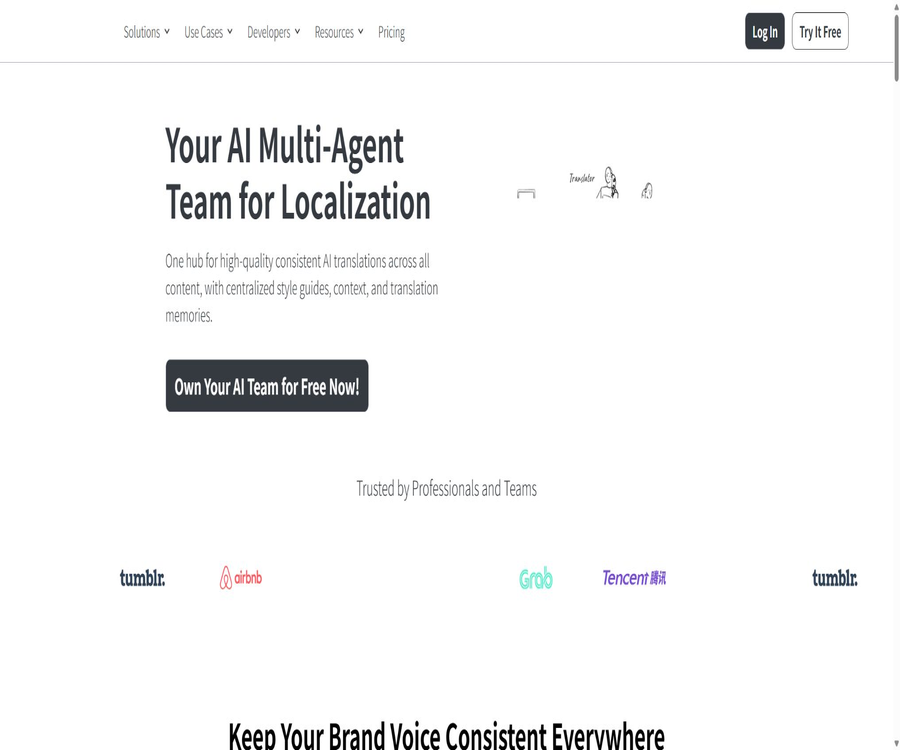
OneSky Localization Agent, abbreviated as OLA, is an AI-based translation and quality management platform designed for handling multilingual content in enterprises. It integrates string management, context supplementation, multiple translation models, automatic evaluation, and manual review into a single workflow.
The platform can handle websites, mobile applications, software interfaces, games, documents, and marketing content. It is better suited for localization projects that require continuous iteration, rather than just translating short pieces of text on an ad-hoc basis.
A one-sentence summary
OneSky OLA carries out translation, comparison, editing, and quality checking through the collaboration of multiple AI agents, and it allows teams to use glossaries, style guides, translation memories, as well as human translators to oversee the final results.
Core functions
- Multi-agent translation: Enables roles such as translation, voting, editing, and quality checking to work together in a coordinated manner.
- Multi-model invocation: The ability to combine different large language models within a workflow.
- AI quality assessment: Identifies issues with meaning, terminology, tone, format, and context.
- Post-editing: Have the machine-generated translation reviewed by professional linguists.
- String management: Centralized management of source strings, translations, status, and historical versions.
- Glossary: Unified product names, industry terms, and expressions that are prohibited from being translated.
- Translation memory database: Reuses verified historical translations.
- Context enhancement: Combines descriptions, screenshots, and project details to reduce ambiguity.
- Team collaboration: Assigning team members, commenting on issues, and managing approval statuses.
- Developer integration: Provides APIs, Webhooks, and command-line tools.
How multi-agent translation works
OLA does not rely on a single model to generate an answer from the same text; instead, the system can assign multiple roles to produce responses independently, compare those candidates, consolidate them into a unified answer, and verify it.
Translator – the role of translation
The translation engine generates candidate translations based on the source text, target language, glossary, and context. Complex content can be processed by different models in order to obtain more comparable results.
Voter comparison roles
It compares different versions to evaluate potential translations and selects those with more appropriate semantics, fluency, and style. This approach can help reduce the chances of errors made by a single model, but it cannot guarantee that the evaluations will always be correct.
Editor – the editing role
The editing role will further refine the sentence structure, terminology, punctuation, and brand wording. The team should still carry out manual review of the key content.
QA quality role
Quality role checks cover omissions, misinterpretations, format issues, length limits, and consistency with the context. The problems identified can be marked, exported, or handed over to project members for handling.
AI translation capabilities
- Generate localized translations based on the source language and target region.
- Restrict product names and technical terms in accordance with the glossary.
- Reuse confirmed expressions by leveraging translation memory.
- Refer to the string descriptions and screenshots to understand the location of the interface.
- Perform batch translation on a large number of product strings.
- Maintain the brand tone across different languages and content types.
- Continuously update the new and changed content.
AI quality inspection
- Check whether the meaning of the original text is fully preserved.
- Identify issues with inconsistent term usage.
- Check numbers, variables, placeholders, and special symbols.
- It was found that the length of the translation might exceed the limits set by the interface.
- Evaluate grammar, fluency, and expression in the target language.
- Mark high-risk translations for manual review.
- Generate a quality report for project acceptance.
Post-editing services
The team can order professional revisions after the AI translation is completed, so as to make the translation more in line with the linguistic habits and business context of the target region. The language service network outlined by the official party includes over a thousand professional linguists; however, the specific translators available and the delivery time depend on the details of each project.
- Suitable for brand marketing, store pages, and public websites.
- Suitable for content that requires adaptation to local culture.
- Suitable for software and game texts before going live.
- Suitable for projects with a high density of terminology and high costs associated with errors.
- Ordinary post-editing should not be equated with legal or medical certification translation.
- Before submitting the order, it is necessary to confirm the language pair, word count, price, and deadline.
Glossary and brand guidelines
A glossary is used to specify how a particular word should be translated, retained, or prohibited from use. Teams can establish rules for product names, feature names, industry terms, and brand expressions, thereby reducing variations in terminology across different languages.
Translation memory database
The translation memory database stores the correspondence between the original sentences and their approved translations. Repeated or similar content can be reused first, which not only reduces costs but also helps maintain consistency across versions.
Context enhancement
- Add descriptions of the purpose and page location for the string.
- Upload screenshots to help identify buttons, titles, or prompt messages.
- Set a character length limit to fit the interface.
- Add product background and special notes to the translator.
- In the Pro plan, AI-based context enhancement is used.
- Provide clear business explanations for homographs with different meanings.
Strings and project management
- Create projects by product, application, or business line.
- Set the source language and multiple target languages.
- Upload or synchronize string files.
- Invite in-house translators, reviewers, and project managers.
- View the translation status and history for each string.
- Handle context and quality issues through comments.
- Filter, review, and export translations by status.
Supported content types
- Product website, help center, and landing page.
- iOS and Android app interfaces.
- Strings for desktop software and SaaS products.
- Game menu, storyline, and event text.
- Product documentation, knowledge base, and training materials.
- Ads, emails, and social media content.
- Tables, database exports, and resource files.
File format
OneSky provides long-term support for various table formats as well as common software resource formats, including CSV, XLS, XLSX, XML, YAML, PO, POT, RESX, RESJSON, and Properties. The specific formats, encoding standards, and file size limits may change with updates to the platform; it is advisable to use sample files for verification before performing bulk imports.
Language coverage
The official website states that it supports over 800 languages and dialects, which makes it suitable for serving common markets as well as some less popular regions. Whether a particular model can be used, the quality of the AI-generated content, or the need for manual editing, all these aspects must be verified on a case-by-case basis depending on the target language.
Website localization
- Centralized management of page titles, buttons, and text.
- Reuse brand terminology and marketing tone.
- Track changes in the source content and update the target language.
- Involve local market staff in the review.
- Before going live, check the link text, variables, and layout length.
Localization of mobile apps and software
- Import application resource files and interface strings.
- Use screenshots to provide context for the text.
- Connect to the build process via API or CLI.
- Check the placeholder and character length limits.
- Export the approved translation to the code repository.
- Perform regression tests before the release of the new version.
Game localization
- Manage role names, item names, and interface terms.
- Distinguish between dialogue, system messages, and marketing copy.
- Explanations help to reduce misinterpretations that cause a disconnect from the plot.
- Invite translators from the target market to check for cultural appropriateness.
- Continue to translate updates and new versions.
Document and marketing localization
- Manage product documentation by chapter and language.
- Use a glossary to standardize technical terms.
- Let AI handle the large number of initial drafts first.
- Hand over highly exposed marketing content to human reviewers for approval.
- Adjust the tone and cultural expressions according to the target region.
- Check the figures, commitments, and compliance statements before publishing.
OneSky Basic Usage Tutorial
- Register an account and create a localized project.
- Select the source language and the target languages that you intend to cover.
- Upload a file or connect to an existing content source.
- Import glossaries, translation memories, and brand rules.
- Add descriptions and screenshots to strings that lack context.
- Run multi-agent translation and AI quality assessment.
- Filter the marked issues and conduct a manual review.
- After approving the translation, export it or synchronize it to the product.
Establish an AI-assisted with manual review process
- Levels are determined based on content exposure and error risk.
- Regular internal content is first translated by AI and automatically checked.
- The product interface is reviewed for context by members familiar with the business.
- Leave marketing, contracts, and sensitive content to professionals for review.
- Record the reason for the modification and update the glossary.
- Enter the approved translation into the translation memory database.
- Collect user feedback after going live and fix issues.
Tutorial on the integration development process
- Create a project on the platform and prepare credentials with minimal permissions.
- Choose API, Webhook, or CLI as the connection method.
- Use test cases to verify uploading, downloading, and character encoding.
- Store the credentials in a secure key management system.
- Pull approved translations in the continuous integration process.
- Set alerts for failures, timeouts, and format errors.
- Check the public download and caching settings before going live.
APIs and automation
OneSky provides platform APIs for project management, file import, translation export, and status checking. Traditional interfaces rely on public keys, private keys, timestamps, and signature verification; developers should refer to the current console documentation.
- Create or read localization projects in bulk.
- Upload the source file and update the string.
- Download the translated content in the specified language.
- Check the translation progress and file status.
- Integrate with Webhook to respond to platform events.
- Integrate the localization steps into the deployment pipeline.
CLI and GitHub tools
The official OneSky GitHub repository provides command-line tools, API documentation, mobile SDKs, and various plugins. onesky-sdk-cli is developed in Go using the BSD 3-Clause license, and it can be used to automate the execution of common tasks on various platforms.
Some of the early SDKs and editor plugins have not been updated for many years, so it cannot be assumed that they are still compatible with the current development environment. Before using them in production, it is necessary to check the latest commits in the repository, the released versions, the list of issues, and the platform documentation.
Open-source status
- The OneSky OLA online platform is not an open-source project.
- The official command-line tool has its source code made public and is licensed under the BSD 3-Clause license.
- Some SDKs, plugins, and sample projects can be found on GitHub.
- The license and maintenance status vary among different warehouses.
- The availability of an open SDK does not mean that it is possible to deploy a complete OneSky service on one’s own.
- Before putting it into commercial use, enterprises should check each dependency and license individually.
Which users are it suitable for
- Software teams that need to continuously maintain multilingual products.
- Internet companies that release both websites and mobile applications at the same time.
- Marketing teams that need to standardize terminology and brand tone.
- Engineering teams that wish to integrate localization into the development pipeline.
- Project managers who need a combination of AI-based initial translation and human review.
- A game development team that covers a wide range of languages and regions.
- Manage the team responsible for technical documentation and the help center.
Typical use cases
- Expand the SaaS interface from English to multiple markets.
- Maintain consistent terminology in app stores, official websites, and in-product text.
- New strings are automatically synchronized before each version release.
- Use AI to translate large volumes of content, and then review the sections with a high risk level.
- Have teams from different countries collaborate to review and approve the translation.
- Use translation memory to reduce the processing cost of repetitive content.
- Identify the content that requires manual processing through the quality report.
It’s not very suitable for which situations
- Individual users who only need to translate a few short sentences from time to time.
- Sensitive projects that must operate entirely offline or in a private environment.
- Teams that require all target languages to have equivalent model capabilities.
- There are no personnel responsible for terms, context, and final review of the project.
- Scenarios where legal certification of translation is required but no qualified translator has been hired separately.
- Users who cannot accept monthly subscriptions and billing based on additional word counts are not accepted.
Package price
As of August 2026, the pricing page on the official website indicates that billing is done on a monthly basis with the option to cancel at any time; the Starter and Pro plans still come with early-bird discounts. Prices, taxes, currencies, and discount offers may change, so it is necessary to refer to the settlement page before making a payment.
| Package | Monthly fee | AI word count | Team members | Number of languages | Main differences |
|---|---|---|---|---|---|
| 14-day trial | Free | 2,000 | Based on the account. | Based on the account. | No credit card required |
| Starter | Original price: 49 dollars, discount of 29 dollars | 5,000/month | 1 | 5 | No AI-based context enhancement or priority support. |
| Pro | Original price: $169, discounted price: $129 | 25,000/month | 10 | 30 | Includes AI-driven context enhancement and priority support |
| Enterprise | Contact sales | Customization | Customization | Customization | More vocabulary, languages, and customization options |
Comparison of package features
| Functions | Starter | Pro | Enterprise |
|---|---|---|---|
| Managed string | Unlimited | Unlimited | Unlimited |
| Multi-agent AI translation | Support | Support | Support |
| AI Translation Evaluation and Quality Report | Support | Support | Support |
| Glossary and translation memory | Support | Support | Support |
| API, Webhook, and CLI | Support | Support | Support |
| AI context enhancement | Not supported | Support | Support |
| Priority support | Not supported | Support | Support |
Additional AI word packs
Additional AI word packs are added on a monthly basis and reset each month; it is necessary to confirm whether any unused portion can be carried over before making a purchase. The official website lists three available packages; for larger volumes of words, it is necessary to contact sales.
| Additional words per month | Additional monthly fee | Indicate unit price |
|---|---|---|
| Up to 10,000 AI words | 70 dollars | $ |
| Up to 20,000 AI words | 130 dollars | $ |
| Up to 50,000 AI words | 300 dollars | $ |
| Larger dosage | Contact sales | Determined in accordance with the contract |
Price for manual proofreading
The cost for post-editing is calculated based on the source language, target language, and number of words. On the official website, the current public rate for translating from English to common target languages ranges from $0.072 to $0.114 per word; another set of prices listed on the site ranges from $0.09 to $0.13 per word.
| Example target language | Example unit price on the public page | Explanation |
|---|---|---|
| Spanish | $ | Specific regional variants should be confirmed separately. |
| German | $ | Complex fields may require additional requirements. |
| Simplified Chinese | $ | The language direction and service conditions affect the price. |
| Japanese | $ | The price at the time of order creation shall prevail. |
| Bokmål of Norway | $ | It is an example of a relatively high price from the public list. |
How to choose a package
- First, use a 14-day trial to test the target language and file format.
- Count the number of new and modified source words each month.
- When there is only one project leader, Starter can be compared first.
- Choose Pro when multiple people’s collaboration is needed, along with additional language support and contextual enhancements.
- For more than thirty languages or when customization is required, please contact Enterprise.
- Include additional word packs, manual proofreading, and taxes in the total cost.
- Evaluate the time saved in engineering and project management through automation.
Subscription, renewal, and refunds
- The price page indicates that billing is monthly and cancellation is possible at any time.
- The terms state that the payment plan is usually automatically renewed at the end of the current cycle.
- The formal terms require written notification of termination at least thirty days before the end of the cycle.
- The payment obligation is usually non-cancellable, and any subscription fees that have already been paid are not refundable.
- The order quantity generally cannot be reduced during the current subscription period.
- A manually translated order can be canceled before it is accepted.
- Once a manual order is accepted, it usually cannot be canceled or refunded.
- Refunds for manual orders that meet the cancellation criteria are issued in the form of platform points.
Privacy and data security
- Users retain the right to submit business data to the service.
- The platform can store, process, and transmit data within the scope required to provide services.
- The terms commit to the use of commercially reasonable technical and organizational measures.
- The analyzed data may include account information, device details, usage statistics for various functions, and certain operation-related data.
- Enabling third-party login and integration expands the scope of data processing.
- Sensitive content should be masked before uploading, and the company’s data policy must be verified.
- Teams should implement the principle of least privilege, key rotation, and operation auditing.
Security considerations for developers
- Private keys must not be included in the frontend code or in public repositories.
- API credentials should be injected through a key management system.
- Assign the minimum project permissions to automated accounts.
- Verify the Webhook signature and restrict the sources of callbacks.
- Check the file type and encoding of the uploaded and downloaded files.
- Public download interfaces may allow those who possess the public key to obtain the translations.
- Before enabling production access, it is necessary to confirm the access control method for the current interface.
Translation quality risk
- AI may misinterpret short strings lacking context.
- It is also possible for multiple models, even when they agree with each other, to choose the wrong translation.
- Automatic scoring cannot replace the verification of users in the target area.
- Technical terms need to be maintained by experts in the field.
- Variables, code, and rich text tags may be altered accidentally.
- Issues related to interface length and layout need to be tested in the actual product.
- High-risk content requires review by qualified human translators.
Product advantages
- Centralize AI translation, QA, and string management in one platform.
- Multi-agent processes are easier to compare and review than single-generation processes.
- It also provides a glossary, translation memory, and screenshot context.
- It offers wide support for over 800 languages and dialects.
- It is possible to purchase artificial elements and edit them to create a hybrid workflow.
- APIs, Webhooks, and CLI are suitable for integrating into the development process.
- There is no limit on the number of managed strings, which facilitates the management of large-scale projects.
- The prices of public packages, word packs, and certain manual services are relatively transparent.
Product restrictions
- The list of testing discounts and models may change depending on the product stage.
- Starter includes only one team member and five languages.
- Additional AI word packs are reset on a monthly basis, so it is necessary to manage the unused quota.
- Manual proofreading significantly increases overall costs and delivery times.
- The AI and human capabilities in some long-tail languages may differ.
- Automatic quality assessment cannot guarantee that the translation is entirely accurate.
- The subscription fee is usually non-refundable, and the service is automatically renewed.
- Older versions of SDKs and plugins may no longer be compatible with the current environment.
- The platform itself is not open source, nor are there any public solutions for its private deployment.
Basic information
| Project | Content |
|---|---|
| Tool name | OneSky Localization Agent |
| abbreviation | OneSky OLA |
| Development entity | OneSky Technology Pte. Ltd. |
| Tool type | AI translation, local management, and quality inspection |
| Price pattern | Free trial, monthly subscription, additional word packs, and human review |
| Free trial | 14 days, including 2,000 AI words |
| Language coverage | The official website supports over 800 languages and dialects. |
| APIs and automation | API, Webhook, and CLI |
| Is it open source? | The platform is not open-source; the source code of some tools is available publicly. |
| Applicable platforms | Integration of Web with developers |
Recommendation score
Recommendation score: 4.4 / 5. OneSky OLA is suitable for teams that need to manage multiple languages in software, websites, and documents on a continuous basis; it offers multi-agent translation, automated QA, term management, and human review, thus forming a comprehensive localization workflow.
Before use, it is essential to assess the quality of the target language, the cost associated with additional vocabulary, the automatic renewal option, the non-refundable terms, and the maintenance status of older integration tools.
Frequently Asked Questions
Can OneSky be used for free?
A 14-day free trial is available; the official website indicates that 2,000 AI words are included, and no credit card is required.
What is the difference between Starter and Pro?
The Starter version includes one member, five languages, and 5,000 AI words per month; the Pro version includes ten members, thirty languages, and 25,000 AI words per month, in addition to AI context enhancement and priority support.
How many languages are supported?
The official website claims to support over 800 languages and dialects, but the availability of models, QA services, and human assistance for specific languages must be verified separately.
Is it possible to purchase additional vocabulary?
Yes, the public word packs include three options: up to 10,000, 20,000, and 50,000 AI words per month.
Is human translation available?
Human post-editing services for AI-generated translations are provided, with pricing based on language pair and word count.
Does it support glossaries and translation memory?
Supported; it is possible to control technical terms separately and reuse already confirmed translations.
Is an API provided?
It provides APIs, Webhooks, and CLI for file synchronization, project management, and automated release processes.
Is OneSky open source?
The online platform does not have its source code made available, but the official command-line tools as well as certain SDKs and plugins do have their source code made public.
Can a subscription be refunded?
Generally, this is not possible – the terms state that paid subscription fees are non-refundable; manual orders can only be canceled if they have not yet been accepted.
Can AI translation be published directly?
It is not recommended to publish important content directly; instead, it should be reviewed taking into account terminology, context, automated QA, and human oversight in the target language.
Tools similar to AI Translation & QA Hub


 Guigong Network Security Registration No. 45132202000164