






AI Recipe Generator
AI Recipe Generator, an intelligent tool focused on improving AI efficiency
Tags:AI improves efficiencyWhat is AI Recipe Generator?
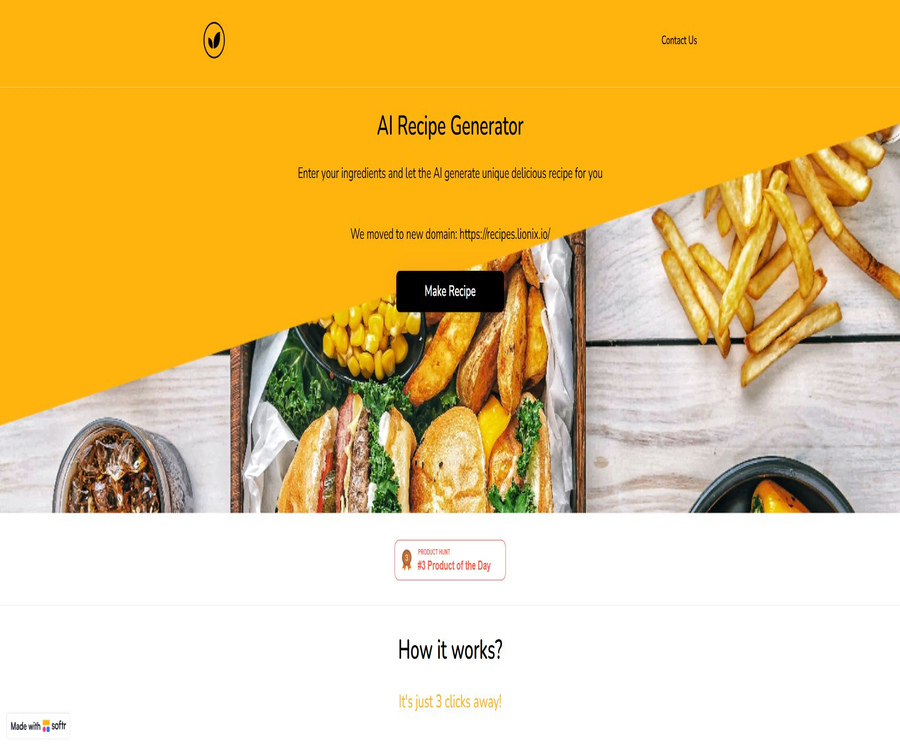
AI Recipe Generator is a web-based tool that creates recipes based on the ingredients available at home. Its early versions were developed using Softr. After users create an account and select their ingredients, the system generates a unique recipe which is sent to their email address.
The old page now clearly indicates that it has been migrated to the new domain name Lionix Recipes. Upon verification using a browser, it was found that the destination site has an expired certificate; regular browsers will block secure access to it, so it should no longer be recommended as a viable tool for use.
Current service status
- The old Softr page is still accessible, but it is mainly used to inform users about the migration process.
- The old page no longer provides the form for creating original recipes directly.
- The current certificate for the Lionix Recipes domain name after migration is invalid.
- One should not proceed with logging in or making payments by ignoring the browser’s security warnings.
- Search engines still retain the historical cache of packages and public recipes.
- The current status should be marked as unsafe for use or as having a service anomaly.
A one-sentence summary
It used to be able to generate recipes based on available ingredients and deliver them via email, but the certificate of the migrated site is now invalid, making it impossible to proceed with registration, payment, or the submission of personal information.
Core historical functions
- Generated by ingredients: Recipes are created based on the ingredients already available at the user’s home.
- AI recipe creation: generates recipe names, ingredients, and cooking steps.
- Account system: After creating an account, you can use your personal credit limit.
- Email delivery: Send the generated recipe to the user’s email address.
- History: The paid plan used to provide a history of recipes.
- Multiple results: Some packages allow multiple unique recipes to be sent to the email at once.
- Public recipe page: Historically generated results can be indexed by search engines through this page.
Old version usage process
- Create an account on the old page and provide an email address to receive recipes.
- Go to the ingredient selection page.
- Check or enter the ingredients you already have at home.
- Submit a generation request and wait for the AI to process it.
- Open the unique recipes sent by the system from your email.
- Check the amount, temperature, time, allergens, and food safety before cooking.
What should be done with the old entrance now?
- Be aware that the old page is only meant to explain the migration process; there is no need to look for the original form hidden somewhere.
- Do not ignore the certificate security warnings for the migration site.
- Do not enter your email address, password, or payment details over an insecure connection.
- If a package was purchased previously, check the auto-renewal status through the historical payment methods.
- After saving the existing recipes, switch to an alternative tool that is in good working condition and has a complete privacy policy.
- If you need a refund or to have your account deleted, submit your request using the contact information from your past orders.
Historical plan quota
The search cache still allows confirmation of the three previous credit levels, but since the migration site cannot be accessed securely at the moment, it is not possible to verify the package names and current prices reliably. The information provided here can only serve as a record of historical data; it should not be considered as an offer for current purchases.
| Package tiers | Recipe quota | Email delivery | History record | Current availability |
|---|---|---|---|---|
| Free | A total of 5 pieces. | The page does not specify the quantity. | Not specified | Cannot be verified securely |
| Mid-range option | 30 copies per month | 3 unique recipes per session | Support | Cannot be verified securely |
| Premium solution | 100 copies per month | 10 unique recipes at a time | Support | Cannot be verified securely |
Why shouldn’t the price be displayed any longer?
- The old Softr page did not have the current price list.
- The new domain name certificate has expired, preventing secure access to the settlement page.
- The search cache only shows the quota, without an accurate real-time amount.
- Historical discount websites cannot replace the official settlement prices.
- The price type for the current directory should be specified as \"historical free plus subscription\", and the exact amount cannot be verified.
What should be entered when creating a recipe?
- Available ingredients: include primary proteins, vegetables, staple foods, and seasonings.
- Portion size per person: Avoid a mismatch between the amount of ingredients and the cooking equipment.
- Dietary restrictions: allergies, vegetarianism, religious and medical constraints.
- Cooking equipment: oven, air fryer, stove, or just a microwave.
- Available time: preparation time and total cooking time.
- Skill level: Beginners need more detailed steps and safety reminders.
- Flavor profiles: mild, spicy, sweet and sour, or specific culinary styles.
How to manually check AI recipes
- Check whether all the ingredients can indeed be consumed together.
- Ensure that the weight, capacity, quantity, and unit are not confused.
- Check whether the cooking sequence is in line with the rate at which the ingredients cook.
- Use reliable food safety information to determine the core temperature and storage time.
- Check for allergens, cross-contact, and alternative ingredients.
- Reduce the amount used for the first preparation, and check the condition at each step.
- Record the actual amount used and the time taken; after making the adjustments, save it as a personal recipe.
Which users are it suitable for
- Home cooks: Draw inspiration from the remaining ingredients in the fridge and cabinets.
- Students and people living alone: Prepare simple meals using limited ingredients.
- Budget-conscious users: Reduce duplicate purchases and food waste.
- Beginners in cooking: Obtain basic ingredients and a draft of the steps.
- Those who enjoy trying new flavors: explore unconventional combinations of ingredients.
- For those who need to decide quickly what to have for dinner: it reduces the time spent searching through numerous recipes.
Typical use cases
- Handle vegetables, meats, and dairy products that are about to expire.
- Use a few common ingredients to prepare dinner for the evening.
- Revise the initial draft of the recipe according to vegan or gluten-free requirements.
- Recreate new meals by combining various leftover dishes.
- Generate multiple options for gatherings or family meals.
- Learn about the common cooking combinations for different ingredients.
Scenarios where direct reliance is not appropriate
- Users with severe food allergies and a risk of anaphylactic shock.
- Special diets for infants, pregnant women, the elderly, and people with weakened immune systems.
- Medical and nutritional plans for diabetes, kidney disease, metabolic disorders, etc.
- Standardized service in restaurants, schools, and hospitals.
- Commercial production that requires accurate calculations of nutrition, cost, and shelf life.
- Users who currently need to register or make a payment at sites with certificate issues.
Precautions for food safety
- AI may provide incorrect suggestions regarding temperature, time, or storage.
- Raw meat, poultry, eggs, and seafood should be handled separately from ready-to-eat foods.
- Do not rely solely on color to determine whether the meat is fully cooked and safe.
- Leftover food should be cooled, refrigerated, and reheated in accordance with reliable guidelines.
- Ingredients that are not recognized or have gone bad should not be consumed merely because of an AI recommendation.
- Users who are allergic must check the labels of ingredients and seasonings one by one.
- When there are medical dietary requirements, it is necessary to consult qualified professionals.
Issues with the quality of publicly available recipes
In the public recipes from the migrated sites that are indexed by search engines, unprocessed JSON tags, content with incomplete formatting, and text that has nothing to do with cooking can be found. This indicates that the formatting checks, content verification, and measures to prevent spam in the historical outputs and public pages are not reliable enough.
- Dish names may be misinterpreted as JSON or generic terms.
- The ingredients and steps may be in different languages.
- The published results may contain unrelated content.
- The amounts, units, and step formats are not consistent.
- It is not possible to judge the quality of content based on the number of public pages.
Email and privacy risks
The old process required creating an account and sending the generated results to an email address. Currently, there is no accessible and complete privacy policy, information regarding the retention period of data, procedures for deleting accounts, or details on third-party AI processing available.
Public recipe pages can be indexed by search engines; therefore, do not include names, diseases, addresses, or any other personal information in the ingredients or recipe names.
What does it mean when a certificate becomes invalid?
- The browser is unable to verify the legitimate identity of the connection partner.
- Users should not bypass security warnings to continue accessing.
- Login credentials and payment information should not be submitted in that connection.
- The site maintenance status and subscription availability cannot be confirmed reliably.
- Even after restoring the normal certificate, it is still necessary to re-check the privacy policies, terms, and prices.
How existing users can protect their accounts
- Check the original order in your email as well as the records from the payment platform.
- Check whether there are any subscriptions that are still being automatically renewed.
- If you reuse the password, change it immediately on other important websites.
- Request to delete the account, email address, past recipes, and payment-related information.
- Save necessary recipes, but do not download attachments from unknown sources.
- Record the contact process and payment documents to address disputes.
Criteria for selecting alternative tools
- The website’s certificate is valid, and the company details and contact information are clear.
- Clearly state the free quota, subscription price, and cancellation process.
- Provide a complete privacy policy, information on data deletion, and details regarding AI processing.
- It allows for the setting of allergens, dietary restrictions, portion sizes, and cooking time.
- The output includes unified units, steps, and food safety tips.
- It is possible to save, export, or delete personal recipes.
- The public content features reporting and review mechanisms.
Advantages of the original product
- Starting with the ingredients already available reduces the pressure of deciding what to eat.
- The process is simple: all you need is an account, the ingredients, and three steps to follow.
- Delivery is done via email, so there’s no need to stay on the website the whole time.
- The historical packages cover occasional experiences as well as more frequent occurrences.
- The paid plan used to provide a history of recipes.
- It helps to make use of any remaining ingredients and reduce waste.
Current restrictions
- The certificate for the new domain name after migration has expired.
- The old page only retains the migration instructions and cannot carry out the original process.
- The current price cannot be verified securely.
- The privacy policy, terms of service, and refund rules cannot be confirmed in their entirety.
- The published recipes contain formatting errors and irrelevant content.
- There is no professional guarantee regarding food safety and nutritional accuracy.
- An email address and account are required, which poses a risk to personal data.
- It is not suitable for registration, logging in, making payments, or uploading sensitive information at the moment.
API and platform support
The original product consisted mainly of a web-based account system, options for selecting ingredients, and an email delivery process; there were no public developer APIs, mobile applications, or desktop clients available. Third-party tools such as WebCatalog could convert the web interface into a desktop window, but this did not mean that an official desktop application existed.
GitHub and the open-source status
No official GitHub repository was found that could be used for verification in conjunction with the old Softr application or Lionix Recipes. The recipe-generation projects with similar names that were found belong to other developers, and therefore cannot serve as the source code for this product.
Therefore, it should be labeled as a non-open-source web service, and a notification about service abnormalities should also be provided at the moment.
Basic information
| Project | Content |
|---|---|
| Tool name | AI Recipe Generator |
| Original platform | Softr web app |
| Migrate brand | Lionix Recipes |
| Tool type | Generate AI recipes based on ingredients |
| Free historical quota | A total of 5 recipes |
| Historical payment amount | 30 or 100 per month |
| Current price | Cannot be verified securely |
| Current status | The certificate of the migration site is invalid. |
| API | Not disclosed |
| Open-source status | Not open source |
Recommendation score
Current recommendation score: 1.2 / 5. The original approach of generating results based on ingredients and delivering them via email was straightforward, but the new site has an invalid certificate; prices and privacy details cannot be verified, and the quality of the results provided is inconsistent. Therefore, it is not recommended for use at present.
Frequently Asked Questions
Can the AI Recipe Generator still be used?
The old page only shows migration prompts; the new domain name cannot be used securely at the moment due to an invalid certificate.
Why can the old pages still be opened?
The old Softr page is still retained to indicate that the product has been moved to a new domain name.
How did it generate recipes in the past?
The user creates an account and selects existing ingredients; the system then generates a recipe and sends it to the email address.
Was there a free quota in the past?
Yes, the historical plan page shows that the Free plan allows for the creation of 5 recipes in total.
How much is the paid package?
The official settlement page cannot be accessed securely at the moment; therefore, unverified amounts should not be displayed.
Is it possible to bypass the certificate warning?
It is not recommended; in particular, one should not enter account details and payment information over an insecure connection.
Are AI recipe generators reliable?
It can only serve as inspiration; the amounts of ingredients, temperature, cooking time, allergens, and storage methods all need to be verified manually.
Will the recipe be made public?
The history generation page can be indexed by search engines; therefore, do not enter any sensitive personal information.
Are APIs provided?
No official developer API documentation was found.
Is the AI Recipe Generator open source?
It is not open source; there is no verifiable official code or model repository.
Tools similar to the AI Recipe Generator



 Guigong Network Security Registration No. 45132202000164