






AI Project Description Generator
AI Project Description Generator, an intelligent tool focused on improving AI efficiency
Tags:AI improves efficiencyWhat is an AI Project Description Generator?
The AI Project Description Generator was an AI project planning tool developed by WeLoveNoCode; its function was to transform a user’s product ideas into project descriptions, technical specifications, and recommendations regarding no-code tools. It was designed for entrepreneurs, product managers, and business teams who are not familiar with software development.
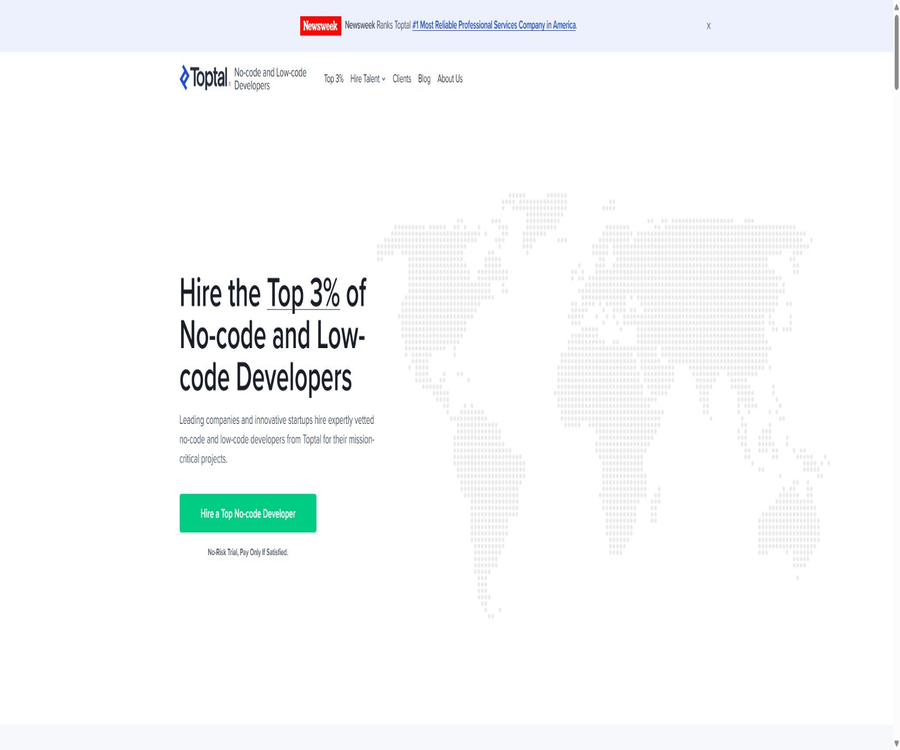
As of this verification, the generator no longer has any official interface for use that can be verified. The website listed in the database now displays Toptal’s services for no-code and low-code development professionals, rather than the AI form generation feature it used to have.
Current service status
- The original AI project description generator can no longer be used through the official portal.
- WeLoveNoCode was acquired by Toptal in 2023.
- The old brand entry currently leads to pages related to Toptal.
- The current page offers code-free talent matching, but does not provide automatic generation of project descriptions.
- There are no public access points for the accounts after migration, historical projects, or generation records.
- The tool directory should be marked as discontinued, rather than being presented as a freely available tool that can still be used.
A one-sentence summary
It used to be able to convert ideas for natural language projects into code-free development instructions, but the original generator is no longer available; the old entry point now only provides Toptal’s talent services.
Core historical functions
- Project description generation: Organizing disparate ideas into clear product descriptions.
- Technical specification compilation: Addition of functional modules, processes, and implementation requirements.
- Natural language understanding: Identifying project objectives from descriptions provided by ordinary users.
- Recommendations for no-code tools: Platforms that are more suitable are suggested based on the requirements.
- Expert matching: Further connects project requirements with no-code development professionals.
- Assistance with requirement communication: Helping customers prepare a preliminary outline before consulting developers.
- Free to use: The historical data generator is labeled as a free tool.
Historical usage process
- Enter the product to be developed, the target users, and the problems that need to be solved.
- Additions include core pages, automated processes, data handling, and requirements for third-party integrations.
- Let the generator organize the project description and preliminary technical specifications.
- View recommended no-code or low-code development tools.
- Range of manual adjustments, priorities, time, and budget.
- Use the finalized draft to consult development experts or to continue planning the MVP.
How can we replace this tool now?
- Describe the target users, core problems, and product value in one sentence.
- List the user tasks that must be completed and the key pages.
- Organize accounts, data, permissions, payments, notifications, and third-party integrations.
- Divide the features into three groups: MVP, future versions, and those that will not be implemented yet.
- Select no-code, low-code, or traditional development methods based on the project’s complexity.
- Please have product and technical staff work together to identify any omissions, dependencies, and risks.
- Create a project brief first, and then inquire about costs and scheduling from the developers.
What should be included in the project description?
- Project background: Why is it necessary to develop this product now?
- Target users: Who will use it, and what are their main difficulties.
- Value proposition: How the product improves existing processes or outcomes.
- Scope of functionality: What the MVP must include and what must be explicitly excluded.
- User process: The key steps from entering the product to achieving the goal.
- Data structure: The objects, fields, and relationships that need to be stored.
- Role permissions: The boundaries between visitors, users, administrators, and team members.
- External integration: payment, email, forms, CRM, and other services.
- Acceptance criteria: What results indicate that the function has been completed.
- Constraints: budget, time, regulations, and equipment and technical limitations.
Technical specification template
| module | Points that need to be explained | Common examples |
|---|---|---|
| Users and permissions | Roles, login methods, data boundaries | Visitors, members, administrators |
| Pages and processes | Page list and main operation paths | Register, search, submit, pay |
| Data | Objects, fields, relationships, and retention periods | Users, orders, projects, messages |
| Automation | Trigger conditions, actions, and failure handling | Notification after submission, timeout alert |
| Integration | External services, interfaces, and permissions | Payments, email, CRM, analytics |
| Non-functional requirements | Performance, security, availability, and compliance | Response time, backup, auditing |
| Acceptance | Completion conditions that can be tested | Success rate, edge cases, error messages |
How to choose a no-code tool
- Web and content sites: Pay attention to design flexibility, CMS capabilities, and SEO capabilities.
- Business applications: Focus on database capabilities, permissions, workflows, and forms.
- Mobile apps: Focus on native components, push notifications, store deployment, and offline functionality.
- Automation: Focus on the number of connectors, execution limits, error retries, and logs.
- Internal tools: Focus on enterprise login, permissions, data sources, and audit records.
- Highly complex projects: Determine whether to use low-code or traditional development methods.
Which users are it suitable for
- Entrepreneur: Turn the product idea into a detailed MVP description that can be discussed.
- Product Manager: Quickly create a preliminary draft of the requirements document.
- Business owner: Expressing process requirements when unfamiliar with technical terms.
- Agency: Collects the list of customers during the pre-sales phase.
- Freelance developers: Reduce oversights in early requirement communication.
- Code-free learners: Understanding the relationship between ideas and tool capabilities.
Typical use cases
- Prepare project summaries for SaaS platforms, e-commerce sites, communities, or internal tools.
- Clarify the functions and scope of delivery before looking for developers.
- Compare different technical approaches such as Bubble, Webflow, and FlutterFlow.
- Convert business processes into page, data, and automation requirements.
- Create an MVP roadmap and a list of subsequent versions.
- Prepare basic materials for cost inquiries, tendering, or internal project initiation.
Scenarios where direct reliance is not appropriate
- Sectors with high compliance requirements, such as healthcare, finance, law, and public services.
- Products that include complex real-time systems, hardware, or high-concurrency architectures.
- Systems that require accurate security threat models and data compliance assessments.
- Contracts, budgets, and delivery dates must be elements that have legal validity.
- Projects that still involve significant conflicts of interest and for which interviews have not yet been conducted.
- Users who must rely on the original generator to continue editing historical projects.
Historical prices
Third-party historical sources generally classify the AI Project Description Generator as a free tool; there is no reliable evidence indicating that it ever offered separate membership plans or point-based subscription options. Since the original service is no longer available, this is not a price at which it can be purchased today.
| Project | Historical or current status | Explanation |
|---|---|---|
| AI generator | History is free | There is no official access point available at the moment. |
| Toptal Talent Services | Communicate by project | It’s not part of the original AI generator package. |
| No-code developers | Custom quote | It depends on talent, timeline, and project scope. |
| Trial mechanism | Toptal Talent Collaboration Trial | It has nothing to do with AI generation tools. |
What is available on Toptal’s current page?
The current page is used to find qualified no-code and low-code developers, covering platforms such as Webflow, Zapier, FlutterFlow, Bubble, Airtable, and Retool. Users first communicate with customer advisors, after which the platform recommends suitable candidates.
This is a service aimed at professional individuals, and it should not be confused with the original free project description generator. The cost is determined based on the specific partner and the project in question.
Current talent service process
- Explain the business objectives, technical requirements, and team details to Toptal.
- Code-free or low-code professionals selected and recommended by customer consultants who match the requirements.
- Communicate with the candidate regarding the project scope, delivery methods, and timeline.
- The trial period is used to determine whether both parties are suitable to continue working together.
- Once satisfied, the project will officially commence as agreed.
Migration and historical data reminders
- Do not assume that the original WeLoveNoCode account can still be logged in to.
- Do not use old generated links as long-term document storage.
- If historical emails are to be retained, the project description and attachments should be exported as soon as possible.
- Issues related to contracts or payments should be confirmed with the current service provider.
- Do not submit sensitive business plans to counterfeit generators.
Project description quality inspection
- Does each feature deliver clear user and business value?
- Can the MVP be delivered within the budget and timeline?
- Does the requirement include verifiable acceptance criteria?
- Whether external services and data sources are truly available.
- Are the requirements regarding permissions, security, and privacy clear?
- Whether process anomalies, refunds, failures, and manual intervention are covered.
- Is the technology choice based on practical constraints rather than AI guesses?
Advantages of the original tool
- Convert vague ideas into structured project descriptions.
- Lower the barrier for non-technical users to create requirement documents.
- Link the functional descriptions with recommendations for no-code tools.
- It is suitable for quickly creating a preliminary draft before consulting developers.
- Historical versions are available for free use.
Limitations of the original tool
- It has been taken offline now, so it is not possible to verify the actual quality of the output.
- The old entrance has been replaced by the talent services page.
- AI-generated specifications may overlook security, compliance, and abnormal processes.
- Tool recommendations may overlook locking costs and platform limitations.
- The generated results cannot replace product research and technical evaluation.
- There are no verifiable instructions for migrating historical projects.
- It is not possible to determine the status of data processing and storage in the older version.
GitHub and the open-source status
No official open-source repository was found that could be used to verify the functionality of the original AI Project Description Generator. The current page on Toptal does not provide the generator code, model weights, or an open-source license either.
Therefore, the original tool should be marked as non-open source and no longer in use; its technical implementation cannot be inferred from third-party projects with the same name.
Basic information
| Project | Content |
|---|---|
| Tool name | AI Project Description Generator |
| Original developer | WeLoveNoCode |
| Tool type | Project description and no-code specification generator |
| Historical prices | Free |
| Current status | Taken offline |
| Changes in the original company | Acquired by Toptal in 2023 |
| Current entry point | Toptal’s no-code talent services |
| API | Not disclosed |
| Open-source status | Not open source |
Recommendation score
Current recommendation score: 1.5 / 5. The approach used in the original tool for organizing projects is still useful as a reference, but the generator can no longer be used; it should therefore not be recommended as a viable AI tool.
Frequently Asked Questions
Can the AI Project Description Generator still be used?
No, the current official portal no longer provides a generator.
Who developed it originally?
It originally belonged to WeLoveNoCode and was primarily used for planning no-code projects as well as matching professionals for such projects.
How is WeLoveNoCode doing these days?
The company was acquired by Toptal in 2023, and the old entry point has been redirected to Toptal’s services.
Is the original tool free?
Historical data lists the generator as free, but this price information no longer reflects the current available services.
Why is the current page dedicated to talent recruitment?
As the original brand’s services have been integrated, the old entries in the database now display Toptal’s no-code talent services.
Is the Toptal service free?
It is not a free generator; the fees for collaborating with experts depend on the project and the appropriate candidate.
Can old projects be recovered?
There is no public migration interface or guarantee; one must inquire with the service provider using past orders and emails.
Is there an official API?
Neither the original tool nor the current page provides a public generator API for this purpose.
Is it an open-source project?
No, there is no verifiable official code, model, or open-source license.
Tools similar to the AI Project Description Generator


 Guigong Network Security Registration No. 45132202000164