






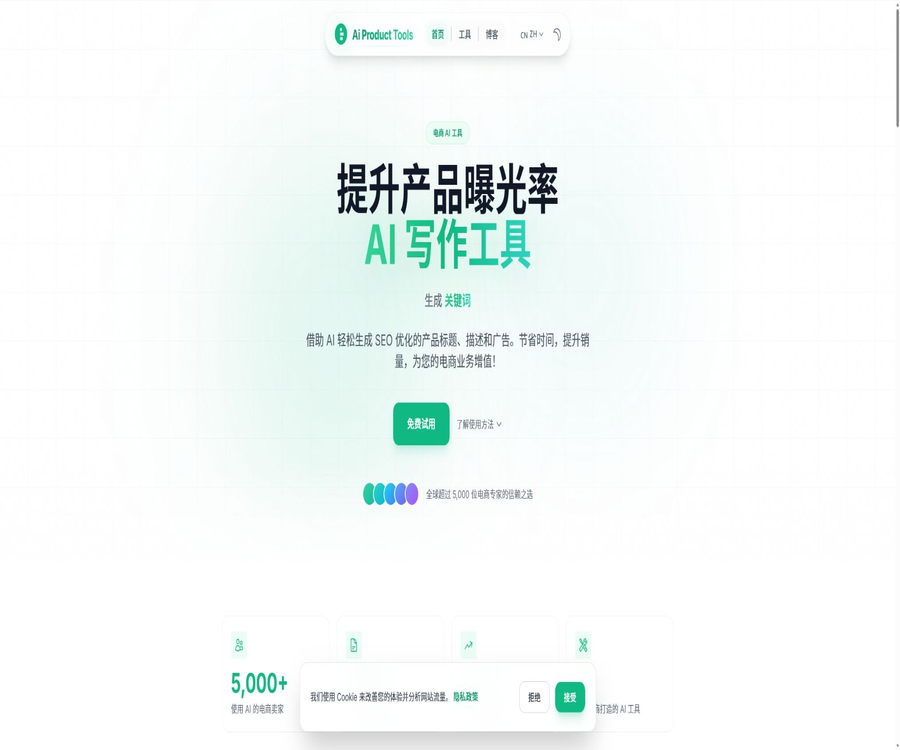
AI Product Tools
AI Product Tools – intelligent tools focused on improving AI efficiency
Tags:AI improves efficiencyWhat are AI Product Tools?
AI Product Tools is a web platform designed specifically for creating content for e-commerce products; it breaks down tasks such as writing titles, descriptions, keywords, tags, specifications, FAQs, as well as preparing ads and marketing emails, into 16 different tools. The official website states that all these tools are free to use, no registration is required, there are no hidden fees, and there is no limit on the number of times they can be used.
It is suitable for quickly creating a preliminary draft of product descriptions, but it cannot replace the verification of product details, brand checks, or compliance assessments required by the platform. Users should use accurate parameters as input and verify each element of the output before publishing it.
A one-sentence summary
AI Product Tools offers 16 vertical generators that require no login, helping sellers to quickly create preliminary versions of content for everything from organizing product details to SEO, advertising, and email marketing.
Complete list of 16 tools
| Category | Tools | Primary uses |
|---|---|---|
| Product basis | Product Title Generator | Generate titles suitable for product listings. |
| Product basis | Product description generator | Generate a description and key points of around 150 to 300 words. |
| Search optimization | Product keyword generator | Organize product-related search terms |
| Data organization | Product feature extractor | Extract functions, specifications, and differences. |
| Search optimization | Product label generator | Generate tags for category, attributes, style, and scenario. |
| Product basis | Product classification classifier | Determine the more appropriate product category. |
| Word-of-mouth content | Product review generator | Generate evaluation templates and response strategies |
| Data organization | Product specification generator | Organize the parameters into specification content. |
| Pre-sales service | Product FAQ Generator | Organize FAQs on purchasing, use, delivery, and warranty. |
| Transform the copy | Product feature extractor | Transform functions into consumer benefits. |
| Advertising and marketing | Product ad title generator | Generate short, attractive titles |
| Advertising and marketing | Product Preheating Copy Generator | Create anticipation for new products and events |
| Advertising and marketing | Product promotion copy generator | Create discount offers and time-limited promotions. |
| Advertising and marketing | Product ad copy generator | Create draft ads for various channels |
| Customer engagement | Product marketing email generator | Generate a topic, main text, and action guidance. |
| Integrated Writing | Product copy generator | Combine short copy, long descriptions, features, and call-to-actions |
Core functions
- Task segmentation: Each page addresses only one type of product-related requirement.
- Use without logging in: It is possible to start the generation process without creating an account.
- Free, unlimited usage: The official website states that there are no limits on the amount of use for these 16 tools.
- Chinese interface: The main tools come with Chinese-language pages and instructions.
- Multilingual generation: The product description tool indicates that it supports multilingual content.
- Structured output: It is possible to generate formats such as titles, key points, tags, specifications, and FAQs.
- SEO assistance: Integrate keywords naturally into titles and descriptions.
- Tone customization: It is possible to add elements that reflect a brand’s style, such as professional, casual, or premium.
- Cross-platform use: The output can be modified and used on standalone websites as well as major e-commerce platforms.
- Supporting tutorials: The official website’s blog provides tags, descriptions, and strategies for e-commerce content.
Product description generator
The product description generator creates descriptions of around 150 to 300 words, based on the product’s features, materials, size, and unique selling points. The output usually includes an introduction, a list of key points, and a statement of the product’s value; moreover, the wording can be adjusted to suit the target audience or the brand’s tone.
Title, keywords, and tags tool
- Title Generator: Condenses core categories, attributes, and selling points into readable titles.
- Keyword generator: Expands candidate keywords based on the product, its uses, and purchasing intentions.
- Tag generator: Creates around 15 tags and organizes them by category.
- Classification classifier: Helps sellers select product categories that are more suitable.
- SEO check: It is still necessary to take into account the platform’s character limits, actual search data, and rules regarding repeated words.
Specifications, FAQs, and features tool
- Feature extraction: Identifying technical features, unique selling points, and user benefits from the original data.
- Specification generation: Organize dimensions, materials, capacity, and compatibility into a clear structure.
- FAQ generation: 8 to 10 questions and answers are created regarding pre-purchase, usage, delivery, and warranty.
- Key feature extraction: Rewrite “What functions does it have?” as “What problems can it solve for consumers?”
- Manual verification: The numbers, certifications, warranty details, inventory levels, and scope of application must match the actual information.
Advertising, promotion, and email tools
- Ad headline: Short phrases suitable for information streams, banners, and landing pages.
- Preheating copy: Used for new product launches, countdowns, and event announcements.
- Promotional copy: Content created around discounts, freebies, deadlines, and calls to action.
- Advertising copy: Combines pain points, selling points, evidence, and conversion instructions.
- Marketing emails: Generate email subject lines, body structures, and button text.
- Comprehensive copy: Both short and long versions are provided to facilitate reuse across different channels.
Tutorial on creating product descriptions
- Organize the product name, category, material, size, functions, target audience, and genuine selling points.
- Open the product description generator and enter all the details.
- Add details on the target platform, tone, keywords, length, and phrases that should be avoided.
- After generation, check the numbers, parameters, commitments, brand name, and the fluency of the language.
- Remove vague or repetitive sentences, and adjust the paragraphs and key points according to the platform’s formatting requirements.
- It is released after being approved by the product manager, and further optimized based on click and conversion data.
Create a set of tutorials on product content
- First, use a feature extractor to organize the raw data into specifications, functions, and benefits.
- Use a classification classifier to determine the category, and then generate a title, keywords, and tags.
- Submit the verified information to the Description, Specifications, and FAQ tool to generate the details page module.
- Use a feature extractor to identify the core value, and then create ad headlines and promotional copy.
- Generate short versions for emails, social media platforms, and advertising spaces separately.
- Standardize terminology and brand tone, and conduct reviews of facts, SEO aspects, and platform rules.
Suggestions for entering prompts
- Fact fields: brand, model, size, material, color, and packaging list.
- Target audience: age, occupation, usage experience, and main needs.
- Primary use cases: home, office, outdoors, travel, or as a gift.
- Differentiating feature: The genuine advantages that can be demonstrated when compared to similar products.
- Tone and style: professional, friendly, minimalist, premium, or technical.
- Channel restrictions: title length, prohibited words, number of tags, and ad character count.
- Prohibition on inference: It is not allowed to invent information regarding certifications, efficacy, warranties, and discounts that are not provided.
Which users are it suitable for
- Independent sellers: Quickly complete the title, description, specifications, and FAQ.
- Sellers on Amazon, Etsy, and other platforms: Expand keywords, tags, and selling points.
- Shopify and WooCommerce management: Standardizing the structure of product catalog contents.
- Cross-border e-commerce team: After creating a draft in multiple languages, it is sent to native speakers for proofreading.
- Content and advertising team: Quickly obtain the title and content direction for the campaign.
- Small businesses: Establishing a basic content workflow in the absence of full-time copywriters.
Typical use cases
- Multiple content modules required to generate a detailed page for a new product in one go.
- Rewritten old product descriptions that were too short, repetitive, or lacked structure.
- Create versions of the same product for different target audiences and different distribution channels.
- Extract benefits that are easier for consumers to understand from the technical specifications.
- Prepare promotional campaigns, emails, ads, and social media content.
- Preliminary suggestions for establishing a labeling system and product classification.
Compliant use of the evaluation generator
The evaluation generator page makes it clear that the content generated should not replace genuine customer reviews. It is suitable for use as emails to invite reviews, response templates, or for internal training and testing purposes, but it should not be used to pretend to be consumer reviews.
- It can be used to design questions for user surveys and templates for collecting evaluations.
- It can be used by customer service teams to practice responding to different ratings.
- It can be used as a fictional example in the testing environment, clearly marked as such.
- Generated reviews must not be disguised as the experiences of real buyers.
- It is prohibited to fabricate information regarding stars, sales volumes, efficacy, or experiences of use that have not actually taken place.
Price and entry barriers
The official website lists the platform as free, stating that the 16 tools available can be used without the need for registration, there are no hidden fees, and no limits on usage volume. The site does not provide information regarding membership plans, package deals, or corporate subscription prices.
| Project | Current situation | Usage tips |
|---|---|---|
| Tool costs | Free | The information is subject to the real-time status on the official website. |
| Registration requirements | No registration required | You can go directly to the tool page. |
| Number of uses | The official website states that there is no limit on the number of times. | High-frequency requests may still be subject to technical limitations. |
| Hidden fees | The official website states that there is none. | There is no page for paid plans yet. |
| API fees | Not made public | No API documentation was found either. |
Privacy and data processing
The privacy policy states that the platform collects the input data used for generation, usage patterns and preferences, as well as technical information about devices and browsers. This data is used to provide and improve services, analyze user experience, ensure security, and deliver important updates.
The website is integrated with third-party AI services, and the content entered may be processed in accordance with the privacy policies of those third-party providers. Therefore, do not submit any unpublished customer information, personal data, trade secrets, or product details that are subject to contractual restrictions.
User data rights
- Request access to the personal information held by the platform.
- Request the correction of inaccurate data.
- Request to have one’s data deleted.
- Oppose specific data processing.
- Pay attention to updates in the privacy policy and changes in the rules regarding third-party AI services.
Content review checklist
- Fact: Whether the model, size, material, compatibility, and contents of the packaging are accurate.
- Promise: Whether warranty, return and exchange policies, delivery, and inventory are in line with the store’s policies.
- Compliance: Are there evidences to support the statements regarding healthcare, health, environmental protection, and safety?
- Copyright: Whether there is permission to use brands, images, text, and the names of competing products.
- Platform: Check whether the title, keywords, tags, and promotional text comply with the channel’s rules.
- Language: Whether the translation is natural, and whether there are any cultural misunderstandings or ambiguities.
- SEO: Ensure that keywords are used naturally, avoiding mechanical stuffing and repetitive content.
Product advantages
- 16 e-commerce writing tasks are gathered on the same platform.
- No registration is required, and the threshold for first-time use is low.
- It is currently free and there is no limit on the number of uses.
- The Chinese version is complete, making it easy for Chinese sellers to get started quickly.
- The tools are organized by task, with clear input and output objectives.
- It covers the entire process, including product information, SEO, conversion rates, advertising, and email marketing.
Usage restrictions
- AI may fabricate parameters, certifications, efficacy claims, warranties, and promotional information.
- Free access with no limit on the number of times is a commitment of the current website; this policy may change in the future.
- There is no project database with accounts, so it is not suitable for storing brand information and historical versions over the long term.
- Since there is no public API, it is not possible to determine whether official batch integration is supported.
- The actual number of searches is not provided; the generated keywords still need to be verified using SEO tools.
- Multilingual output requires verification by a native speaker.
- If the evaluation template is used as a genuine evaluation, it can lead to misguidance.
API and batch processing capabilities
As of this verification, the official website does not provide any API documentation, key management information, limits on the number of calls that can be made, or pricing details for developers. The platform is suitable for manually creating individual tasks; however, when dealing with a large number of SKU entries, it is still necessary to copy and organize the data manually and conduct manual reviews.
GitHub and the open-source status
A search reveals a GitHub organization named AI Product Tools, but this organization does not currently have any public repositories, and there is insufficient information to indicate the existence of reusable open-source code. The official website does not make the code, models, deployment instructions, or open-source licenses available to the public.
Therefore, the catalog should be labeled as a non-open-source online tool, rather than an open-source project that can be deployed on one’s own.
Basic information
| Project | Content |
|---|---|
| Tool name | AI Product Tools |
| Tool type | E-commerce AI copywriting toolkit |
| Number of tools | 16 models |
| Use the platform | Web version |
| Chinese support | Support |
| Registration requirements | No registration required |
| Price pattern | Currently free |
| Public usage limits | The official website states that there is none. |
| API | Not disclosed |
| Open-source status | Not open source |
Recommendation score
Recommendation score: 4.1 / 5. Its advantages are that it is free, does not require login, and covers a wide range of tasks, making it suitable for small and medium-sized sellers to quickly create initial drafts of content; however, facts, search data, translations, and compliance with platform rules still need to be verified manually.
Frequently Asked Questions
Are AI Product Tools free?
Yes, the official website states that all 16 tools are free of charge, with no hidden fees or limits on the number of times they can be used.
Is registration required?
It’s not necessary; users can go straight to the specific generator to use it.
Is Chinese supported?
Yes, the website offers a Chinese-language tool page, and the product description tools also indicate support for multiple languages.
Is it possible to generate a complete details page at once?
It is necessary to combine multiple tools: first organize the features and specifications, and then create titles, descriptions, FAQs, and selling points.
Can the generated content be published directly?
It is not recommended; before publishing, one should verify the facts, copyright issues, advertising laws, and the rules of the target platform.
Can a review generator create fake positive reviews?
No, the official website clearly states that the generated evaluations are meant to serve as templates and should not replace genuine customer reviews.
Is there an API?
Currently, there are no public API documentation, keys, or pricing information available.
Is the input content collected?
The privacy policy states that input data will be collected and may be processed by third-party AI services.
Are AI Product Tools open source?
It is not open source; the relevant GitHub organization does not have any public code repositories at the moment.
Tools similar to AI Product Tools



 Guigong Network Security Registration No. 45132202000164