






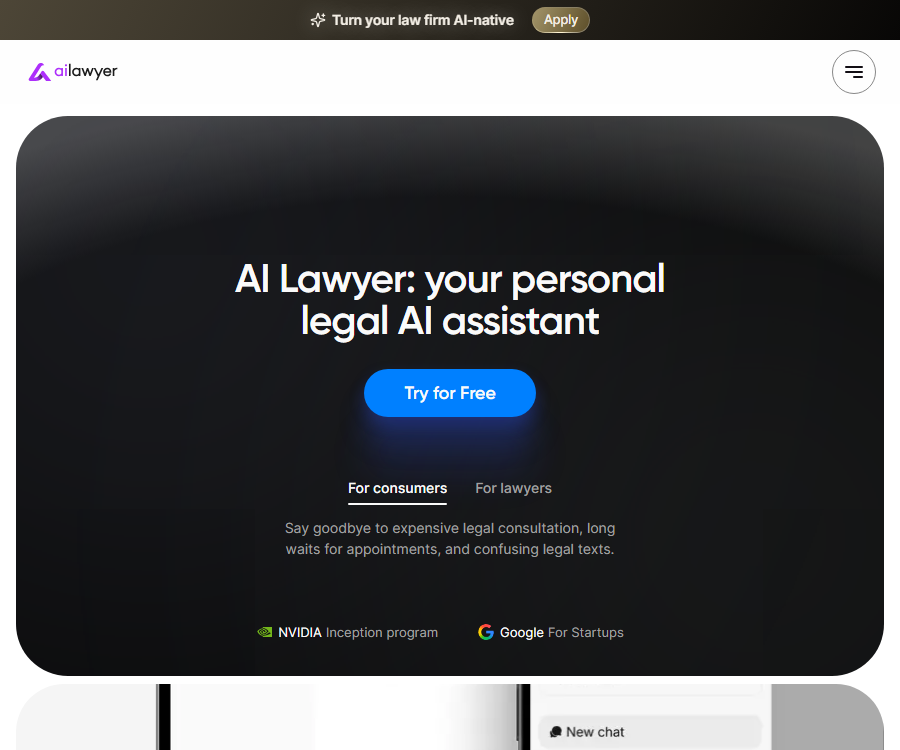
AI Lawyer
AI Lawyer – an intelligent tool focused on enhancing efficiency through AI.
Tags:AI improves efficiencyWhat is an AI Lawyer?
AI Lawyer is an AI-based platform for legal information and document processing, designed for consumers, lawyers, law firms, and law students. It integrates functions such as question-and-answer dialogues, online research, contract analysis, document summarization, OCR, translation, and legal document templates within web and mobile applications.
The product name might give the impression that it provides legal representation, but the official terms of use clarify that the information provided by the platform is intended solely for general reference and does not constitute professional legal advice; it also cannot replace a licensed lawyer.
A one-sentence summary
AI Lawyer can explain legal concepts in natural language, analyze uploaded files, and generate common legal documents from templates; however, matters involving high risk still need to be reviewed and handled by lawyers with local licensing.
Core functions
- Legal Q&A: Ask questions in natural language and receive straightforward explanations.
- Online research: Searching for public information on the internet and organizing the results of the research.
- Legal document analysis: Identifying contract clauses, key elements, and potential risks.
- Document summary: A condensed version of the key contents of long protocols, notifications, and case materials.
- Text extraction from images: Extracts readable text from scanned documents or images.
- Document translation: Converting legal documents into other languages.
- Contract comparison: Compare version differences and clause changes.
- Legal document generation: Creating drafts of agreements, letters, and policies from structured templates.
- Prompt library: Provides templates for common questions in various legal fields.
- Chat history: Saves conversations for further analysis later on.
- Personalized settings: Adjust the usage experience according to the user’s preferences.
- Multi-platform use: Available on web browsers, iPhone, iPad, and Android.
What can legal Q&A do?
- Explain the terms, obligations, and common clauses in the contract.
- Provides an overview of a certain type of legal process and the materials that may be required.
- Transform complex legal language into easy-to-understand explanations.
- Prepare a list of questions to consult a lawyer further.
- Provide general research directions based on the user’s description.
- Generate summaries of the legal topics to be verified.
- It is not possible to make case-by-case judgments that carry the responsibilities of a lawyer.
- It cannot act on behalf of the user to communicate with courts, institutions, or other parties.
Document processing capability
- Upload contracts, agreements, notices, and other legal documents.
- Extract the main terms, parties involved, dates, and obligations from the document.
- Generate summaries and to-do lists for long files.
- Identify terms that may be unfavorable, abnormal, or require attention.
- Compare the changes between the two versions.
- Perform text recognition on scanned images.
- Translate the file into another language and then proceed with the analysis.
- The generated results still need to be checked item by item against the original text.
Generation of legal templates and documents
AI Lawyer offers a free database of legal templates, including agreements, letters, notices, company policies, and other common documents. After entering the relevant details such as parties involved, dates, amounts, locations, and specific conditions, users can create editable drafts that can be exported.
- Drafts of non-disclosure agreements, lease agreements, and shareholder agreements.
- Letters of demand, requests, and letters ordering the cessation of infringement.
- Termination notice, complaint letter, and authorization form.
- Drafts of website terms, privacy policy, and company regulations.
- Travel consent forms, letters of intent, and business agreements.
- Generate PDF or DOCX files from a template.
- For multi-jurisdictional templates, it is still necessary to verify the local mandatory requirements.
- Key terms should be reviewed by professionals prior to formal signing.
Start using the tutorial
- Register via email, Google, or Apple account.
- Confirm the free trial and subsequent subscription period.
- Choose legal Q&A, document analysis, or template generation.
- Indicate the country, state, or region as well as the background of the issue.
- Remove ID numbers, accounts, and sensitive information that are not relevant to the analysis.
- The system is required to distinguish between facts, assumptions, and legal provisions that need to be verified.
- Verify each item in the output, including regulations, case laws, dates, and procedures.
- Consult a licensed lawyer promptly in cases involving loss of rights or significant risks.
Contract Review Tutorial
- Retain the original contract and all attachments; do not overwrite the single copy.
- Confirm that you have the right to upload files to third-party cloud services.
- Hide identification documents, banking information, and unrelated personal data.
- Upload the file and specify the contract type, region, and review objectives.
- It is required to list the terms regarding deadlines, payment, termination, responsibilities, and disputes.
- Have the system identify missing information, ambiguities, and asymmetric obligations.
- Check each item against the original text to avoid relying only on the AI summary.
- Have it reviewed by a lawyer before signing, negotiating, or rejecting it.
Tutorial on Generating Legal Documents
- Select the file type from the template library that is closest to the requirements and jurisdiction.
- Fill in the party involved, date, amount, deadline, and method of fulfillment.
- Additional jurisdiction, dispute resolution, and methods of notification.
- After generating the draft, check whether all placeholders have been replaced.
- Check the definitions, clause numbers, and cross-references.
- Remove the clauses that are contradictory to each other or not applicable to this case.
- Export the document and use revision mode to retain records of manual changes.
- Have it verified by a local lawyer for enforceability before official use.
Which users are it suitable for
- Ordinary consumers: Understanding notices, agreements, and common legal concepts.
- Freelancer: Generates draft basic contracts and payment reminders.
- Small business owners: Organizing terms, policies, and business documents.
- Lawyer: Accelerate the preliminary research, summaries, and non-final versions of documents.
- Law firm team: Assign repetitive document tasks to a unified tool.
- Law students: Practice case summaries, research, and legal writing.
- Contract management staff: Compare versions and identify key obligations.
- Multilingual users: First, translate and understand legal documents.
Typical use cases
- Explain the terms in lease, employment, service, and software contracts.
- Organize documents related to consumer complaints, refunds, or billing disputes.
- Generate drafts of demand letters, termination letters, and cease-and-desist letters.
- Extract the payment, renewal, termination, and liability clauses from the contract.
- Compare the versions of the agreement before and after the negotiations.
- Prepare a timeline of facts and a list of questions for the lawyer consultation.
- Prepare summaries of lengthy policy documents, notices, and judgments.
- Generate case briefs and research outlines for course study.
- Search for public legal information in a specific jurisdiction and create a verification checklist.
Matters that are not suitable for direct handling
- Criminal charges, detention, searches, or upcoming expiration dates for legal proceedings.
- Child custody, domestic violence, and emergency protection orders.
- Immigrant status, deportation, asylum, and forced departure.
- Significant tax, securities, investment, and regulatory enforcement matters.
- High-value transactions, equity financing, and complex corporate restructurings.
- Claims for medical malpractice, personal injury, and significant damage.
- Matters that require appearing in court, negotiating, signing as a witness, or invoking a lawyer’s confidentiality privilege.
- Any incorrect advice may immediately lead to the loss of rights.
Multilingualism and legal jurisdiction issues
Officials state that the platform can be used worldwide, and questions and answers can be conducted in various languages. However, the fact that multiple languages are supported does not mean that the platform is aware of the latest laws in each country, state, province, or city, nor does it imply that it grants local professional qualifications.
- When asking a question, specify the country, state, province, city, and date.
- Distinguish between federal, state, local, and industry regulations.
- It is required to list the names of the laws that need to be verified and the authorities in charge.
- Do not automatically consider the translated terms as equivalent legal concepts.
- Cross-border contracts require separate examination of the applicable law and the jurisdiction for resolving disputes.
- When the jurisdiction is unclear, the output can only serve as general information.
Online research and case retrieval
- It allows for quick searches on the public web and the organization of legal topics.
- It can generate preliminary directions for case studies, regulatory analyses, and issue research.
- It is suitable for identifying keywords, organizations, and potentially relevant materials.
- Search results may omit paid databases or unpublished documents.
- The model may misinterpret web pages, dates, and judicial levels.
- Any citation of case law should be verified by referring to the court records or authoritative databases.
- Cases that cannot be opened or whose existence cannot be confirmed must not be cited.
What needs to be verified in AI outputs?
- Name of the regulation, article number, and date of entry into force.
- Name of the case, court, case number, and year of the judgment.
- Whether the law applies to the designated jurisdiction and facts.
- Statute of limitations, time limits for filing complaints, and deadline for submission.
- The latest requirements from courts, administrative agencies, and forms.
- The amounts, dates, definitions, and cross-references in the contract.
- Facts that AI fills in on its own, as not provided by the user.
- Exceptions, defenses, and opposing views present in the conclusions.
AI Lawyer is not a licensed lawyer.
The official terms specify that the platform provides general legal information, not professional legal advice, and does not guarantee that the content is accurate, complete, or up-to-date. Users are responsible for any consequences that arise from using the information provided.
- The platform does not establish traditional lawyer-client relationships.
- It cannot appear in court on behalf of the user, submit documents, or conduct negotiations.
- It cannot be guaranteed that the generated contract will be enforceable in a specific jurisdiction.
- It cannot replace the fact-finding and professional judgment of local lawyers.
- Chat content should not be automatically considered to be protected by the attorney-client privilege.
- In case of urgent or high-risk matters, contact a qualified lawyer immediately.
Subscription price
AI Lawyer offers a free trial; the official subscription options are available on a weekly, monthly, or annual basis. The official price figures for 2026 are given in dollars, but the actual amount to be paid may vary due to store fees, taxes, region, and any promotions in effect.
| Plan | Public price | Conversion characteristics | Suitable for users |
|---|---|---|---|
| Free trial | Starting from $0 | New users can first experience the main features. | First, test question-answering and document processing. |
| Weekly | $ | Short-term costs are the highest, but exit is flexible. | One-time short projects |
| Monthly | $ | Automatic monthly renewal | Ongoing research and documentation tasks |
| Yearly | $ | Approximately 8.33 dollars per month on average | Frequent long-term users |
| Students and teachers | Standard price: 50% off | Educational authentication may be required. | Law students and educators |
Free trial and educational discounts
- New users can try out the product before making a payment.
- According to the official statement, a credit card is not required at the start of the trial period.
- The free template library can be used to view common file structures.
- Students and teachers can select educational discounts within the app.
- The educational discount is 50% of the standard price.
- The platform may request verification of educational credentials at a later stage.
- The scope and duration of the trial shall be based on the real-time information displayed on the account page.
Subscription, cancellation, and refunds
- Weekly, monthly, and annual plans may be automatically renewed based on the selected cycle.
- Before subscribing, check the end date of the trial period and the date of the first deduction.
- When purchased through an app store, cancellation is usually handled by that respective store.
- Purchases on the website should be managed through the account or billing page for subscriptions.
- The official FAQ states that if you are not satisfied, you can contact support to request a refund.
- The scope, deadline, and methods for refunds are subject to the rules stated on the purchase page and the payment platform.
- Deleting an app usually does not automatically cancel the subscription.
- After cancellation, the payment confirmation and support communication records are retained.
How to choose among different options
- First, use the free trial to test your language, jurisdiction, and file types.
- Consider a weekly schedule only when dealing with a project that takes a few days.
- If you plan to use it for one to several months, select Monthly and set a renewal reminder.
- The lowest annual unit cost is achieved with long-term, high-frequency use.
- Eligible students and teachers are given priority to apply for a 50% discount.
- None of the options include services provided by licensed lawyers.
- Do not lower the standards for manual verification just because of the annual fee payment.
Privacy and third-party model processing
AI Lawyer sends chat messages, uploaded files, and a small amount of technical metadata from its own servers to third-party AI models for processing. The processors listed in the privacy policy currently include OpenAI and Mistral AI.
- The third-party model receives the content of the request, but not the name, email address, or payment information.
- In accordance with the agreement, the supplier shall not use the user’s content to train general-purpose models.
- Third-party content is retained either not at all or for up to 30 days for abuse monitoring.
- The platform will collect the name and email address required for registration.
- The platform can use information for communication, analysis, and service improvement.
- Users can request access to, correction of, or deletion of their personal information.
- Stopping the use of AI features or deleting the account allows you to revoke such consent.
- A list of the specific processors can be obtained from the platform.
Chat and file retention
The product page states that chat history is saved so that users can return later to continue the conversation; however, the privacy policy does not specify a fixed time limit for the storage of chats and files on the platform. The fact that third-party models have their data retained for up to 30 days does not mean that the data associated with AI Lawyer accounts will also be deleted after 30 days.
- Sensitive content should be minimized and anonymized before being uploaded.
- Do not submit attachments and personal information that do not require analysis.
- After completing the task, check whether the account allows the deletion of chats and files.
- If a complete deletion is required, contact the platform and keep a record of the confirmation.
- Lawyers and law firms should first ensure confidentiality, manage data residency, and conduct supplier reviews.
- For regulated or highly confidential matters, the approved internal systems should be used first.
Lawyers’ confidentiality and professional responsibility
- Uploading materials to a regular AI platform generally does not automatically confer lawyer-client privileges.
- Lawyers must abide by the obligations of confidentiality and professional competence in their jurisdiction.
- The law firm should verify whether the client permits the use of third-party AI to process data.
- Unnecessary customer identities and sensitive data should be removed before uploading.
- All legal judgments and final documents must be reviewed by the assigned lawyer.
- Important matters require manual verification and documentation of the decision-making process.
Supported platforms
| Platform | Support status | Primary uses |
|---|---|---|
| Web | Support | Legal Q&A, research, templates, and document analysis |
| iPhone | Provide official apps | Mobile Q&A and document processing |
| iPad | It can be used through Apple apps. | Reading and processing longer files |
| Android | Provide official apps | Access chats and files at any time |
| Export format | PDF and DOCX | Save and manually edit template documents |
Product advantages
- Legal Q&A, research, and document processing are all consolidated on one platform.
- Provides a structured template library for common documents.
- It supports file summarization, OCR, translation, and version comparison.
- Conversations can take place in various languages.
- Available for Web, iOS, and Android.
- New users can try it out for free first.
- Students and teachers can apply for a 50% discount.
- The subscription price is transparent, and the annual cost per unit is low.
- The privacy policy lists the main third-party AI processors.
- It is suitable for accelerating repetitive legal information and document-related tasks.
Usage restrictions and precautions
- The platform is not a law firm, nor does it provide services carried out by licensed lawyers.
- The output may contain factual errors, outdated laws, and fictional case law.
- Being available in multiple languages worldwide does not mean that all local laws are covered.
- Online searches may miss paid databases and the latest case materials.
- The generated contract does not guarantee to be valid, complete, or enforceable.
- Chats and file uploads are sent to third-party models for processing.
- The fixed retention period for account chat history is not clearly disclosed.
- Automatic renewal and refunds are subject to the rules of the purchase channel.
- The long-term cost of the Weekly plan is significantly higher than that of the monthly and annual plans.
- For high-risk matters, it is necessary to consult a lawyer with local qualifications.
GitHub and open source
The official website of AI Lawyer does not provide a link to an official code repository that can be verified; moreover, it does not make its legal Q&A models, prompt templates, document processing services, training data, or application source code available to the public. The AI Lawyer repositories found through searches are created by other developers, and therefore cannot be considered official projects of this commercial product.
Therefore, AI Lawyer should be classified as a commercial, closed-source service. Even if third-party repositories with the same name can be deployed on one’s own, they do not necessarily offer the same functions, the same privacy guarantees, the same legal templates, or the same operational structure.
Basic information
| field | Content |
|---|---|
| Product name | AI Lawyer |
| Tool type | AI assistant for legal information, research, and document processing |
| Primary users | Consumers, lawyers, law firms, and law students |
| Core competencies | Legal Q&A, online research, contract analysis, and document drafting |
| Platform | Web, iOS, and Android |
| Price pattern | Free trial, weekly subscription, monthly subscription, and annual subscription |
| Educational discounts | 50% discount for students and teachers |
| Replace the lawyer? | No |
| Whether a public API is provided | Unpublished standard developer API |
| Is it open source? | No; commercial closed-source services |
Recommendation score
4.2 / 5. The AI Lawyer feature covers Q&A, research, template creation, and contract processing; its pricing is relatively clear, making it suitable for the initial screening of legal information and for handling repetitive document tasks. However, it is unable to establish lawyer-client relationships, and cases, jurisdictions, privacy issues, as well as the final documents must all be verified manually.
Frequently Asked Questions
Is AI Lawyer free?
It offers free trials for new users as well as a free library of templates; continuous use of the main features requires a subscription.
How much does an AI lawyer cost?
The public price is $9.99 per week, $19.99 per month, or $99.99 per year; the actual amount depends on the purchase channel.
Are there any discounts for students?
Students and teachers can apply for a 50% discount on the standard price; the platform may require subsequent verification of their educational status.
Can it replace a lawyer?
No, the official terms clearly state that the information provided is intended for general reference only and does not constitute professional legal advice.
Is contract review supported?
It supports uploading, summarizing, extracting clauses, and providing risk warnings; however, legal review is still required before signing or negotiating.
Is Chinese supported?
Officials state that multiple languages are supported and responses can be given in the language of the question, but the accuracy of laws in Chinese and their applicability in different regions still need to be verified.
Will the uploaded content be sent to third parties?
Yes, chats, files, and a small amount of technical metadata are sent to third-party AI models for processing.
Can I request a refund?
The official FAQ states that it is possible to contact support to request a refund; the specific time limits and requirements are determined by the rules of the purchase channel.
Is AI Lawyer open source?
It is not open source; the official website does not provide accessible, verifiable core code, models, or a formal open-source license.
Tools similar to AI Lawyer



 Guigong Network Security Registration No. 45132202000164