






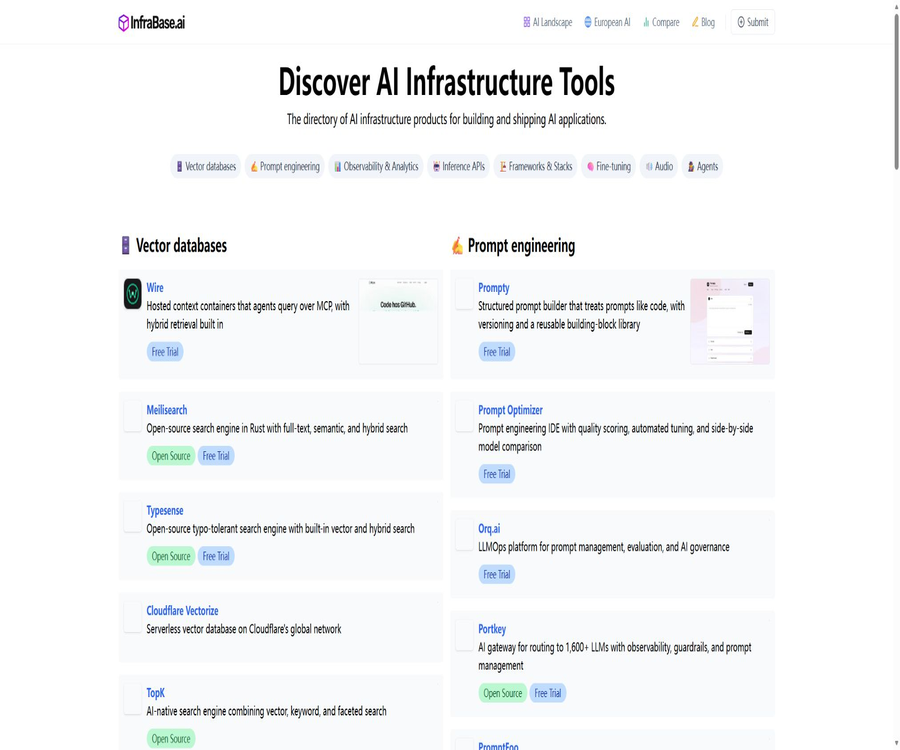
AI Infrastructure Tools Directory at Infrabase.ai
The AI Infrastructure Tools Directory on Infrabase.ai features intelligent tools designed to improve AI efficiency.
Tags:AI improves efficiencyWhat is Infrabase.ai?
Infrabase.ai is a specialized vertical directory that compiles products related to AI infrastructure, aiming to assist developers in finding the tools needed to build, deploy, and operate AI applications. It focuses on areas such as inference, vector retrieval, observability, fine-tuning, Agents, audio processing, and development frameworks, rather than chat or office applications intended for ordinary users.
Each product entry attempts to summarize the product’s functionality, pricing model, free trial options, open-source status, deployment methods, compliance information, and alternative products. The catalog is manually maintained by the administrators, and manufacturers as well as the community can submit new tools or report errors for correction.
A one-sentence summary
Infrabase.ai is a searchable and filterable map of AI infrastructure, designed to help developers quickly compare inference APIs, vector databases, LLM monitoring tools, fine-tuning solutions, and agent development tools.
Core functions
- Vertical tool catalog: It aggregates infrastructure products required for the development and deployment of AI applications.
- Browse through eight categories: organized by technical fields such as reasoning, vector databases, and observability.
- Keyword search: Quickly find entries using the product name or relevant feature keywords.
- Condition filtering: Narrow down the options based on attributes such as open source, free trial, and EU hosting.
- Product details page: displays positioning, capabilities, price, deployment, and relevant tags.
- Alternative products page: Identifies similar and related products based on the degree of classification overlap.
- Landscape map: View the distribution of all tools and categories on a single page.
- Price information: Indicate options such as free, free trial, paid, and enterprise inquiry.
- Open source identifier: Used to distinguish between commercial services and open-source projects that can be deployed independently.
- EU Information: Helps teams that need data storage locations find suppliers in Europe.
- Tool submission: Allows product developers and the community to add missing entries.
- Public datasets: Reusable directory snapshots are available via GitHub.
Eight categories of tools
| Classification | Main contents included | Common selection issues |
|---|---|---|
| Inference APIs | Model inference, hosting, routing, and acceleration services | Model coverage, latency, throughput, regions, and billing |
| Vector databases | Vector databases, search engines, and hybrid searching | Index scale, filtering, mixed retrieval, and deployment |
| Observability & Analytics | Tracking, evaluation, monitoring, security, and gateways | Logs, costs, quality, playback, and alerts |
| Prompt engineering | Prompt management, testing, optimization, and version control | Collaboration, evaluation, deployment, and rollback |
| Frameworks & Stacks | LLM application frameworks, runtimes, and complete technology stack | Language, model compatibility, scalability, and self-hosting |
| Fine-tuning | Training, fine-tuning, data processing, and model deployment | Hardware, methods, costs, and data control |
| Audio | Speech recognition, speech synthesis, cloning, and dialogue voices | Language, real-time performance, authorization, and voice quality |
| Agents | Agent frameworks, orchestration, hosting, and tool integration | Status, tool calls, evaluation, and production deployment |
Size of the current directory
The Landscape page on the official website lists 271 tools upon verification, which are divided into 8 categories. The catalog is continuously updated, so the number of tools displayed on the home page, on the Landscape page, and in the GitHub snapshots may vary.
- The inference API is one of the largest categories in terms of scale at present.
- Observability and analytics cover monitoring, evaluation, security, and gateways.
- The framework and technology stack include options for local execution, cloud deployment, and application development frameworks.
- Vector databases encompass both dedicated databases and search engines with vector capabilities.
- The number of categories changes as new ones are added, existing ones are removed, and categories are reassigned.
- GitHub repositories generate snapshots, which are not necessarily synchronized in real time with the website.
How to find AI infrastructure tools
- First, determine whether the project is in the prototype, testing, or production phase.
- Determine whether the issue to be resolved is related to reasoning, retrieval, observation, fine-tuning, audio, or Agents.
- Enter the corresponding category and first browse the category description and representative products.
- Use the search function to find known product names, technology names, or key capabilities.
- Filter by attributes such as open source, free trial, and deployment location.
- Open the product details page for the candidate options and compare the location, price, and alternative solutions.
- Return to the product’s official website and documentation to check the current prices, restrictions, and compliance statements.
- Create a shortlist and conduct technical testing using real workloads.
How to select a product
- List the required models, protocols, languages, and deployment locations.
- Record the expected number of requests, data volume, concurrency levels, and latency targets.
- Select three to five candidate products from Infrabase.
- Check the free trial, open-source license, and commercial pricing separately.
- Check the stability of the SDK and APIs, as well as rate limiting and error handling.
- Compare quality, speed, reliability, and cost using the same test set.
- Evaluate data retention, logging, permissions, compliance, and exit strategies.
- Starting from the directory information, decisions are made based on the official supplier contracts and test results.
The actual use of filtering criteria
- Open Source: Look for projects that are auditable, modifiable, or can be deployed on your own.
- Free Trial: First, test the integration, performance, and cost per usage.
- EU hosting: Establishes a pool of candidates to meet the requirements regarding data residency and procurement in Europe.
- Category tags: Exclude products that are functionally similar but not directly interchangeable.
- Price labels: Distinguish between free, pay-as-you-go, subscription, and sales inquiry.
- Alternatives: Discover similar products and alternative options that better meet the needs.
What is included on the product details page?
- Product name and one-sentence description.
- Category and related skill tags.
- Free trial, open source, and pricing models.
- Information related to deployment, hosting location, or compliance.
- The substitution relationship with similar products.
- Expanded introduction and frequently asked questions.
- Link to the product’s official website.
- Channels for submitting corrections or additional information.
Alternatives – Page for alternative solutions
The alternatives page lists tools from the same category based on the product’s category and the degree of overlap in its features, and it also includes related products. It is useful for creating a list of potential options; however, belonging to the same category does not mean that the products have identical functions, prices, or deployment methods.
- View similar tools that are closest to well-known products.
- Distinguish between open-source alternatives and hosted API alternatives.
- Identify regional suppliers within the same category.
- Compare whether adjacent tools can replace some components of the technology stack.
- Avoid making purchases based solely on rankings.
- Ultimately, it is still necessary to read the supplier’s official documentation and carry out testing.
Landscape infrastructure map
Landscape groups all directory entries into eight categories and shows the number of tools available at the moment. It is more suitable for gaining an overall view of the ecosystem, identifying popular areas, and determining the concentration of suppliers in certain regions.
- View the relative scale of different infrastructure categories.
- Quickly glance at the name of each product category and its brief description.
- Use search and filtering to narrow down large directories.
- Jump from the map to the details of a single product.
- Identify the components in the project’s technology stack that are not yet covered.
- It is used for research rather than to directly prove market share.
How to determine open-source tools
The Open Source tag in the catalog can help with an initial screening, but the scope of open source options may include only SDKs, clients, or community versions. When making a choice, it is necessary to verify the specific repository, license, version, hosting service, as well as the enterprise features.
- It is confirmed that the core services still have only the client code made available under an open source license.
- Check whether the license permits commercial use and redistribution.
- Check whether the warehouse is continuously maintained and security updates are released.
- Distinguish between the community version, cloud service, and enterprise version capabilities.
- Assess the costs of GPUs, databases, and operational maintenance required for self-hosting.
- Do not equate public GitHub repositories with free production services.
EU custody and compliance screening
- Used to identify potential suppliers whose headquarters or infrastructure are located in Europe.
- Assist in establishing an initial list for evaluating data residency and cross-border transfer.
- It cannot replace the data processing protocols and the list of sub-processors.
- It is necessary to continue confirming the actual reasoning area as well as the locations for backups and logs.
- Industry certification and regulatory compliance should be verified by the procurement and legal departments.
- Supplier statements may change; written documentation should be obtained prior to signing the contract.
Which users are it suitable for
- AI application developers: searching for models, retrieving them, evaluating them, and working with Agent components.
- Architect: Plans the infrastructure stack from prototype to production.
- Technical Lead: Create a shortlist of suppliers and open-source solutions.
- Startup team: Use free trials to quickly validate the technical approach.
- Corporate procurement: Compare regions, pricing models, and alternative products.
- Researchers: Observing the evolution and classification of the AI infrastructure ecosystem.
- Open-source maintainers: Increase the project’s visibility among target developers.
- Infrastructure manufacturers: Submit products, update information, or purchase featured placement.
Typical use cases
- Compare the coverage and deployment regions of the inference APIs for different models.
- Select vector databases and hybrid search engines for the RAG project.
- Look for LLM tracking, evaluation, cost monitoring, and security tools.
- Compare open-source and hosted Agent development frameworks.
- Discover model fine-tuning, training, and GPU deployment platforms.
- Select recognition, synthesis, and dialogue interfaces for real-time voice products.
- Look for open-source or regional alternatives to a well-known product.
- Create a list of suppliers that offer internal AI infrastructure.
- Observe the number of products in different technology categories and the ecological changes.
Which tasks are not suitable for it?
- It directly replaces the supplier’s official documents, contracts, and service level agreements.
- Do not rely on directory labels alone to determine safety, privacy, or compliance with regulations.
- It serves as the sole source for real-time price and availability information.
- Prove that a certain product is definitely superior to all alternative options.
- Looking for AI applications for writing, drawing, and office work for ordinary consumers.
- No conclusions can be drawn regarding model quality, throughput, and latency without testing.
- Estimate market share or supplier revenue based on the number of entries.
Submit a tutorial for the new tool
- Confirm that the product belongs to one of the eight categories of AI infrastructure.
- Prepare the product name, official website, brief description of its position in the market, and main categories.
- Check the price, open source status, free trial option, and information on hosting locations.
- Go to the submission page and enter accurate, verifiable information.
- Avoid using exaggerated rankings and unverifiable claims about performance.
- After submission, wait for the maintainers to conduct compatibility and quality reviews.
- When an error is found, it is corrected through submission channels, Issues, or pull requests.
- Update the information promptly when there are changes in the price or functionality of the product.
Free inclusion and Featured display
Regular users can browse the catalog free of charge, and products that meet the criteria can also be submitted for review. The Featured service is a paid option intended for manufacturers, which allows for the promotion of content; it does not include unrelated products in categories that are not appropriate for them.
| Project | Price | Included content | Suitable for |
|---|---|---|---|
| Browse directory | Free | Search, classification, Landscape, and details page | Developers and researchers |
| Submit product | Free review | Apply to add or modify directory entries | Infrastructure product providers and communities |
| Featured | $ | Badges, preferred placement in categories, alternative page displays, and additional descriptions | Manufacturers that need to increase exposure |
| Cancel | Cancel at any time | Remain Featured throughout the paid period | Manufacturers subscribed to Featured |
What benefits are included in Featured?
- Display the Featured badge on product listings and category pages.
- Achieve a higher position in its actual category.
- It appears in the Featured section on the relevant alternative solutions page.
- Extended product descriptions and frequently asked questions are written by Infrabase.
- Subscribe on a monthly basis through the secure payment page.
- No guarantees are provided regarding the number of clicks, visits, or sales.
- The ranking of the editorial alternatives and the conclusions of the summary remain unchanged.
- New products still need to pass a catalog compatibility review first.
How to understand Featured correctly
- Featured indicates that a clearly marked display location has been purchased.
- A paid placement does not equate to the product being objectively ranked first.
- Category matching is still reviewed by the catalog administrator.
- The extended introduction was researched and written by Infrabase.
- The manufacturer can provide information and corrections, but does not have direct control over the text.
- The catalog does not guarantee that items marked as Featured will generate traffic or sales.
GitHub public datasets
The official associated repository provides a Markdown snapshot of the AI infrastructure catalog, which includes the names of the tools, their descriptions, categories, and links to their respective products. The data related to these repositories is maintained and generated by Infrabase; the community can submit new entries or make corrections.
| Project | Current information | Explanation |
|---|---|---|
| warehouse | arvida/ai-infrastructure-directory | Associated with the Infrabase directory |
| Number of snapshot tools | 231 | Warehouse instructions generated on July 27, 2026 |
| Number of website tools | 271 | Real-time display in Landscape during verification |
| Number of categories | Category 8 | In line with the main category of the website |
| License | CC BY 4.0 | Signed data is required for reuse. |
| Update method | Automatic generation | It is not recommended to manually maintain the files only when they are being created. |
| Ways of contributing | Submit a page, Issue, or pull request | The fix requires first entering the source directory and then regenerating it. |
Why are the numbers of websites and GitHub accounts different?
The website continuously adds, removes, and reclassifies tools, while the GitHub repository represents a static snapshot taken on a specific date. When checking, the website shows 271 tools, but the repository listing still indicates 231 tools; therefore, the number in the repository should not be considered as the current total.
- The directory website is the main entry point for viewing current entries.
- GitHub is more suitable for downloading, citing, and reviewing public snapshots.
- The research report should indicate the date of retrieval and the version.
- Check the last update time of the warehouse before automatic synchronization.
- Differences in quantities do not necessarily indicate data errors.
- When real-time information is needed, the website should be checked again.
Data reuse and signing
- The public repository uses the CC BY 4.0 license.
- Appropriate attribution is required when copying, adapting, and republishing.
- It should be indicated whether the original data has been modified.
- It is not permitted to imply that Infrabase endorses the derivative project.
- Product logos, trademarks, and third-party content may have separate rights.
- Before commercial reuse, it is necessary to check both the warehouse license and the information provided by third parties.
Product advantages
- Focused on AI infrastructure; the categorization is more targeted than that of comprehensive tool catalogs.
- It covers the entire technical chain, from model inference to monitoring and Agents.
- It supports practical filters such as open source, free trial, and EU hosting.
- Product details, Landscape, and alternatives are interrelated.
- Regular browsing and product submission are free of charge.
- Featured content is clearly distinguished from editorial rankings.
- The catalog is maintained manually, allowing the community to correct errors.
- GitHub provides reusable data snapshots that allow for signed modifications.
- It is suitable for quickly creating shortlists of suppliers and open-source projects.
Usage restrictions and precautions
- The catalog information may be outdated compared to the supplier’s official website.
- Prices, free quotas, availability zones, and licenses can change.
- The overlap in categories does not mean that the two products can be completely exchanged for one another.
- The Open Source label does not indicate that all components are open source.
- The EU label cannot replace data residency and compliance audits.
- Featured represents paid promotion and should be distinguished from editorial recommendations.
- The catalog does not provide any guarantees regarding accuracy, performance, or service availability.
- The current data on the website may not be synchronized with the GitHub snapshot.
- Official documentation verification and real-world load testing must be completed prior to procurement.
- It is not suitable as evidence for market share, revenue, or security certification.
Usage suggestions
- Start with the requirements and categories; don’t just search for brand names.
- Use the catalog to identify candidates, rather than to make the final decision.
- Save the filtering date to prevent old prices from being considered as current prices.
- At the same time, compare the total costs of open-source, self-hosted, and hosted APIs.
- Understand rankings, Featured items, and regular entries separately.
- For high-risk purchases, suppliers should be required to provide written proof of compliance.
- The technical solution should include baseline testing, failure drills, and an exit plan.
Basic information
| field | Content |
|---|---|
| Product name | Infrabase.ai |
| Tool type | AI infrastructure tool catalog and Landscape |
| Primary users | Developers, architects, technical leaders, and manufacturers |
| Core classification | Reasoning, vector databases, observability, prompts, frameworks, fine-tuning, audio, and Agents |
| Number of website tools | 271 during verification |
| Usage price | Regular browsing is free. |
| Featured price | $ |
| Public data | GitHub directory snapshot |
| Data license | CC BY 4.0 |
| Is registration required? | Browsing requires no registration. |
Recommendation score
4.4 / 5. Infrabase.ai offers a clear structure and practical categorization; it combines website filtering, alternative options, and reusable datasets, making it suitable for AI development teams to conduct preliminary research. However, its database is not real-time, so key details regarding prices, compliance, and performance still need to be verified separately.
Frequently Asked Questions
Is Infrabase.ai free?
Regular users can browse, search, and view product details for free, and tools that meet the requirements can also be submitted for review without charge.
Does it include ordinary AI writing and drawing tools?
It is mainly not included; it focuses on the infrastructure products needed to build and deliver AI applications.
How many tools are there currently?
During verification, the Landscape page shows 271 tools, and this number may change as the catalog is updated.
What are the categories?
There are eight categories in total: reasoning APIs, vector databases, observability and analytics, prompt engineering, frameworks and technology stacks, fine-tuning, audio, and agents.
Can I submit my own products?
Yes, after submission, the maintenance team will review whether the product falls within the scope of AI infrastructure.
How much is Featured?
During verification, the early bird rate is $29 per month; cancellation is possible at any time, and no guarantees are provided regarding the number of clicks or sales.
Are the prices in the catalog accurate?
Not necessarily; supplier prices can change, so it is essential to check the official website, the checkout page, and the official quote before making a purchase.
Can GitHub data be reused?
Yes, public snapshots are licensed under the CC BY 4.0 license; proper attribution is required when reproducing or adapting them.
Is Infrabase.ai itself open source?
The complete source code of the website is not made public; the official repository provides only snapshots of the directory data, rather than the entire website application.
Tools similar to the AI Infrastructure Tools Directory on Infrabase.ai



 Guigong Network Security Registration No. 45132202000164