






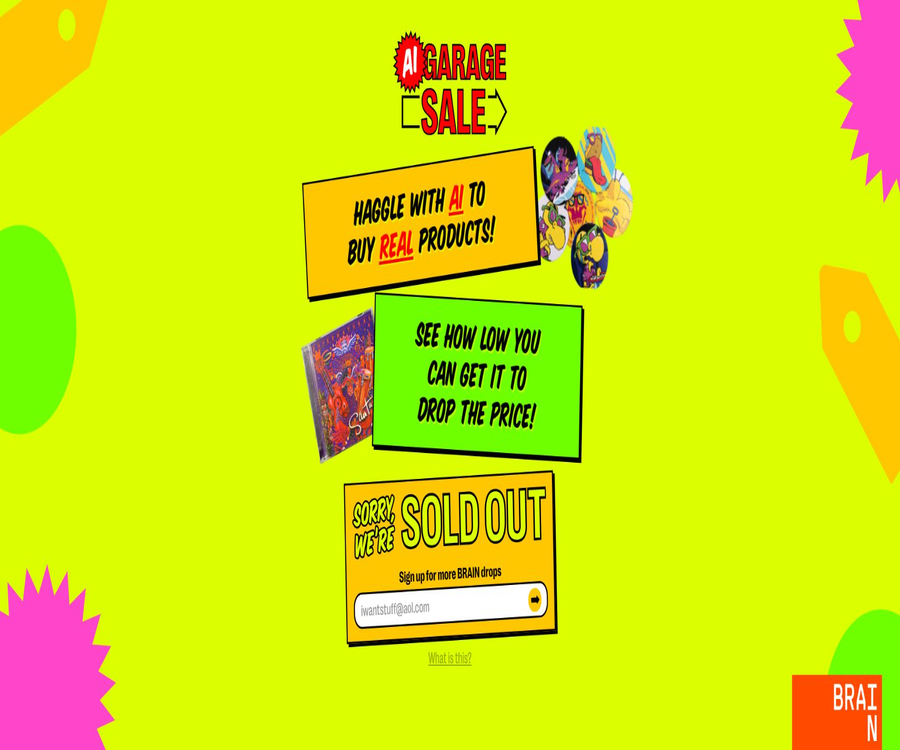
AI Garage Sale
AI Garage Sale: intelligent tools focused on improving AI efficiency
Tags:AI improves efficiencyWhat is AI Garage Sale?
AI Garage Sale is an interactive art and e-commerce experiment launched by the creative studio BRAIN. In this project, large language models act as salespeople with different personalities; users can negotiate prices for real products through conversations, and after accepting a quote they can proceed to checkout and purchase the desired items.
It is not an ordinary second-hand trading platform, nor is it a tool for estimating values or finding goods available for sale in physical garages. This initiative is part of a one-time, limited event; the official website already shows that all items have been sold out, and no further negotiations regarding new products are possible.
A one-sentence summary
AI Garage Sale allowed users to negotiate the prices of real products with AI salespeople, and it used a gamified approach to demonstrate the capabilities and limitations of generative AI in negotiation, e-commerce, and prompt control; currently, this project’s offerings are all sold out.
Current operating status
- The official website is still accessible as usual.
- The page clearly shows that all items are out of stock.
- The start button no longer allows entry into a new valid purchase process.
- Users can only read the project description and historical FAQs.
- You can subscribe via email to receive future updates from BRAIN.
- There is no new round of products, no date for resumption, and no commitment regarding ongoing operation.
- It should not be listed as a regular shopping service available at the moment.
Core historical gameplay
- The system randomly assigns a real product.
- The system randomly assigns an AI salesperson with a different role setting.
- Users propose prices, reasons, and negotiation strategies in the conversation.
- AI can accept, reject, negotiate, or increase the price.
- AI has the authority to determine the price at which a product is sold.
- After accepting the quote, the user views the actual products and costs on the checkout page.
- After the payment is completed, the project owner delivers the actual item.
- Refreshing the page can change the random products and salesperson.
Historical participation process
- Go to the event homepage and click Start.
- View the products randomly selected by the system and the AI salesperson.
- First, confirm the product, the reference price, and the maximum amount you are willing to pay.
- Submit a quote through chat and explain the reasons.
- Continue negotiating based on the AI’s counteroffer, or refresh and replace the product.
- Before accepting the price, open the checkout page to verify the products, quantity, and shipping cost.
- Payment is made after agreeing to the final sales terms.
- Wait for the project owner to ship the item within the specified deadline.
How does AI determine prices?
BRAIN provides guidance for AI in negotiations, but it does not set a fixed minimum reduction threshold; as a result, different entities may adopt entirely different strategies. The project’s FAQ states that, in theory, the AI could reduce prices to just a few cents, or it might raise its bid as a response to attempts at setting low prices.
- Generate a response based on the price and reasons provided by the user.
- Adopt different emotions and negotiation styles in line with the character’s background.
- You can accept the quote or propose a new amount.
- They may react negatively to excessive price cuts and raise prices as a result.
- Large language models have limited mathematical capabilities, and their pricing logic may be unstable.
- The checkout service sets a minimum transaction price of 50 cents.
What can AI negotiate?
| Negotiation items | Is it effective? | Actual rules |
|---|---|---|
| Product prices | Effective | AI has the authority to decide the price at which transactions are displayed to users. |
| Number of items | Invalid | The quantity listed on the checkout page shall prevail. |
| Free gifts or buy one get one free | Invalid | An AI’s verbal promise cannot change the details of the settlement. |
| Replace with another product. | Invalid | Only items available on the current checkout page can be purchased. |
| Shipping cost | Invalid | The shipping cost is determined by the system, not by AI. |
| Refund or return | Invalid | Historical rules stipulate that all sales are final transactions. |
What products have been sold in the past
The project deliberately mixes high-value electronic products, popular tickets, nostalgic collectibles, and quirky items to simulate the uncertainty of a real garage sale. The stock of items is limited, and once an item is sold, it is not included in the permanent catalog.
- Consumer electronics such as the PlayStation 5 and AirPods.
- Popular concert tickets.
- Nostalgic electronic toys such as Tamagotchi.
- Pogs collectibles and music CDs.
- Restaurant gift cards and commemorative coins.
- Novel ornaments such as Big Mouth Billy Bass and others.
- Large inflatable dancing dolls.
- Magazines, wallets, and other random old items.
Price and fee rules
AI Garage Sale does not charge any subscription fees or software packages; users only pay the price of the products after AI has negotiated it, along with the shipping cost shown on the checkout page. Since all items are already sold out, there are no current prices available for purchase.
| Project | Historical price method | Current status |
|---|---|---|
| Visit the website and negotiate | Free | The page is accessible, but no actual purchases can be made. |
| Product prices | Dynamically negotiated by AI and the user | No products available for sale. |
| Minimum order amount | 50 cents | Limits on historical settlement services |
| Shipping cost | It is displayed separately on the checkout page. | It cannot be modified by AI. |
| Subscription fee | None | No memberships or software packages available |
| Refund | Historical rules do not allow for refunds or returns. | There are no new transactions at the moment. |
| Future notifications will be issued by BRAIN. | Free email subscription | You can still submit your email address on the official website. |
Delivery and sales rules
- Historical activities are available only for deliveries within the United States.
- The delivery time varies depending on the product, and is typically between one and four weeks.
- It is the items, quantities, prices, and shipping costs on the checkout page that constitute the actual order.
- The additional products or shipping discounts promised by AI during conversations are invalid.
- All sales are marked as final transactions.
- The project’s FAQ clearly states that refunds or returns are not accepted.
- No new orders will be accepted once the limited-time offer is sold out.
Examples of negotiation strategies
- First, set a payment limit based on the public retail price or second-hand market rates.
- Provide a specific price and give the condition of the product or alternative options as reasons.
- Respond to unreasonable quotes with verifiable market prices.
- Maintain a natural tone, and observe which reasons the AI character gives priority to.
- Break down the large price reduction target and achieve it through multiple rounds of small adjustments.
- Stop when you notice the price rising or the conversation losing its meaning.
- Do not treat the emotionally charged stories created by AI as genuine information from sellers.
- At all times, the checkout page and personal budget should be taken as a guide.
Safe methods for practicing negotiation
- Choose a fictional product and a specific market reference price.
- Set minimum or maximum acceptable prices for buyers and sellers respectively.
- Provide AI salespeople with limited roles and negotiation rules.
- Record each round of quotes, the reasons behind them, and any price changes.
- Check whether the model contains arithmetic errors, excessive commitments, or contradictions.
- Set the maximum number of rounds, minimum price, and manual approval nodes.
- Compare the results of different cues, models, and negotiation strategies.
- Practice should be used only for education or testing; the model must not be allowed to control actual payments directly.
Which users are it suitable for
- A product manager who specializes in the interactive design of generative AI.
- E-commerce teams that explore AI-driven sales and negotiation experiences.
- It assists AI developers in addressing issues related to constraint analysis and model overreach.
- Students who study human-computer negotiation, trust, and behavioral economics.
- Seeking creators of examples of interactive art and Internet experiments.
- Educators who wish to understand the limitations of AI sales agents.
- The brand marketing team that analyzes the methods used to promote limited-time campaigns.
Which users are not suitable for it
- Consumers who wish to purchase discounted electronic products now.
- Look for sellers who operate second-hand markets on a continuous basis.
- Users who need AI to identify products and estimate their second-hand prices.
- I’m hoping to find someone who sells items at a discount in a local garage.
- Companies that need a stable e-commerce API or a white-label pricing system.
- Shoppers who request clear refund guarantees and international shipping.
- Development teams that need reusable open-source negotiation code.
Typical research and teaching scenarios
- Negotiation experiments: Observing the impact of language, anchoring, and emotions on prices.
- Hint engineering: Test whether the model can comply with price and permission constraints.
- E-commerce design: Analyzing whether chat-based bargaining can enhance user engagement.
- AI Security: Demonstrates prompt injection, role induction, and privilege escalation.
- Consumer protection: Discussions on AI-driven sales practices, price fairness, and information disclosure.
- Interactive art: Exploring how real transactions affect audience engagement.
- Marketing communication: Analyzing the attention generated by limitations, randomness, and gamification.
What does this experiment illustrate?
- Natural language can turn a fixed-price page into an interactive negotiation experience.
- The character design significantly influences users’ perception of the AI salesperson.
- The model can create a sense of negotiation, but it does not necessarily truly understand prices.
- When no hard boundaries are set, the generated model may produce loss-making quotes.
- AI may promise quantities, products, or delivery conditions that exceed the system’s capabilities.
- Real transactions must have their final content constrained by a deterministic settlement system.
- Novel experiences can attract participation, but they do not constitute a sustainable business model.
Comparison of AI sales agents and traditional pricing methods
| Comparison items | AI Garage Sale-style bargaining | Traditional fixed price |
|---|---|---|
| Interaction method | Multiple rounds of natural language negotiation | Check the price and purchase directly. |
| Transaction price | Different users may receive different quotes. | It is usually the same at the same time. |
| Experience feel | Gamified, random, and with character stories | Simple, fast, and predictable |
| Operational risk | Arithmetic errors, unauthorized commitments, and extreme price cuts | The price is determined by the seller’s rules. |
| Fair interpretation | It is necessary to explain how dynamic prices are determined. | Promotions and pricing are easier to display. |
| Purchase efficiency | Multiple rounds of communication are required. | Fewer steps |
Insights for e-commerce teams
- Using AI to explain products and address objections is a risk-reducer compared to directly controlling price risks.
- The discount should be calculated by the rule engine; the model merely provides suggestions.
- AI can select discounts within the allowed range, without exceeding the profit threshold.
- The products, quantities, shipping costs, and refunds must be confirmed by a deterministic system.
- High-value orders and abnormal discounts should trigger manual approval.
- It is necessary to save the quotation path for resolving disputes and conducting audits.
- It is necessary to monitor whether different user groups are subject to unfair differential pricing.
- It is necessary to clearly disclose that the party in the conversation is an AI and its scope of permissions.
Purchase risks and precautions
- The current product is already out of stock; do not trust any sales pages that pretend to be affiliated with it.
- Historical events do not offer refunds or returns, and consumer protection is weaker than in regular retail.
- AI-generated character stories are created content and do not reflect the actual situation of the sellers.
- The model may miscalculate discounts, compare prices, or provide inconsistent quotes.
- Chat promises cannot override the actual order details on the payment page.
- Users outside the United States cannot use international shipping for historical orders.
- Limited quantities and randomization mechanisms can easily lead to impulsive buying.
- For high-value products, it is still necessary to compare prices, warranty options, and return policies through legitimate channels.
Privacy and email subscriptions
The current homepage allows users to submit their email addresses to subscribe to future updates from BRAIN; these addresses are sent to BRAIN’s subscription service. Users who only wish to access information about past projects do not need to provide an email address, nor should they enter payment cards or other sensitive data in any public discussions.
- Use only the email address for which you have permission to submit.
- Before subscribing, consider whether you wish to receive future marketing or project notifications.
- Do not disclose identification documents, account details, or payment information in AI chats.
- Payment information should only be entered on trusted, official payment pages.
- Do not send order details to unofficial contacts after the project has been completed.
Project advantages
- Transform the concept of AI-driven negotiation into a tangible, purchasable interactive experience.
- Random items and characters give each conversation a gaming feel.
- The direct exposure model reveals issues in terms of mathematics, boundaries, and consistency.
- Use the checkout system to limit the discrepancy between AI promises and actual transactions.
- It provides compelling examples for AI-based e-commerce, consumer behavior, and interactive art.
- The official website still retains a complete FAQ and historical rules, making it easy to review past situations.
Usage restrictions and precautions
- This is a one-time experiment, not a continuously operating AI tool or marketplace.
- All items are currently out of stock, so purchases cannot be made.
- Both products and AI are randomly assigned by the system; users cannot choose them directly.
- Historical services are only available for shipments to U.S. addresses.
- No refunds or returns are accepted after the purchase is completed.
- AI can only determine the price; it cannot change the products, quantities, or shipping costs.
- The model may increase the quote due to emotional factors or arithmetic errors.
- The limited-time trial does not provide a public stable API, a merchant dashboard, or enterprise packages.
- The project has not specified a date for the next opening.
- It should not be confused with second-hand valuation services, garage sale maps, or SaaS discount websites.
GitHub and open source
The AI Garage Sale website does not provide a link to the official GitHub repository, nor does it disclose any information regarding pricing guidelines, model configurations, the product system, payment codes, or licenses. The various garage sale and valuation projects with similar names that were found have no verifiable official connection to the BRAIN experiment.
Therefore, this project should be marked as non-open source. The front-end resources of a web page can be loaded by browsers, but this does not grant an open source license that allows for the copying, deployment, or commercial use of the entire system.
Basic information
| field | Content |
|---|---|
| Project Name | AI Garage Sale |
| Creative team | BRAIN |
| Date of initial public offering | November 2023 |
| Project type | AI-based bargaining, e-commerce, and interactive art experiments |
| Main models | AI salespeople based on OpenAI models |
| Trading partner | Limited edition authentic products |
| Historical service areas | United States |
| Current status | Sold out; only introductions and email subscriptions are available. |
| Is there a fee? | Browsing and negotiating are free; the purchase price plus shipping cost are due at the time of buying. |
| Is it open source? | No; no official code repository or license is available publicly. |
Recommendation score
3.6 / 5. AI Garage Sale is a creative experiment in AI-based negotiation and actual transactions, suitable for researchers in the fields of products, design, and AI security to use as a reference; however, all tickets for this event have already been sold out, and ordinary users can only view its historical information – it cannot be used as a shopping tool that is available for ongoing use.
Frequently Asked Questions
Is it still possible to purchase items at AI Garage Sale?
No, the official website clearly states that the items are out of stock; there are no new products available nor is any date set for their reavailability.
Are the items it sells genuine products?
Yes, goods from historical events can be purchased and delivered at prices determined through AI negotiation.
Can AI really determine prices?
Historical rules allow AI to determine the transaction price, but the product, quantity, and shipping cost are still fixed by the checkout system.
What is the lowest amount that can be discussed?
AI does not have a hardcoded minimum price, but historical billing practices require a payment of at least 50 cents.
Can I choose between products or AI?
No, both the products and AI sales assistants are assigned randomly; existing users can change them by refreshing the page.
Is international shipping available?
Not supported; historical activities are available only for deliveries within the United States.
Is refund or return available?
Not supported; the project’s historical FAQ states that all sales are final transactions.
Are the AI-promised gifts valid?
It is invalid; ultimately, only the items and quantities explicitly listed on the checkout page can be selected.
Is AI Garage Sale open source?
It is not open source; BRAIN does not make the official code repository for this project available, nor does it provide configuration instructions or an open source license.
Tools similar to AI Garage Sale



 Guigong Network Security Registration No. 45132202000164