






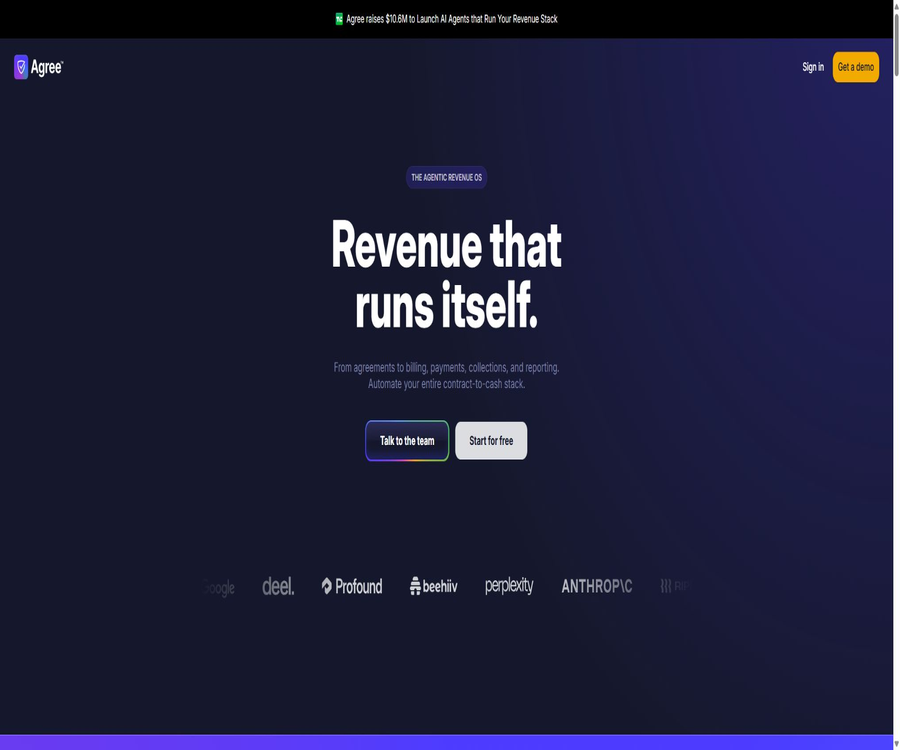
Agree.com
Agree.com: an intelligent tool focused on enhancing efficiency through AI.
Tags:AI improves efficiencyWhat is Agree.com?
Agree.com is an Agentic Revenue OS designed for the processes related to corporate contracts and payments; it integrates agreements, bills, invoices, payments, collections, reconciliations, and revenue reports within a single platform. Once a contract is signed, the system can automatically initiate the subsequent billing and collection procedures based on the terms outlined in the contract.
It is not merely a tool for providing electronic signatures or for making payment links; rather, it transforms the commercial intentions outlined in contracts into actionable revenue mechanisms. The official website is currently aimed at corporate clients who need demonstrations and customized implementations.
Core functions
- Import existing contracts or create new agreements from scratch.
- Use variables to create consistent and reusable contracts.
- Securely collect and track electronic signatures in real time
- Automatically generate one-time or periodic invoices based on the contract terms.
- Invoices are generated and sent automatically at the start of a business transaction.
- Provide a built-in payment experience on the invoice.
- Manage saved payment methods and subscription status
- Automatically identify overdue payments and send reminders along with retry attempts.
- Real-time synchronization of payments, ledgers, and income records
- Display metrics such as ARR, MRR, DSO, and cash flow.
- Connect CRM, ERP, and accounting systems via APIs and Webhooks
The entire process from contract signing to payment receipt
| Phase | Agree capability | Automation results | Human liability |
|---|---|---|---|
| Agreement | Creating, importing, variables, and signatures | Establish structured business terms | Review legal and business conditions |
| Billing | Read the terms and create a billing plan. | Reduce duplicate entries | Confirm the price, timeline, and tax rules. |
| Invoicing | Generate and send invoices based on events. | Initiate collection in a timely manner. | Handling disputes and special adjustments |
| Payments | Provide payment options and track settlements. | Shorten the payment process | Manage refunds, permissions, and risks |
| Recovery | Detect overdue items, provide reminders, and enable retries | Reduce manual collection efforts | Handling high-value and sensitive clients |
| Reconcile | Synchronized payments and accounting records | Reduce discrepancies between records and actual conditions. | Review of exceptions and monthly closing |
| Reporting | Summarize revenue and risk indicators | Provides a real-time view | Explain the parameters and make business decisions. |
Agreements protocol management
Agree allows for the import of existing agreements or for the creation of contracts from scratch; it uses variables to ensure that the terms, customer information, and business-related fields remain consistent. The status of the contract and the progress of signing can be tracked in real time.
- Upload or migrate existing protocol content
- Create standard contracts and reusable templates
- Insert customer, amount, date, and billing variables
- Adjust specific business terms based on transactions
- Sent to internal and external signers
- View in real time the status of viewing, signing, and completion
- Save the signing result and initiate the subsequent revenue processing.
Electronic signature
The platform uses the signature as a signal to initiate the process of processing the contract payment, rather than as an isolated final step. Once the contract is completed, the Contract Agent can initiate the billing and payment procedures.
- Collect electronic signatures from multiple parties
- Displays the real-time status of the protocol signing.
- Keep the downloadable record after completion.
- Billing and invoicing are initiated based on signature events.
- Notify of reducing sales and shifting to manual financial processing
- Configure the signing order, identities, and permissions.
The legal validity of electronic signatures, as well as the requirements regarding identity verification and evidence, vary depending on the country, region, and type of contract. Before putting such systems into use, a company’s legal team should verify the templates, the signing process, and the storage requirements.
Contract variables and revenue logic
Variables can convert amounts, periods, start times, and customer information from textual terms into reusable fields. Structured fields enable the billing system to automatically generate the relevant arrangements after signing.
- Standardize customer names, addresses, and entity information.
- Define one-time costs, recurring costs, and start date.
- Indicate quantity, price, discount, and payment deadline
- Schedule invoices based on milestones or business events
- Update subsequent processes simultaneously when the contract is changed.
- Reduce duplicate data entry among sales, legal, and finance teams
- Manual inspection and exceptional status are reserved for non-standard terms.
Automatic billing
The Billing module creates billing arrangements based on the signed contracts, supporting both one-time and periodic charging, and keeps everything in sync when there are changes to the contracts. It is suitable for converting sales commitments into financially actionable plans.
- Extract the billing amount and time from the contract.
- Generate a one-time expense plan
- Establish periodic subscriptions or recurring charges
- The invoice is generated at the start of the service or after a scheduled event.
- Addressing the impact of contract changes on future invoices
- Maintain the connection between the billing source and the original contract.
- Have the finance staff review non-standard billing arrangements.
Invoice management
Agree can generate invoices based on the billing plan and keep track of the status of those invoices. The payment option is integrated directly into the invoice interface, thereby reducing the need for customers to switch between different systems.
- Invoices are generated automatically based on the contract and billing events.
- Include customers, projects, and payment terms in the invoice.
- Send invoices and track delivery and payment status
- Generate corresponding records for one-time and periodic bills.
- Provide payment options within the same process
- Feed back the settlement status to the revenue and reporting modules.
- Establish approval processes for credits, cancellations, and disputes.
Payments – Making payments
The Payments module enables companies to accept payments via invoices, as well as to track fund settlements and reconciliations. The official website does not list all payment methods, countries, currencies, and transaction fees on its public pages; it is necessary to verify each of these details separately when placing orders.
- Go from the invoice to a secure payment experience
- Manage the payment methods saved by customers
- Supports payment and subscription arrangements corresponding to the contract.
- Check the status of successful, failed payments, and settlements.
- Synchronize payment events to subsequent systems
- Manual handling is reserved for refunds, declines, and abnormal payments.
- Restrict who can modify the receiving account and payment settings.
Collection Agent
The Collection Agent is responsible for collecting payments using the saved payment methods and keeping track of subscriptions. It links contracts, bills, and payment status together, thereby reducing the need for manual checks of each customer’s account.
- Attempt to collect the payable amounts on the agreed date.
- Check whether the subscription is being paid for as required.
- Identify payment failures and information that needs to be updated.
- Synchronize the results with invoice and revenue records
- Initiate a retry or send a customer reminder according to the rules.
- Abnormal amounts and transactions involving key customers are sent for manual review.
Recovery Agent: Recovery beyond the deadline
The Recovery Agent automatically sends reminders and attempts retries in the event of a payment error, with the aim of reducing revenue losses and shortening the DSO. Companies should determine the frequency and tone of these actions based on the customer relationship, the amount involved, and local collection practices.
- Real-time detection of overdue unpaid amounts and payment failures
- Send reminders at a preset interval
- Automatically retry the payment when allowed.
- Distinguish between technical failures, insufficient balance, and customer disputes.
- Forward continuous overdue upgrades to the finance or customer success team
- Suspend sensitive accounts that are not suitable for automatic collection efforts.
- Record each reminder, retry, and customer response
The Reconcile Agent performs automatic reconciliation.
The Reconcile Agent keeps the payment records in sync with the accounting books, thereby reducing the need for manual reconciliation at the end of the month. Automatic reconciliation still requires an exception queue and financial review to handle differences in amounts, refunds, charges, or duplicate entries.
- Match settlement events to invoices and contracts
- Synchronize the collection status with accounting or ERP records
- Items that do not match, are duplicated, or have inconsistent amounts were identified.
- Maintain the complete connection from the agreement to the payment.
- Abnormalities that cannot be automatically explained will be routed to manual processing.
- Provides traceable records for audits and monthly closing.
Insight Agent and revenue reports
Insight Agent aggregates real-time revenue information from contracts, invoices, and payments, including metrics such as ARR, MRR, DSO, and cash flow. The accuracy of these metrics depends on the correctness of the contract details, accounting practices, and the underlying data.
- View annual and monthly recurring revenue
- Monitor accounts receivable and the average collection period
- Identify overdue risks and potential revenue losses
- Track payments, settlements, and cash flow changes
- Analyze by customer, contract, or revenue type
- Update the report results after continuous reconciliation.
- Provide a consistent contract receipt view for managing meetings.
Six types of AI Agents
| Agent | Main tasks | Trigger signal | Output |
|---|---|---|---|
| Contract Agent | Convert contract signing into an income generation process | Contract completed | Billing and payment logic |
| Billing Agent | Arrange and generate bills and invoices | Contract terms and time-related events | Billing plans and invoices |
| Collection Agent | Process payments and track subscriptions. | Payment due date | Payment status and subsequent actions |
| Recovery Agent | Track overdue items and remind users to try again | Failure or timeout | Reminders, retries, and upgrades |
| Reconcile Agent | Synchronized payments and accounting records | Payment and settlement events | Matching and exception records |
| Insight Agent | Analyze revenue, collections, and cash flow | Continuous data updates | Indicators such as ARR, MRR, DSO, etc. |
Integration capability
Agree synchronizes revenue data to existing CRM, ERP, and accounting systems through APIs, Webhooks, and system connections. Companies should identify the primary system for each type of data to prevent overlap between different platforms.
| System type | Synchronize content | Key design elements |
|---|---|---|
| CRM | Customers, transactions, contracts, and sales status | Customer primary key and phase mapping |
| ERP | Orders, accounts receivable, payments, and revenue records | Accounting entity and period control |
| Accounting | Invoices, settlements, expenses, and reconciliation | Accounts, taxes, and currencies |
| API | Read or write data as required by business needs. | Authentication, quotas, idempotency, and permissions |
| Webhooks | Signing, invoicing, payment, and settlement events | Signature verification, retry, and deduplication |
APIs and event automation
APIs and Webhooks enable companies to create advanced automation around contract signing, invoices, payments, and settlement processes. All write operations should include an idempotent key, permission checks, and error handling that allows for recovery.
- Create or prepare agreements after a deal is closed in CRM.
- Notify the delivery and finance teams at the time the contract is signed.
- Activate the product or service after payment and settlement.
- Create a follow-up task for the customer upon deadline expiration.
- Synchronize invoices and payments with the accounting system
- Update revenue metrics in the data warehouse
- To prevent duplicate Webhooks from resulting in duplicate bills or actions.
Applicable scenarios
- SaaS companies establish subscription-based billing upon the signing of contracts.
- Service companies issue invoices based on a one-time fee or at key milestones.
- The sales team reduces the manual handover of contracts to the finance department.
- The finance team automatically generates invoices and tracks payments.
- The accounts receivable team sends automatic reminders and retries for overdue payments.
- Unified contracts, payment procedures, and metrics for revenue operations
- Companies link payment transactions to the product activation process.
- Management monitors ARR, MRR, DSO, and cash flow in real time.
Which companies are suitable?
- B2B companies whose contract terms directly determine the billing method
- Companies that handle both one-time and recurring revenues simultaneously
- Hope for a platform team that can integrate electronic signatures, invoices, and payments.
- Financial organizations that need to reduce revenue leakage and manual collection efforts
- Companies that have the capability to integrate CRM, ERP, or accounting systems
- The revenue operations team that requires real-time reports once the contract payment is received
- Large and medium-sized clients capable of managing contracts, payments, taxes, and permissions
Agree.com prices
The current main website of Agree.com does not disclose the current monthly fees, package names, transaction rates, or free usage limits; information on these aspects can only be obtained by communicating with the team. The pricing model should be indicated as a customized quote for the enterprise, rather than relying on the package options available on the old version of the website.
| Product range | Current public price | The quote needs to be confirmed. |
|---|---|---|
| Agreements and electronic signatures | Not disclosed; company is seeking a quote. | Users, contract volume, templates, and signing requirements |
| Billing and Invoicing | Not disclosed; company is seeking a quote. | Bill volume, subscriptions, currency, and taxes |
| Payments | Not disclosed; company is seeking a quote. | Countries, methods, transaction and settlement fees |
| Recovery and Reconcile | Not disclosed; company is seeking a quote. | Automation of measurements, reminders, retries, and accounting connections |
| Reporting and Insight Agent | Not disclosed; company is seeking a quote. | Indicators, data ranges, and seats |
| API and enterprise integration | Not disclosed; company is seeking a quote. | Call volume, implementation, and technical support |
Why can’t historical prices be used?
In the search results, older versions of the Agree page from around 2015 can still be seen; these pages contain information such as 3 free contracts, a fee of $20 per month, and a processing fee of 2.9%. These pages relate to the earlier contract products for photography and services, and they do not reflect the current Agentic Revenue OS.
- The content on the old page is over a decade old, and the product’s target audience is different.
- The current main website does not list the old packages and rates again.
- The price for original founding members in the old version was part of a historical time-limited offer.
- The current payment region and processing partner may have changed.
- Purchases must be based on the current sales prices and contracts.
- The tool catalog should not list historical prices as current options.
Purchase confirmation list
- Platform licensing is billed based on users, contracts, invoices, or revenue volume.
- Payment processing, cross-border transactions, refunds, and chargebacks
- Supported countries, currencies, payment methods, and settlement periods
- Scope of migration for contracts, invoices, customer, and payment data
- API calls, Webhooks, sandbox, and constraints in the production environment
- Implementation, training, professional services, and SLA support
- Rules for data export, termination, renewal, and price adjustments
- Boundaries of responsibilities for taxation, accounting, electronic signatures, and payments
Quick Start Tutorial
- Review the existing process from closing a sale to receiving the actual payment.
- List the contract types, billing modes, currency, and payment terms.
- Apply for a demonstration and use masked real contracts to verify the parsing.
- Confirm the applicable regions for electronic signatures, payments, and data.
- Define the master data boundaries for CRM, ERP, and accounting systems.
- First, configure one standard contract and one billing method.
- Complete signing, invoicing, payment, and reconciliation testing in the sandbox.
- It goes live after passing the approvals from legal, finance, security, and revenue operations teams.
Tutorial on configuring contract receipt settings
- Create contract templates approved by the legal department.
- Define customers, prices, cycles, and dates as structured variables.
- Set the signer, order, and completion conditions.
- Map contract fields to billing and invoicing rules.
- Configure one-time, periodic, or milestone-based billing.
- Define the processes for handling payment failures, delays, and disputes.
- Map the settlement results to ERP and accounting records.
- Test with normal, modified, canceled, and abnormal contracts.
Recovery setup tutorial
- Classify strategies by customer type, amount, and number of days overdue.
- Define the timing for the first reminder, subsequent reminders, and retry intervals.
- Create communication templates that comply with the brand’s guidelines and local regulations.
- Configure a secure path for customers to update their payment methods.
- Manual escalation is provided for disputes, key clients, and large amounts.
- Limit the number of retries and prevent duplicate charges.
- Record each action, response, and the final outcome.
- Adjusted continuously based on customer complaints, recovery rate, and DSO.
Safety and compliance
The official website of Agree states that it complies with SOC 2 Type II standards, and it emphasizes that the processes related to payments are secure, compliant, and measurable. Companies still need to verify the scope of the relevant reports, their payment responsibilities, the location where data is stored, as well as their own compliance obligations.
- Use strong authentication for contracts, payments, and banking configurations.
- Separate permissions by sales, legal, finance, and administration roles
- Restrict who can modify the templates, prices, and payment accounts.
- Approval is required for refunds, cancellations, and non-standard contracts.
- Verify webhook signatures and protect API credentials
- Hide card numbers, bank details, and other sensitive personal information in the logs.
- Regularly review SOC 2 reports, suppliers, and data flows
- Establish processes for handling payment disputes, security incidents, and business continuity.
Legal and financial considerations
- AI cannot replace lawyers in reviewing contract terms and applicable laws.
- Automated extraction of results may misinterpret special billing or termination conditions.
- Companies are responsible for determining tax rates, revenue recognition, and accounting entries.
- The requirements for electronic signatures vary depending on the type of contract and the region.
- Automatic debt collection must comply with rules regarding consumer and business communications.
- Payments, refunds, and chargebacks are subject to the rules of the payment service provider.
- Management reports rely on complete and consistent contract receipt data.
Effect evaluation
| Indicators | Key points of evaluation | Suggested method |
|---|---|---|
| Signing cycle | Time from sending to completion of the protocol | Comparison by contract type |
| Delay in issuing invoices | From signing or starting the service to invoice generation | Record automatic and manual differences |
| DSO | Average days to collect receivables | Analysis by customer and account age |
| Automatic recovery rate | Overdue amounts that do not require manual collection | Exclude disputes and bad debts |
| Reconciliation accuracy rate | Are the payments correctly matched with the accounts? | Sample verification of financial records |
| Revenue leakage | Amounts that were omitted, under-reported, or not followed up on | Comparison on the same basis before and after going live |
| Abnormality rate | Contracts and payments that require manual processing | Categorized by root cause |
Product advantages
- Place agreements, bills, invoices, payments, and reports within the same process.
- An automated revenue calculation mechanism is triggered upon contract signing, reducing the need for manual data transfer.
- It supports both one-time and periodic billing.
- Multiple types of agents are responsible for billing, collection, recovery, and reconciliation respectively.
- The built-in payment experience shortens the customer’s payment process.
- Late detection, reminders, and retries reduce the burden of manual collection efforts.
- Ongoing reconciliation ensures that revenue figures are in line with actual payments.
- APIs and Webhooks facilitate integration with existing revenue technologies
- The official website indicates compliance with SOC 2 Type II.
Usage restrictions and precautions
- The current website does not disclose the available packages and transaction fees; costs must be requested by contacting them.
- The older free versions and the $20 packages that are available in searches cannot be considered as the current prices.
- The payment methods, currency, and available countries need to be confirmed separately.
- Contract AI may misinterpret non-standard, ambiguous, or conflicting clauses.
- Errors in automatic billing and collections can have direct financial consequences.
- Taxation, accounting, and revenue recognition cannot rely solely on platform automation.
- The Recovery Agent may affect important customer relationships, so a hierarchical strategy is required.
- Integrating CRM, ERP, and accounting systems requires a rigorous design of master data.
- The platform’s performance data is derived from official aggregates, and it is not possible to guarantee the results for each individual company.
- The core product is not open-source; the entire system relies on commercial hosting services.
GitHub and open source
No official core open-source repository for Agentic Revenue OS on Agree.com could be identified in this investigation; the contract management, billing, payment, recovery, reconciliation, reporting, and control functions are all provided as commercial services.
The AGREE project with the same name on GitHub is an Assume-Guarantee inference environment for AADL models; it has nothing to do with the contract-based payment services offered by Agree.com. The availability of APIs and Webhooks does not mean that the source code of the platform is open source.
| Components | Status | Explanation |
|---|---|---|
| Agree.com Revenue OS | Commercial closed-source | Currently listed products |
| AI Agents | Commercial hosting capabilities | Contracts, billing, collections, recovery, reconciliation, and insights |
| APIs and Webhooks | Open interface | Used for authorization in integration; it is not open source. |
| AGREE GitHub with the same name | Irrelevant items | It belongs to model checking tools. |
| Official complete source code | Not verified. | Open source cannot be identified based on a warehouse with the same name. |
Basic information
| field | Content |
|---|---|
| Tool name | Agree.com |
| Product positioning | Agentic Revenue OS |
| Core process | From Agreement to Billing, Payment, Recovery, and Reporting |
| Primary users | Sales, Legal, Finance, Accounts Receivable, and Revenue Operations teams |
| Billing type | One-time and periodic bills |
| Integration | CRM, ERP, accounting systems, APIs, and Webhooks |
| Current price | Not disclosed; custom quotes available from the company |
| Safety | The official website indicates compliance with SOC 2 Type II. |
| Is it open source? | No, the core platform is a commercial, closed-source product. |
Recommendation score
4.6 / 5. Agree.com is suitable for companies that wish to link B2B contract terms directly to invoices, payments, collections, and revenue reports; its end-to-end agent design is quite distinctive. However, the pricing is not transparent at present, and payment coverage, accounting standards, and the accuracy of complex contracts need to be verified before making a purchase.
Frequently Asked Questions
What is Agree.com mainly used for?
It connects contracts, electronic signatures, billing, invoices, payments, overdue collection, reconciliation, and revenue reports into an automated process.
Is Agree.com just an electronic signature tool?
No. The signature is merely the starting point of the revenue collection process; the platform is also responsible for the invoices, payments, and reports that arise after the signing of the contract.
Does Agree.com support periodic billing?
Supported; the official website clearly lists one-time billing and recurring billing.
How much is Agree.com?
The current official website does not display a fixed price; it is necessary to contact the team to obtain a quote from the company.
Is the old price of $20 per month still valid?
It is not possible to make a judgment based on this. That price comes from the page for an older version of the product from over a decade ago, and it does not reflect the current Agentic Revenue OS.
Can Agree.com perform automatic collections?
Yes, the Recovery Agent can detect overdue situations and issue alerts as well as initiate retries, but the company needs to establish rules for manual escalation.
Does Agree.com provide an API?
APIs and Webhooks are provided to enable integration with CRM, ERP, accounting systems, as well as custom automation solutions.
Is Agree.com safe?
Although the official website states compliance with SOC 2 Type II, companies should still verify the scope of the report, the payment architecture, and their own security requirements.
Is Agree.com open source?
It is not open source. No official core source code repository for the current Revenue OS was found this time.
Tools similar to Agree.com



 Guigong Network Security Registration No. 45132202000164