






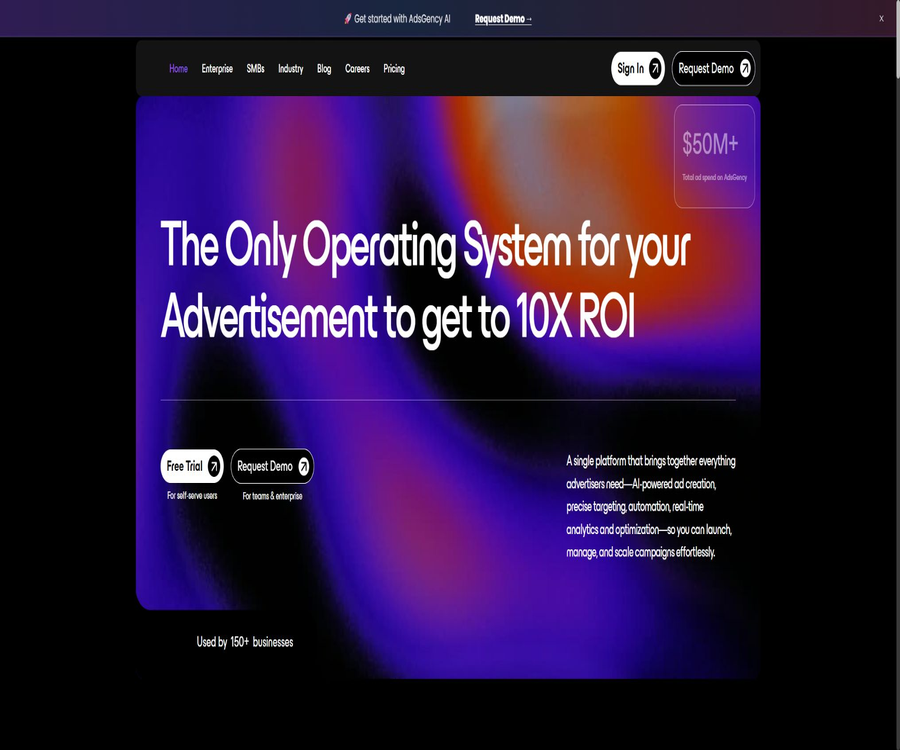
AdsGency AI
AdsGency AI: an intelligent tool focused on improving AI efficiency.
Tags:AI improves efficiencyWhat is AdsGency AI?
AdsGency AI is an intelligent advertising management platform designed for advertisers, marketing teams, and agencies. It aims to integrate strategy planning, content creation, account management, ad deployment, performance analysis, and continuous optimization into a workflow driven by AI.
The product positions itself as an advertising management system, rather than just a tool for creating text or images. Users can start by defining the company’s information and marketing goals, then use it to connect with various advertising platforms in order to carry out and analyze campaigns.
Main functions of AdsGency AI
- AI-based advertising planning: Determines the direction of campaigns based on the brand, website, products, target audience, budget, and objectives.
- Creative content generation: Assists in creating ad copy, headlines, images, and various test versions.
- Competitor ad research: Search for real ad examples and compile information on the creativity and market strategies of competitors.
- Material Collection Library: Save advertisements that are useful as references to serve as inspirational material that can be reused by the team.
- Project management: View generated or executed advertising campaigns in one place, with the ability to filter by platform.
- Ad account connection: Connect common search and social advertising platforms within the same process.
- Audience and customer profiles: Document the characteristics of the target audience, the market, and ideal customers.
- Automated deployment: It reduces the need to repeatedly configure and transfer assets across various platforms.
- Real-time analysis: Aggregates costs, conversions, and ad performance to help identify any abnormal changes.
- Budget optimization: Provides suggestions for budget adjustments and activity optimizations based on performance indicators.
- Creative testing: Generate variables in bulk and use the results to find more effective combinations.
- Advertising fraud monitoring: Monitor invalid traffic, risky expenditures, and budget savings that can be achieved.
Advertising planning feature
Users can first fill in information about the company, its website, target customers, and the objectives of the campaign, after which they can choose between SEO, social media, email, and other options. The system uses the brand context to complete the details of the campaign, providing suggestions regarding budget, channels, target audience, and creative strategies.
- Company brief: Documents the product, value proposition, brand tone, and business stage.
- Goal setting: Define objectives for brand visibility, customer acquisition, sales, or retargeting.
- Channel selection: Determine search, social, or other touchpoints based on the user journey.
- Budget forecasting: Estimate the allocation of resources for different deployment options prior to release.
- Customer profile: Describes the target industry, job position, interests, region, and behavioral characteristics.
- Intelligent completion: Generates draft fields for the event based on the already entered company information.
Creation of advertising materials and creative testing
- Generate titles, content, selling points, and call-to-actions based on marketing goals.
- Create multiple versions in different languages, with various tones and from different user perspectives for the same product.
- Conduct multivariate testing by combining different titles, visuals, formats, and action buttons.
- Use historical performance to provide a predictive score for new creative concepts.
- Monitor the decline in interaction to help teams identify potential creative fatigue.
- Feed the performance results back into the next round of creative presentations and material iterations.
- Maintain a human-centered creative approach to prevent all materials from becoming homogeneous.
Competitor ad research and AdSpy
- Search for competitor ads by brand, category, product, format, or status.
- Check the ad duration, page interactions, format of the content, and the message being conveyed.
- Save the excellent examples in the Swipe File material collection.
- Compare the creative structures of direct competitors with those of high-performing brands from other industries.
- Extract the opening hook, key selling points, evidence, and call to action.
- Use competitor research to formulate hypotheses, rather than directly copying existing works.
Project repository and team collaboration
- View projects from platforms such as Meta, Google, Pinterest, YouTube, etc., in one place.
- Filter by advertising platform, event type, workspace, favorites, and recent usage.
- Reopen previous projects to reuse brand assets, audience data, and previously created materials.
- Place strategy, creativity, execution, and post-mortem analysis within the same project context.
- Reduce the information scattered across different tools for agents or multi-brand teams.
- Enterprise collaboration, member permissions, and scope of services need to be determined based on the actual package selected.
Supported advertising platforms
| Platform or channel | It can be used for | Precautions before implementation |
|---|---|---|
| Meta | Planning of social media ads, along with the selection of materials and organization of related campaigns | Appropriate advertising account permissions are required. |
| Search and other Google ad campaigns | The conversion and account structure must be configured correctly first. | |
| TikTok | Short-video ads and audience campaigns | Material specifications and regional policies can change. |
| B2B audience and sponsored content | Suitable for defining job roles and company profiles. | |
| Visual discovery and product inspiration ads | The ratio of the components and the product information must be consistent. | |
| YouTube | Video advertising projects and creative management | Available videos and a landing page need to be prepared. |
| SEO and emails | Event planning and content direction | Not all external tools can be used for direct publishing. |
How to use cross-platform advertising
- Create brand materials by filling in information on products, the website, value proposition, and target market.
- Connect the ad accounts and data sources for which the team actually has permissions.
- Set clear goals for each channel, such as search conversions or lead generation through social media.
- Upload brand assets and create creative versions that meet the specifications of various platforms.
- Check the audience, budget, region, attribution, pixel, and landing page settings.
- First, release it with a controlled budget to observe data synchronization and the results of platform review.
- Adjust the budget based on actual conversions and incremental effects, rather than just focusing on the click-through rate.
Generate advertising campaigns from brand briefs
- Select a business goal and key conversion event that can be quantified.
- Enter the brand background, product features, price, evidence, and prohibited expressions.
- Describe the ideal customer, purchase barriers, use cases, and target regions.
- Let AI generate channel plans, content directions, and initial budget suggestions.
- The marketing manager reviews the facts, tone, compliance, and creative differences.
- Select a small number of versions for testing, and define in advance the conditions for stopping and scaling up.
- Save the test results in the project database to provide a basis for subsequent activities.
Advertising performance analysis and optimization
- It aggregates key metrics such as campaign costs, conversion rates, customer acquisition costs, and advertising returns.
- Use real-time changes to detect budget consumption, asset degradation, and conversion anomalies.
- Compare the differences in performance across channels, audiences, creativity, and time periods.
- Based on the objectives, suggestions are made regarding budget adjustments, suspensions, or increases.
- Use predictive analysis to assist in assessing future performance and risks.
- Set manual approval thresholds to prevent the system from amplifying erroneous activities automatically.
- At the same time, monitor profits, refunds, retention, and growth, rather than relying solely on platform attribution.
Advertising traffic fraud monitoring
AdsGency AI displays information on the integrity of display ads, estimates the associated risks and potential cost savings. Teams can further examine issues such as click fraud, regional anomalies, device-related problems, and risks related to advertising slots.
- Monitor invalid clicks, abnormal traffic, and suspicious conversion patterns.
- Check the risk distribution by country, device, ad slot, or campaign.
- Estimate the budget waste caused by fraudulent traffic.
- Formulate suggestions for interception, exclusion, or budget adjustments.
- Cross-check the platform’s assessments with the reports on invalid traffic from the advertising network.
- Significant anomalies require manual investigation; it is not possible to rely solely on a single risk score.
Which users are it suitable for
- Independent marketers: Use a unified process for planning, content creation, and basic optimization.
- Small and medium-sized enterprises: Reduce the need to switch between various advertising tools and enter data repeatedly.
- E-commerce brands: Quickly generate product ideas and continuously test the audience as well as the key selling points.
- B2B companies: Plan activities based on job positions, company profiles, and lead objectives.
- Advertising agencies: Provide centralized management of information related to multiple clients, platforms, and projects.
- Growth Team: Connects first-party data to optimize customer acquisition costs and advertising returns.
- Large enterprises: Evaluate more complex governance requirements through demonstrations and customized solutions.
Key industries and use cases
- E-commerce: Create product ads, manage multi-channel campaigns, and monitor conversions.
- Technology and SaaS: A funnel for trial usage, scheduled demos, and converting users into paying customers.
- Insurance and finance: Target specific customer segments while strengthening compliance and manual review.
- Marketing agents: Establish standardized processes for ad creation and review across multiple clients.
- Consumer brands: Identify new ways of communication through large-scale creative testing.
- Local services: Generate marketing strategies by taking into account the region and the customer’s intentions.
- Corporate growth: Unified advertising data, budget recommendations, and management reports.
First-party data applications
- Integrate website behavior, purchase history, email interactions, app usage, and customer relationship data.
- Similar audiences and dynamic segments are created based on the characteristics of high-value customers.
- Predict churn, potential value, and the likelihood of conversion for different users.
- Reflect user feedback in the audience targeting, bidding strategies, and personalized creatives.
- Define data authorization, usage, retention period, and deletion procedures.
- Set restrictions on sensitive attributes, discriminatory targeting, and the use of data without consent.
Prices and packages
AdsGency AI charges based on the number of campaign workflows per month, with additional fees applied for any extra activities. The subscription fee covers only the use of the platform; the actual costs associated with advertising in various media channels are still charged separately by each advertising network.
| Package | Monthly fee | Activities are included every month. | premium price | Suitable for |
|---|---|---|---|---|
| Starter | 99 dollars | 20 Campaigns | 5 dollars per piece | Independent marketers and small teams |
| Growth | 499 dollars | 120 campaigns | 4 dollars per piece | A company team that is in continuous growth |
| Pro | 1,999 dollars | 400 Campaigns | 3 dollars per piece | Large-scale advertising operations |
| Enterprise | Custom quote | Flexible usage | Determined in accordance with the contract | Enterprises that require SLAs, dedicated support, and bulk discounts |
What is the billing unit for Campaign?
A Campaign refers to a complete workflow carried out within AdsGency AI, and it may involve tasks such as AI-generated content creation, data collection, scoring, and optimization. One campaign can trigger multiple model executions; therefore, it is not equivalent to a single ad or a single click.
| Billing concepts | Meaning | Places that are easy to confuse |
|---|---|---|
| Campaign | Execution of a complete workflow | It may contain multiple AI steps. |
| Includes the number of activities | Number of workflows available per month for the package | It’s not the limit on activities within advertising platforms. |
| Excessive activity | Charges applied per use once the monthly limit is exceeded | The price per package varies depending on the option chosen. |
| Additional activity pack | Temporary increase in the purchasable quota for usage | It isn’t necessarily necessary to upgrade the package. |
| Media spending | The budget allocated to advertising networks such as Meta and Google | Not included in the platform subscription fee |
| Taxes and fees | Additional fees may be charged at the time of settlement. | The public price is stated in US dollars. |
How to choose a package
| Monthly demand | Recommended package | Reason for selection |
|---|---|---|
| No more than 20 complete workflows | Starter | The base cost is the lowest, and it can be expanded on a per-use basis. |
| Nearly 120 workflows exist, and advanced optimization is required. | Growth | The average cost per transaction is lower. |
| Persistently above 120 and close to 400 | Pro | More suitable for large-scale operations and priority processing. |
| The amount used varies significantly. | Current package plus promotional bundle | Avoid performing long-term upgrades for short-term peaks. |
| Multiple teams, SLAs, or complex permissions | Enterprise | Custom governance and service contracts are required. |
Subscription, upgrade, and refund policies
- The price of the package is expressed in US dollars, and taxes such as sales tax may not be included at the time of settlement.
- Charges are applied at the corresponding excess rate once the package limit is exceeded.
- Additional Campaign packages can be purchased to address seasonal or short-term spikes in activity.
- An upgrade can take effect immediately, while a downgrade is usually scheduled to occur after the current billing cycle ends.
- Canceling the subscription will stop further charges, but the benefits generally remain valid until the end of the paid period.
- The terms of service state that payments are generally non-refundable.
- Payment failure may result in the loss of access to premium services.
- Before making a purchase, a company should verify the invoice, tax details, usage notifications, and the methods for controlling excess usage.
Example of cost estimation
| Assume monthly usage | Optional methods | Estimated monthly platform fee | Explanation |
|---|---|---|---|
| 15 Campaigns | Starter | 99 dollars | The number of items within the limit is 20 or less. |
| 30 Campaigns | 10 extra units on top of the starter amount | 149 dollars | Calculate based on an excess of $5 per item. |
| 100 Campaigns | Growth | 499 dollars | Within the limit in 120 cases |
| 150 Campaigns | Growth plus 30 units of excess. | 619 dollars | Calculate based on $4 per excess amount. |
| 350 campaigns | Pro | 1,999 dollars | Within the 400 items that are included in the quota |
The figures above take into account only the subscription fees and any additional charges associated with the AdsGency platform; they do not include costs related to advertising network budgets, taxes, material creation, data tools, or internal staff expenses. The actual bill may also be affected by campaign packages or corporate contracts.
Steps to be taken before going live
- Statistically track the monthly activity volume, advertising platforms, media budget, and manual operation time.
- Select a brand and a channel to conduct a small-scale pilot test.
- Organize brand materials, first-party data, conversion events, and asset permissions.
- Connect to the test account and verify the read, write, and publish permissions.
- A draft of the campaign is created, which is then reviewed jointly by the marketers, the brand representatives, and the legal team.
- Operate with a limited budget to verify data feedback, attribution, and automated actions.
- Compare the time, cost, and business benefits of the manual baseline approach with the platform-based solution.
- Expand after establishing systems for approval, budget limits, abnormal shutdowns, and key rotation.
Key evaluation indicators
| Indicators | Used for judgment | Precautions |
|---|---|---|
| Customer acquisition cost | Does automation reduce the cost of acquiring new customers? | The conversion criteria should be standardized. |
| Advertising returns | Revenue generated by media investment | Pay attention to refunds and profit margins. |
| Time for creative output | Efficiency in material creation and deployment | Speed does not equate to high quality. |
| Proportion of winning materials | The effectiveness of batch creative testing | A statistical sample must be available. |
| Proportion of invalid traffic | Fraud monitoring and budget protection | It should be cross-verified with platform reports. |
| Manual modification rate | The distance of the AI draft from being ready for use | Recording the reasons for modifications is more valuable. |
| Incremental conversion | The genuine additional benefits brought about by the system | Prioritize the use of controlled experiments. |
Product advantages
- A complete advertising workflow that covers strategies, assets, deployment, analysis, and optimization.
- Reduce repetitive tasks across multiple advertising platforms and creative tools.
- AI planning can transform fragmented brand information into structured activity plans.
- It supports common search, social, and video advertising channels.
- Competitor research and the collection of materials help to continuously build creative knowledge.
- Batch generation and multi-variable testing can accelerate the pace of creative iteration.
- The project repository facilitates the reuse of past activities and team retrospectives.
- Budget and performance analysis help identify inefficient expenditures.
- The ad fraud module provides an additional perspective on traffic quality.
- The package limits, excess pricing, and activity definitions are relatively clear.
Usage restrictions and precautions
- AI recommendations cannot guarantee the achievement of the returns or growth targets stated on the official website.
- The effectiveness of advertising is still influenced by the product, price, market conditions, marketing materials, target audience, and the landing page.
- Automatic release or adjustment of budgets requires strict permissions and budget limits.
- The interfaces, policies, and review rules of different platforms can change.
- Platform attribution may overestimate the actual impact; it should be combined with incremental experiments and business revenue.
- First-party data must be authorized legally and comply with privacy requirements.
- The materials generated may contain factual errors, brand inaccuracies, or intellectual property risks.
- Campaigns are billed based on the workflow, and frequent creation and testing will increase usage.
- The subscription does not include an actual media budget; the total cost must be estimated separately.
- Payments are usually non-refundable; it is necessary to conduct a trial and review the contract before making a purchase.
- The ad fraud score is a risk indicator and cannot replace manual investigation.
- Enterprise-level permissions, data residency, and SLAs need to be determined through customized solutions.
Advice on data privacy and compliance
- Only connect the ad accounts and data fields required to complete the pilot.
- Set minimum permissions for different team members and review them regularly.
- Before uploading customer data, confirm consent, purpose, location, and retention period.
- It is prohibited to use sensitive attributes for discriminatory purposes or for targeting in ways that are not permitted by law.
- When publishing AI-generated ads, comply with the platform’s rules regarding synthetic content and political ads.
- Save logs of automated operations to ensure that budgeting and release decisions can be traced.
- Establish a shutdown response process for account anomalies, incorrect volume allocations, and data breaches.
GitHub and the open-source status
During this verification, no official GitHub repository maintained by AdsGency AI and intended for making the source code of its core platform available to the public was found. Web applications, advertising automation tools, models, connectors, and analysis services should be regarded as commercial, closed-source software.
| Components | Status | Explanation |
|---|---|---|
| AdsGency AI web platform | Commercial closed-source | The source code of the core applications is not made public. |
| Advertising platform connector | Business services | Connection capability does not imply open-source code. |
| AI models and optimization logic | Not disclosed | It cannot be replicated solely based on the marketing page. |
| Official GitHub repository | Not verified. | Projects with the same name developed by third parties cannot be considered official. |
| Self-hosted version | No standard public solution was found. | Enterprise requirements should be inquired about separately regarding deployment conditions. |
Basic information
| field | Content |
|---|---|
| Tool name | AdsGency AI |
| Founder | Bolbi Liu |
| Tool type | Platform for intelligent ad management, creative development, and cross-platform delivery |
| Primary users | Advertisers, growth teams, agencies, and corporate marketing departments |
| Key capabilities | Planning, generation, research, deployment, analysis, optimization, and anti-fraud |
| Usage method | Via the web interface, users can register autonomously or schedule a demonstration. |
| Billing method | Monthly subscriptions, Campaign quotas, and overage pricing |
| Is an account required? | Yes |
| Is it open source? | No, no official core source code repository was found. |
| Currency of price | The dollar amount; taxes and fees may apply separately. |
Recommendation score
4.3 / 5. The advantage of AdsGency AI is that it covers the entire advertising operation process, linking together competitor analysis, creative testing, cross-platform management, and fraud detection; however, the team still needs to verify the actual incremental benefits, the stability of platform connections, and the cost associated with campaign usage.
Frequently Asked Questions
What is AdsGency AI mainly used for?
It helps advertising teams plan campaigns, generate creative ideas, study competitors, link advertising accounts, launch campaigns, analyze their performance, and continuously optimize them.
What is the difference between AdsGency AI and ordinary ad generators?
While ordinary generators focus mainly on text or images, AdsGency AI places greater emphasis on the entire operational workflow, from strategy to deployment, analysis, and optimization.
Which advertising platforms are supported?
The official website lists platforms such as Meta, Google, TikTok, LinkedIn, Pinterest, and YouTube; the actual access rights need to be verified within the account.
How much is the Starter package?
The Starter plan costs $99 per month and includes 20 campaigns; any additional campaigns are charged at $5 each.
Who is the Growth package suitable for?
Growth costs $499 per month and includes 120 campaigns as well as advanced optimization options; it is suitable for growth teams that have a consistent volume of campaigns to manage.
Is a Campaign a single ad?
No. A campaign represents the execution of a complete workflow, which may include various steps such as generation, data retrieval, scoring, and optimization.
Does the subscription fee include an advertising budget?
Not included. The actual media costs for advertising networks such as Meta and Google are charged separately by each platform.
What to do if the monthly limit is exceeded?
The system charges at the excess unit price of the current package; it is also possible to purchase additional campaign packages or upgrade the package.
Can AdsGency AI automatically optimize ads?
The platform offers real-time analysis, budget recommendations, and automated workflows, but companies should establish rules for manual approval, budget limits, and handling of abnormal shutdowns.
Is AdsGency AI open source?
No. No official core source code repository was found during this verification; the product should be regarded as a commercial, closed-source platform.
Tools similar to AdsGency AI



 Guigong Network Security Registration No. 45132202000164