






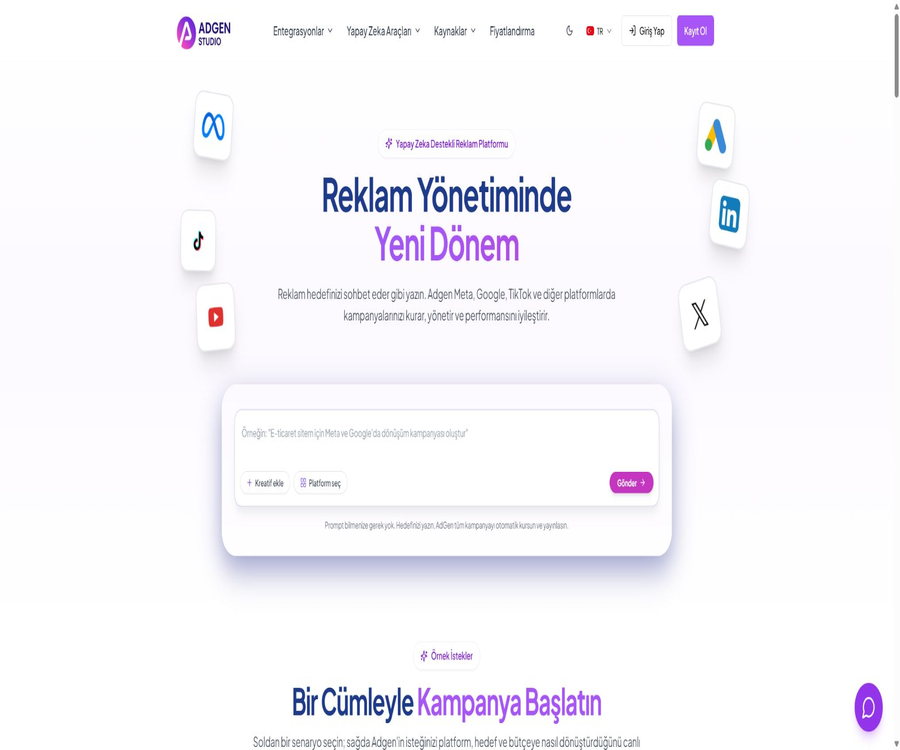
Adgen Studio
Adgen Studio, an intelligent tool focused on improving AI efficiency.
Tags:AI improves efficiencyWhat is Adgen Studio?
Adgen Studio is an AI-based advertising management platform designed for businesses, advertisers, and agencies; it serves the digital marketing needs in Turkey as well as on an international scale. Users can describe their campaign objectives in natural language, and the system helps them with creating advertisements, selecting target audiences, allocating budgets, analyzing promotional materials, and carrying out ongoing optimizations.
The platform emphasizes managing Meta, Google, and TikTok ads through a unified dashboard, while also displaying channels such as LinkedIn, X, and YouTube on the official website. The specific integrations available, ad types, and automation options depend on the settings in the account dashboard after registration.
Main functions
- Natural language activity creation: Describe the sales, traffic, or customer acquisition goals in one sentence.
- Multi-platform ad management: View and manage different media accounts from a single workspace.
- AI ad copy: Generates headlines and copy based on products, target audience, and channels.
- Image generation: Create and edit ad visuals from textual descriptions.
- Video creation and editing: Producing short videos, as well as performing tasks such as cropping, adding subtitles, and applying effects.
- Smart audience: Helps in selecting location, demographic characteristics, interests, and similar audiences.
- Budget optimization: Adjust the budgets for channels, campaigns, or ad groups based on the performance of the ads.
- Performance analysis: Aggregates metrics such as CTR, conversion rate, CPA, and ROAS.
- A/B testing: Compare different audiences, content, or budgeting strategies.
- Automated optimization: Identifies inefficient ads and suggests pausing or making adjustments to them.
Natural Language Advertising Assistant
Adgen Studio designs advertising tasks as dialogue-based processes, so users do not need to master complex instructions. The system can break down goals such as “creating Meta and Google conversion campaigns for e-commerce stores” into elements related to the platform, objectives, budget, target audience, and marketing materials.
- Set sales, traffic, engagement, or lead generation goals based on natural language recognition.
- Select the target platform and generate suggestions for the event structure.
- Allocate the daily budget or total budget to different channels.
- Generate ad copy, creative directions, and audience suggestions.
- Answer questions related to account performance and inefficient ads.
- Convert complex operations into steps that require user confirmation.
- Summarize the weekly advertising performance in the form of entries.
Platform support and integration
| Platform | Capabilities displayed on the official website | It needs to be confirmed before connecting. |
|---|---|---|
| Meta | Creation, management, and optimization of assets and presentation | Business management platform, pages, pixels, and account permissions |
| Google Ads | Search or conversion campaigns and unified analysis | Customer ID, conversion action, and specific ad type |
| TikTok | Ad creation, video asset, and effect management | Region of the advertising account and scope of interface availability |
| List of multiple platforms on the official website and scenarios for acquiring customers | Is native creation and writing supported at the moment? | |
| X | The official website shows it as a supported channel. | Actual management functions and account permissions |
| YouTube | Video ads and multi-platform analysis scenarios | It usually relies on a Google Ads account and video assets. |
Creation of AI-driven advertising campaigns
- Choose a goal based on brand awareness, interaction, traffic, sales, or leads.
- Set the country, city, age, interests, and other audience criteria.
- Enter the daily budget or the total budget for the event.
- You can upload pictures or videos, or use AI-generated content.
- Let the system generate the ad text, title, and action button.
- Preview the event structure and make manual adjustments before publishing.
- Create an ad draft or campaign after connecting the correct media account.
Smart Audiences and Retargeting
- Recommend a target audience based on the product and campaign objectives.
- Narrow down the range using location, age, gender, and interests.
- Create custom audiences from existing customers or website visitors.
- Create similar audiences based on high-value users.
- Retarget users who have visited, added items to their cart, or failed to complete a conversion.
- Avoid excessive segmentation of the audience, which can lead to a shortage of learning data.
- Conduct additional checks on restrictions for audiences in sensitive industries.
Analysis of advertising copy and materials
The platform can create ad copy, as well as score the materials that have been uploaded and provide suggestions regarding text, images, and opening phrases. These scores are useful for sorting and identifying issues, but they cannot replace actual media testing.
- Generate titles and text in accordance with the character limits for each channel.
- Different perspectives are presented regarding pain points, interests, discounts, and social proof.
- Check whether the hook on the first screen is clear and appropriate for the target audience.
- Analyze the consistency of images, videos, and action buttons.
- Generate new hooks for videos with better performance.
- Create multiple versions of the materials for structured testing.
- Before publication, facts and the brand’s tone are manually verified.
AI image generation
- Describe the ad visuals in natural language.
- Create a preliminary visual draft suitable for the brand or product.
- Adjust colors, composition, text, and brand style.
- Save the generated image in the asset library for reuse.
- It supports advanced features such as batch generation and high resolution.
- Check the characters, trademarks, text, and product details before publishing.
- Confirm the commercial usage terms for the generated services and materials.
AI video generation and editing
- Describe the product videos and the pacing of the shots in words.
- Generate ad video clips or preliminary versions of the video.
- Crop, merge, and adjust colors, speed, and effects.
- Add text, audio, and auto-subtitles.
- Use templates to maintain consistency in the layout of common ads.
- Adjust the proportions for short videos and other content sections.
- Save the entire segment to the video library and edit it again.
Budget management and automatic optimization
The system identifies inefficient campaigns based on their performance in advertising, and can allocate more budget to those campaigns that perform better. Automatic suspension and budget adjustments have a direct impact on media spending; therefore, it is necessary to establish limits, approval processes, and mechanisms for handling exceptions.
- View in real time the amount already spent, the remaining budget, and the allocation across channels.
- Ad groups with high consumption but no conversions were identified.
- Reduce budgets for inefficient ads or suggest suspending them.
- Increase the budget for winning campaigns within the target range.
- Prevent a single channel from exhausting the entire budget too early.
- Adjustments are made based on CPA, ROAS, or conversion goals.
- Set security limits for daily increases and individual changes.
A/B testing
- Compare the two audiences while keeping the materials and budget unchanged.
- Compare images, videos, titles, or opening hooks.
- Use a budget that is close to the same within the same period.
- Avoid changing too many variables at once.
- Define the success criteria and minimum sample size in advance.
- Take attribution delay and the media learning stage into account.
- Transform the results into guidelines for the next round of creativity and targeting.
Analysis and ROAS Insights
| Indicators | Primary uses | Precautions |
|---|---|---|
| CTR | Assessing the ability of an ad to receive clicks | A high number of clicks does not indicate high-quality conversions. |
| CPC | Measuring the cost of acquiring one click | Affected by bidding, audience, and placement. |
| CPA | Measure the cost of converting a target once | It is necessary to verify whether the conversion event was successful. |
| ROAS | Compare advertising revenue with advertising expenses | It does not include all goods and operating costs. |
| Conversion rate | Observe the degree of alignment between the landing page and traffic. | The attribution window affects the results. |
| Frequency | Identifying repeated exposure to the audience and material fatigue | The definitions may vary across different channels. |
Appropriate use cases
- The Turkish e-commerce brand provides unified management for Meta, Google, and TikTok ads.
- Local businesses attract customers in their vicinity through geographic targeting.
- SaaS companies carry out registration or lead-generation campaigns.
- Small teams can quickly create a preliminary draft of an ad using natural language.
- The agent manages multiple client activities through a single panel.
- The creative team creates test versions of images, videos, and copy.
- The marketing manager aggregates CPA and ROAS values across various platforms.
- Mature accounts reduce repetitive optimization tasks through rules and AI.
Which scenarios are not suitable?
- Projects that lack media accounts, pixels, or conversion tracking capabilities.
- Users who only need to post natural social content without displaying ads.
- Companies that require the full product to be open source and deployed locally.
- Teams that require a full Chinese interface and local Chinese support.
- Accounts that have automatic budgeting and suspension features cannot have manual oversight set up for them.
- Small businesses with low advertising spending and for whom it is not possible to determine the return on platform costs.
- Industries that are subject to strict regulation but lack a compliance approval process.
Adgen Studio Setup Guide
- Register an account and create a workspace corresponding to the brand.
- Select the advertising platforms you want to manage and the appropriate business account.
- Connect media accounts through the official authorization process; the master password is not shared.
- Check the page, pixels, conversion actions, time zone, and currency.
- Import existing activities and check whether the data is complete.
- First, use the analysis and recommendation features; full write permissions will not be granted immediately.
- Set safeguards and approvers for budgeting, suspension, and expansion.
- Select a small number of activities for a trial run, and then gradually expand the scope.
Tutorial on Creating Activities with Natural Language
- Specify the product, market, target platform, and purpose of the campaign.
- Add the daily or total budget, as well as the start and end dates.
- Specify the audience’s region, language, and any necessary exclusions.
- Upload authorized image or video materials.
- Check the goals, structure, copy, and target audience generated by the system.
- Modify inaccurate prices, selling points, and performance claims.
- Save it as a draft first and complete the preview on the media platform.
- Launch with a small budget, and increase spending once tracking is confirmed to be working properly.
Tutorial for automatic optimization deployment
- Identify key objectives such as CPA, ROAS, and the quality of sales or leads.
- Check the historical data for at least one complete attribution cycle.
- Exclude the impact of new products, promotions, and inventory anomalies on the baseline.
- Limit the increase in the daily budget and the scope of individual changes.
- Large adjustments, suspensions, and new activities require manual approval.
- First, run the system in the recommended mode and record the adoption rate.
- Periodically conduct random checks on the reasons for suspending or expanding advertisements.
- Discontinue automation immediately in the event of abnormal costs, data interruptions, or tracking failures.
Prices and billing methods
During this verification, Adgen Studio’s official website did not list any specific package names, monthly fees, or annual prices that could be confirmed. Users can register or get in touch with the platform to learn more about trial and commercial options; advertising budget costs are usually charged separately by platforms such as Meta, Google, and TikTok.
| Cost items | Public status | Explanation |
|---|---|---|
| Register for the platform or try it out | Accounts can be created; the specific scope of free services is not disclosed. | Confirm whether a payment method is required before registering. |
| Platform subscription fee | Fixed price not disclosed | It may be determined based on the account, features, or level of usage. |
| Advertising media costs | Paid separately | Consumed by various advertising platforms based on impressions, clicks, or conversions |
| AI images and videos | Unrevealed limit | The number of generations, resolution, and storage can affect the solution. |
| Multi-account or agent functionality | Quotation required | The customer workspace, seats, and white-labeling capabilities need to be verified. |
| Interfaces and custom integration | Quotation required | The tool page on the official website mentions the directions for interface integration. |
It is necessary to confirm before making a purchase.
- Monthly fees, annual fees, taxes, and whether charging is based on a percentage of advertising expenses.
- Free trial duration, feature limitations, and whether auto-renewal is available.
- Each plan includes the ad accounts, workspaces, and team seats it provides.
- The specific writing capabilities of Meta, Google, TikTok, and other platforms.
- Quotas for AI images, videos, storage, and batch processing.
- Automatically optimized frequency, guardrails, and liability for mistakes.
- Processes for data retention, export, deletion, and contract termination.
- Currencies, languages, support, and tax arrangements for markets outside Turkey.
Free tools and resources
The official website offers free tools such as a character counter for Meta ads, and it also publishes guidelines for creating ads in Turkish and English. The character limits vary depending on the media format; these free tools are useful for quick checks, but they should not replace the final preview provided by the ad management platform.
- Check the length of the main text, titles, and descriptions on Meta.
- Learn the basics of advertising on Meta, Google, and TikTok.
- Learn about automation, funneling, and creative testing methods.
- Use industry articles to create an activity checklist.
- Return to the media backend before official release to check the latest restrictions.
Permissions and data security
- Through authorized connections via advertising platforms, account passwords are not sent to third parties.
- Only the minimum permissions necessary for analysis, creation, or management are granted.
- Assign separate roles to different customers and team members.
- Regularly check third-party applications, tokens, and access rights for employees who have left the company.
- Logs are kept for budgeting, suspension, and expansion operations.
- Clarify the data processing workflow for media, Adgen Studio, and generative models.
- Revoke the authorization and export the necessary records upon the end of the contract.
How to interpret the performance figures on the official website?
The demo page on the official website shows figures such as increased ROAS, reduced costs, as well as the number of campaigns and the time required for their setup; however, it does not provide complete examples, control groups, or the calculation methods in one place. This information should be regarded as part of the product demonstration or marketing materials, rather than a guarantee for each individual account.
- Suppliers are required to specify the industry sector, time frame, and range of advertising expenses for the samples.
- Distinguish between the effects of platform optimization and those caused by seasonality, promotions, and brand growth.
- Use your own historical data to establish a baseline before testing.
- Retain the control activities or regions for platforms that are not in use.
- At the same time, compare profit, conversion quality, and operation time.
- Do not enter into long-term contracts based solely on the ROAS metric.
Product advantages
- Advertising tasks can be described in natural language, thereby reducing the barrier to using them.
- Ad creation, assets, audience, budget, and analysis form a complete process.
- Emphasize unified management of Meta, Google, and TikTok.
- It also offers tools for image generation, video creation, and video editing.
- It supports switching between AI automation and manual control.
- A/B testing and ROAS insights are suitable for continuous optimization.
- It is friendly toward the Turkish market and Turkish-language advertising content.
- Free character tools and advertising learning resources are provided.
Usage restrictions and precautions
- The official website does not disclose a fixed price, making it difficult to calculate the total cost of ownership directly.
- Promotion across multiple platforms does not mean that all channels have exactly the same level of functionality.
- AI may generate incorrect selling points, unlawful promises, or inappropriate targets.
- Automatic budgeting and suspension features have a direct impact on the actual amount spent on advertising.
- The performance figures shown on the official website lack a complete and publicly verifiable method.
- The product interface and main content are primarily in Turkish.
- Generating images and videos still requires approval with regard to copyrights, trademarks, and characters.
- Changes in media interfaces, policies, and attribution methods can affect the results on the platform.
- Key advertising campaigns require manual approval and fallback in case of abnormalities.
GitHub and the open-source status
This search did not yield any GitHub repositories that are officially affiliated with Adgen Studio and that provide the complete source code for an advertising management platform. The AdGen poster generator, video-related projects, and advertising SDKs that were found belong to other teams, and therefore cannot be considered as part of the code for this product.
| Project | Status | Explanation |
|---|---|---|
| Adgen Studio platform | Closed-source online services | The source code for ad connections, AI tools, and optimization capabilities is not available. |
| Official GitHub repository | Not confirmed | No public repository corresponding to the official website was found. |
| Interface integration | Functional directions of the official website | The available range, documents, and prices need to be confirmed with the platform. |
| Third-party AdGen repository | Irrelevant | The same name does not imply official authorization or the source of the code. |
| Self-hosted version | No findings were detected. | Private deployment and data residency must be confirmed prior to purchase. |
Basic information
| field | Content |
|---|---|
| Tool name | Adgen Studio |
| Main markets | Users of digital advertising in Turkey and on multiple platforms |
| Tool type | Platform for creating, managing AI advertisements, as well as generating and optimizing ad materials |
| Key channels | Meta, Google Ads, and TikTok |
| Official website expansion channels | LinkedIn, X, and YouTube |
| Primary language | Turkish; the official website provides an English version. |
| Price pattern | The fixed price is not available publicly; registration or a quote is required. |
| Are free tools available? | Yes, it includes a character counter for Meta ad copy. |
| Is it open source? | No |
Recommendation score
4.1 / 5. Adgen Studio combines a natural language advertising assistant, multi-platform management, asset generation, and automatic optimization in a fairly comprehensive way, making it suitable for small and medium-sized enterprises as well as advertising teams in the Turkish market; however, the price, the level of integration in some aspects, and the performance data still need to be verified using actual accounts.
Frequently Asked Questions
What does Adgen Studio do mainly?
It helps users create and manage ads using natural language, and offers capabilities for targeting, budgeting, asset management, A/B testing, and performance optimization.
Which advertising platforms are supported?
Priority support is provided for Meta, Google Ads, and TikTok; the official website also lists LinkedIn, X, and YouTube. The specific features available depend on the account settings.
Is it necessary to understand prompt words?
No complex prompts are required – users can simply describe the goals of the campaign; however, it is still necessary to understand budgeting, the target audience, conversion rates, and advertising compliance.
Can ads be controlled manually?
Yes. The official website states that it is possible to switch between AI-driven control and manual control, and users can still manage budgets, audiences, copy, and creative elements.
Can it generate images and videos?
Yes, the official website provides separate pages for AI-powered image and video generation as well as video editing; it also shows a material library and options for batch processing.
How much is Adgen Studio?
The official website does not currently disclose fixed prices for packages; it is necessary to register or contact the platform to determine the subscription options, quotas, and agency plans.
Is the advertising budget included in the platform fees?
It is usually not included; media advertising costs are covered by platforms such as Meta, Google, or TikTok. It is necessary to check whether there are any additional service fees before making a purchase.
Is it suitable for Chinese users?
It is possible to study its multi-platform approach, but the product is primarily aimed at the Turkish market; therefore it is necessary to verify the availability of a Chinese interface, payment options, support services, and the relevant media channels.
Is the increase in ROAS shown on the official website reliable?
These figures lack complete publicly available samples and calculation methods; they should be regarded as marketing materials, and one should verify them by conducting tests using their own account.
Is Adgen Studio open source?
It is not an open-source product, and no complete official source code repository was found this time.
Tools similar to Adgen Studio


 Guigong Network Security Registration No. 45132202000164