






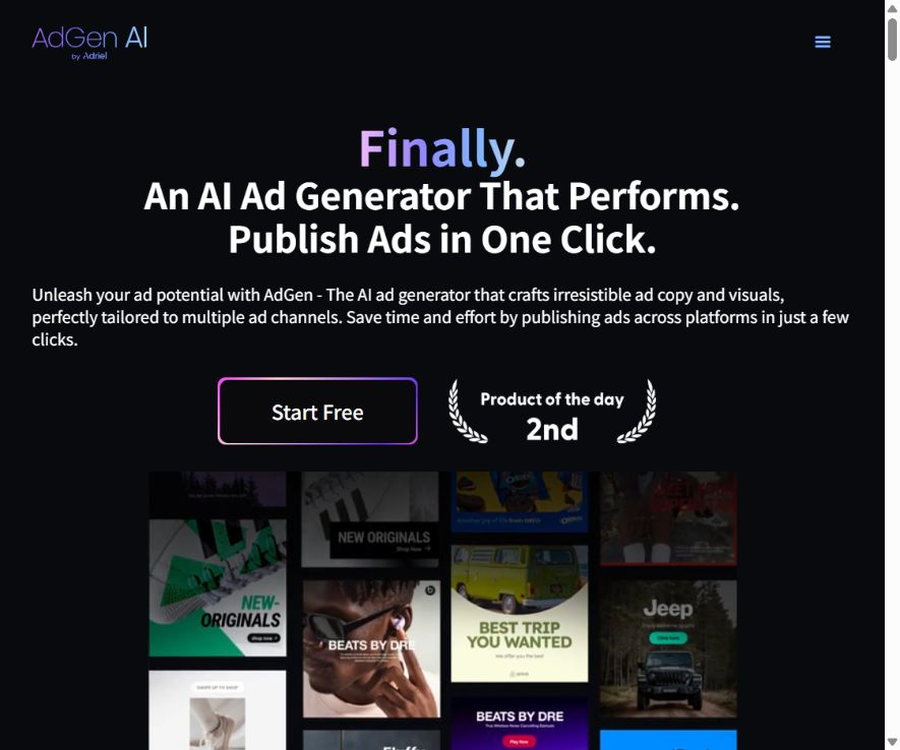
AdGen AI
AdGen AI: an intelligent tool focused on improving the efficiency of AI.
Tags:AI improves efficiencyWhat is AdGen AI?
AdGen AI is a programmatic creative platform developed by the advertising technology company Adriel; it can extract brand information from product or service pages and generate multiple sets of ad copy and images. It is intended for marketers, advertising agencies, e-commerce brands, and companies that need to test materials on a large scale.
Unlike chat tools that only output copy, AdGen AI integrates brand analysis, copy generation, image compilation, platform-size adaptation, and ad publishing into a single process. Users should still verify facts, check the licensing of materials, adhere to brand guidelines, and comply with the policies of the advertising platforms before publishing.
Main functions
- Page analysis: Reads the title, images, key features, and brand information on product or service pages.
- Ad copy creation: Generate various combinations such as titles, body text, descriptions, and action buttons.
- Image ad creation: Combines product elements, backgrounds, layouts, and text to form a banner.
- Brand style extraction: Determine the tone, colors, and visual direction based on the content of the page.
- Multi-size adaptation: Specifications are generated in accordance with the requirements of different advertising platforms.
- Batch variations: Generate a large number of testable creative combinations for the same product.
- Material editing: Allows users to modify the text and visual elements suggested by the system.
- One-click publishing: Pushes the approved ads to the connected advertising account.
- A/B testing: Conduct comparative tests using multiple variations of content.
- UTM management: Generates and reuses tracking parameters for advertising links.
Generate ads from website pages
Once the user enters the URL of a product that is accessible, the system extracts the product name, its value proposition, images, and brand identity, and then creates advertisements suitable for publication. The more accurate the information on the page and the clearer its structure, the easier it is to review the resulting advertisements.
- Identify brand names, product types, and key selling points on web pages.
- Extract product images and visual elements that can be used in advertising.
- Generate titles and texts of varying lengths based on the target platform.
- Automatically combines copy, images, backgrounds, fonts, and action buttons.
- Multiple marketing perspectives can be presented at once, facilitating creative testing.
- Marketers are allowed to edit again before publishing.
Supported advertising channels
The official feature page lists platforms such as Meta, Google, LinkedIn, and TikTok, emphasizing that it can automatically adjust to the format of each platform. Some older version of the help materials only mention Google and Meta, indicating that the capabilities for these platforms were introduced in stages; the actual permissions depend on those specified in the account dashboard.
| Channels | Content that can be generated | Notes for publication |
|---|---|---|
| Meta | Advertising copy and images for Facebook and Instagram | A marketing account with the appropriate permissions is required for connection. |
| Advertising content such as searches and displays | Keywords, dimensions, and policies vary depending on the type of ad. | |
| Ad variants targeted at professional and corporate audiences | It is necessary to check the page, account, and audience permissions. | |
| TikTok | Copy and creativity suitable for short-form content contexts | The actual supported formats should be confirmed in the background. |
| Other display channels | Banner materials can be exported. | It does not necessarily support one-click publishing in its native format. |
Advertising copy creation
- Different perspectives are developed around product features, benefits, pain points, and promotions.
- Adjust the length of titles and descriptions according to the platform’s character limits.
- Offers a variety of tones, styles, and action buttons.
- Convert the information on the brand page into advertising copy.
- Multiple versions are generated for users to filter and combine.
- It allows for the modification of the text; there is no requirement to use the AI’s suggestions directly.
- Create variants for different audiences and campaign objectives.
Image and banner generation
- Use product images from web pages to create ad visuals.
- Adjust the canvas ratio automatically based on different layout positions.
- Combine background, font, layout, buttons, and marketing copy.
- Generate multiple image variants for testing.
- Reduce manual size adjustments and repetitive formatting tasks.
- It allows for the replacement of materials or the modification of the generated results.
- Maintain a relatively consistent visual direction for brand campaigns.
Multilingual ads
The official list of frequently asked questions specifies six languages in which content can be generated: English, Korean, French, German, Spanish, and Chinese. Multilingual generation can improve the efficiency of localization, but brands still need to have their content reviewed by native speakers, especially with regard to cultural context, prices, units, and legal statements.
| Language skills | Suitable uses | Manual inspection is required. |
|---|---|---|
| English | Advertising in the global or English-speaking markets | Brand tone and regional terminology |
| Chinese | Initial draft for the Chinese market creative concept | Simplified and traditional characters, sensitive words, and natural expression |
| Korean | Materials for the Korean market | Polite language, culture, and product names |
| French | France and French-speaking markets | Country differences and legal statements |
| German | Germany and German-speaking markets | Compound words, grammar, and level of formality |
| Spanish | Spanish and Latin American markets | Regional vocabulary and currency expressions |
Batch creativity and A/B testing
AdGen AI is capable of generating multiple sets of titles, images, and layouts for the same page, thereby accelerating the testing process. Effective testing requires controlling a small number of variables at a time; otherwise, it becomes difficult to determine whether the differences are caused by the text, visuals, target audience, or bidding amounts.
- First, establish a set of existing materials as a control group.
- Test the selling points, the visual design of the home screen, and the action buttons separately.
- Keep the audience, budget, and attribution window as consistent as possible.
- Generate clear names and UTM parameters for each variant.
- After a sufficient sample size is reached, the materials are either eliminated or expanded.
- Feed the results back into the next round of creativity, rather than focusing only on click-through rates.
Advertising account connection and publishing
- Connect the advertising account using the media platform authorization process.
- Only the permissions necessary for creating and managing ads are granted.
- Select the correct business, ad account, page, and pixel.
- Confirm the budget, date, location, and audience before publishing.
- Check the asset dimensions, landing page, UTM parameters, and tracking events.
- First, test the release results with a draft or a low-budget campaign.
- Regularly revoke third-party permissions that are no longer in use.
UTM and performance tracking
The platform can generate UTM parameters for complex campaigns and allows the reuse of common names. UTM parameters only help in identifying the source of traffic; the final assessment still requires consideration of media attribution, website analysis, and actual order data.
- Standardize the naming of sources, media, events, content, and keywords.
- Maintain separate content parameters for each creative variant.
- Avoid including personal identification or sensitive information in the parameters.
- Test whether the parameters are retained intact after the jump.
- Compare the data from advertising platforms with the website conversion data.
- Log attribution windows and cross-device differences.
Appropriate use cases
- E-commerce brands quickly create multiple sets of image ads for new products.
- Small businesses create basic marketing materials from their existing website.
- Advertising agencies create preliminary drafts of creative concepts for multiple clients simultaneously.
- The growth team is increasing the number of copy and visuals for A/B testing.
- The cross-border team generates localized drafts in six languages.
- Marketers maintain brand consistency across multiple advertising platforms.
- Companies combine creative idea generation with Adriel’s data analysis processes.
Which scenarios are not suitable?
- Projects that have no available website pages or brand materials.
- Teams that require complex film and television shooting as well as high-end brand campaigns.
- Industries that require AI to take automatic responsibility for ensuring compliance with advertising regulations.
- Users who only need a schedule for organic content on social media.
- Companies that require a fully open-source platform to be deployed on their own.
- Teams that do not wish to connect to advertising accounts and must publish content in a native format.
- Purchases that are currently operating stably on a commercial basis but for which trial verification cannot be carried out need to be confirmed.
AdGen AI Usage Guide
- Select product pages that have complete information, clear images, and are publicly accessible.
- Enter the page and verify the brands, products, and selling points extracted by the system.
- Select the advertising channels, campaign objectives, and target language.
- Generate multiple sets of copy, images, and size combinations.
- Remove versions that contain factual errors, repeated statements, or are not in line with the brand’s image.
- Manually check prices, terms, copyright, and advertising policies.
- Connect to the correct ad account and save it as a draft first.
- After testing with a small budget, iterate further based on the conversion data.
Tutorial on preparing high-quality pages
- On the initial page of the site, the brand, products, and target audience are clearly displayed.
- Use high-resolution product images that come with commercial licensing.
- Indicate the true functions, specifications, price, and applicable conditions.
- Place the key selling points and evidence in easily accessible locations.
- Remove expired promotions, placeholder text, and conflicting information.
- Add information on privacy, refunds, delivery, and necessary legal notes.
- After generation, verify each piece of information extracted by the system.
Tutorial on checking advertisement postings
- Verify that the advertising account, page, payment method, and pixel are all correct.
- Check the campaign objectives, conversion events, and attribution window.
- Check the budget, schedule, location, language, and target audience.
- Preview the cropping effects on different devices and layout sizes.
- Check the character limits of the text, spelling, and action buttons.
- Verify the landing page, mobile experience, and tracking parameters.
- First, conduct small-scale tests and set up alerts for abnormal spending.
- Keep records of the final approver and the version of the material.
Instructions for the public price page
The official price page for AdGen AI still shows the pricing from the early testing phase, and it retains outdated promotional messages such as “free until November 14th”; the page does not indicate the current year clearly. The figures listed there can only be used as a reference for historical prices, and cannot be considered as the current purchase prices.
| Plan | Monthly fee for page history | The limits listed on the page | Status description |
|---|---|---|---|
| Free trial points | $ | 5 points; the page states that there is no expiration date. | It is necessary to verify in the registration backend whether it is still being issued. |
| Starter | $ | 10 points, over 50 text creations, around 600 image variations | Reference for old price page |
| Pro | $ | 50 points, over 250 text creations, around 3,000 image variations | Reference for old price page |
| Team | $ | 150 points, over 750 text generation tasks, around 9,000 image variations | Reference for old price page |
| Enterprise | Contact sales | Capabilities for large-scale generation, analysis, integration, and customization | It is necessary to request a new quote. |
How to calculate the integral
According to the information on the old pricing page, 1 point allows for the creation of more than 5 ad copies for a single platform, as well as around 60 different image variations for the same page and product descriptions. Unused monthly points are not carried over, and no refunds are provided after a purchase, though it is possible to cancel the subscription for the next period.
| Points rules | Instructions for the old page | It needs to be confirmed before purchasing. |
|---|---|---|
| Registration gift | 5 points, with no expiration date. | Can new accounts still be obtained at the moment? |
| 1 point generated | More than 5 copy texts and around 60 image variations | Are different channels and models consistent? |
| Monthly carry-over | Do not carry forward | Settlement date and time zone |
| Refund | No refund will be given after the purchase plan is acquired and the payment is processed. | Local consumer regulations and contract terms |
| Enterprise interface | Provided by Enterprise | Call volume, price, and data range |
It is necessary to confirm before purchasing and trying it out.
- Is registration and backend generation still available normally at the moment?
- Can Starter, Pro, and Team still be purchased at the old public prices?
- The latest methods for calculating free points, monthly points, and image variants.
- The current actual reach of Meta, Google, LinkedIn, and TikTok.
- Team seats, number of brands, work areas, and approval permissions.
- Commercial usage rights for the generated materials and third-party image sources.
- Permissions for data reading and manipulation after the advertising account is connected.
- Processes for cancellation, refund, data export, and account deletion.
Differences from Adriel BI
| Products | Primary uses | Core input | Main output |
|---|---|---|---|
| AdGen AI | Create, test, and publish ad creatives | Website pages, brand information, and advertising objectives | Copy, image variations, and ad drafts |
| Adriel BI | Integrate and analyze marketing data from multiple channels | Advertising accounts, analysis tools, and business data | Dashboards, reports, alerts, and optimization actions |
| Use in combination | From creative generation to effect analysis | Generate material along with actual deployment data | Creative insights and directions for the next round of testing |
Advertising compliance and brand safety
- Check the prices, features, reviews, and performance promises provided by AI.
- Ensure that the product images, fonts, people, and background have commercial licenses.
- Ads in the fields of healthcare, finance, recruitment, and housing require additional review.
- Misleading countdowns, false notions of scarcity, or unverifiable data must not be used.
- Ensure that the different language versions retain the necessary restrictions and disclaimers.
- Check the platform’s policies on prohibited content and restricted categories before publishing.
- Versions and approval records are reserved for automatic generation as well as manual modification.
Effect evaluation indicators
- Time required for an idea to go from concept to release.
- The number of valid materials that can be tested for each activity.
- Material approval rate and manual rework time.
- Click-through rate, landing page views, and conversion rate.
- Cost per conversion, ROAS, and incremental profit.
- Differences in the performance of different copy, images, and action buttons.
- Number of brand violations, platform rejections, and false promises.
- The total cost of creation, design, and media expenses.
Product advantages
- The process from entering data on a web page to generating advertising materials is simple.
- Generate copy and images simultaneously to reduce the need to switch between multiple tools.
- It enables the rapid creation of a large number of platform-based creative variations.
- It supports platforms such as Meta, Google, LinkedIn, and TikTok.
- Six language options for the text are available, including Chinese.
- It allows direct connection to advertising accounts to publish content that has been approved.
- UTM and batch testing capabilities are suitable for growing marketing teams.
- It is integrated with Adriel’s marketing data products.
Usage restrictions and precautions
- The official price page still shows the old promotions; the current business status needs to be verified.
- AI may misinterpret web pages or generate claims about products that do not exist.
- Generating a large number of items in bulk does not necessarily mean that the quality of creativity and the conversion rate will be higher.
- The real-time publishing capability of different advertising channels may differ from that of the old feature pages.
- The quality of the web materials has a direct impact on the resulting output.
- Monthly points are not carried over under the old rules, which may result in frequent users wasting their quota.
- Connecting an advertising account brings risks related to budget, permissions, and accidental postings.
- Creating images can involve issues related to copyright, trademarks, and portraits of people.
- Marketers are still needed to be responsible for formulating strategies, conducting reviews, and assessing the effectiveness.
GitHub and the open-source status
This search did not yield any GitHub repositories that can be confirmed as belonging to AdGen AI and that provide the complete source code of its platform. The research projects related to cross-border ad generation as well as the demonstration tools with similar names found in the search cannot be considered as official product code from AdGen AI.
| Project | Status | Explanation |
|---|---|---|
| AdGen AI platform | Closed-source commercial services | The capabilities for web page analysis, creation, publishing, and testing are not open source. |
| Official GitHub repository | Not confirmed | No public repository containing the corresponding complete product was found. |
| Enterprise interface | Listed on the historical prices page | It relates to commercial customization capabilities and does not indicate that the platform is open-source. |
| Third-party AdGen project | Irrelevant | Similar names, but different teams, code, and products. |
| Self-hosted version | No findings were detected. | Requests for private deployment should be confirmed with Adriel. |
Basic information
| field | Content |
|---|---|
| Tool name | AdGen AI |
| Development company | Adriel |
| Tool type | AI-based advertising copywriting, image generation, and programmatic creativity platforms |
| Primary channels | Meta, Google, LinkedIn, and TikTok |
| Supported languages | English, Korean, French, German, Spanish, and Chinese |
| Primary users | Advertising agencies, e-commerce brands, small businesses, and marketing teams |
| Price status | The prices shown on the public page are from the historical testing period; they need to be verified currently. |
| Whether an interface is provided | The old Enterprise version lists the interface capabilities. |
| Is it open source? | No |
Recommendation score
3.9 / 5. AdGen AI offers a comprehensive workflow for converting web pages into multi-channel ads, making it suitable for creating initial versions of creative content in bulk; however, the publicly available pricing information and details regarding certain functions are still at an early stage, and it is necessary to verify the current status of registration, publishing, billing, and support before making any official purchase.
Frequently Asked Questions
What is AdGen AI mainly used for?
It generates branded ad copy and images from website pages, and creates various sizes and combinations that can be tested for different advertising channels.
What do I need to prepare in order to use it?
At a minimum, there is a need for an accessible website page that contains the products, brand descriptions, and images; to publish directly, it is also necessary to have access to the corresponding advertising account.
Which advertising platforms are supported?
The official feature page lists Meta, Google, LinkedIn, and TikTok; the types of ads that can be published actually depend on the settings in the account’s backend.
Is Chinese supported?
Supported. The six language options listed by the official team include Chinese, but marketing efforts and compliance checks in Chinese are still required before it can be officially launched.
Can the text generated by AI be modified?
Yes, users can edit the text and materials suggested by the system, and then decide whether to connect an advertising account to publish the content.
How much does AdGen AI cost currently?
The official old pricing page lists monthly fees of $19, $79, and $199, but it also shows outdated promotions; therefore, the current prices must be confirmed again during registration or purchase.
Do free points expire?
The old price page stated that the 5 points offered as a registration bonus had no expiration date, but it is necessary to verify whether these points are still granted to new accounts at present.
Can monthly points be carried over?
The rule for old pages is that no points are carried over, and unused points are not accumulated in the new period; the current contract and settlement rules still need to be confirmed once again.
Is AdGen AI the same as Adriel?
It’s not exactly the same. AdGen AI is responsible for creating and delivering creative content, while Adriel BI focuses on integrating, analyzing, and managing marketing data from various channels.
Is AdGen AI open source?
It is not an open-source product, and no complete official source code repository was found this time.
Tools similar to AdGen AI


 Guigong Network Security Registration No. 45132202000164