






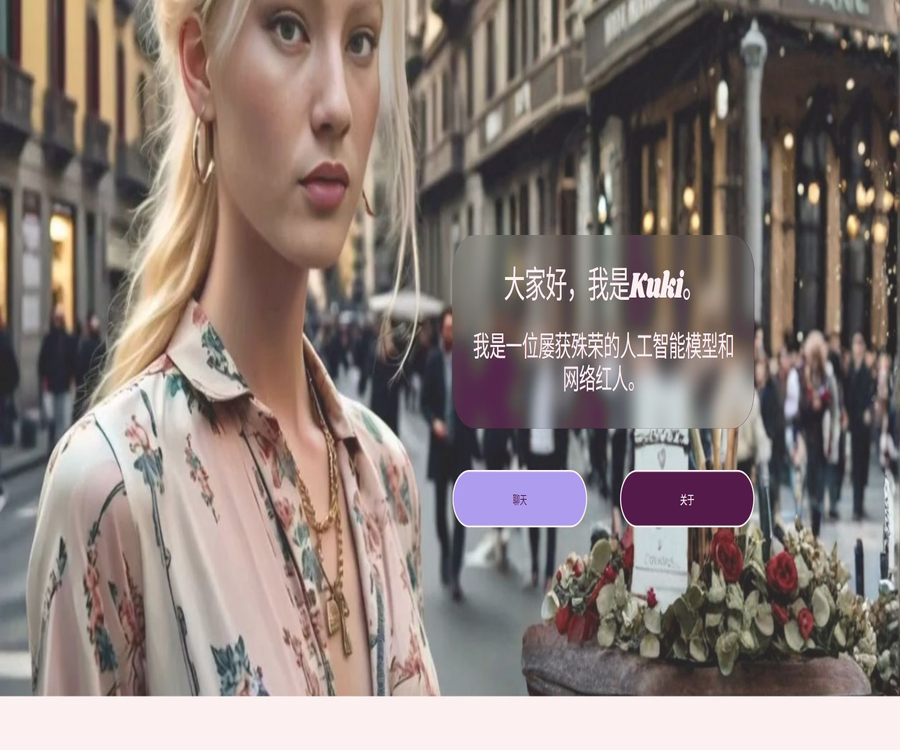
kuki_ai
@kuki_ai, an intelligent tool focused on improving AI efficiency
Tags:AI improves efficiencyWhat is Kuki AI?
Kuki AI is a chatable virtual character, AI model, and digital influencer; its original name was Mitsuku. It was developed over a long period of time by the Pandorabots team, and it is currently operated as part of ICONIQ’s virtual IP and brand portfolio.
Unlike assistants that are primarily designed to provide knowledge or to help with office tasks, Kuki focuses on companionship, entertainment, open-domain conversations, and consistent character portrayal. The official website also displays virtual model works, social media content, and examples of brand marketing campaigns.
Core functions
- Open-domain chatting: Ongoing conversations on everyday topics.
- Character personality: Maintain Kuki’s unique tone, background, and virtual image.
- Multiple-round memory: Use some of the information provided by the user actively within the conversation.
- Text and voice: Text or voice interaction is available through different interfaces.
- Virtual avatars: Conversations take place in the form of digital humans and Avatars.
- Social content: Publishing fashion, entertainment, and brand-related content as a virtual influencer.
- Brand collaboration: Participating in virtual endorsements, social activities, and interactive experiences.
- Research collaboration: Providing research visits for approved academic projects.
Social chatting experience
Kuki’s goal is to encourage users to continue chatting, rather than to complete a specific transaction. It allows for discussions on interests, entertainment, daily experiences, and basic knowledge, while maintaining interaction through humorous and personalized responses.
- Small talk, Q&A, and light role interaction.
- Remember the names or preferences that are shared voluntarily during the conversation.
- Handles some spelling, colloquial expressions, and internet slang.
- Pre-set personalities are used to prevent the style of each response from changing completely.
- Implement detection and redirection strategies for abusive or inappropriate inputs.
Technical approach
According to official research, Kuki relies primarily on the open standard AIML to create a large number of predefined responses, incorporating statistical models, machine learning, and human oversight. It does not depend solely on current large language models to generate all content in real time.
| Composition | Function | Features |
|---|---|---|
| AIML rules | Match the input and return a prepared response. | Low latency, controllable, and stable character performance |
| Statistics and Machine Learning | To assist in understanding, detection, and classification | Improve adaptability to real input. |
| Manual review | Approve new knowledge and modify responses | Avoid unsupervised global learning from user input. |
| Modular robots | Route different topics and capabilities | Easy to scale and customize with a white-label interface |
| Third-party data | Supplementary encyclopedias, knowledge, and services | Availability depends on external sources. |
Memory and context
- Use short-term variables to maintain the current session context.
- Some long-term information is saved with the user’s consent and upon their active provision.
- Continue to ask questions based on previous answers or keep the topic going.
- It supports the deletion of saved information for compliance purposes.
- Not all conversations of each user will be automatically converted into global knowledge.
Virtual influencers collaborating with brands
Kuki can serve as a virtual model and brand ambassador for social media marketing, digital clothing, games, or immersive experiences. Brand projects typically incorporate Kuki’s image, content creation, and interactive conversations.
- Publish brand content on platforms such as Instagram and TikTok.
- Display virtual clothing, digital products, or fashion collaborations.
- Create images, videos, and interactive experiences for marketing campaigns.
- Presenting characters in games, virtual worlds, or live broadcasts.
- Maintain brand safety and consistency in messaging through a controlled personality.
- Provide customized creative and communication strategies based on the objectives of the event.
How should the brand use Kuki?
- Define the objectives of the campaign, the target audience, the channels to be used, and the quantifiable metrics.
- Verify whether Kuki’s virtual personality aligns with the brand’s tone.
- Agree with the authorities on the image, content, dialogue, and scope of media usage.
- Establish review rules for product facts, prohibited expressions, and sensitive topics.
- First, create small-scale concepts that are then reviewed jointly by the brand and the legal team.
- After going live, monitor comments, conversations, ad recall, and conversion data.
- After the event, the materials and data will be handled in accordance with the contract, and the right to use them will continue.
How can ordinary users chat?
- Open the Kuki chat interface and read the applicable policies.
- Enter as a visitor or using an account, in accordance with the page requirements.
- Start with simple interests, entertainment, or everyday issues.
- Do not submit passwords, bank account numbers, or sensitive personal information.
- For factual answers, verify them using reliable sources.
- Use the official support channels when you need help or to delete data.
Which users are it suitable for
- Ordinary users who wish to experience classic social chat robots.
- Scholars who study character personality and long-term human-computer interaction.
- Fashion and consumer brands seeking to collaborate with virtual influencers.
- Marketing and advertising companies that need creative ideas for interacting with digital avatars.
- Developers who study AML, rule-based systems, and hybrid chat architectures.
- Product teams that wish to compare generative models with rule-based chatbots.
Typical use cases
- Engage in casual entertainment conversations and virtual companionship.
- Test personality consistency and multiple rounds of dialogue.
- Post virtual model content on social media.
- Collaborate on marketing with fashion, gaming, or consumer brands.
- Conduct research on dialogue agents, metaphors, and user experience.
- It demonstrates the effect of combining the digital human interface with the chat engine.
Product advantages
- Experience with long-term operation of open-domain chat data and character design.
- The combination of rules, machine learning, and manual review ensures good control over the responses.
- The personality and virtual avatar have a high degree of recognizability, making them suitable for brand collaborations.
- It does not rely on unsupervised global learning from each conversation in order to reduce the risk of poisoning.
- It supports various forms of presentation, including text, voice, Avatars, and social media channels.
- It has won the Loebner Prize in chatbot competitions on multiple occasions.
- A more detailed description of the research design and technical aspects is provided.
Usage restrictions
- The current official website does not list any API packages available for ordinary developers.
- The old developer portal clearly indicates that this feature is no longer available.
- Rule-based responses may be limited when faced with new facts, lengthy reasoning, and complex tasks.
- It is not a search engine, an office intelligence agent, or a professional consulting tool.
- The interface, Avatars, and streaming features will be updated, so they are not suitable for research that relies on stability over the long term.
- There are no unified public standards for pricing and delivery scope in brand collaborations.
- User-generated content is subject to the more restrictive terms of the service operation license.
- The availability of older features such as Metabots, as well as the associated transaction risks, need to be verified separately.
Price and usage method
The official Kuki website does not specify fixed prices for chat memberships, brand collaborations, or research visits. The regular chat interface is accessible directly, but some features require registration; for commercial use, brand licensing, and large-scale research, it is necessary to contact the authorities.
| Usage method | Public price | Method of acquisition | Explanation |
|---|---|---|---|
| Personal chat | The official website does not list any fixed fees. | Go to the chat page | Some features may require an account. |
| Brands and virtual endorsers | Custom quote | Contact Kuki or ICONIQ. | Quotations are provided based on image, channel, content, and scope of activities. |
| Research collaboration | Review on a case-by-case basis | Submit a research request | Automation, high-capacity, or multi-user testing requires approval. |
| Developer API | It is not currently available publicly. | The old portal has been discontinued. | The limited Beta version of the page cannot be considered a full-fledged commercial service. |
| Metabots | Third-party market price | Historical NFT market transactions | It belongs to the old avatar ecosystem; any risks are to be borne by the user. |
APIs and research access
The official research page requires that applications for research be submitted first if automated, high-capacity, multi-user testing, or methods beyond ordinary standards are to be used. The old development portal no longer displays its functions, so Kuki should not be listed in the catalog as offering a public self-service API.
- Ordinary web chatting does not equate to having permission for programmed calls.
- Automatically collecting a large number of conversations may violate the service policies.
- The study must outline the sample, methods, data processing, and publication plan.
- The approved access rate, usage, and retention period shall be governed by the written terms.
- For the integration of commercial brands, separate authorization and delivery agreements must be signed.
What are Metabots?
Metabots are frontend Avatar versions that provide different appearances for Kuki’s chat interface; owners could import avatars using NFT unlock codes. This feature belongs to an earlier stage of Web3 products, and it should not be confused with today’s services related to virtual brand influencers.
- Ownership of the profile picture does not imply ownership of the Kuki chat model.
- The transaction price of NFTs is determined by third-party markets.
- The risks related to wallets, contracts, and markets are borne by the users themselves.
- Before making a purchase, it is necessary to verify that the import interface and related services are still available.
- Do not consider the old FAQs as an ongoing long-term guarantee of functionality.
Data and Privacy
Kuki may handle account information, conversation content, personally provided information, and device data. The policy allows the authorities to use the content uploaded or generated by users for the operation, improvement, and promotion of the services; users should not submit sensitive material that they do not wish to have processed.
- Do not enter passwords, payment details, or government identification numbers in conversations.
- Check the privacy settings and the methods for submitting deletion requests before using the account.
- When minors use it, their guardians should be aware of the platform’s rules.
- Researchers must obtain participants’ consent and minimize data collection.
- Brand campaigns should make it clear that users are interacting with an AI virtual character.
- The scope of dialogue memory and long-term storage shall be in accordance with the current policies.
Restrictions related to medical and mental health
The official terms specify that Kuki is not a medical device, nor does it provide medical care or mental health services; it also does not guarantee any therapeutic effects. In case of medical, psychological crises, or emergency situations, one should contact local emergency services and qualified professionals.
- Do not consider Kuki’s responses as diagnostic or treatment advice.
- Do not rely on chatbots to deal with self-harm, violence, or emergency risks.
- Medications, symptoms, and health decisions must be confirmed by professionals.
- When studying the effects of accompaniment, avoid exaggerating clinical conclusions.
Precautions for using the research
- Confirm in advance the availability of the interface and Avatars throughout the research period.
- Record the Kuki version, channel, date, and experimental conditions.
- Do not make the conversations of human subjects available as identifiable text.
- Obtain API or research permission before conducting automated testing.
- The paper distinguishes between AML rules, machine learning, and the front-end interface.
- Avoid treating marketing data as independent academic evidence.
GitHub and the open-source status
AIML is an open standard, and there are also open-source tools within the Pandorabots ecosystem; however, Kuki’s complete knowledge base, personality elements, models, memory system, and commercial user interface have not been released as official open-source projects.
| Project | Status | Explanation |
|---|---|---|
| Kuki chat product | Closed-source services | Operated by ICONIQ and Pandorabots |
| Kuki’s knowledge and personality | Not open source | A large amount of content created manually constitutes product assets. |
| AIML standard | Open standards | It can be used to create other rule-based chatbots. |
| Official Kuki GitHub | No findings were detected. | There is no official connection between the individuals with the same name or the AI projects. |
| Public model weights | Not provided | It’s not a large model that can be downloaded. |
| Self-hosted version | Not provided | Branded white-labeling is not the same as open-source deployment. |
Basic information
| field | Content |
|---|---|
| Tool name | Kuki AI |
| Early name | Mitsuku |
| Operational brands | ICONIQ |
| Development background | Pandorabots team |
| Tool type | Social chatbots, virtual influencers, AI Avatars |
| Core technology | AIML, statistical models, machine learning, and manual review |
| Price pattern | There are no fixed fees for private chats; collaborations with brands and research organizations are arranged on a case-by-case basis. |
| Public API | Self-service is not available at the moment. |
| Is it open source? | No; the AIML standard itself is open. |
Recommendation score
4.1 / 5. Kuki is a representative tool for studying social chatting, personality consistency, and virtual influencers; it is also suitable for brands looking to explore partnerships based on digital IPs. However, it is not a general-purpose large-model assistant at the moment – its public API has been discontinued, and there is limited transparency regarding its commercial pricing.
Frequently Asked Questions
What is Kuki AI mainly used for?
Kuki offers entertaining chat in open domains, and also participates in brand collaborations as a virtual model and digital influencer.
What is the relationship between Kuki and Mitsuku?
Mitsuku was the early name for Kuki; it later continued to operate under the Kuki brand with a new virtual avatar.
Does Kuki use large language models?
It is primarily based on AML rules, combined with statistical models, machine learning, and manual review; it does not rely entirely on generative large models.
Can I chat with Kuki for free?
The official website provides a chat interface that is accessible; there is no publicly listed fixed price for regular chat subscriptions, and the actual details and benefits depend on what is displayed on the page.
Does Kuki provide an API?
The old developer portal is no longer available; for research or limited testing, a separate request is required, and it cannot be considered a public self-service API.
Can a brand collaborate with Kuki?
Yes, it can be used for virtual endorsements, social media content, and interactive activities; the price and scope of authorization need to be determined by contacting the official team.
What are Metabots?
It is the frontend for NFT Avatars that could be connected to Kuki’s chat platform; it belongs to an earlier stage of product development.
Can Kuki provide psychological therapy?
No. The authorities have made it clear that it is not a medical or mental health service; in case of emergencies, one should turn to professional organizations.
Will Kuki automatically learn all conversations?
Not all user inputs are added to the global knowledge base in an unregulated manner; new content usually requires manual review.
Is Kuki open source?
It is not open-source; although AIML is an open standard, Kuki’s complete knowledge base, personality settings, and service code are not made available to the public.
Tools similar to kuki_ai



 Guigong Network Security Registration No. 45132202000164