






News mini malist
News Mini Malist – a smart tool focused on improving AI efficiency.
Tags:AI improves efficiencyWhat is News Minimalist?
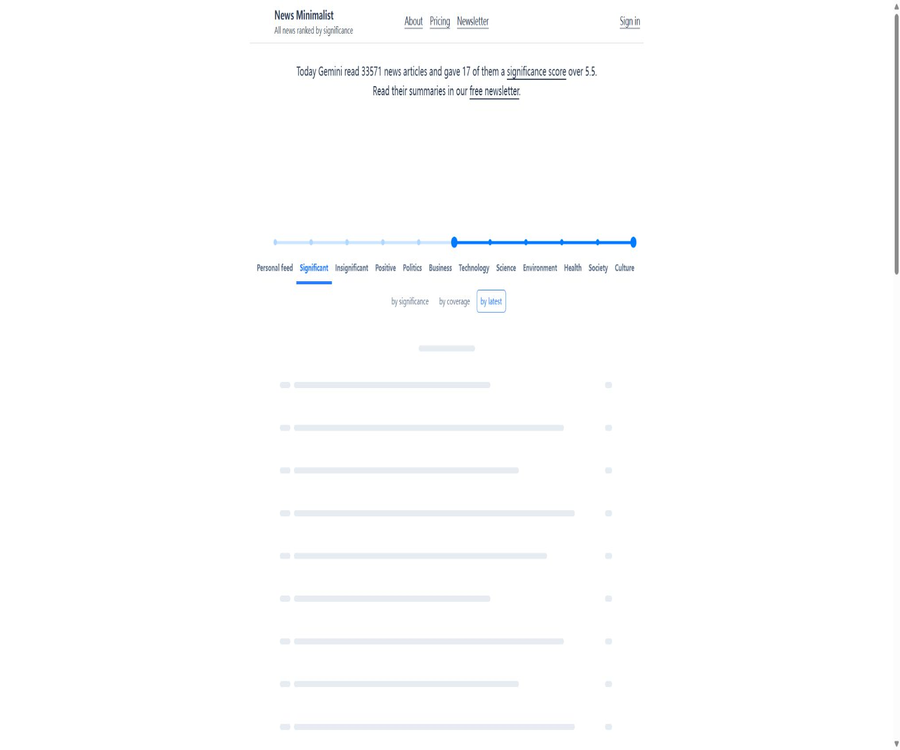
News Minimalist is an AI-based news aggregation tool that ranks articles based on their importance rather than their popularity; it was created by Vadim, an independent developer from Vancouver, Canada. This tool enables the algorithm to read a large number of news articles, assign scores to them, and then summarize the most important content in the form of summaries, web feeds, email briefings, and RSS updates.
Its goal is to reduce clickbait, advertisements, and information overload, rather than covering all news stories. Users still need to access the original articles in order to verify the facts, understand the context, check the timing, and see different perspectives from various media outlets.
How News Minimalist works
According to the information on the official website, the system analyzes around 30,000 news articles per day and assigns a relevance score ranging from 0 to 10. The public briefings include mainly those articles with a score of over 5.5, approximately 10 such articles per week on average.
| Processing stage | Main function | The result shown to the user | Potential errors |
|---|---|---|---|
| News collection | Aggregate a large number of media articles | Candidate news pool | The source coverage cannot include all media outlets. |
| Event recognition | Articles that cover the same event together | Reduce duplicate news articles | Similar events may be incorrectly merged. |
| Importance score | Rate the impact on a scale of 0 to 10. | High-score events are given priority. | The scoring takes into account model and rule preferences. |
| Summary generation | Extract the key information of the event. | Brief news overview | Restricting conditions or details may be omitted. |
| Filter and publish | Apply a threshold of 5.5 or similar. | A very small number of important news items | Events with low scores but that are related to the individual will be hidden. |
Main functions
1. News importance score
Each news item is assigned a significance score, allowing users to view the events in order from lowest to highest. This scoring is intended to reflect the actual impact of an event, rather than the number of clicks, social media attention, or frequency of publication.
2. AI news summaries
The system compiles multiple reports on the same event into brief summaries, allowing users to quickly understand what has happened. These summaries are useful for deciding whether to read more, but they are not suitable as official sources for citation.
3. Significant information flow
By default, the important news feed highlights events that exceed a certain threshold, allowing users to focus on only the most impactful content. If no events meet the criteria on a given day, the briefing may not be filled in completely.
4. Theme and emotion filtering
Websites can be filtered by topics such as politics, business, technology, science, environment, health, society, culture, and sports; it is also possible to determine whether their tone is positive or negative. The classification and assessment of sentiment are carried out by AI, and errors may occur in these assessments.
5. Free email newsletter
Users can subscribe to a free news newsletter to receive summaries that have been filtered based on certain criteria. According to the website’s newsletter, there are already over 10,000 subscribers, and the frequency of deliveries depends on whether any sufficiently important events occur.
6. RSS subscription
News Minimalist offers content in RSS format, which is ideal for viewing high-quality news articles in Feedly, Inoreader, or other readers. RSS helps to reduce the need to visit a website repeatedly, but it is still subject to public filtering criteria.
7. Personalized information stream
Premium users can choose news categories and countries to follow, block certain keywords, and access events that may not appear on the general trend pages. Personalized filtering improves relevance but can also reinforce information bubbles.
What use cases are suitable?
- Busy users: Stay informed about major global events with concise summaries.
- Reducing information overload: cutting down on sensational headlines, repeated reports, and irrelevant updates.
- Research preparation: First, identify news leads that warrant further investigation.
- Industry Insights: Focus on specific areas through topic and country filtering.
- Morning reading: Establish a regular news habit through email briefings.
- RSS users: Add high-scoring news to their existing readers.
- Content creators: Identify high-impact events and keep seeking primary sources.
- Media researchers: Observing how AI ranks the importance of news.
What situations are not very suitable
- Users who need minute-by-minute breaking news and continuous live broadcasts.
- It is necessary to cover local, community-related, or highly niche and vertical news stories.
- A systematic study that takes into account all political perspectives and media views is required.
- Treat AI-generated summaries as direct, citable primary news sources.
- Users who need a Chinese interface and comprehensive Chinese-language media coverage.
- Scenarios where decisions need to be made promptly based on financial, medical, or public safety information.
News Minimalist Usage Guide
Quickly read important news.
- Open today’s news feed and first check the events with higher ratings.
- Read the summary and confirm the date on which the event occurred as well as its scope of impact.
- Switch the theme or apply positive/negative filters to check for any overlooked areas of interest.
- Open the original report and verify the figures and quotes in the summary.
- Find a second independent source and compare the differences in facts and statements.
- Create your own checklist to keep track of events that require ongoing attention.
Set up personal information stream
- Register an account and check the current price of Premium as well as the trial terms.
- Choose topics that truly have an impact on work or life.
- Add key countries or regions to avoid an overly broad scope.
- Block keywords that are not relevant over the long term, but avoid excessive filtering.
- Keep the entry for non-trendy news, and regularly check for events that are overlooked by the algorithm.
- Review and refine the filtering rules on a monthly basis as needed.
Use email or RSS
- Choose a free email newsletter or add the RSS feed to your reader.
- Create separate labels or folders to keep them apart from regular emails.
- Turn off unnecessary real-time notifications and opt to read them in batches on a daily or weekly basis.
- For important events, open the original text rather than just saving the summary.
- Unsubscribe in a timely manner if you do not read for an extended period, to prevent the accumulation of new information.
Free version and Premium prices
As of August 2026, public web pages, rating feeds, important news summaries, and RSS feeds are available for free. Current public information indicates that the price of Premium is around $15 per month; earlier subscribers had the option to pay $10 per month.
| Plan | Reference price | Primary interests | Suitable for users |
|---|---|---|---|
| Public web pages | Free | View news ratings, summaries, and public filters | Read occasionally |
| Free briefings and RSS | Free | Receive important news items with ratings above the public threshold. | Users who wish to reduce the amount of information |
| Premium Personal Information Stream | About $15 per month | Categories, countries, blocked keywords, non-trendy news, etc. | Users who require personalized long-term tracking |
The pricing page is protected by dynamic access controls; the discounts for annual payments, trial periods, taxes, renewal rules, and refund policies are specified on the settlement page after logging in. The historical price of $10 should not be used as the current pricing for new users.
How should the importance score be understood?
- The score reflects the system’s estimate of an event’s impact, not the accuracy of the facts.
- Global importance and personal relevance are not the same thing.
- High-scoring news stories may also contain errors, biases, or incomplete reports.
- News with low scores can be very important for a particular city, industry, or family.
- Thresholds can reduce the amount of information and also actively hide marginal events.
- The scoring models and criteria for different dates may continue to be adjusted.
AI model and scoring updates
In the early stages of the project, ChatGPT was used for scoring, but it was later announced that Gemini had been adopted instead. Developers also utilized more powerful models to create scoring benchmarks, and then used less expensive models to learn from those benchmarks in order to improve efficiency when handling large volumes of data.
Changing the model will affect the scores, summaries, and classification results. The main text of the catalog should not present a particular model as being fixed forever, nor should AI-generated scores be described as having been manually reviewed by a news editorial team.
News sources and media bias
- Aggregators can only process media reports that are already connected or can be located.
- Mainstream English-language media are more likely to gain visibility in the global information flow.
- Original articles, reposts, and commentary on the same event should be distinguished from one another.
- First-hand information from governments, courts, companies, and research institutions is more suitable for verification.
- News on politics and war should be presented differently by media from various regions and with different perspectives.
- The fact that it isn’t included in the high-score feed does not mean that the event does not exist or is unimportant.
How to verify news summaries
- Confirm the time when the event occurred and the time when the article was published.
- Check the names, locations, amounts, and percentages in the summary.
- Open the original text to see the omitted conditions and background.
- Refer to at least two independent and reliable sources.
- Give priority to consulting primary sources such as statements, judgments, papers, or datasets.
- Distinguish between factual reporting, analysis, commentary, and predictions.
- Update your records once an important correction becomes available.
Personalized filtering and information bubbles
Premium allows users to block certain keywords and select countries and topics, which helps to reduce irrelevant content; however, excessive filtering may prevent users from coming across opposing views or changes in related fields.
- Only block topics with consistently low value; do not block all opinions that are not liked.
- Maintain a global portal for important news, without any personalized conditions.
- Regularly check for news that is not trending or has low ratings.
- Expired block words are removed on a monthly basis.
- Temporarily expand the scope of countries and topics during major events.
Privacy and account guidelines
Personalized services require the storage of preferences such as topics, countries, and blocked words; email newsletters also need the user’s email address. The available information does not provide full details on all aspects of analysis, data storage, and third-party processing, so it is necessary to read the current privacy policy before subscribing.
- Do not use sensitive personal names, customer names, or internal project names as filter terms.
- Use a manageable email address for the briefing.
- Regularly check your account, payment methods, and auto-renewal settings.
- Delete the personal information stream and account when they are no longer in use.
- If an RSS address contains private tokens, it should not be shared publicly.
Product advantages
- Sort by the importance of the event, rather than by clicks or popularity.
- A large volume of news is processed every day, with only a very small number of high-priority events retained.
- The abstract is short, allowing for a quick assessment of whether it’s worth reading in detail.
- Public web pages and briefings are not disrupted by traditional news advertisements.
- It offers email and RSS, making it easy to integrate into daily reading habits.
- Premium allows for the creation of personal information streams based on topics and countries.
- It supports blocking keywords and viewing news that is not part of the trends.
- Independent developers continuously provide public explanations regarding changes in the scoring methods.
Usage restrictions and precautions
- The AI importance score takes into account preferences related to the model, data sources, and developer rules.
- The 5.5 threshold will hide a large number of low-scoring and local news items.
- The abstract may omit the background, constraints, and media controversies.
- It’s not an emergency alert, a financial terminal, or a public safety alarm system.
- English content and coverage by international mainstream media are more prominent.
- Merging topics, emotions, and events may lead to incorrect classification.
- The real-time price of Premium and the rules regarding refunds need to be checked on the settlement page.
- The model has been switched from ChatGPT to Gemini, and changes may occur in the future as well.
- There is no public list of complete news sources along with scoring codes.
- Users still need to open the original report and verify it cross-checkingly.
GitHub and the open-source status
The real-time search did not yield any official source code repository that is linked directly by the News Minimalist website or its developers. The projects with similar names listed in the search results, such as Minimal News, are news aggregators created by other developers and have nothing to do with this product.
News Minimalist’s systems for aggregating, scoring, removing duplicates, and summarizing content should be considered closed-source online services. The public documentation provided does not mean that the scoring code, data pipelines, or model weights are made available in an open source format.
Basic information
| field | Content |
|---|---|
| Tool name | News Minimalist |
| Developer | Vadim, independent software engineer |
| Tool type | AI news aggregation, rating, and summarization |
| Rating range | 0 to 10 points |
| Public threshold | It mainly features news with a rating of over 5.5. |
| Daily processing volume | The official website states that there are around 30,000 articles. |
| Current scoring model | Gemini; in the past it used ChatGPT. |
| Free entry | Websites, email briefings, and RSS |
| Premium | Approximately $15 per month, as indicated on the settlement page. |
| Is it open source? | No |
Recommendation score
4.4 / 5. News Minimalist reduces the number of news items effectively by using importance scores; its free newsletters and RSS feeds are also useful. However, there are issues with the scoring criteria, the range of media sources covered, and the AI-generated summaries, so it is suitable only as a starting point for accessing news rather than as the only source.
Frequently Asked Questions
Is News Minimalist free?
Public web pages, important news email summaries, and RSS are available for free. Features such as personalized themes, countries, blocked words, and non-trending news are part of the Premium package.
How much is Premium?
According to publicly available information, the starting price is around $15 per month during verification. The previous price of $10 was part of an initial promotional offer; new users should refer to the real-time pricing page for the current price.
Why are there few news reports sometimes?
The system selects only those events that exceed the importance threshold; it does not include news items with low scores just to reach a certain number. The official website states that around 10 such articles are published per week on average.
Is the importance score reliable?
It is an AI estimate of influence, not an indication of accuracy or objective truth. Local and individual-related events can be very important even if they receive a low score.
Is RSS supported?
Supported. Users can add important news RSS feeds to their preferred readers; whether a separate address is provided for the personal feed depends on the account settings.
Does News Minimalist use ChatGPT?
In the early stages, ChatGPT was used; however, project updates indicate that Gemini is now employed for the large-scale scoring of news articles. The model may continue to undergo adjustments.
Can I view just one country?
The Premium personal information stream allows users to select countries and categories. The free public stream focuses on significant global events as determined by the system.
Is News Minimalist open source?
No verifiable official source code repository was found; it should be marked as a closed-source service.
Tools similar to News Minimalist



 Guigong Network Security Registration No. 45132202000164