






GPT3DEMO
GPT3DEMO, an intelligent tool focused on improving AI efficiency
Tags:AI improves efficiencyWhat is GPT3Demo?
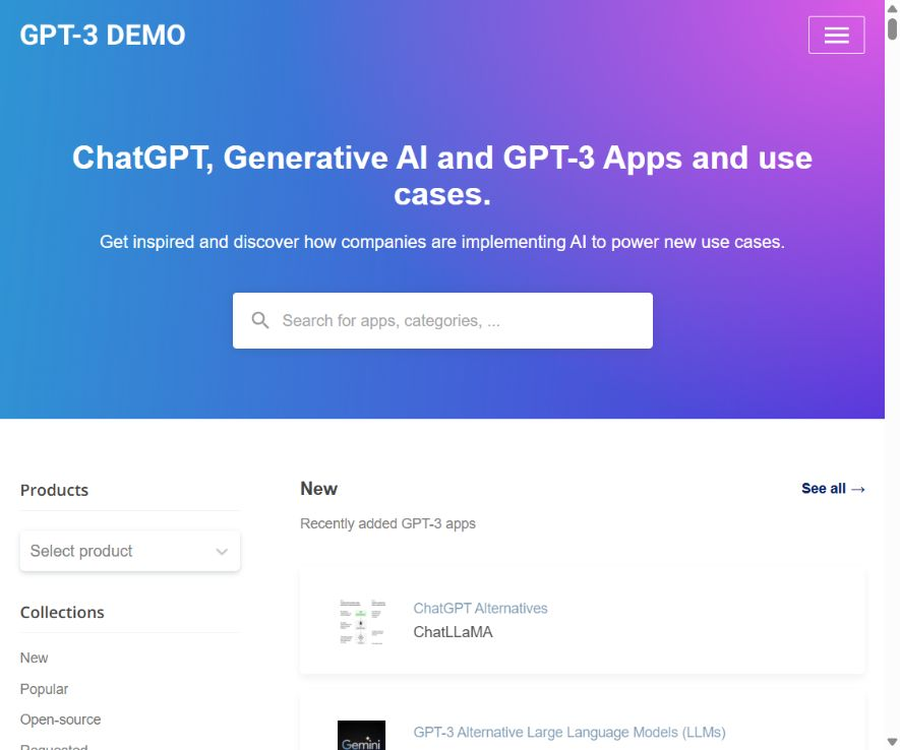
GPT3Demo is a directory that showcases generative AI applications, products, and real-world examples. The website organizes the tools of various companies, research projects, open-source models, and conceptual demonstrations into categories; users can browse the descriptions and then access the corresponding projects.
It is not an online environment for running the GPT-3 model, nor does it provide ChatGPT accounts or unified call quotas. The website is built using the Apideck Ecosystem technology framework; its scope goes beyond GPT-3 and includes multimodal models, Agents, images, voice capabilities, as well as development tools.
What is currently included on the website?
The website’s title still highlights over 800 examples related to ChatGPT, GPT-3, and generative AI, but the actual listings also include Gemini, Grok, LLaMA, Mistral, Stable Diffusion, Whisper, AgentGPT, as well as various specialized applications. The homepage displays the content in four categories: Latest, Popular, Open Source, and All.
Each entry usually includes a name, category, a brief description, relevant links, tags, and images; some pages also provide information on the source, terms of use, or privacy settings. The completeness of the information depends on how well the items are submitted and how carefully the catalog is maintained.
Core functions
AI Application Directory
Users can browse the tool cards on the all-apps page in sequence, and search for suitable options by product name or function. The catalog is useful for initial discovery, but it does not constitute an endorsement of the quality, security, or operational status of the tools.
Browse by category
Entries are categorized into subcategories such as development tools, chatbots, copywriting, images, audio, Agents, databases, education, and finance. These categories help to narrow down the scope, but the same product can be suitable for multiple purposes at once.
Newly added collections
The New collection is used to display items that have been added to the catalog recently. By “new” is meant the time at which they were added to GPT3Demo; this does not necessarily correspond to the date of the product’s initial release or to the moment it became available online.
Popular popular collections
The Popular section showcases the most notable cases, such as writing, tables, images, and search-related applications. The website does not disclose the full formula used to determine popularity, so the rankings cannot be considered an objective reflection of market share.
Open-source collection
The open-source collection lists projects such as Alpa, DeepSpeed, Falcon, GPT-Neo, MPT, Stable Diffusion, and Whisper. Users still need to visit the official repositories to check the licenses, code versions, model weights, and commercial terms.
Application details page
The details page usually explains the product’s uses, the AI technology involved, or various use cases, and provides links for external access. Some of the information includes the background of when the product was released; it may contain outdated models, prices, and status details.
Submission and collaboration portal
The website provides links related to Get listed, Request, and Partner; developers can apply to have their projects included there. No fixed pricing is displayed on the public page, and details regarding whether a fee is charged, the process for approval, and the methods of promotion need to be confirmed with the site administrators.
Relevant ecological entry points
The footer recommends Apideck’s API network and API Tracker; they are related products, and it should not be assumed that all tools in the GPT3Demo directory are connected to a unified API.
List of main functions
- Explore over 800 generative AI applications, cases, and research projects.
- View the New, Popular, Open-source, and All collections.
- Filter by categories such as development, writing, images, voice, and Agents.
- Read the purpose, background, and brief description of each item.
- Access the product’s official website or demo through the entry’s external link.
- Look for examples related to GPT-3, ChatGPT, and other models.
- Discover open-source large models, training frameworks, and developer tools.
- Submit a new application or contact the platform to establish a partnership.
- Continue exploring APIs and the integration ecosystem from the related entry point.
What use cases are suitable?
- Entrepreneurs are looking for directions for generative AI products as well as market examples.
- The product manager identifies industry use cases and competitor categories.
- Developers discover models, frameworks, Agents, and API tools.
- The researchers reviewed the evolution of applications from the GPT-3 era to the multi-model phase.
- Students learn about the uses of AI in writing, design, finance, and education.
- Content creators look for topics, examples, and ideas for products.
- Investment and consulting professionals create an initial list of market observations.
- Open-source enthusiasts can quickly find candidate repositories and model projects.
- The AI product team applies for inclusion in the catalog to gain external visibility.
It’s not very suitable for which scenarios
- Users who need to run the GPT model or generate content directly online.
- It is required that the prices, versions, and operational status of all items be accurately reflected in real time during procurement.
- List of software that requires security audits and compliance certifications.
- Companies that seek to standardize criteria such as performance and total cost should choose this option.
- Treat the popularity rankings as objective measures or a guarantee of product quality.
- Beginners who need a Chinese interface, Chinese tutorials, and support for local payment methods.
- Development projects that require all inclusion tools to be accessed through a unified API.
- Decisions that rely on directory summaries rather than the official website’s terms, pricing, and privacy policies.
Steps to find AI tools
- First, clarify the task, such as writing, images, code, speech, or research.
- Go to the page of all applications or the relevant category.
- Narrow down the range by combining the New, Popular, and Open-source categories.
- Open the candidate entries and read about the product’s uses and technical background.
- Record the official website, GitHub, development company, and target users.
- After leaving the directory, check the product’s current official website and official documentation.
- Confirm the price, registration requirements, data processing, and licensing.
- Actually test two or three candidate tools before making a choice.
- Delete projects that are no longer in operation, have been renamed, or do not meet compliance requirements.
Steps to verify an entry
- Check whether the directory details page indicates the source and external links.
- Verify that the external domain name is still maintained by the corresponding company or project.
- Check the website’s latest announcements, help center, and status page.
- Open the official pricing page to check the free quota and paid plans.
- On GitHub, verify the repository owner, license, and recent commits.
- Check whether the product has been discontinued, acquired, renamed, or transformed.
- Check whether the model names and descriptions in the catalog are still valid.
- When uploading materials, please read the current privacy and data retention policies.
- Record the verification date and evidence in your selection table.
Steps to submit an AI product
- Prepare the product name, official website, a brief description of its position in the market, and clear categorization.
- Organize real screenshots, logos, and descriptions of the core features.
- Provides links to the development company, pricing information, support, and the privacy policy.
- If it is an open-source project, include the official repository and the exact license.
- Go to the Get listed, Request, or Partner page to submit the information.
- Check whether there are any terms related to paid promotion, content licensing, or partnerships.
- Wait for the operator to review it and provide any additional information requested.
- After going live, check whether the title, links, categories, and descriptions are accurate.
- Proactively request corrections when a product is updated, renamed, or discontinued.
Price and usage fees
As of this verification, ordinary users do not need to purchase a subscription in order to access the GPT3Demo directory; there is no charge per use or any membership barrier. The fact that accessing this directory is free does not mean that the third-party AI tools available within it are also free.
The product submission and partnership pages do not specify any fixed, uniform prices; details regarding commercial inclusion, placement in promotional areas, or partnership terms must be asked of the operators directly. The costs associated with subscriptions to third-party tools, APIs, hardware, and models are determined by their respective providers.
| Project | Current rules | Explanation |
|---|---|---|
| Browse directory | Free | There is no need to pay to view public entries. |
| View categories and collections | Free | New, Popular, Open-source, and All can all be viewed. |
| Open the details page | Free | External tools may require registration or payment. |
| Create a regular account | Not necessary for browsing | The public catalog can be accessed directly. |
| Submit product | A unified price is not displayed. | Subject to the responses from the applicant and the operator. |
| Promotion or collaboration | Contact for a quote | It may involve business arrangements. |
| Third-party AI tools | Individual pricing | GPT3Demo does not include any membership benefits or API quotas. |
| Apideck associated services | Independent billing | It is not included in the costs related to directory browsing. |
Comparison of main sections
| Section | Uses | Judgment at the time of use |
|---|---|---|
| New | Discover applications that have been added to the directory recently | It’s not the same as being newly released or recently updated. |
| Popular | Browse the popular cases selected by the platform. | The ranking method has not been fully made public. |
| Open-source | Searching for open-source models and projects | It is necessary to return to the warehouse to verify the license. |
| All | View all listed entries | There are a large number of items, making it suitable to use sorting and filtering. |
| Category | Find products by function or industry | The categories may overlap or be outdated. |
| App details | Understand the background of a single project | The description is not necessarily updated in real time. |
| Partner | Submit projects and seek collaborations | The review and business rules need to be confirmed separately. |
The difference between a table of contents and actual AI tools
| Project | GPT3Demo directory | AI tools that are included |
|---|---|---|
| Main function | Discovery, classification, and introduction | Actually carry out tasks related to generation, analysis, or automation. |
| Model invocation | It is usually not provided directly. | Performed by the tool itself or an upstream model |
| Account | Browsing usually does not require an account. | Registration and verification may be required. |
| Price | Directory browsing is free. | Charged based on each tool’s respective package or usage amount |
| Data processing | Processing access and submission of information | It may handle prompts, files, and business data. |
| Service responsibilities | Responsible for the directory page | The tool provider is responsible for the actual product. |
| Open-source status | The website itself is not open source. | Each project requires independent verification. |
Timeliness and accuracy of information
GPT3Demo contains many early examples of generative AI, which is valuable for understanding the history of this industry; however, the content of some entries still reflects their old state. For instance, the catalog still includes descriptions of products and models that have been discontinued, renamed, or replaced.
Some ChatGPT pages listed in the directory still retain information regarding the previous knowledge cutoff date and historical prices; such information cannot be used to assess the current OpenAI products. Any facts that might affect purchasing, deployment, or release must be verified on the official, up-to-date pages.
- Treat directory entries as clues, not as current proof of fact.
- Check the source date and the background of the product’s release on the page.
- Be vigilant regarding shutdowns, acquisitions, name changes, and domain modifications.
- Prices, models, and free quotas must be checked on the official purchase page.
- To determine the open-source status, it is necessary to check the repository license and the latest commits.
- Tools related to health, law, and finance require additional professional review.
- Do not rely solely on directory labels to determine the commercial use license.
- After navigating to the external link, verify the domain name and certificate again.
Privacy and security of external links
The details page for GPT3Demo may lead users to demonstrations provided by different companies or individuals, to GitHub pages, to research-related sites, or to domain names that have changed owners. Once leaving that directory, data processing will be governed by the terms and privacy policies of the respective website.
- Before clicking the external link, check the actual domain name and the destination of the redirect.
- Do not enter work secrets directly on unfamiliar demonstration pages.
- Verify the official repository before downloading code, models, or installation packages.
- Do not reuse the main email address and production password for test directory entries.
- Check the permissions and publisher before installing a browser extension.
- When API Keys are involved, create test keys with low permissions and a low budget.
- Stop accessing and report any expired, malicious, or hijacked links.
- Companies conduct security, legal, and data compliance reviews before making purchases.
Product advantages
- The scope of coverage includes GPT-3, ChatGPT, and various other approaches to generative AI.
- Collections such as New, Popular, and Open-source are easy to browse quickly.
- Detailed categories help users discover products based on their tasks.
- The details page usually includes the purpose, background, and external links.
- It allows free browsing without requiring the creation of a regular user account.
- There are both commercial products as well as research efforts, concepts, and open-source projects.
- A large number of early examples of generative AI applications have been preserved, offering historical reference value.
- Developers can apply to have their products included, thereby increasing their visibility.
- Linked to the Apideck ecosystem, it is suitable for further exploration of the API market.
Usage restrictions and precautions
- A website is a directory, rather than an AI model that can directly generate content.
- The more than 800 entries do not represent all of those that are still in operation or being updated regularly.
- Some detail pages include information on outdated models, prices, and product status.
- The Popular sorting lacks a unified scoring method that can be reviewed.
- The open-source label cannot replace license and weight review.
- The security of external links and the quality of third-party services are not guaranteed by the directory.
- There are no comprehensive and unified comparisons regarding prices, privacy, performance, and security.
- Support for the Chinese interface and Chinese content is limited.
- There are no publicly established fixed standards for the fees associated with submitting proposals for business partnerships.
- There is no unified API that covers all the included tools.
GitHub and the open-source status
The real-time search did not yield any complete source code repository for GPT3Demo that was released by GPT3Demo or Apideck itself and that had been verified through information available on their websites. The source code of the website indicates that it uses the Apideck Ecosystem Generator as well as related market catalog technologies, but this does not mean that an open-source license is in use.
Therefore, the GPT3Demo website itself should be labeled as non-open source. The Open-source collection in that directory is merely a list of third-party open-source projects; each project has its own repository, license, model terms, and maintenance status.
Basic information
| field | Content |
|---|---|
| Tool name | GPT3Demo / GPT-3 Demo |
| Tool type | Directory of generative AI applications, use cases, and open-source projects |
| Associated ecosystem | Apideck Ecosystem |
| Collection scale | The official website states that there are over 800 applications and use cases. |
| Main collection | New, Popular, Open-source, All |
| Price pattern | Directory browsing is free; quotes are required for collaborations. |
| Is registration required? | Browsing is not required. |
| Is it provided directly as AI-generated content? | No |
| Is a unified API provided? | No |
| Is it open source? | The website is not open source; it includes some third-party open-source projects. |
Recommendation score
4.0 / 5. GPT3Demo is useful for discovering early examples of generative AI applications in various fields; it is free and its categorization is clear. However, the status and descriptions of many entries require further verification, so it cannot be used directly for making purchasing decisions or determining compliance requirements.
Frequently Asked Questions
Can GPT3Demo be used directly with GPT-3?
No. It is a directory of applications and examples; it usually directs users to the pages of third-party products or projects.
Is GPT3Demo free?
Browsing public catalogs, categories, and detail pages is free. The tools listed there may be available free of charge, via subscription, on a pay-as-you-go basis, or it may be necessary to contact sales.
Does the website only have GPT-3 applications?
No. Currently, it also includes projects such as ChatGPT, Gemini, Grok, LLaMA, multimodal systems, image processing, voice recognition, and Agents.
Can all the projects in open-source collections be used for commercial purposes?
It cannot be judged in this way. It is necessary to verify separately the code license, model weights, training data, and the terms related to third-party components.
Is the directory information up to date?
Not all entries are updated in real time. Some pages still contain information on older models, prices, or products that are no longer available; it is necessary to check the official website before using them.
How can a product be included in GPT3Demo?
Product information can be submitted through the Get listed, Request, or Partner options; the approval process and commercial terms will be determined by the operator.
Is GPT3Demo open source?
No verifiable official, complete source code repository was found; the website itself should be considered a closed-source directory platform.
Tools similar to GPT3DEMO



 Guigong Network Security Registration No. 45132202000164