






Ali Translation
Machine translation services for cross-border e-commerce and enterprise use cases
Tags:AI improves efficiencyWhat is Ali Translate?
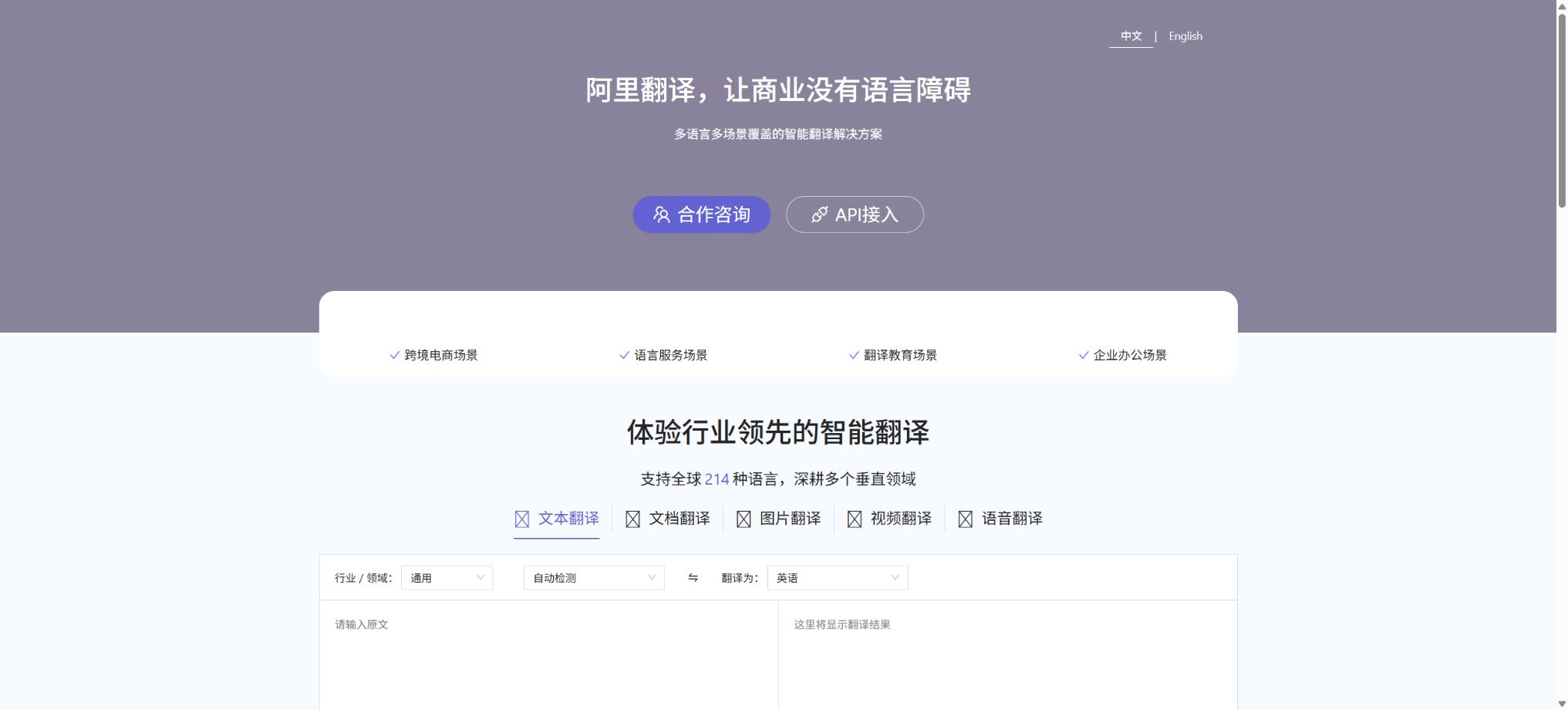
Ali Translation generally refers to Alibaba’s machine translation services as well as those offered by Alibaba Cloud, and it is intended for use in cross-border e-commerce, education, healthcare, finance, manufacturing, translation companies, and by developers. It is not a simple web-based translator for individuals to enter a sentence into; rather, it is a set of enterprise-level translation solutions that include online platforms, project management tools, post-translation editing functions, APIs, SDKs, and customized models.
According to the official information, support is available in 214 languages; five different formats are supported – text, documents, images, audio, and video. The platform offers a standard version, a professional version, custom models, language recognition functions, services for e-commerce images, processing of standard identification documents, subtitle translation, as well as a human-machine collaborative translation system.
Core functions
1. General text translation
The general version is suitable for everyday content, social interactions, news, and texts from various industries; it allows specifying the source language and target language either through the console or via API. It supports languages such as Chinese, English, Japanese, Korean, Spanish, Russian, French, Portuguese, German, Thai, and Vietnamese, and enables translation between 214 supported languages as listed in the product catalog.
Machine translation may misinterpret context, negative expressions, and cultural nuances. Contracts, medical documents, financial materials, and publicly published content still require review by professionals.
2. Translation in specialized fields
The Professional version is optimized for industries such as e-commerce, healthcare, technology, finance, and verbal communication, and it is suitable for businesses that make use of many technical terms. The Professional version and the Standard version are two separate billing options; the free credits and resource packages provided for each cannot be combined.
3. Customized translation models
Companies that have bilingual data can train customized models to ensure that the translations better match their product names, terminology, and style of expression. The platform offers a free trial for the first 3 model training sessions; thereafter, a fee is charged based on the number of training sessions, with additional charges applied per character when the model is used.
The effectiveness of training depends on the amount of data available, the quality of alignment, and the consistency within the specific domain. Customer data must not contain copyrighted text that is not permitted for use, nor any personal sensitive information.
4. Language recognition
The language recognition interface can first determine the language of the input text and then route it to the appropriate translation direction; it is suitable for user-generated content, multilingual customer service, and cross-border product data. Short texts, spelling errors, and mixtures of different languages may lead to incorrect judgments, so in critical processes users should be able to make manual selections.
5. Document translation
Document translation is supported for formats such as PPT, PPTX, PDF, DOC, DOCX, XLS, XLSX, CSV, HTML, XML, TXT, SRT, JSON, XLIFF, TMX, DITA, Markdown, and IDML. PPT, PPTX, and PDF are billed on a per-page basis, while the other document formats are calculated as one page every 2000 characters.
HTML tags, JavaScript, and CSS code are not counted as characters in the pricing for document translation; however, Chinese characters, letters, punctuation marks, and spaces within the text are all included in the calculation. Complex layouts, scanned documents, and formulas may still require correction after translation.
6. General image translation
Image translation combines OCR, text processing, machine translation, and image synthesis; after uploading an image, a version in the target language is generated. The online editor allows for modifying the translation, font styles, background, making cuts, and restoring the original image areas.
7. Translation of e-commerce images
The e-commerce version is designed for product main images and detailed photos; it can identify the text in those images and generate multilingual versions of them. It also offers a function for filtering out text related to the physical product, allowing users to decide whether to translate the text on clothing, packaging, or electronic screens, thereby avoiding the replacement of brand elements that should remain unchanged.
E-commerce images and general image resource packs are not interoperable. After automatic synthesis, it is necessary to check the trademarks, specifications, prices, dimensions, and the authenticity of the products.
8. Translation of documents
Standard document formats include those such as ID cards and driver’s licenses; OCR and translation technologies are used to process structured information. Documents represent highly sensitive personal data, and companies must restrict uploading, access, logging, and retention periods – they cannot assume they have the authority to process such data just because the relevant interfaces are available.
9. Audio/video and subtitle translation
Video and audio platforms support the uploading of common file formats such as MP4, MP3, MOV, and WAV; the size of a single file cannot exceed 1GB. Text subtitles are generated through speech recognition, after which the video can be translated, edited sentence by sentence, and compressed. Subtitles can be exported in ASS, SRT, or XLSX format, while videos can be exported in MP4 or FLV format.
Currently, Chinese or English can be used as the source language, with target languages including Chinese, English, Japanese, Korean, Russian, Spanish, French, Italian, German, and more. It supports dual-language display, as well as primary or secondary subtitles, and allows export in 480p, 720p, and 1080p resolutions.
10. Human-machine collaborative translation platform
The human-machine collaboration platform is designed for translation companies and translators; it supports over 40 types of documents, images, and videos, and offers features such as project dashboards, task distribution, glossaries, corpora, translation services, quality inspection, verification, bilingual alignment, revision tracking, and data reports.
The platform can assign tasks on a sentence-by-sentence or document-by-document basis, and it uses the customer’s accumulated corpus to train more appropriate models. The software subscription fee is calculated separately from the actual cost of machine translation requests.
Online platforms and developer APIs
Non-developers can access the online document, image, and audio/video translation platforms via the Alibaba Cloud console; developers can use APIs for text, batch text, documents, images, identification of documents, and language recognition, as well as SDKs in common programming languages.
For batch text translation, each individual text fragment may not exceed 1000 characters, and a maximum of 50 fragments can be processed at once. The application should utilize the minimum required level of RAM, serve-side keys, as well as mechanisms for call auditing and cost monitoring; access keys must not be stored in the frontend or in public code repositories.
Price and version comparison
| Package or version | Prices, quotas, and core benefits |
|---|---|
| Prices for the standard version and the professional version | In the general version, each main account is entitled to 1 million characters for free per month, and sub-accounts share this quota; any excess usage is charged at 50 yuan per million characters. A package of 10 million characters costs 480 yuan, while a package of 100 million characters costs 3800 yuan – the lower the volume, the lower the price. The professional version also offers 1 million characters for free per month, with charges of 60 yuan per million characters for any excess usage. A package of 10 million characters costs 570 yuan, and a package of 100 million characters costs 4500 yuan. The calculation of character counts includes Chinese characters, letters, punctuation marks, spaces, and HTML tags. The free quota is refreshed on the 1st of each month, and any unused portion is not carried over. Charges are applied in order: first from the free quota, then from the resource packages, and finally through pay-as-you-go pricing; billing is done on an hourly basis, and service may be suspended if the balance runs out. |
| Prices for custom models and language recognition | The training of custom models costs 500 yuan per session, with the first 3 models available for free testing; the usage of custom models costs 150 yuan per million characters. Language recognition is provided free of charge for 1 million characters per month, with a charge of 70 yuan per million characters for any amount exceeding that limit. |
| Prices for documents, images, and subtitles | 1,000 pages of document translation are provided free of charge each month; beyond that, the cost is 0.2 yuan per page. 100 general-purpose images and 100 e-commerce images can be translated for free each month, with costs of 0.05 yuan per image and 0.06 yuan per image respectively for any additional images. For ID cards and driver’s licenses, 1,000 translations are available free of charge per month under the applicable rules, and the cost is 0.04 yuan per additional translation. Subtitle translation is free for 15 minutes per month, after which the cost is 0.5 yuan per minute. There is no free quota for video export, with a charge of around 0.14 yuan per minute. Images, documents, or videos that fail to be translated are generally not charged in accordance with the official rules. |
| Price of human-machine collaboration platform | The free version for individuals or teams costs 0 yuan; the paid versions are available at 118 yuan per 30 days, 218 yuan per 60 days, or 288 yuan per 90 days. For businesses, the standard version costs 14,999 yuan per year, the advanced version 29,999 yuan per year, and the flagship version 59,999 yuan per year. The free and paid versions for individuals and teams differ in terms of the terminology database, corpus, number of files, file size, number of active users, and the ability to export content in two languages. The paid version allows up to 5 active users; in the free version, documents can be up to 5MB in size, images up to 2MB, and videos up to 100MB, while these limits increase to 50MB, 5MB, and 500MB respectively in the paid version. |
Prices for the standard version and the professional version
The standard version provides 1 million characters for free per month per main account, and sub-accounts share this quota; any excess usage is charged at 50 yuan per million characters on a pay-as-you-go basis.
A resource package with 10 million characters costs 480 yuan, while one with 100 million characters costs 3,800 yuan; the larger the volume, the lower the unit price.
The Professional version also provides 1 million characters for free each month; beyond that, the cost is 60 yuan per million characters. A package containing 10 million characters costs 570 yuan, while one containing 100 million characters costs 4500 yuan.
Character calculation includes Chinese characters, letters, punctuation, spaces, and HTML tags.
The free quota is refreshed on the 1st of each month, and any unused portion is not carried over. The order of charges is: free quota, resource packages, then pay-as-you-go; billing is done on an hourly basis, and service may be suspended if the balance runs out.
Prices for custom models and language recognition
The training of a custom model costs 500 yuan per session, with the first 3 models available for free testing; the usage of a custom model costs 150 yuan per million characters.
Language recognition is free for 1 million characters per month; any amount exceeding that costs 70 yuan per million characters.
Prices for documents, images, and subtitles
Translation of documents is free for up to 1,000 pages per month, with a charge of 0.2 yuan per page beyond that limit. For general-purpose images and e-commerce images, 100 images per type are available free of charge per month, and the cost rises to 0.05 yuan per image and 0.06 yuan per image respectively for any additional images.
For translations of ID cards and driving licenses, 1,000 copies are provided free of charge per month under the various sharing rules; beyond that, the cost is 0.04 yuan per copy.
Subtitle translation is available for 15 minutes per month free of charge; beyond that, the cost is 0.5 yuan per minute. There is no free quota for video export, and the cost is around 0.14 yuan per minute on a pay-as-you-go basis.
Images, documents, or audio/video files that fail to be translated are generally not charged in accordance with the official rules.
Resource package rules
The validity period of a resource package is 1 year; packages of the same type can be used together, with priority given to those that will expire first. Resource packages for different products are not interchangeable – for example, general-purpose text packages and professional text packages, as well as general-purpose image packages and e-commerce image packages, cannot be combined for use.
Debugging APIs also generates usage. Once the resource package is used up, billing shifts to a post-payment model; companies should set alerts for available balance, usage levels, and high consumption amounts.
Price of human-machine collaboration platform
The free version for individuals or teams costs 0 yuan; the paid versions are available at 118 yuan per 30 days, 218 yuan per 60 days, or 288 yuan per 90 days.
The standard version for businesses costs 14,999 yuan per year, the advanced version 29,999 yuan per year, and the flagship version 59,999 yuan per year.
The free and paid individual team versions differ in terms of the terminology database, corpus, number of files, file size, number of active users, and bilingual export options. The paid version allows up to 5 active users.
The free version allows 5MB for documents, 2MB for images, and 100MB for videos; the paid version raises these limits to 50MB, 5MB, and 500MB respectively.
Differences in the Enterprise version
The Enterprise Advanced version includes self-learning machine translation capabilities, while the Enterprise Premium version offers a data dashboard, as well as options for API integration and customization. The amount of machine translation usage allowed under the enterprise packages is still determined according to the rules applicable to each specific product; it is not possible to use this service indefinitely after purchasing the software.
Refund rules
Within 5 days after payment for a new order on the human-machine collaboration platform, there is a transaction guarantee period during which a full refund can be requested without giving any reason; after 5 days, as well as for trial orders and renewals outside of this guarantee period, a refund without reason is not available.
Once an invoice has been issued, it must be returned following the established procedure.
Service reliability and performance
Official figures indicate that the reliability of the machine translation service is 99.9%, with over 1 billion requests processed per day; it utilizes data centers located around the world. The decoding of a single sentence takes place in just a few hundred milliseconds, but the end-to-end latency depends on factors such as the network connection, queueing conditions, file parsing, and the application architecture.
Open-source status
Ali Translate and Alibaba Cloud Machine Translation are commercial cloud services, not open-source translation models. The official SDKs, API examples, or the client code available on GitHub only help with integration; they do not include the translation models or training data needed for actual translation tasks.
Ali Translate Usage Guide
Complete a basic task.
- Clarify the issue, time frame, location, source priority, and output format;
- On Ali Translate, upload materials for which you have permission to use or enter search queries;
- First, establish a framework using general text translation, and then supplement it with evidence through translation specific to the field in question.
- It is necessary to distinguish between factual information from the source, the author’s opinions, and AI-generated conclusions.
- Check each item for dates, numbers, the original location, and any conflicting evidence;
- The conclusions are manually revised, the verification time is recorded, and then they are published;
Create reusable professional workflows
- Break down complex topics into four categories of questions: background, data, comparison, and conclusions;
- A fixed set of research steps is established by combining general text translation, translation in specialized fields, and custom translation models.
- Give priority to using the official website, research papers, regulatory documents, and raw data;
- A second person is assigned to review conclusions that are considered high-risk;
- Save queries, evidence, versions, and unresolved issues;
- Re-run after the data changes and update the conclusions;
Which users is it suitable for?
- E-commerce team responsible for translating product titles, descriptions, and images;
- Companies that handle documents and multilingual content in bulk;
- A content team responsible for creating subtitles for courses, videos, and product videos;
- Translation companies that require terminology, source material, quality control, and a division of tasks among translators;
- Developers who can integrate text, image, and document translation services through APIs;
- Large organizations that need to learn on their own, develop custom models, or achieve enterprise integration.
Product advantages
- It covers 214 languages and five modalities;
- It boasts strong capabilities in the field of cross-border e-commerce;
- Online platforms, APIs, and human-machine collaborative workflows are all fully available;
- The free quota and pay-as-you-go prices are made public;
- It supports editing of translated images, subtitle timelines, and video compression;
- Offers professional, customized, and self-learning model approaches.
Restrictions and Precautions
- The free quotas and resource packages for different products are not interchangeable, and any remaining quota after the expiration of a resource package becomes invalid.
- Once the free quota is used up, the service will automatically switch to a pay-as-you-go model, and it is necessary to set up budget alerts.
- Machine translation can result in errors in terms, numbers, and context.
- Documents, contracts, as well as medical and financial information must have access controls in place and be reviewed by qualified professionals;
- The entry point for the “Ali Translate” website is located in a different place than the Alibaba Cloud Machine Translation console. Enterprise features generally require an Alibaba Cloud account to be activated, so it should not be described as a completely free personal translation service.
Frequently Asked Questions
Is Alibaba Translate free?
Alibaba Cloud’s General Edition and Professional Edition offer 1 million characters of free usage per month, with a monthly limit also applied to documents, images, and subtitles; any excess usage is charged on a pay-as-you-go basis or through resource packages.
How many languages are supported?
The official product portfolio claims to support 214 languages, but the number of available combinations for audio/video, documents, and specialized fields is smaller than that for text translation.
How much does the text API cost?
The standard version costs 50 yuan per million characters, while the professional version costs 60 yuan per million characters; resource packs can reduce the unit price.
Can product images be translated?
Yes, e-commerce image translation supports OCR, translation, image synthesis, entity text filtering, and online editing.
Are documents and videos available?
It supports a variety of office and localized files; it is also possible to upload common audio and video files up to 1GB in size, and multi-language subtitles can be created and edited.
Is Ali Translate open source?
It is not open source. It offers commercial APIs and SDKs, but its core models and data are not available to the public.
Tools similar to Ali Translate


 Guigong Network Security Registration No. 45132202000164