






What is enso?
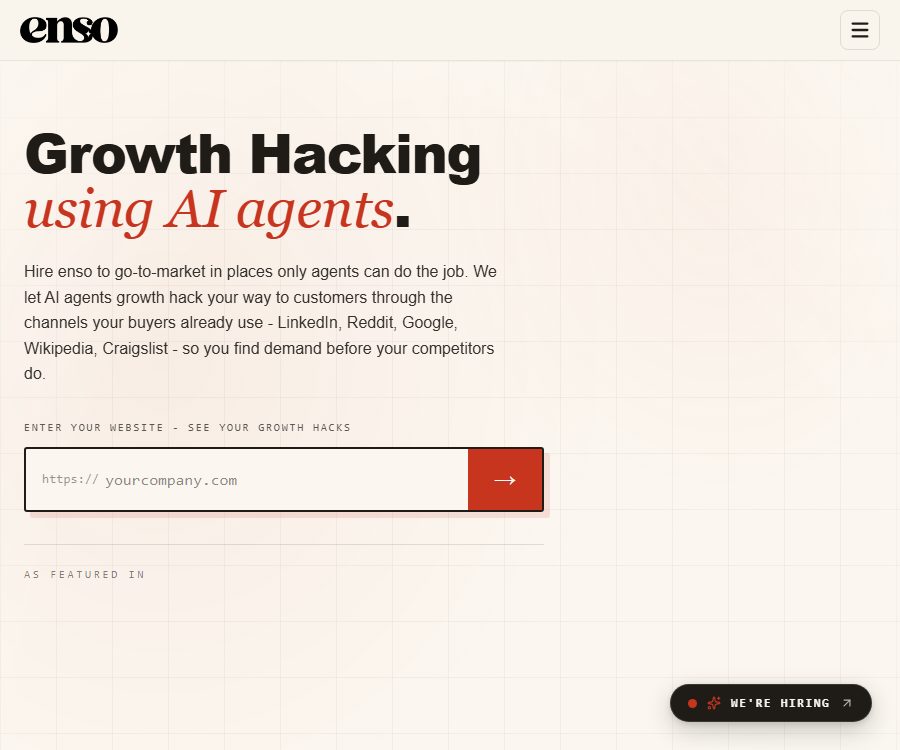
Enso is an Agentic GTM service that relies on AI agents to carry out tasks related to market growth and customer acquisition; its team is based in Tel Aviv. It utilizes agents that operate continuously for purposes such as search and use of large language models, sales development, community management, publication of weekly updates, and social media activities.
At present, enso is neither a marketplace where users can choose templates after registering, nor a self-service tool that merely provides software accounts. Each project is developed by enso specifically for a particular client, with engineers and operational staff being responsible for its design, integration, operation, and weekly optimization.
Product transformation and current delivery methods
The older descriptions in the database portrayed enso as a market for AI agents aimed at small businesses, but the current products focus on customized growth agents and pre-implementation services. The team analyzes the ideal customer profile, sales funnel, brand tone, business data, and distribution channels of clients, before deploying the agents in their actual working environments.
| Product stage | Main morphology | Current judgment |
|---|---|---|
| Old introduction | An automated agent market is available for selection. | It is not suitable to be used as a basis for current functions. |
| Current service | One set of specifications per company, one person in charge of operations | Current main delivery models |
| Develop interfaces | REST, MCP, signaling, and landing page interfaces | Used for integrating content and growth systems |
This model is more akin to \"agent software combined with professional services\" rather than a generic SaaS solution. Customers need to evaluate not only the capabilities of the model but also the skills of the implementation team, their experience in specific channels, data access rights, and the quality of ongoing support.
Overview of the five types of growth agents
| Agent | Primary channels | Core tasks | Main outputs |
|---|---|---|---|
| Agentic SEO and GEO | Google, ChatGPT, Perplexity, Claude | Identified gaps in searching and citation. | Content pages, citation monitoring, and visibility reports |
| Agentic SDR | Email, LinkedIn, CRM | Identify purchase signals and schedule meetings. | Account list, personalized outreach, and meeting context |
| Agentic Community | Slack, Discord, Reddit, Circle, Skool | Monitor community purchase signals | Thread background, suggested replies, and CRM leads |
| Agentic Newsletter | Beehiiv, Substack, Mailchimp, etc. | Continuously create and improve the weekly publication. | Weekly review of content, themes, and outcomes |
| Agentic Social | X, LinkedIn, Threads, Bluesky, Instagram | Planning, publishing, and repurposing social content | Content calendar, posts, replies, and derived materials |
Agentic SEO and GEO
The agent for Agentic SEO is named Hermes; its goal is to increase the chances of a brand being cited in traditional searches, Google AI Overviews, and the responses provided by various large language models. It continuously considers the questions that buyers might ask, keeps track of competitors and the locations where citations appear, and then identifies topics for which there are no high-quality answers available.
- The client provides the business category, competitors, existing content, and verifiable facts.
- The agent runs purchase-related queries across multiple response engines and records the current references.
- The system ranks the citation gaps based on commercial value and the degree to which they can be filled.
- Draft pages in the brand’s tone, including extractable facts and evidence.
- After approval, it is released to the customer content system or the configured channels.
- Recheck the same issue every six hours or at the set interval to track changes in references.
Both the citation of large models and the sorting of search results are controlled by third-party platforms; therefore, ENSO cannot guarantee that a page will be cited, retained, or lead to conversions. Teams should rely on solid evidence, clear attribution of authorship, and verifiable data, avoiding the creation of unverified conclusions merely for the purpose of obtaining citations.
Agentic SDR Sales Development
Agentic SDR identifies companies that are likely to be in a position to make purchases by looking at factors such as financing options, hiring activities, changes in the technical stack, and other public business indicators; it then prepares an appropriate introductory message for each potential client. It can send emails and utilize multiple communication channels on LinkedIn, handle some of the responses received, and record appointments and full conversations in the CRM system.
- Target accounts are defined using ICP, exclusion lists, and CRM data.
- Save the trigger signals and reasons for scoring for each account.
- Write a personalized introduction by referring to the customer’s website, posts, and recent news.
- It supports batch approval or individual editing of the text before sending.
- Perform sequential contacts up to the quantity limit set by the customer.
- Pass the meeting details, lead signals, and conversation context to the sales team.
The product claims that its processes do not rely on the collection of personal data and emphasizes compliance with GDPR regulations; however, the published privacy policy does not provide a sufficient explanation regarding how sales data is obtained, the legal basis for such collection, or the rights of data subjects. Customers are still required to examine on their own the rules related to electronic marketing, spam prevention, professional networking platforms, and the reputation of the domains used for sending messages.
Agentic Community community agents
The Community agent monitors discussions on Slack, Discord, Reddit, Circle, and Skool that relate to customer issues, complaints about competitors, or comparisons of different tools. It provides the team with background information on those discussions, relevant evidence, and suggested responses, while also passing on any valuable insights to the CRM system.
- First, establish a history of normal, long-term, and constructive participation within the target community.
- Pay attention to specific issues and purchase signals, rather than conducting general monitoring of all members.
- Draft context-aware responses based on the founder’s or brand’s tone.
- The product clearly states that it will not pretend to be a customer to post content, nor will it engage in fake grassroots marketing.
- Each piece of content is approved by humans before it is added to the community.
Even when approval is done manually, community marketing can still come into conflict with rules regarding disclosure, privacy, and prevention of manipulation on the platform. Teams should clarify any commercial relationships they have, and avoid sending automatic private messages, creating fake recommendations, or using multiple accounts to influence discussions.
Agentic Newsletter Weekly Intelligent Agent
The Newsletter entity is used to produce a weekly brand newsletter on a regular basis, while maintaining a consistent tone from the author. It can be integrated with publishing platforms such as Beehiiv, Substack, Mailchimp, Customer.io, and ConvertKit, enabling a cycle that includes research, writing, editing, sending, and review.
- Select this week’s theme from product, sales, customer, and industry signals.
- Generate drafts based on the designated audience, sections, and brand tone.
- Have the person in charge review the facts, opinions, links, and calls to action.
- After sending, analyze performance in terms of opens, clicks, and conversions.
- Use the feedback on the outcomes to shape the theme and structure of the next edition, rather than mechanically repeating the template.
The customer is still responsible for granting permissions, unsubscribing, and suppressing replies in email services. When generating weekly newsletters automatically, it is also necessary to verify facts, copyright issues, and the licensing of images used from third parties.
Agentic Social social content
The Social agent extracts relevant content from product updates, sales conversations, and customer feedback, and then creates weekly plans in various formats for X, LinkedIn, Threads, Bluesky, and Instagram. It can also monitor mentions, prepare responses, and transform the most effective ideas into threads, carousels, or short content pieces.
- Minimum read access is granted to the update logs, documents, and approved meeting minutes.
- Provide authentic posts in the tone of the founder, as well as topics that are prohibited from discussion.
- The agent generates a weekly content plan and specifies the format for each platform.
- Manually check facts, tone, disclosures, and any statements that may give rise to controversy.
- Publish in line with the platform’s schedule, and handle responses during key time periods.
- Review outreach, saves, private messages, and qualified leads, rather than focusing solely on page views.
The current product guidelines prohibit interactive groups, robots, and the purchase of followers, but some pages use aggressive narratives such as \"growth loopholes\". Companies should establish clear rules based on compliance, platform policies, and long-term brand trust.
The implementation process of enso
The client first selects a direction from the growth experiments that have already been carried out by enso, and then the team transforms it into a customized agent. The standard process indicates that a typical deployment takes about two weeks, but the actual time required can be affected by factors such as system integration, approvals, and data preparation.
- Choose a proven growth experiment or agent approach that aligns with the business objectives.
- Break down the funnel, the ideal customer profile, and the channels through which buyers come from, to produce auditable results that can be retained.
- Define prompt keywords, fact rules, prohibited terms, brand tone, and thresholds for manual review.
- Connect to CRM, content systems, email, Slack, or other project environments.
- Deployment is carried out by the designated engineer, and it is tested using a limited set of data.
- After approval, gradually increase the pace, and record each action and its outcome.
- The operations manager adjusts the qualified leads and revenue streams on a weekly basis.
Deployment does not mean that all actions should be carried out automatically. For external communications, community posts, website updates, and the entry of customer data, approval processes, limits, audit mechanisms, and emergency stop functions should be established separately.
Input, output, and system integration
| Category | Common inputs | Common outputs | Risk control |
|---|---|---|---|
| Market positioning | ICP, competitors, funnel, and brand tone | Channel planning and agent specifications | Avoid unverified assumptions about customers. |
| Corporate data | CRM, documents, pricing, changelog, and meeting minutes | Clues, content, and personalized copy | Minimum permissions and field filtering |
| Channel account | Email, social media, community, and CMS permissions | Reach, posts, replies, and pages | Manual approval, frequency, and rollback |
| Effect data | Citation, access, response, meetings, and CRM stages | Weekly tuning and experimental evaluation | Distinguish between relevance and true incremental value |
Price conflicts with procurement requirements
On the currently visible page of enso, it is clearly stated that there is no option for self-registration nor any public price list; each project is designed separately by the company, and the costs involved are determined through communication. The pricing section actually leads to a page for scheduling discussions, rather than a list of packages that can be purchased directly.
The structured summary for the same site still states that the cost per agent contact is 49 dollars per month, that the Growth plan applies to five agents, and that there are separate quotes available for multi-brand and custom enterprise solutions. These two statements are contradictory; therefore, the price of 49 dollars cannot be considered the confirmed current pricing.
| Plan or proposal | Price | Billing cycle | Core benefits or quota | Suitable for users |
|---|---|---|---|---|
| Current custom implementation | Custom quote | In accordance with the contract | Custom specifications, implementation, designated operators, and weekly optimization | Enterprises that require comprehensive growth strategies |
| Single Agent Summary | Starting at $49 | Monthly | An agent contact; the specific amount is not disclosed. | For reference only in case of conflicts |
| Growth Summary | Not yet made public | Not yet made public | There are five combinations of intelligent agents; the current text does not specify a unified price for them. | Multi-channel Growth Team |
| Multiple brands and enterprises | Custom quote | In accordance with the contract | Multi-brand or enterprise-level implementation | Complex organizations |
Before making a purchase, the seller should confirm in a written quote the deployment costs, monthly operating expenses, the channels and number of actions included, the cost of third-party tools, the costs associated with the models, the minimum contract duration, as well as the procedures for suspension, refund, and exit. If the settlement details or the order information differ from those on the website, the terms outlined in the order signed by both parties shall prevail.
Public REST API
Enso offers OpenAPI 3.1 specifications as well as read-only REST endpoints that require no authentication; these endpoints enable access to company profiles, blogs, research projects, and job openings. They are designed primarily for content retrieval and integration with agents, and they are not complete APIs for controlling the operation of agents aimed at driving customer growth.
- The company endpoint returns information on agents, price summaries, as well as details related to teams and policies.
- The blog endpoint lists the article titles, authors, and identifiers.
- The research endpoints provide a list of experiments and details for each one.
- The recruitment endpoint provides a list of positions along with detailed descriptions.
- Public read-only endpoints do not require account authentication.
Company endpoints may inherit price conflicts that already exist in the site, and the caller cannot assume that structured fields represent the most up-to-date contract details. Production applications should record the time of retrieval and require manual verification for key fields.
MCP and OAuth
enso offers MCP services that make use of streamable network transmission, and they are protected by OAuth 2.1 as well as dynamic client registration. This tool can retrieve information on companies, experiments, blogs, and job openings; both the authorization server and the metadata of the protected resources are made available publicly.
- It is possible to view the company’s basic information as well as details on its current products.
- Growth research experiments can be listed and read.
- Blog posts and job openings can be listed.
- The OAuth scopes include basic identity, email, and profile permissions.
- Accessing the MCP endpoint directly via a regular web request may result in an unacceptable response due to content negotiation.
The public availability of MCP does not mean that the control functions related to customer growth can be invoked anonymously. Developers should use compatible clients for tasks such as discovery, authorization, token storage, and revocation, while also restricting unnecessary scope of identities.
Signal API
The Signal API is a read-only interface that requires an API key; it is used to transform the behaviors of visitors and potential customers on the enso site into event streams, and to aggregate data related to users, pages, channels, and stages based on the company’s domain name. It also provides tools for polling and intent sorting that can be used by automated agents.
- The event stream allows contacts to be read by time and type.
- The account view aggregates activities related to the same company.
- The signal can be used to identify visits with a high intention for follow-up by a human agent.
- The API Key must be stored on the server and cannot be placed on public web pages.
- User behavior data must be subject to clear disclosure, a specified retention period, and lawful handling criteria.
The published privacy policy provides only general information; it does not give specific explanations regarding signal event fields, personal identification, retention periods, or cross-border data processing. Customers who require such capabilities should have these details specified in the contract and privacy statement.
Landing page Content API
Authorized agents can use the Content API to generate, create, update, list, or remove landing pages in the enso style. The interface accepts content in the form of page sections, and it supports main visuals, customer logos, data, features, steps, references, rich text, FAQs, lead forms, and call-to-actions.
- Prepare the theme, target customer profile, verifiable facts, and desired call to action.
- Call the generation interface, and the system will create the copy and the main visual elements.
- The quality check verifies the uniqueness of the main visual, the description of the target audience, the length of fields, and the format of secure links.
- Data or customer reference blocks should not be generated in the absence of evidence.
- The generated page is first saved as a draft, with the text and visuals reviewed by humans.
- It is published after approval, and can later be read, modified, or removed.
Another direct writing interface allows for the immediate publication of completed blocks, which means it carries a higher level of risk compared to the draft creation process. Companies should restrict API keys, maintain a log of changes, and conduct checks on domain names, legal statements, and form data before publishing them.
API, SDK, GitHub, and open-source status
| Project | Current status | Explanation |
|---|---|---|
| Public REST API | Available | Read-only company, blog, research, and job content |
| Signal API | An API Key is required. | Reading behavior events and account aggregation |
| Content API | An API Key is required. | Create and manage brand landing pages |
| MCP service | OAuth protection | Provide companies and content retrieval tools. |
| Official SDK | Not confirmed yet | No dedicated installation package or version policy was found. |
| Founder GitHub | Official website link | Public repositories containing marketing skills and catalogs, etc. |
| enso core services | Open source not confirmed | The public skills repository does not imply that the custom platform is open source. |
When searching, it is easy to confuse enso.bot with other data analysis tools, encryption protocols, or open-source projects that share the same name. Only the development resources and founder’s repositories directly associated with enso.bot can be used for this entry; the licenses of other organizations with similar names cannot be applied.
Privacy Policy
Enso’s privacy policy was last updated in June 2026; it states that the company collects contact information provided by users, data derived from basic page analysis, and authentication details during logins. The company claims it does not sell personal data, sharing it only with service providers responsible for hosting, databases, and email infrastructure, as required for operating its products.
- Cookies are used for essential session states and aggregate analysis.
- Users can request access to, correction of, or deletion of their personal data.
- The policy does not specify particular sub-processors or hosting regions.
- There is no public information specifying the retention period for customer CRM, email, community, and social data.
- It is not specified whether customer data is used for model training or for reusing in experiments.
- No details on encryption, audit certification, backup, and incident response are disclosed.
For services that are capable of reading CRM data, email messages, meeting records, and interacting with external channels, this brief policy is not sufficient for conducting a thorough corporate review. The purchaser should obtain a data processing agreement, security guidelines, a list of sub-processors, as well as commitments regarding data deletion and model training.
Terms, Copyrights, and Commercial Restrictions
The terms of service were also updated in June 2026; they state that the website and related services are provided as they are, and their functions may be updated, changed, or discontinued. Users are not allowed to carry out large-scale data extraction activities that could affect the services, compromise authentication, access data that does not belong to them, or engage in illegal activities.
The content submitted by users remains the property of those users; meanwhile, enso is granted a limited license to store and process such content in order to provide the services. The terms do not provide detailed information regarding copyright guarantees for content generated by agents, responsibilities related to third-party materials, service levels, refunds, or limitations of liability.
- Customers should ensure that they have the permissions to handle CRM data, documents, posts, and recordings.
- Before publishing content, verify the facts, customer logos, citations, and image permissions.
- Outreach and community activities must comply with the platform’s rules and requirements regarding the disclosure of business relationships.
- The specific commercial scope of the customized implementation, as well as matters related to confidentiality and ownership of the results, should be specified in the contract.
- The procedures for exporting data, unbinding accounts, and deleting them when services are discontinued should be agreed upon in advance.
Suitable for users and scenarios
- B2B companies that need to advance simultaneously in GEO, SEO, outreach, community building, and content creation.
- The internal team lacks the engineering resources needed to run experiments and agents on a continuous basis.
- There are already established teams responsible for the growth of ICP, product evidence, CRM, and content assets.
- Companies that prefer to have a dedicated person in charge of deployment and weekly optimization, rather than maintaining the tools on their own.
- The development team responsible for the existing systems needs to integrate research, clue signals, and content publication into those systems.
- Organizations that are able to establish processes for manual approval, platform compliance, and data governance.
Main advantages
- It covers five complementary growth channels, with experiments coordinated by a unified engine.
- It is carried out by designated engineers and operators, thereby reducing the barriers for customers to create their own intelligent agents.
- It focuses on iterating through experiments for genuine growth, rather than just providing generic templates.
- Prompt words, guardrails, brand tone, and data integration are customized for each individual client.
- REST, OpenAPI, MCP, signaling, and content publishing interfaces are provided publicly.
- Emphasize action logs and weekly optimization focused on revenue streams.
Main limitations and risks
- There are no self-service options or fixed, public price lists; the budget must be determined through discussion.
- There is a direct conflict between a starting price of $49 for the same site and the absence of an announced price.
- The cases of growth achieved are disclosed by the platform, and it cannot be guaranteed that such results will be replicated in other industries.
- Some methods involve outreach, community engagement, and platform ranking; they carry a high level of compliance and account risk.
- The privacy and terms are too brief, and there is insufficient detail regarding how corporate data is processed.
- Agents require advanced permissions for CRM, email, CMS, and social functions.
- There is no confirmation regarding an official SDK, a native mobile application, a browser extension, or a core open-source license.
Purchase and deployment checklist
- Include in the quote the specific channels, volume of actions, and scope of human support for the five types of agents.
- Confirm whether the summary of $49 is still valid, and use the signed order as the final price.
- Establish hierarchical approval processes for content publishing, outreach, community responses, and CRM entries.
- Obtain instructions for data processing, security, sub-processors, model training, and deletion.
- Use small-scale experiments to verify the actual increment, rather than relying solely on exposure or correlation.
- Clarify the responsibilities for responding to platform bans, incorrect postings, domain reputation issues, and data breaches.
- Handover of data, credentials, landing pages, accounts, and knowledge assets upon the agreed termination.
Summary
Enso is suitable for companies that wish to transform their research on growth, their content, sales development efforts, and community feedback into continuously operating intelligent agents, without having to manage the entire system themselves. Its key differentiator lies in customized implementation and managed services, rather than being part of the market offering low-cost, self-service intelligent agents.
Before adoption, it is necessary to resolve issues related to price conflicts, data management, platform rules, and manual approval processes. Public APIs and MCP are suitable for content retrieval and system integration, but this does not mean that the core services are open-source or that customers can control all aspects of development.
Frequently Asked Questions
Is Enso still a market for self-service AI agents?
It is not the current primary mode. The current page clearly states that each agent is customized for a specific customer, deployed by designated engineers, and optimized on a weekly basis by operation staff.
What growth agents does enso provide?
There are five categories in total: Agentic SEO and GEO, Agentic SDR, Agentic Community, Agentic Newsletter, and Agentic Social, which cover search citations, sales outreach, communities, weekly newsletters, and social media respectively.
What is the price of enso?
The current text states that there is no public price list and quotes are requested on a project-by-project basis; however, the structured summary indicates that a single agent costs $49 per month or more. These two statements are contradictory, and the actual written quote and the order details should take precedence.
How long does it take to deploy?
The public process indicates that the designated engineer can typically complete the deployment within about two weeks, but system permissions, data preparation, legal considerations, and approval processes can affect the actual timeline.
Will community AI impersonate brands to post messages?
The product page states that it will not pretend to be the customer in order to post content or carry out fake grassroots marketing, and requires human approval for each reply. Customers should still check the community rules as well as the disclosures regarding business relationships.
Does Agentic SDR collect personal data?
The product claims to operate in a compliant manner and does not rely on the collection of personal data, but its public privacy policy lacks specific details regarding the handling of such data. Before deployment, it is necessary to obtain information regarding the fields involved, the legal basis for processing the data, as well as the procedures for storing and deleting it.
Does enso have a public API?
Yes. REST APIs that do not require authentication can be used to access content related to companies, blogs, research, and job listings; there are also interfaces for signals and landing pages that require an API key.
Does enso provide MCP?
It offers MCP services protected by OAuth 2.1, which allow access to company information, experiments, blogs, and job listings. It is not an interface for anonymously controlling agents aimed at driving customer growth.
Is enso open-source software?
The core services are not open-source products that have been officially recognized as such. The founder’s GitHub account contains repositories related to marketing and cataloging, but this does not mean that the enso platform is open source.
Are there any native mobile apps or browser extensions?
No official native mobile application or browser extension for enso.bot was identified in this investigation. The current offerings focus on enterprise systems, channel accounts, and web development interfaces.
Tools similar to enso





 Guigong Network Security Registration No. 45132202000164