






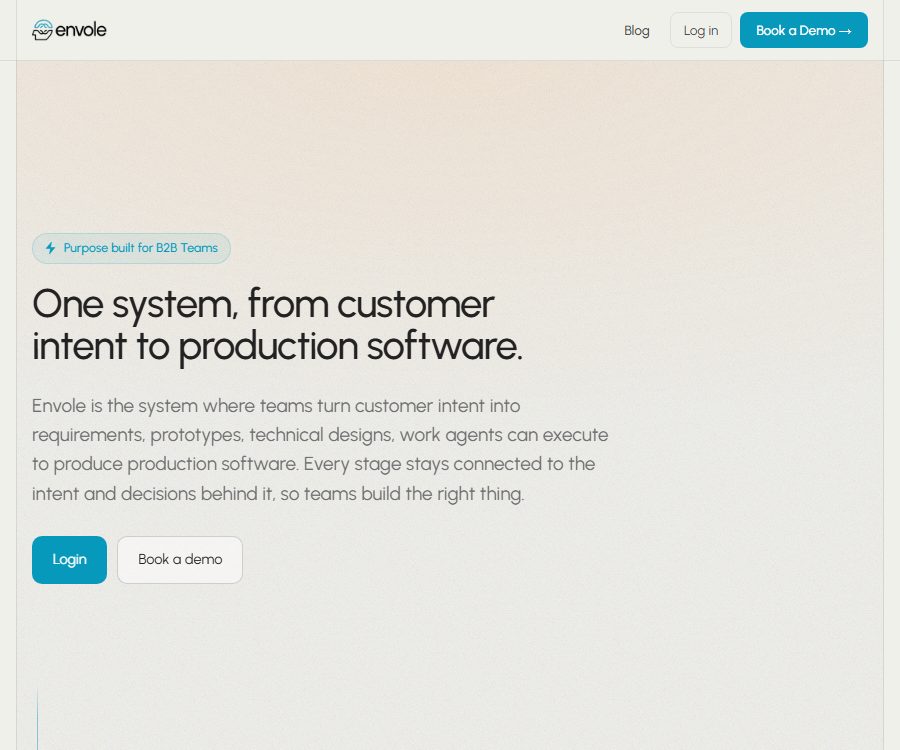
What is Envole?
Envole is an intelligent software delivery platform developed by Envole Inc., designed for B2B products, as well as for design, engineering, QA teams and AI entities involved in development processes. It integrates customer and business objectives throughout the entire process, from requirements and prototypes to technical design, task definitions, coding, reviews, testing, and feedback, thereby reducing context loss that occurs when switching between different tools.
The current product positions itself as a System of Action for Agentic Software Delivery, that is, an action system for the delivery of agent-based software. It is neither an infrastructure for continuous integration or deployment, nor is it merely project management software or new coding agents.
Current product positioning and historical documents
Envole’s current homepage focuses on the complete delivery process that goes from understanding customer intentions to delivering the software. The publicly available development documentation still primarily describes the earlier system of individual team assistants, sub-assistants, and multi-assistant collaboration; therefore, these two sets of materials represent different stages of the product development.
| Data or function layer | The form of the product as described | Current usage recommendations |
|---|---|---|
| Current product interface | Customer intent-driven software delivery system | Used to determine the current positioning and main workflows. |
| Public development documentation | Team personal assistant, sub-assistant, and assistant message APIs | Treat it as data related to the previous generation of capabilities; verify whether it is still applicable before integration. |
| Terms of Service and Privacy Policy 2025 | The old names such as AI Personal Assistants are still in use. | Legal rules still need to be followed, but product terminology may fall behind. |
This means that the assistant builder, API endpoints, and event mechanisms present in the older documents cannot be considered as part of the current functional capabilities of the delivered system. Before purchasing or developing integrations, it is necessary to have Envole clarify the current version of the product, the migration procedures, and the scope of support available.
Overview of core workflow
| Phase | Main inputs | Output | Actual value |
|---|---|---|---|
| Capture | Meetings, tickets, messages, documents, charts, emails, support conversations, and questions | Continuously updated context records | Save the customer’s original words, evidence, and the context behind the decision. |
| Contextualization | Scattered customer and business signals | Requests, decisions, risks, bottlenecks, and scope changes | Decide the next steps based on the impact. |
| Demand | Intent, constraints, and customer evidence have been confirmed. | Requirements and acceptance criteria | Clarify what needs to be done and why. |
| prototype | Approved requirements and existing product components | Runnable product prototype | Verify interactions and scope before formal development. |
| Technical design | Requirements, architectural constraints, and dependencies | Technical directions that can be evaluated | Expose trade-offs, risks, and open issues in advance |
| Work item | Approved requirements and design | Executable tasks with context | Provide clear boundaries for developers and agents. |
| Implementation and verification | Work items, code, reviews, and testing | Controlled implementation and verification results | Check whether the delivery meets the original intent. |
| Feedback | Product feedback, support issues, defects, and accidents | Next round decision context | Keep the delivery lifecycle continuously updated. |
Capturing customer and business context
The team can bring meetings, support tickets, instant messages, documents, charts, emails, and issue records into a continuously updated workspace. The system keeps track of where the content originated, when it appeared, and what decisions were made at that time, preventing requirements from remaining as mere statements without context.
- Combine customer feedback, pre-sales commitments, support issues, and internal discussions into a single record.
- Retain evidence related to the signals and their impact on customers, to facilitate review by the product team.
- Separate repeated requests from the specific needs of individual customers in order to reduce error priorities.
- Retain the original intent, responsible person, and decision-making process when requirements change.
Before accessing meeting contents and communications with clients, the team must first verify the legal basis for recording, transcription, email handling, and cross-system synchronization. When dealing with sensitive client data, it is necessary to use the minimum necessary scope and a controlled working environment.
Convert signals into actionable decisions
Envole extracts functional requests, decisions, risks, blockers, and scope changes from the captured content, and links evidence to customer impacts. The team can accept, reject, defer, or investigate these signals, or elevate them to new or existing build specifications.
- Product managers can consolidate similar issues raised by multiple customers to determine whether a common requirement has emerged.
- Design and engineering personnel can view the constraints behind a request, rather than only receiving the task title.
- The person in charge can record the reasons for acceptance, rejection, or postponement, to facilitate subsequent tracking.
- Changes in scope will continue to be related to relevant requirements, designs, work items, code, and tests.
The system provides a decision-making context, but it does not offer authoritative decisions regarding the route to be followed. Factors such as revenue impact, customer representation, implementation costs, security risks, and strategic consistency still need to be assessed collectively by the team.
Requirement definition and acceptance criteria
Envole brings customer requirements, constraints, and acceptance criteria together in the same workspace, where they can be reviewed and improved both by humans and AI agents. The requirements can be linked to actual customer signals, resulting in structured product requirement documents.
- Select the verified customer or business signals, and identify the affected users and issues.
- Add supplementary objectives, non-objectives, constraints, dependencies, and unacceptable outcomes.
- After drafting the initial version, verify each fact individually and remove assumptions that cannot be supported by evidence.
- Have product, design, engineering, and QA teams review the feasibility and testability respectively.
- Proceed to prototype and technical design only after confirming the acceptance criteria, while documenting the reasons for any modifications.
The requirements generated may overlook edge cases or interpret vague feedback in an overly specific manner. For high-risk functions, additional requirements related to regulations, security, accessibility, and fault recovery should be included; reliance solely on automated processing is not sufficient.
Generate a runnable prototype from requirements.
The platform can generate functional prototypes based on the approved requirements, making use of real products and their existing components wherever possible. The team can iterate on the interface, processes, and scope before proceeding with actual implementation, thereby making the client’s intentions clear and open to discussion.
- Use structured requirements rather than a temporary prompt as the starting point for generation.
- Reusing existing components helps to make the prototype more similar to the actual design system of the product.
- Enable product, design, engineering, and QA teams to identify and resolve misunderstandings as early as possible on the prototype.
- Modify the prototype and continue to link it to the requirements and subsequent technical design.
Prototypes are used to verify intentions and interactions; they are not equivalent to code that has undergone tests for security, performance, accessibility, and readiness for production use. Teams should not skip formal architecture reviews and quality standards just because the interface works.
Technical design and real-time review
The engineering team can document the architecture, dependencies, risks, constraints, and technical trade-offs before implementation. Human members and agents can directly comment on the design, propose changes, and resolve open issues, thereby preventing errors from going unnoticed until large amounts of code have been developed.
- Link requirements and customer impacts to specific architecture choices.
- Mark issues related to interfaces, data models, permissions, retries, rate limiting, and lifecycle management.
- Record who proposed, accepted, or resolved the design suggestions.
- Identify the work items, code, and tests that may be affected when there are design changes.
Envole can improve the design context and collaboration, but it does not replace an organization’s security reviews, threat modeling, architecture committees, or professional engineering judgment. The suggestions provided by the agents must be verified by individuals who possess the relevant responsibilities and experience.
Work items, coding agents, and implementation
The approved requirements and technical designs can be broken down into well-defined tasks with clear context, which are then assigned to developers or coding agents of the team’s choice for execution. Envole is responsible for maintaining the relationship between the upstream intentions and the downstream implementation, without requiring the team to use a specific coding tool.
- Candidate work items are generated from the approved requirements and designs.
- Check the scope, dependencies, acceptance criteria, and areas where modifications are not allowed for each task.
- Leave the work to existing IDEs, code repositories, issue trackers, or coding agents.
- During code review, examine the implementation of the corresponding requirements and technical decisions.
- Upon detecting a deviation, return to the requirements or design phase to make corrections, and update the affected tasks accordingly.
The official interface presents this workflow through Git branches, pull requests, terminals, and code repositories, but it does not guarantee that all coding tools offer the same level of bidirectional synchronization. Actual write permissions, event triggering, and rollback mechanisms should be tested in pilot projects.
Testing, validation, and feedback loop
During the testing phase, the implementation is compared with the approved intentions, designs, constraints, and acceptance criteria. This allows the team to not only determine whether the tests have passed or not, but also to track which requirements have been covered by the tests and why any changes were made.
- QA can create verification checklists and testing tasks based on the acceptance criteria.
- The code, review results, and test outcomes can be linked back to customer requests and design decisions.
- Defects, accidents, support issues, and implementation changes can be fed back into the next round of signal processing.
- When adjusting requirements, it is possible to check whether the associated prototypes, designs, work items, and validations are affected.
Passing tests does not mean that the software is free of defects, nor does it prove that the established acceptance criteria are complete. Performance, security, compatibility, as well as manual testing and production monitoring should still be handled in accordance with the team’s existing quality management system.
Tool integration and support platform
Envole is centered around a web-based workspace, and it emphasizes the continued use of the team’s existing customer systems, documents, issue tracking tools, code repositories, IDEs, coding assistants, and testing systems. The current page shows various third-party tools, but it does not disclose in detail the permissions for each connector, the direction of synchronization, or the requirements for different subscription plans.
| Category | Tools displayed | Possible contexts it can carry | It should be confirmed before deployment. |
|---|---|---|---|
| Code and development | GitHub, GitLab, VS Code | Warehouse, branches, review, and implementation | Read/write permissions, event scope, and rollback |
| Tasks and Collaboration | Jira, Linear, Asana, Slack, Microsoft Teams | Work items, messages, and decisions | Two-way synchronization, channel range, and notifications |
| Documents and files | Notion, Confluence, Google Drive | Specifications, instructions, and informational materials | Index range, versioning, and deletion propagation |
| Customers and Support | HubSpot, Intercom, Zendesk | Customer relationships, tickets, and feedback | Personal data, field mapping, and access isolation |
| Emails and meetings | Gmail, Outlook, Fireflies, Granola | Emails, meeting minutes, and transcripts | Authorized entity, retention period, and consent for recording |
The fact that a tool’s identifier is shown in the product presentation does not mean that it can be activated immediately for every account, nor does it indicate that full read and write permissions are available. When making a formal purchase, it is necessary to obtain the current list of integrated tools, information regarding permissions, instructions on how to retry in case of failures, as well as any planned restrictions.
Registration, pilot testing, and launch process
The current website provides options for logging in and scheduling demonstrations, but it does not specify the conditions under which a fully self-service setup is possible. It is better for teams to start by choosing a real delivery process for a controlled pilot project, and then gradually expand to cover the entire lifecycle.
- Schedule a product demonstration to verify whether the current version covers the required code repositories, tickets, documentation, and customer systems.
- Choose a feature with a clear scope, controllable risks, and real customer evidence to serve as a pilot.
- Define the data that needs to be synchronized, the authorized personnel, the minimum level of permissions required, and the sensitive fields whose import is prohibited.
- Connect a small number of tools to verify the tracking between signal capture, requirements, prototypes, designs, and work items.
- Have product, design, engineering, and QA conduct an end-to-end review and verification.
- Check the accuracy of the generated content, synchronization latency, access isolation, audit logs, and deletion process.
- Expand the team and the scope of data only after confirming the contract, prices, data processing terms, and support arrangements.
Suitable for users and typical use cases
- B2B product teams need to convert a large amount of customer feedback into requirements that can be reviewed.
- Research and development organizations that rely on various documents, tickets, code, and communication tools often lose context during handovers.
- The goal is to ensure that coding agents have access to approved requirements and technical designs, rather than relying solely on ad-hoc prompts.
- The design and engineering teams need to use real components to verify the product’s intended functionality before starting formal development.
- QA and delivery leads who are responsible for tracking the relationship between customer requests, the corresponding code, testing results, and feedback after deployment.
- Companies that aim to establish a repeatable process for delivering intelligent agents, while still maintaining human oversight at key points.
For small teams that have only a single code repository, few requirements, and simple collaboration structures, deploying cross-system action layers can increase maintenance costs. If the main tasks are simply writing code, managing tasks, or running CI/CD processes, it is better to consider using specialized tools first.
Product advantages
- Continuously link customer evidence and business intentions to the delivered products, rather than creating only isolated documents.
- It covers the entire process encompassing requirements, prototypes, design, work items, implementation, testing, and feedback.
- It allows humans and agents to review, comment on, and revise decisions within the same delivery model.
- It emphasizes the reuse of existing toolchains and coding agents to reduce the pressure of forced system replacement.
- A runnable prototype allows the team to identify misunderstandings regarding scope and interactions before starting formal development.
- Cross-product tracking helps determine the impact of changes and maintains accountability for decisions.
Capacity limits and usage restrictions
- Envole is not responsible for CI/CD, deployment infrastructure, or replacing existing project management systems.
- It is not a new coding agent; the actual code is still executed using the development tools preferred by the team.
- Public information does not provide quantitative figures regarding prototype creation, data synchronization, model invocation, or storage limits.
- The integrated display does not indicate the online status of each connector, its read/write capabilities, or the package requirements.
- There may be omissions or errors in the requirements, design, tasks, and testing generated by agents.
- The publicly available development documentation differs from the current product orientation, and the capabilities of the old APIs cannot be applied directly to the current version.
- Cross-system access to customer data and code expands the scope of access control and compliance management.
Prices, subscriptions, and refunds
At present, there is no verifiable public price list, free quota, or standard trial period; the website primarily directs teams to schedule demonstrations. For specific prices, seat allocations, usage amounts, support levels, and corporate terms, it is necessary to contact sales, with the details determined by the actual order.
The terms of service state that some services are billed on a subscription basis, with payment typically made on a monthly or annual basis in advance. Subscriptions are automatically renewed, and can be canceled through the account management page or by contacting support; any price changes take effect after the current billing cycle ends, and appropriate notice is given in advance.
- Paid subscriptions are generally non-refundable, except in cases mandated by law.
- Canceling the renewal does not mean a refund of the fees already paid for the current period.
- The currency, taxes and fees, seat options, minimum contract duration, overage pricing rules, and downgrade policies have not yet been made public.
- Before making a purchase, it is necessary to specify in the order the costs associated with the pilot phase, the date of renewal, as well as the services related to data export and termination support.
API, SDK, GitHub, and open-source status
| Project | Current confirmed status | Precautions |
|---|---|---|
| Current product API | Not yet officially confirmed | The endpoints, authentication, and rate limiting of the current delivery system are not clearly defined. |
| Old version of assistant API | Available in public documents | It includes session threads, SSE, human approval, and multi-assistant events; however, the suitability of this version has not yet been confirmed. |
| SDK | Not confirmed yet | No verification has been done regarding the current official SDK and version support policies. |
| Official GitHub | The public warehouse has not been confirmed yet. | The warehouse examples shown on the page are not equivalent to the publicly available source code. |
| Core products | Proprietary cloud services | The terms reserve the platform’s, software’s, design’s, and functionality-related rights. |
| MCP | Not confirmed as a product interface | The FAQ mentions that self-built systems may be connected to MCP servers, but this does not mean that Envole offers public MCP services. |
The older API documentation describes how to create sessions using the messaging API, receive responses via Server-Sent Events, handle tool approvals, and work with multiple assistants. New production integrations should not be designed based on these old interfaces unless Envole explicitly confirms compatibility.
Privacy, data training, and security
The privacy policy explains how account personal information, usage data, as well as customer data from third-party tools, knowledge bases, and communication channels that users connect to are handled. Personal information may include names, email addresses, company details, and billing information, while usage data may include IP addresses, browsers, visited pages, and diagnostic information.
- Customer data is not used to train general AI or machine learning models.
- The underlying AI service providers also commit, through agreements, not to use the service data for training models.
- Customer data is retained during the contract period and deleted upon its termination.
- Personal data is retained only for as long as it is necessary to achieve the purposes outlined in the policy and to fulfill legal obligations.
- Payment card information is processed directly by third-party payment processors; Envole states that it does not store any details of the cards.
- Data may be transferred across countries or regions, and may be disclosed to service providers subject to contractual obligations.
- Users in regions such as the European Economic Area can request access to, correction of, deletion of, restriction of, objection to their data, as well as data portability.
Envole implies the use of commercially acceptable technical and organizational measures, but it is clear that internet transmissions and electronic storage cannot guarantee absolute security. To date, no information has been made publicly available regarding encryption details, the locations where data is stored, a complete list of sub-processors, security certifications, recovery objectives, or the scope of penetration testing.
Customer content, copyright, and commercial usage guidelines
The customer retains the right to submit or have content processed through the service, and is responsible for ensuring that it has the proper authority to use and process such content. The input must not violate privacy rights, rights of publicity, copyright, contractual obligations, or any other rights of third parties.
- Do not import customer emails, meeting minutes, code, or internal documents that you are not authorized to handle into the platform.
- When creating prototypes and designs, it is necessary to verify the licensing of existing components, fonts, images, and third-party code.
- Illicit, fraudulent, harassing, deceptive, spammy, and infringing uses are prohibited.
- It is prohibited to use robots or other automated methods to access the service without permission or to interfere with the security mechanisms.
- The software, features, design, and intellectual property of the platform itself belong to Envole or its licensors.
The public terms do not provide separate copyright or commercial usability guarantees for all AI-generated outputs. When generating prototypes, specifications, or code for commercial use, companies still need to conduct reviews regarding intellectual property rights, open-source licenses, and originality.
Pre-deployment checklist
- Verify the migration and compatibility relationship between the current product version and the older assistant documentation.
- Obtain the current prices, seats, usage amounts, support options, refund policies, and termination terms.
- Verify individually the availability of the connector, read/write permissions, synchronization direction, and failure handling.
- Review data processing agreements, sub-processors, hosting locations, encryption, logging, and deletion certificates.
- Establish human approval points to prevent unapproved requirements, designs, or code from reaching production.
- Use real projects to verify tracking relationships, ensure accuracy, and identify the impact of changes.
- Set minimum permissions and retention rules for customers’ content, code, meetings, and emails.
Summary
The core value of Envole lies not in adding yet another coding tool, but in integrating customer intentions, product decisions, technical design, as well as the execution and verification by intelligent agents into a traceable delivery process. It is particularly suitable for B2B R&D organizations that have numerous tools, face complex handovers, and wish to utilize coding intelligent agents in a systematic manner.
At present, the prices, the current APIs, SDKs, security certifications, and details of some connectors are not fully disclosed; moreover, the development documentation still reflects information related to the previous generation of products. Before adoption, it is necessary to test the version through demonstrations and small-scale trials, with the terms of the contract and the actual permissions associated with the account serving as the final basis for decision-making.
Frequently Asked Questions
Is Envole an encoded agent?
No. Its role is to determine what needs to be built, why it needs to be built, how it should be designed, what changes have taken place, and how to verify those changes; the actual coding can still be carried out using the developers and coding agents preferred by the team.
Will Envole replace Jira, GitHub, or existing documentation tools?
No. The product focuses on connecting CRM, documents, issue trackers, warehouses, IDEs, coding agents, and testing systems, and it maintains a unified delivery context across these tools.
What outputs can Envole generate?
The current products cover requirements and acceptance criteria, functional prototypes, technical designs, work items with detailed context information, implementation details, testing and verification processes, as well as records of feedback. Each of these outputs still needs to be reviewed by the relevant responsible persons.
Does Envole offer public pricing and a free version?
At present, no public price list, free usage quota, or standard trial period has been identified; the main way to access the service is by scheduling a demonstration. The monthly or annual pricing, as well as the number of seats and amount of usage, are determined according to the sales quotation and the order placed.
Can the old version of the Team Personal Assistant still be used?
The public documentation still mentions team personal assistants and sub-assistants, but the current homepage focuses on intelligent software delivery systems. It is necessary to check with Envole to determine whether the old functions will be retained, migrated, or available only for existing customers.
Does Envole have an API?
The old documentation includes APIs for assistant sessions, SSE, tool approval, and multi-assistant collaboration; however, the public API terms for the current delivery system have not yet been finalized. It is necessary to obtain the current documentation and version commitments before integrating it into production.
Is Envole open-source software?
It is not a product whose open-source status has been confirmed. There is no evidence of an official publicly available source code or open-source license for the core platform, and the GitHub repository examples shown on the page do not prove that the product is open-source.
Will customer data be used to train general models?
The privacy policy clearly states that customer data will not be used to train general AI or machine learning models, and it adds that the underlying AI service providers are also bound by this commitment not to conduct such training.
How are customer data handled after the contract is terminated?
The privacy policy states that customer data is retained during the duration of the contract and deleted upon its termination. The company should specify in the contract the timing for exporting such data, the time when backups are removed, and proof of deletion.
Can I get a refund after making the payment?
The terms of service state that paid subscriptions are generally non-refundable, unless required by law. It is necessary to check the billing cycle, automatic renewal options, cancellation deadlines, and any special terms included in the order before making a purchase.
Tools similar to Envole





 Guigong Network Security Registration No. 45132202000164