






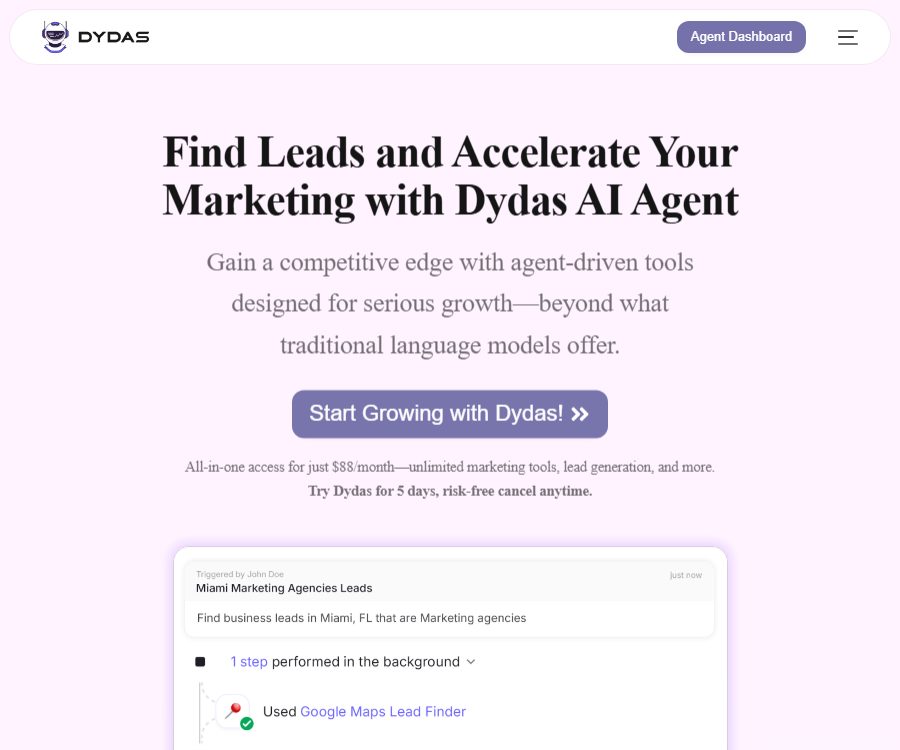
What is Dydas?
Dydas is an AI agent for web use, created by Mark Fulton; it is designed to assist with marketing tasks, sales and customer acquisition, as well as improving business efficiency. It brings together multiple language models, external data tools, and various sub-agents within a single conversational workspace, allowing users to issue tasks using natural language.
Unlike generic chat tools that merely answer questions, Dydas places more emphasis on using search, scraping, information retrieval, and content generation tools to produce specific results. It is suitable for integrating research, filtering, writing, and image creation into a single workflow, though the final output still requires manual review.
Main functions
| Functions | User input | Main output | Suitable for tasks |
|---|---|---|---|
| Web search and crawling | Topic, website address, or research requirements | Web page information, summaries, and structured research results | Market research, competitor analysis, and content preparation |
| Clue discovery | Regional, industry, position, or company requirements | List of potential customers and their qualification details | Acquiring customers locally, B2B sales, and leveraging agency networks to acquire customers |
| Trends and Content Research | Keywords, platforms, or target audience | News, trends, video, and social content insights | Topic selection, event planning, and market insights |
| SEO article generation | Theme, keywords, audience, and writing requirements | Article drafts and related marketing content | Creation of blogs, landing pages, and search content |
| Generation of social media content | Event details, brand tone, and platform requirements | Draft posts for LinkedIn, Facebook, X, and others | Multi-channel promotion and content rewriting |
| Image generation | Image description, style, and marketing purpose | AI images that can be used for content composition | Social visuals, article images, and event materials |
| Multi-tool collaboration | Natural language tasks that involve multiple steps | The result of combining models, tools, and sub-agents | An integrated workflow from research to creation |
Clue generation and eligibility assessment
Dydas allows users to search for potential clients based on industry, location, company, or job requirements, and it can utilize tools from websites, Google Maps, and LinkedIn to provide additional background information. Users should first define clearly the profile of their target clients, in order to avoid obtaining a list that is too broad and difficult to verify.
- Local businesses: Search for companies based on criteria such as city, category, and rating.
- B2B sales: Identify potential contacts based on the company’s, position’s, or business’s characteristics.
- Agency: Creates a list of potential customers for specific vertical industries.
- Competitive research: Collecting information on company websites, positioning, content, and signals from the open market.
- Criteria for identifying leads: Use predefined conditions to select those candidates who merit further manual follow-up.
- Outreach preparation: Create personalized communication drafts based on the available background information.
Search or scraping results may be outdated, incomplete, or contain objects with the same name; therefore they cannot be considered as verified customer data. Before sending emails, messages, or advertisements, it is necessary to comply with the rules of the target platform, as well as privacy regulations and anti-spam requirements.
Research, SEO, and social content
Dydas can gather search results, news, trends, videos, RSS feeds, and social media content, and then organize this information into marketing analyses or draft content. Users can specify the target audience, keywords, channels, tone, and desired actions, thereby reducing the need to switch between various separate tools.
- Organize industry topics into a list of topics, trend summaries, or observations on competitors.
- Draft structured SEO articles based on keywords and research materials.
- Rewrite the same content as post texts for different social media platforms.
- Find topics, creators, or collaboration partners from videos and social media content.
- Use prompting tools to refine vague requirements, and then pass them on to specialized agents for execution.
- Generate accompanying visual materials for articles or live content.
Whether an SEO article achieves a ranking depends on the quality of its content, the foundation of the website, the competitive landscape, and the search engine’s policies; no tool can guarantee a ranking. For news items, data, product specifications, and quotes, it is necessary to refer back to the original sources and verify each piece of information individually.
Model and tool combination
On Dydas’ current product page, the available models include GPT-4o, GPT-4o Mini, o1-preview, Claude 3.5 Sonnet, Groq, and FLUX for image processing; it is also stated that agents can access more than twenty advanced tools. The list of models and related interfaces is subject to change, and the actual range of available options should be checked in the console after logging in.
| Ability categories | The technologies or tools listed on the page | Main function | Precautions |
|---|---|---|---|
| Language and Reasoning | Models related to OpenAI, Claude, and Groq | Analysis, writing, summarization, and planning | The specific models may be updated or discontinued. |
| Image | FLUX | Generate marketing images from text | The text, characters, and brand elements still need to be checked. |
| Web page data | Search, full web page scraping, and news tools | Obtain real-time public information | Affected by website structure, access restrictions, and data quality. |
| Clue data | Tools related to maps, companies, and professional networks | Identify companies and potential contacts | It is necessary to verify the accuracy and legality of use. |
| Content tools | SEO articles and social media posts bot | Generate draft channelized content | It cannot replace fact-checking, brand verification, and compliance audits. |
The product encapsulates the models and data sources within the same agent, so ordinary users do not need to configure each external interface individually. The public page does not indicate whether it is possible to manually select all models, set limits on the usage of each tool, or define how to handle failures.
Usage process
- First, determine the objectives of the task – for example, identifying potential customers in a certain city, researching a market, or creating a set of promotional materials.
- Prepare the target region, industry, audience, brand tone, keywords, exclusion criteria, and desired output format.
- Register an account and access the web-based agent console; the subscription process requires creating a username and password.
- Describe the entire task in natural language, and clearly state the selection criteria and completion conditions.
- Agents are allowed to choose from search, scraping, clue extraction, writing, or image tools to carry out tasks.
- Check the company names, contacts, dates, numbers, quotes, and website information in the output.
- Provide specific instructions for making the changes to the inaccurate or non-compliant parts.
- Export or copy the final content and submit it to sales, marketing, or editorial staff for approval.
- Retain the data sources and records of manual approval before proceeding with outreach or official release.
Complex tasks should be divided into four stages: collection, screening, creation, and review, with the results of each stage being verified. Requiring an agent to search through a large amount of information and generate content directly can make it more difficult to identify data errors.
Input and output
| Type | Processable content | Possible output | Use boundaries |
|---|---|---|---|
| Natural language commands | Tasks, conditions, tone, and format | Planning, analysis, and content | Vague instructions reduce the stability of the results. |
| Websites and public data | Search results, websites, news, RSS, and platform data | Abstracts, lists, and research materials | Access and scraping capabilities are restricted by third parties. |
| Marketing conditions | Region, industry, position, keywords, and customer profile | Evaluation of candidate leads and eligibility | Public data does not equate to material that can be used freely for marketing purposes. |
| Content brief | Themes, brands, platforms, and action objectives | Articles, advertisements, and social media content | Fact, copyright, and brand verification are required. |
| Image hints | Subject, composition, style, and intended size | AI-generated images | The text and details may require multiple revisions. |
The available public information does not provide a complete list of the file upload formats, the maximum length of a single context, the formats for batch export, nor the list of supported languages. When dealing with content that is not in English, it is necessary to first test the search coverage, the quality of the generated text, and the accuracy of localization using actual samples.
Prices, trials, and cancellation
| Package or version | Price | Billing cycle | Core benefits or quota | Suitable for users |
|---|---|---|---|---|
| 5-day trial | No subscription fee is charged during the trial period. | 5 days | Experience the Dydas agent; payment details are required on the settlement page. | Functional verification and short-term testing |
| Dydas subscription | 88 dollars | Monthly | Unlimited access to marketing and lead generation tools | Individual marketers, small businesses, and consultants |
| Agency edition | Contact sales | Customization | Solutions for application connectivity, business process automation, and team agents | Agency firms and corporate teams |
“Unlimited” is the description given on the product page for the subscription benefits, but the available information does not specify limits regarding fair use, concurrent connections, the number of downloads, or restrictions related to third-party tools. It is necessary to check the actual limitations in the account before using the service frequently. The price and scope of application for the Agency edition need to be confirmed through demonstrations and sales discussions.
- The trial period lasts 5 days, and it is stated on the page that no subscription fee will be charged before the end of this trial period.
- Subscriptions are billed via credit card, with Stripe handling the payment processing on the billing page.
- The terms permit periodic charges and allow the service provider to adjust the subscription price.
- Users can cancel at any time; once canceled, the service can usually be used until the end of the current billing cycle.
- Fees already paid are generally not refundable, unless required by law or as specified in the terms.
- The start time of the trial period, the effective date for cancellation, and the final amount shall be as indicated on the settlement confirmation page.
Platform, API, and open-source status
| Project | Current verification status | Explanation |
|---|---|---|
| Web version | Confirmed | Provides access to the account, subscription, and agent consoles. |
| iOS and Android apps | Not confirmed yet | No official app store page was found. |
| Desktop client | Not confirmed yet | No official native desktop version was found. |
| Browser extensions | Not confirmed yet | No official extensions with verifiable identities were found. |
| Public APIs and SDKs | Not yet made public | No official documentation or key management procedures for developers were found. |
| GitHub code repository | Not confirmed yet | No official warehouse that can be confirmed as belonging to Dydas products was found. |
| Product source code | Private custody services | The terms of service designate the platform’s functions as proprietary intellectual property. |
When Dydas mentions advanced tools and external APIs, it refers to the ability of hosted products to call third-party services; this does not mean that users have access to public APIs. Nor does the presence of a GitHub icon on a page indicate that the source code of the platform, models, or agents is open source.
Suitable for users and typical use cases
- Small businesses: Research the local market, create a list of potential customers, and prepare promotional materials.
- Marketing consultant: Conducts rapid research, selects topics, and prepares initial drafts of copy for various industries.
- Agency: Handles the processes of identifying leads, creating content, and integrating business tools.
- Sales team: Gathers information on target accounts and helps determine the priority for follow-up actions.
- Content team: Combines trend research, SEO articles, and social media posts across multiple platforms.
- Independent entrepreneurs: Use a single workspace to carry out research, writing, and the preparation of graphic materials.
It is more suitable for users who can clearly describe the business requirements and are willing to conduct manual reviews of the results. Teams that need verifiable data pipelines, public APIs, self-hosted deployment options, or proof of strict corporate compliance should first carry out technical and contractual evaluations.
Main advantages and limitations
Main advantages
- Bring search, scraping, clue analysis, writing, and image generation together in a single dialogue interface.
- Natural language interaction lowers the barrier to configuring external marketing tools one by one.
- The focus is on marketing and customer acquisition tasks, rather than just general Q&A.
- The research findings can be further turned into articles, posts, and promotional materials.
- It offers individual subscriptions as well as customized options for agencies.
Main limitations
- The public page does not specify the criteria for fair use of the unlimited benefits, nor does it set limits on third-party access.
- The model list includes specific versions, which may change in the future due to adjustments on the upstream side.
- The clues and collected data may be incomplete, outdated, or not suitable for use in direct outreach.
- No public APIs, SDKs, official code repositories, or open-source licenses were found.
- No confirmed native mobile apps, desktop clients, or browser extensions were found.
- Information on enterprise security certification, encryption, data residency, and audit records is not yet available publicly.
Privacy, security, and commercial considerations
Dydas’ privacy policy states that only names and email addresses are collected for account maintenance and important updates; it also says that no data generated or processed by users is recorded or stored, except for the minimum amount of data necessary for operation. Some personal identification information may be shared with Relevance AI as part of the provision of services.
- Do not enter unauthorized lists of customers, passwords, trade secrets, or sensitive personal information.
- Clue data must be manually verified, and legitimate procedures for its processing as well as deletion procedures should be established.
- Before releasing anything to the public, check for issues related to facts, defamation, trademarks, copyrights, and platform policies.
- AI-generated images should be checked for similar people, brand logos, incorrect text, and usage scenarios.
- Users can request access to, correction of, deletion of, or export of the personal information held by the platform.
- The public policy does not specify the exact encryption algorithms, data retention periods, backup schedules, or security certifications.
The terms of service grant only a limited license for personal or internal business use of the platform, and prohibit the unauthorized copying, distribution, modification, or creation of derivative works based on its content. The terms do not clearly specify ownership of all generated results nor the scope of their use for commercial purposes; written approval must be obtained before delivering such results, using them in advertisements, or distributing them on a large scale.
Frequently Asked Questions
What is Dydas mainly used for?
It is primarily used for marketing and acquiring customers; it can be employed for web research, identifying and filtering leads, creating SEO articles, drafting social media content, and generating AI images. The intelligent system will call on different tools depending on the natural language tasks at hand.
Is Dydas a free tool?
It is not a tool that is permanently free. The current individual subscription costs $88 per month, and a 5-day trial period is available; to start the trial, payment details need to be provided.
What happens after the trial period ends?
The subscription page states that no charges are incurred before the end of the trial period, after which fees are charged according to the subscription cycle. If you do not wish to continue using it, you should confirm cancellation before the trial period ends.
Does \"unlimited\" really mean there are no restrictions at all?
The page states that there are no limits on the number of visits, but it does not specify any limits regarding fair use, concurrent access, or third-party tools. It is necessary to consult the service provider before carrying out large-scale data extraction or frequent generation of content.
Can Dydas send marketing emails directly?
The available information confirms that it is possible to identify research leads and draft outreach messages, but there is no explicit guarantee of built-in email sending capabilities. For formal outreach, compliant channels must be used, along with adherence to privacy and anti-spam rules.
Does Dydas have an API or SDK?
No API or SDK documentation available for public use has been found yet. The use of external APIs within the product does not equate to providing developer interfaces.
Is Dydas open source?
The core product is a proprietary hosting service; no source code for this product nor an open-source license has been found. The GitHub icon on the page is not sufficient to indicate that the platform is open-source.
Is it compatible with mobile apps or browser extensions?
It has been confirmed that the control panel is available via the web; no official mobile app, desktop client, or browser extension with verifiable identity has been found yet.
Will the entered content be saved?
The privacy policy states that no data generated or processed by users is recorded or stored, except for the minimum amount of data necessary for operation. Enterprise users should still verify how third parties handle such data, as well as the specific retention periods and procedures for deleting it.
Can the generated content be used for commercial purposes?
The terms permit individual or internal business use of the services, but do not explicitly grant any external commercial rights over all the content generated. Prior to delivering, advertising, or redistributing such content, written confirmation of ownership and the scope of permission is required.
Tools similar to Dydas





 Guigong Network Security Registration No. 45132202000164