






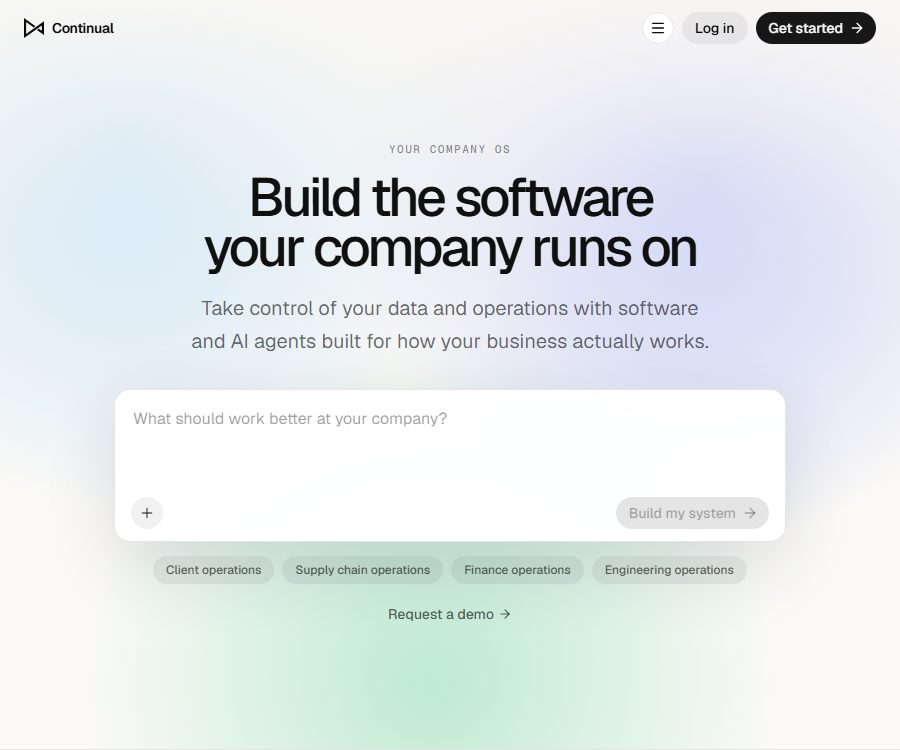
What is Continual?
Continual is a platform for enterprise software and AI agent development provided by Continual, Inc.; it is currently positioned as a kind of Company OS for businesses. Teams can create analysis tools, internal applications, and automated agents based on real business processes, without having to adapt their work entirely to generic SaaS solutions.
The current product is different from the earlier AI copilots that were centered around data warehouses; therefore, the descriptions from those earlier versions can no longer be used as a basis for describing its features. The registration page is marked as Beta, and users can apply for an account or contact sales to discuss potential use cases.
Unified business foundation
Continual places business objects, workflows, metrics, and permissions under the same governance layer, making them available for analysis, application, and use by agents. This helps to avoid issues arising from different definitions of the same customer, order, or product in various tools.
| Basic components | Management content | Primary value |
|---|---|---|
| Objects | Business entities such as customers, products, and orders | Create a shared data model |
| Workflows | Steps, approvals, notifications, and automation | Convert practical operations into executable processes |
| Metrics | Goals, metrics, and predictions | Use unified metrics for applications and agents. |
| Permissions | Access, policies, and auditing | Limiting the number of people and the operations that can be automated |
Main functions
Build business software through dialogue
- The user describes how they want the business to function, and the system uses this information to create data models, workflows, user interfaces, and agents.
- It is appropriate to start with specific business aspects such as contract renewals, supply chain disruptions, order processing, or approval processes, rather than rebuilding all systems at once.
- The structures generated by AI require business managers to examine the fields, statuses, exceptions, and approval responsibilities; natural language descriptions cannot be considered as complete requirements.
Analytics Business Analysis
- Analytical capabilities share the same data foundation as business objects and metrics, allowing views to be created based on orders, customers, inventory, or financial processes.
- Unified metrics reduce definition discrepancies between reporting systems and execution systems, while exceptions can be further handled by workflows or agents.
- The public page does not specify the types of charts, the query languages, or the frequency at which data is updated; complex BI requirements should be tested during the trial period.
Internal applications within Applications
- The platform can create workspaces and interfaces for specific tasks, enabling teams to view records, handle exceptions, complete approvals, and track status.
- It includes built-in deployment, authentication, permission management, and monitoring, which reduces the need to set up infrastructure repeatedly when transitioning from a prototype to a production application.
- Suitable for internal enterprise operation software; the capabilities for large-scale consumer applications intended for the general public, as well as information regarding regional deployment and performance limits, are not yet available.
Agents for business automation
- Agents have access to business contexts and tools with permission controls, enabling them to investigate anomalies, coordinate tasks, or carry out process steps.
- The platform emphasizes the need to maintain control over personnel; it is possible to set the results generated by agents as pending review, with authorized personnel giving approval before further action can be taken.
- The level of automation is determined by data quality, tool permissions, and the stability of third-party systems; for high-risk actions, the principle of minimum permissions and human verification should be applied.
Version and release control
- The modifications can first be placed in draft form; only after testing and approval are they released as a new version, thereby avoiding any impact on the processes that are currently in operation.
- The platform displays information on deployment, authentication, permissions, and monitoring status, which is used to determine whether the application is ready for deployment.
- Public information does not disclose the rollback granularity, the testing frameworks, or the number of environments; the strategies for making changes in production need to be confirmed within the account.
Basics of Git and Postgres
- The generated and expanded code is stored in Git, allowing engineers to examine it and make direct modifications, rather than being able to work only with closed visual configurations.
- The business data is stored in a hosted Postgres environment, which facilitates the use of common database tools and migration methods; the product’s design goal is to avoid locking the data.
- The fact that the code is accessible does not mean that the Continual platform itself is open source; the conditions regarding the backup, export, and restoration of the hosted databases still need to be specified in a contract.
Connected data and systems
| Connected object | Content that can be hosted | Typical uses | Matters to be confirmed |
|---|---|---|---|
| CRM and ERP | Customers, orders, products, procurement, and financial records | Establish operational applications and abnormal process handling. | Connectors, field permissions, and synchronization methods |
| Tables and documents | Plans, policies, records, and unstructured knowledge | Add supplementary business context and rules | Parsing format, updates, and scope of sensitive data |
| API | Internal services and data from third-party applications | Read the status or perform controlled actions | Authentication, rate limiting, error handling |
| External AI tools | Entry points for agents such as ChatGPT, Claude, Cursor, etc. | Allow external tools to access the same governance framework. | Each supplier’s data policy and scope of authorization |
Usage process
- Select a business process with clear boundaries, and define the objectives, involved roles, data objects, approval rules, and common exceptions.
- Register for a Beta account or contact sales to connect test data, and assign only the minimum necessary permissions for CRM, ERP, documents, or APIs.
- Describe the data model, workflows, interfaces, and the responsibilities of agents through dialogue, so that the platform can generate the first version of the application.
- The business and engineering teams examine fields, rules, permissions, logs, and third-party calls, and use non-production data to test normal and abnormal workflows.
- Fix issues during the draft and review stages, and release the version after confirming the deployment, authentication, permissions, and monitoring status.
- After going live, review the agent’s decisions, failed tasks, and permission usage, and gradually expand the scope of automation with new versions.
Suitable for users and scenarios
- Operations team: Creates workspaces for contract renewal, orders, procurement, supply chain management, and exception handling.
- Data team: Uses unified objects and metrics for analysis, and feeds the identified issues into executable processes.
- Engineering team: Inspects and expands the generated code in Git, and connects internal systems via APIs.
- Manager: Place approval, policies, and auditing on a shared basis, and gradually introduce controlled agent automation.
Prices, trials, and refunds
Continual does not disclose specific details regarding package costs, the number of users, database capacity, the amount of resources used by models, or the limits on agent operations. The registration process is in beta phase; whether access to a trial version is granted, as well as the features available and the duration of such access, are determined by the terms of the actual account or subscription.
| Package or version | Price | Billing cycle | Core benefits or quota | Suitable for users |
|---|---|---|---|---|
| Beta registration | Not yet made public | Not yet made public | Accounts can be applied for; the features, number of users, and limits are not disclosed. | The team responsible for evaluating the platform |
| Sales plan | Contact sales | As agreed in the subscription or order terms | Specific services, support, professional assistance, and usage metrics are specified in the contract. | Enterprises that require production deployment |
The terms state that fees are generally not refundable, and subscriptions cannot be canceled within the agreed period; invoices must be paid within 30 days of issuance, otherwise additional fees may apply or the service could be terminated. Only in specific situations such as the termination of the service due to intellectual property disputes may the remaining prepaid amount be refunded.
API, SDK, and open-source status
- The platform can be connected to APIs and external agents; the terms also state that certain subscriptions may use SDKs or command-line clients, but no current development documentation or list of stable interfaces is available.
- No official public source code repository or open-source license for the Continual product has been found; therefore, it should be considered a commercially hosted platform.
- The customer codes are stored in Git and can be expanded by engineers; however, this does not mean that the underlying platform code is available to the public.
- Third-party CRM, ERP, cloud, modeling, and payment services may have their own separate fees and terms, and a Continual subscription does not necessarily cover these costs.
Data, Privacy, and Copyright
- The terms stipulate that the customer owns the customer data, as well as the outputs derived from it and delivered as part of the service, the model parameters, configurations, knowledge base documents, and user inputs.
- Continual retains the rights to the platform, client software, and the technologies related to professional services; the ownership of any customized outputs shall be determined in accordance with the relevant order.
- The privacy policy briefing session saves the organizational context, uploaded documents, data connections, user messages, agent configurations, as well as retrieves data and generates responses.
- Personal information and usage data may be processed in the United States, or they may be handed over to services providers responsible for analysis, marketing, support, hosting, and payments.
- Customers must obtain the legitimate authority to connect business data and personal information to the platform; for personal data from the EU, an addendum regarding data processing can be requested.
- Unless otherwise specified in the subscription terms, payment card details should not be submitted; health data that is subject to HIPAA regulations requires the signing of the applicable business partner appendix first.
- The service will use aggregated or anonymized performance data to improve the products; the specifics regarding log retention, backup, data storage duration, and deletion timelines shall be specified in the contract.
Usage restrictions
- Errors may occur in the platform’s outputs and in the agents; the terms do not guarantee that the service will be available continuously without interruptions or errors, nor do they ensure that customer data will never be lost.
- It must not be used for illegal purposes, malware, fraud, harassment, infringement of rights, violation of privacy, or to provide legal, medical, or financial advice without appropriate security measures.
- Failures of third-party systems, field errors, and improper permission settings can all affect the application and its agents; the customer remains responsible for the legitimacy and quality of the data.
- The functions, interface, and limitations in the Beta phase may change rapidly; procurement for production should be based on the current accounts, orders, and technical assessments.
Frequently Asked Questions
What product is Continual now?
It is now the Company OS platform used for developing enterprise analytics, internal applications, workflows, and AI agents; it is no longer just the data warehouse copilot from earlier versions.
Is programming knowledge required?
Sales representatives can describe requirements through conversations, but the production application still requires review by engineering, data, and security teams regarding the data structures, code, permissions, and integrations that are created.
Is Continual free?
The public page does not list any free plans or price tables. It is currently possible to apply for a Beta account; the specific features available for testing, the duration of this trial period, and the payment conditions depend on the details provided in the account application or in the confirmation from sales.
Can code and data be exported?
According to the product description, the code is stored in Git while the data is kept in a hosted Postgres database; this setup facilitates monitoring and expansion. The conditions regarding full export, migration, and retention after termination need to be confirmed through a contract.
Is Continual open source?
It is not an open-source product that has been officially recognized. The fact that customers have access to their own code does not mean that the underlying platform’s source code is also open source; moreover, no official open-source license has been identified at present.
Can agents automatically perform high-risk operations?
The platform has the capability to handle workflows and invoke tools, but for high-risk operations, minimum permissions, manual approval, auditing, and fail-safe mechanisms should be in place; such operations should not be carried out in a fully automatic manner.
Tools similar to Continual





 Guigong Network Security Registration No. 45132202000164