






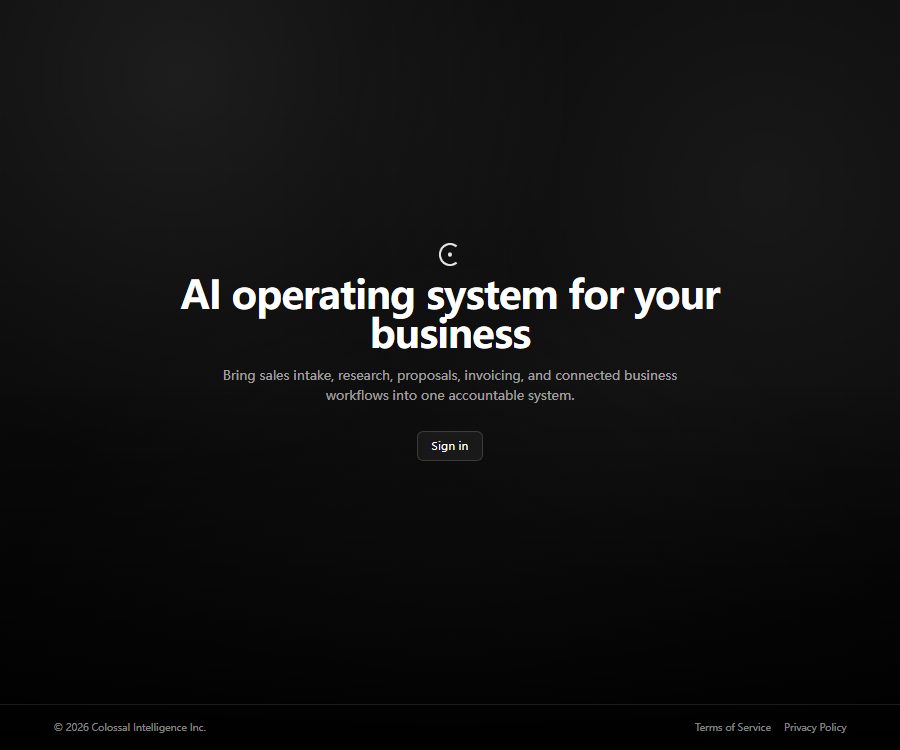
What is Colossal?
Colossal is an enterprise AI operating system provided by Colossal Intelligence Inc., a company based in Delaware, United States. Its goal is to integrate tasks such as lead management, online research, proposal creation, invoicing, and various connected business processes into a single trackable system. It also offers features related to business projects, shopping carts, customer management, checkout processes, orders, automation, and store operations.
The current brand is evolving from its initial smart business builder to a more comprehensive enterprise workflow platform. Registration for the main website is now available, but some of the marketing pages still indicate that the system is in closed beta or about to be released. Whether certain functions can be used depends on the interface and permissions available once one logs in to the system.
Main functions
Enterprise AI agents
- Agents can engage in conversations within Colossal Web applications, and they can also integrate into the existing communication processes of a team via Slack.
- It can be used for customer support, operations, marketing, and other team tasks, and allows the creation of custom agents tailored to specific businesses.
- Custom agents can combine skills, existing automations, and corporate knowledge to ensure that responses are relevant to project data and team processes.
- The Insights interface allows you to view activities, conversations, active users, messages, Token usage, as well as commonly used tools and users over a certain period of time.
Business projects and core data objects
- Project is the top-level business environment; each project manages products, prices, customers, integration, automation, and team members separately.
- The core objects include Products, Cart, Customers, Checkout, and Orders; they can be combined to form a complete purchasing process, or they can be integrated separately with existing infrastructure.
- The typical process is that the seller lists the products, the customer adds them to the shopping cart and proceeds with checkout; after the payment is completed, an order is generated.
- The project supports roles such as Owner, Builder, and Member; the Owner is responsible for managing invitations and team settings, while the Builder can use the chat and building interfaces.
Natural language automation
- The user describes the triggering conditions and desired actions in the chat, and Automation Builder combines the available connections along with the events and actions of Colossal App to create a workflow.
- Triggers include business events such as orders, products, payments, invoices, customers, and notifications, in-store shopping cart and checkout events, callbacks from third-party connections, as well as scheduled tasks.
- The steps are executed in sequence, and they support conditional branching, loops, parallel execution, as well as custom agent steps; subsequent steps can access the data that triggered them and the outputs from previous steps.
- The automated definition will be verified and saved; users can then modify it using natural language or revert to the previous version.
- Each execution records the overall and step-by-step status, as well as the input data and output of each step; the execution is persistent, and failed steps are automatically retried.
Store location, checkout, and custom domain name
- When a project is created through chat, the platform automatically assigns a free subdomain to the store, which is suitable for previewing and conducting initial tests.
- Production stores can be linked to custom domain names, and these domain settings can be accessed via the chat or posting menu.
- A store can be structured around products, variants, inventory, shopping carts, customers, and orders; the specific features available depend on the template, SDK, and project configuration used.
- Agentic Commerce, which enables AI agents to discover products and purchase them on behalf of users, is considered a area for ongoing development; protocol capabilities that are not yet available should not be treated as default functions at present.
Invoices and billing primitives
- Currently, invoices can be created manually using actions and tools, or payment requests can be generated from completed transactions or API calls.
- The invoicing functionality can be part of the Colossal business process, or it can be integrated with existing product and customer systems.
- The document describes the billing plan structures, including those based on usage, seats, fixed monthly fees, tiered pricing, packages, and a base fee plus additional charges for excess usage.
- The billing plans that allow for automatic invoice generation are still marked as upcoming, so the manual invoicing option currently available does not mean that full subscription-based billing is already in use.
Functional entry points and technical interfaces
| Functional surface | Primary uses | Suitable for tasks | Precautions |
|---|---|---|---|
| Web application | Chat, projects, teams, agents, and automated management | Daily operations by sales staff | The account visibility features may vary. |
| Slack | Invoke an agent in team conversations | Support, operation, and collaboration | It is necessary to connect to the organizational workspace and manage permissions. |
| Storefront GraphQL API | Read and write business objects | Custom storefronts and external clients | Authentication and permissions need to be set according to the project. |
| MCP | Have a compatible AI assistant read the project data. | Query products, customers, orders, and analysis data | The current document focuses on read-only data access and the creation of automation. |
| Agent Skills | Provide store SDKs, design libraries, and design extraction guidelines for encoding agents. | Use Codex, Cursor, and similar tools to create storefronts. | Skills, scripts, and dependencies should be reviewed before installation. |
| Actions and Tools | Deterministic actions or callable tools selected by the model | Automated steps and agent execution | Write operations should be carried out in accordance with approval policies. |
The workflow from registration to going live
- Register an account and check out the available functions, then create a separate testing project; do not connect to the production email accounts, customer databases, or payment systems from the beginning.
- Define the purpose of the project, assign Owner, Builder, and Member roles, and grant management rights only to the members who need them.
- Add basic data such as products, prices, and customers; first use test items to verify the shopping cart, checkout, and order processes.
- Describe a simple automation through a chat, such as notifying the team after an order is confirmed; check the generated events, steps, field mappings, and approval settings.
- Use test events to trigger the process and monitor its execution status as well as the status of each step; verify that repeated events, failed retries, and parallel steps do not result in duplicate writes.
- Create or configure agents by granting them only the knowledge, skills, connections, and tools necessary to complete tasks, and test their response and writing capabilities before integrating them with Slack.
- When a custom storefront is required, the Storefront API, SDK, or Agent Skills are used to review the generated code and dependencies in an isolated environment.
- Bind a custom domain name before publishing, and verify the processes related to permissions, payment, notifications, taxation, refunds, data deletion, and backups.
MCP access method
The Colossal MCP Server enables coding assistants that comply with the MCP authorization standards to connect directly to a project’s GraphQL API. It uses browser-based OAuth for authentication, so users do not need to copy MCP tokens; these tokens are intended solely for use with this server and cannot be reused as regular Colossal API credentials.
- Prepare clients that can support MCP and its authorization process, and add the Colossal MCP Server to those clients.
- During the first connection, the client opens a browser, logs in to Colossal, and checks the items for which access is requested as well as the associated permissions.
- After approval, the client is allowed to save the token on its own, and then connection success can be confirmed through the MCP status interface.
- First, execute read-only queries on products, customers, orders, etc., to verify project isolation and the fields returned.
- Relevant capabilities should be introduced gradually only when automation is needed, and manual approval must be obtained before any external write operations are carried out.
If external services need to use REST or GraphQL directly, a dedicated API Token should be created in the console; MCP authorization and direct API credentials are two separate mechanisms. Neither keys nor tokens should be included in public repositories, front-end code, prompt texts, or team chats.
Agent Skills and SDK
| Development resources | Current status | Function | License verification |
|---|---|---|---|
| Colossal MCP | The document has been provided. | Connects the AI assistant with project data | Managed services do not imply that the platform is open source. |
| Agent Skills | Public warehouse | Store setup, design libraries, and design extraction | The open-source license at the warehouse level has not been confirmed. |
| Storefront SDK | Public repositories and documents | Calling store capabilities in a React application | The open-source license at the warehouse level has not been confirmed. |
| Apps SDK | Public warehouse | Build platform-native integration | MIT License |
| Initial store launch project | Public warehouse | Quickly create a Vite store | Permits and dependencies need to be checked on a per-warehouse basis. |
| Colossal core platform | Not open source | Managed agents, business, and automation services | Making the SDK and skills available publicly does not mean making the source code of the product available. |
Agent Skills can be installed on compatible tools such as Claude Code, Cursor, Codex, and Gemini CLI, providing agents with the capabilities to use Storefront SDK as well as to handle design assets and store design workflows. When these skills include executable scripts, it is necessary to review their content, network access rights, file writing permissions, and any third-party licenses before installing and running them.
Price and payment status
Colossal currently does not have a public pricing page, nor are there any official subscription prices available. The terms of service state that it is possible to access some or all of the functions without any explicit pricing or subscription requirements; in the future, subscription models, pay-as-you-go options, automatic renewal, or contract-based services might be introduced.
| Package or version | Price | Billing cycle | Core benefits or quota | Suitable for users |
|---|---|---|---|---|
| Currently publicly accessible | Not yet made public | Not yet made public | Registration is possible; however, there are no standardized specifications regarding the free features available, the number of items, the usage limits, and account permissions. | Individuals and teams on the evaluation platform |
| Self-payment in the future | Not yet made public | Disclose at the time of purchase | Options may include subscription, pay-as-you-go, automatic renewal, or trial; the actual benefits are displayed before settlement. | Customers who require continuous use of the service |
| Organizational contract | Contact sales | As agreed in the order or contract | Functions, usage amounts, prices, data processing, and service commitments are determined by the signed documents. | Organizations with requirements regarding procurement, compliance, and service support |
If a paid service for the future is selected, the price, billing cycle, included usage volume, options for renewal, as well as the procedures for trying out the service and canceling it should be displayed before payment is made. Unless otherwise specified in the purchase details, the agreement signed, or applicable laws, the payment obligation once incurred cannot usually be cancelled, and any amounts already paid are non-refundable.
Future subscriptions will be renewed automatically only if the renewal terms are clearly stated at the time of registration; the date on which cancellation takes effect is specified on the purchase page. Since there is no unified public price available at present, it is not possible to determine the free usage amount, subscription cost, or refund deadline based on the old \"free premium\" label.
Suitable for users and typical use cases
- Business teams that need to consolidate leads, research, proposals, invoices, and internal follow-ups in a trackable system.
- Business operators who wish to use natural language to create order notifications, inventory checks, customer segmentation, and scheduled reports.
- Brands, e-commerce platforms, and digital product teams that require basic functionalities for products, shopping carts, checkout processes, orders, and invoices.
- I hope to deploy a corporate knowledge bot in Slack, as well as to see the support or operations teams that can provide insights based on its use.
- Developers who wish to enable coding agents to use real business data through MCP, GraphQL APIs, SDKs, and Skills.
Advantages and capabilities boundaries
- The platform brings together agents, data objects, automation features, and development interfaces within the same project, which facilitates tracking the process from a conversation to the execution of actions.
- Automated natural language generation can lower the barriers to configuration, but event selection, field mapping, idempotency, approval processes, and exception handling still require manual verification.
- The document lists features that are already available, those in closed testing, those about to be released, as well as features part of the roadmap; therefore, future capabilities such as Billing Plans or Agentic Commerce cannot be considered available by default.
- AI-generated outputs may be inaccurate, incomplete, biased, outdated, or similar to those produced by other systems; they should not be used as the sole basis for making important decisions regarding employment, housing, credit, insurance, healthcare, etc.
- Services may be subject to restrictions imposed by the provider, volume limits, and maintenance activities; there is no guaranteed level of service in the absence of a signed agreement.
- Agents and automation systems may send messages, create records, or initiate payment-related processes; therefore, mechanisms for design approval, authorization, and cancellation must be established before they are put into use.
Copyright, Export, and Commercial Use Notes
- Users retain their original rights to the customer content they possess, and are responsible for obtaining the necessary permissions to access business records, emails, files, and third-party content.
- Within the limits permitted by law, Colossal will transfer to the user its rights regarding the Output generated specifically for that user.
- This transfer does not include third-party content, cited materials, Colossal technology, models, templates, prompting methods, existing materials, or usage data.
- The platform does not guarantee that the outputs are copyrighted, unique, accurate, or free from infringement; similar outputs may also be provided to other users.
- The service license permits use only by legitimate individuals for internal purposes; it is not allowed to sell, relicense, rent out, copy it, or use it to create competitive services without explicit permission.
Privacy, model training, and data retention
The privacy policy covers accounts, organizational roles, customer content, connected services, technical logs, and AI workflow data. Customer content may include contacts, emails and attachments, CRM data, proposals, invoices, documents, calendars, reminders, chats, feedback, and outputs.
Model processing and training
- Except for excluded data, agreements signed, or legal restrictions, Colossal may use eligible customer content, inputs, outputs, feedback, publicly available web materials, and interaction data to develop, train, fine-tune, test, evaluate, and improve its own models and products as well as those of its affiliated entities.
- Authorized employees and service providers may select content for review regarding labeling, quality, safety, support, and model improvement; deleting the original content does not necessarily require retraining or removing the information that the model has already learned.
- Google Workspace API data and the information derived from it are excluded from sharing or use in the training of general models, and are subject to stricter Limited Use restrictions.
- The platform states that it will not voluntarily include customers’ content in the general training programs of third-party model providers, unless explicit permission is given through subsequent notification, approval, or the signing of an agreement.
OpenAI and external research
- For tasks such as generation, extraction, classification, chatting, analysis, and web research, prompts, messages, business records, email or proposal excerpts, as well as file contents, are sent to OpenAI as required.
- The request specifies that the response status intended for retrieval should not be saved, but this does not mean that no data will be retained. When this policy takes effect, either Zero Data Retention or Modified Abuse Monitoring is not enabled for this item.
- OpenAI’s abuse monitoring logs may contain prompts and outputs and are retained for up to 30 days; the encrypted version of prompt caches may be kept for up to 24 hours, with specific rules governed by the provider’s policies and exceptions.
- Requests for the analysis of public web pages only send the available business lead identifiers; no summaries of opportunities, original email threads, or attachments are sent. Private opportunity details are handled by a separate request that disables web page searching.
Retention, security, and user responsibility
- The data retention period depends on the type, sensitivity, functionality, account status, organizational guidelines, backups, provider, and legal requirements; there is no fixed number of days specified publicly.
- Security, anti-fraud, billing, delivery, and audit records may remain after an account or business content is deleted, and backups can also persist until they are normally overwritten.
- The platform employs security measures such as authentication, role-based authorization, control over tenants and teams, data encryption during transmission, restrictions on credentials, logging, and lifecycle checks, but it does not guarantee absolute security.
- Restricted data such as regulated health data, complete card details, financial account credentials, authentication secrets, government identification information, precise location data, and child-related information should not be submitted proactively, unless the corresponding workloads and controls are explicitly approved through the signing of an agreement.
- Organization administrators can manage users, permissions, connections, and organizational content; they can also access, retain, export, transfer, suspend, or delete information related to organization accounts.
Platform support
| Platform or channel | Current status | Explanation |
|---|---|---|
| Web application | Already provided | Registration, login, projects, chat, and management – the main entry points |
| Slack | Document confirmation | Use agents in team conversations |
| MCP client | Already provided | An AI coding assistant that supports compliance with the MCP authorization standards. |
| GraphQL API | Already provided | Used for reading and writing data by stores and external clients |
| Native mobile apps | Not confirmed yet | The official clients for the App Store or Google Play have not been confirmed. |
| Browser extensions | Not confirmed yet | The official expansion store version has not been confirmed. |
Summary
Colossal is suitable for teams that wish to combine business data, enterprise agents, and executable automation, especially in scenarios where there are needs related to physical stores, orders, invoices, or Slack-based collaboration. Its technical foundation is fairly solid, but the product is still in rapid development; its pricing and certain aspects of its roadmap have not yet been finalized.
Before officially integrating the service into operations, it is necessary to first use a separate project to test permissions, write operations, payment processes, automated retry mechanisms, and the quality of outputs; only after that can a decision be made as to whether to connect real email addresses with customer data. Enterprise users should also sign agreements to clarify aspects such as prices, refunds, data processing, retention periods, third-party handling, and service levels.
Tools similar to Colossal





 Guigong Network Security Registration No. 45132202000164