






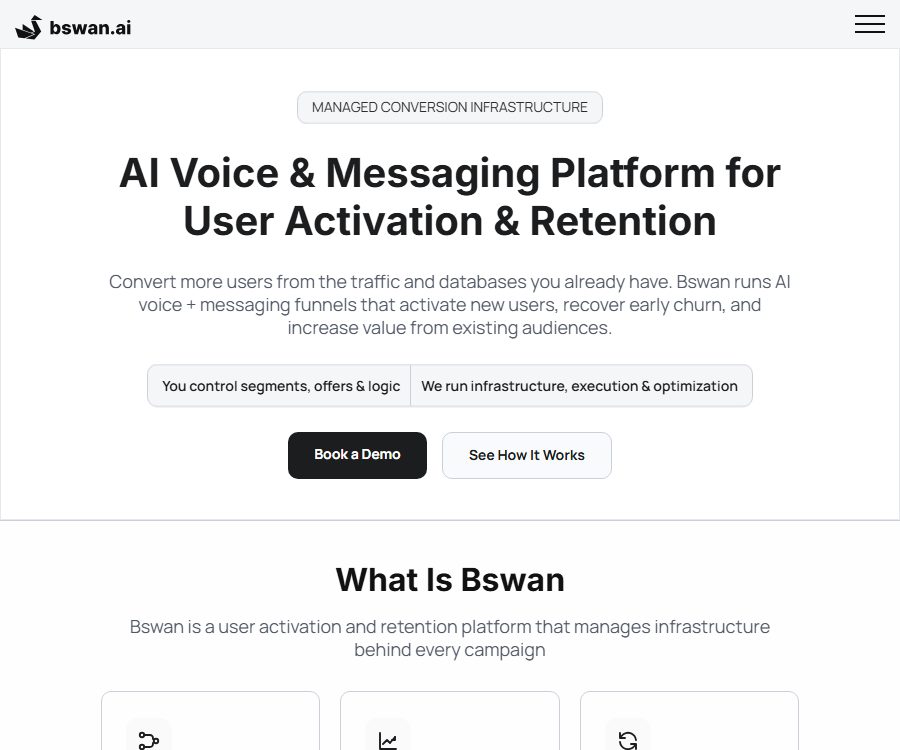
What is Bswan AI?
Bswan AI is an enterprise-level platform for user activation, retention, and reactivation, operated by BSWAN AI LTD; it is used to manage existing registered users and customer databases in companies.
It constitutes a multi-touchpoint campaign through AI-powered voice, SMS, email, and messaging, and it handles telecommunication routing, delivery, attribution, and optimization; it is not a general-purpose personal chatbot.
Main functions
- AI voice outbound calls: Conduct two-way conversations based on grouping, user status, language, and campaign objectives; handle common objections during the dialogue, record feedback, or transfer calls to human agents.
- Multi-touchpoint messaging: Combines text messages, emails, WhatsApp, etc. before and after the voice call to provide users with details on offers, links to take action, or reminders for the next steps.
- Audience segmentation: It takes in fields such as registration status, activity level, time since churn, preferences, and value provided by customers, in order to direct different groups of people to appropriate scripts and follow-up processes.
- Activity scheduling: A complete funnel is established based on goals, discounts, timing, scripts, messages, and termination conditions, to ensure that not all contacts receive the same content.
- Communication infrastructure: Managing telephone lines, calling numbers, routing, sending services, and alternative paths, while adjusting delivery strategies during peak usage periods.
- Approval before launch: Customers can test the AI-powered calls, check the SMS messages, discounts, audience rules, and business logic; the campaign is only launched after confirmation.
- Conversion tracking: Links calls, messages, replies, cancellations, and conversions to campaigns, segments, and user identities, allowing for the analysis of funnel performance in the backend.
- Ongoing optimization: Scripts, routing strategies, offers, and follow-up processes are adjusted based on actual delivery, conversation, and conversion data; activity-level A/B testing is supported.
- CRM and API integration: Synchronize grouping through interfaces, trigger recurring activities, and send the results back to the CRM or internal analysis systems.
- Private deployment: Organizations that require greater control over their data, infrastructure, or compliance aspects can negotiate a deployment solution within their own environment.
Input and output
| Stage | Enter | Processing | Output |
|---|---|---|---|
| Audience preparation | Contact, grouping, and behavior fields synchronized via CSV or API | Deduplication, verification of consent and block lists, field encryption | The target user group authorized to access the event |
| Event design | Business objectives, discounts, language, time, scripts, and stop conditions | Configuration of voice and message paths, routing, and follow-up logic | Activity plans that can be previewed and approved |
| Activity execution | The audience and communication rules have been approved. | Reaching out via AI calls, text messages, emails, or messages | Call results, replies, feedback, appointments, transfers, or cancellation |
| Attribution analysis | Communication records, user identifiers, and business conversion events | Associate the contact results with clustering, activities, and conversions. | Funnel, conversion, campaign performance, and feedback data |
Which fields can actually be uploaded, what languages and accents are allowed, and which channels can be used in the target region – all of these aspects need to be specified in the project plan and the appendices related to data processing.
Complete usage process
- Schedule a demonstration and provide details on the industry, target region, audience size, objectives for activation or reactivation, as well as the existing CRM environment.
- Select scenarios such as registration activation, recovery of early churners, user retention, or reactivation of inactive users, and define measurable business conversion events.
- Customers select the audience that has been legally gathered and for whom contact is permitted, and use options such as cancellation of subscriptions, prohibition of contact, and industry-specific restriction lists.
- Sign the confidentiality and data processing agreements, upload the CSV files via the secure portal, or set up APIs for repeated cluster synchronization.
- Jointly determine the discounts, call scripts, message content, language, numbers, number of contacts, manual transfer, and termination conditions.
- Listen to the audio in the background and review each message, as well as the routing and activity logic, to obtain approval from the internal legal and compliance teams.
- Start on a small scale and examine delivery rates, call quality, user feedback, cancellation rates, and conversion data, before deciding whether to expand the scale.
- Send the results back to CRM, continuously review the scripts, groupings, and A/B tests, and delete the activity data at scheduled intervals.
Suitable for users and typical use cases
- iGaming operators: Reach out to players who have registered but not completed their first deposit, those who have left temporarily, or those who have been inactive for a long time, while adhering to self-exclusion and regional regulations.
- Trading and fintech platforms: Remind users who are registered but have not yet completed identity verification, fund deposit, or activation of key products.
- Travel platforms: recover unfinished bookings, promote seasonal offers, and provide further access to users who show clear interest.
- Medical service providers: They send appointment reminders, follow up in case of missed appointments, and conduct follow-up visits with patients, all after obtaining the necessary authorization.
- A team dedicated to customer retention, equipped with a mature CRM system: AI-powered voice messages serve as an additional means of communication in addition to existing emails, text messages, and push notifications.
- Enterprises that require a controlled communication infrastructure: Bswan is responsible for managing the lines, routing, numbers, and the execution of tasks, while the internal team retains the authority to make business decisions and provide approvals.
Platforms, Channels, and Deployment
| Method | Uses | Current status | Precautions |
|---|---|---|---|
| Enterprise website backend | Configure agents, upload contacts, approve activities, view reports and balances | Already provided | Some accounts require business and risk verification. |
| AI voice | Inbound or outbound two-way calls, eligibility checking, scheduling, and manual transfer | Already provided | Subject to restrictions regarding phone numbers, regions, and recording laws. |
| Text messages and emails | Batch reminders, discount details, and multi-touchpoint follow-up | Already provided | There must be a legal basis, and cancellations must be handled properly. |
| Messages such as WhatsApp | Dialogic follow-up after the call | Configure by project | Subject to constraints such as channel accounts, template approvals, and regional policies. |
| CSV upload | Import audiences in one go or in batches | Already provided | Customers should first filter, remove duplicates, and apply the blocklist. |
| API Integration | Synchronized grouping, automatic activation of tasks, and transmission of results | Enterprise access | References for public APIs and rate limits have not been released yet. |
| Private deployment | Run on infrastructure controlled by the customer | Negotiable | The scope, operation and maintenance, as well as the boundaries of responsibilities are determined by the contract. |
| Native mobile apps | iOS or Android client | Not confirmed yet | No official app store page was found. |
Prices and billing
| Package or version | Price | Billing cycle | Core benefits or quota | Suitable for users |
|---|---|---|---|---|
| Usage mode | Custom quote | Use in accordance with the amounts stipulated in the contract. | Calculated based on the number of users, data volume, channels, region, and deployment method. | Companies that hope to see costs change in line with the actual scale of their activities |
| Activation Fee mode | Custom quote | Activate the results or projects as specified in the contract. | Designed around the objectives of the campaign and the number of silent users | Teams measured by the results of activation or reactivation |
| Managed events | Contact sales | By project or contract | Activity design, communication infrastructure, execution, tracking, and optimization | Companies that lack internal capabilities for voice and telecommunications operations. |
| API Integration | Contact sales | Customization | Repeated cluster synchronization, automated tasks, and result feedback | Organizations that already have a CRM or data platform |
| Private deployment | Contact sales | Customization | The data, infrastructure, compliance requirements, and operational scope are determined as specified in the contract. | Organizations with strict regulatory requirements or high data control needs |
The platform does not disclose a fixed monthly fee, a price per call, a price per message, a minimum usage amount, or any free trial period; the costs vary depending on the size of the audience, the channel used, the region, the level of complexity in deployment, and the nature of the campaign.
The account may use a prepaid communication balance, and taxes are usually not included in the price; before signing a contract, it is necessary to clarify the costs related to failed calls, retries, numbers, recording, third-party communications, and implementation.
Main advantages
- By placing AI conversations, telephone lines, message sending, routing, and attribution within a managed execution layer, the need for companies to establish their own communication infrastructure is reduced.
- Customer approval is required before the campaign is launched, which is suitable for telemarketing scenarios where business, brand, and compliance aspects all need to be taken into account.
- It is possible to gradually shift from CSV pilots to API automation, thereby reducing the barriers associated with the need for full integration in initial projects.
- The results of calls and messages can be linked to actual business conversions, facilitating the comparison of the real impact of different customer groups, scripts, and offers.
- A private deployment option is provided, offering an alternative delivery method for organizations that need control over their infrastructure and user data.
Capacity limits and risks
- The platform does not verify whether the contact data is legitimate on behalf of the customer; the customer remains the one in control of the database and is responsible for ensuring that the contacts are valid.
- Unauthorized automated calls, spam, lists purchased or obtained illegally, harassment, and circumventing telecommunications protection measures are all prohibited.
- Rules regarding call recordings, marketing consent, silent lists, contact hours, and AI identity disclosure vary depending on the country, industry, and channel.
- AI conversations may generate inaccurate or inappropriate content; manual review is necessary when such conversations involve promotional terms, financial activities, or health information.
- Disruptions, suspensions, or policy changes to third-party telecommunications, cloud, email, and CRM services can affect delivery and the progress of activities.
- Case conversion rates and revenue come from specific segments, regions, and campaigns, and cannot be used as guaranteed outcomes for other customers.
- High-risk areas, large-scale uploads, or a sudden increase in usage may trigger additional identity, business, and risk assessments, resulting in delays in the initiation of activities.
API, SDK, GitHub, and open-source status
| Project | Current status | Explanation |
|---|---|---|
| Enterprise API | Accessible | Used for audience synchronization, automation of repetitive tasks, and feedback on business outcomes |
| Public API documentation | Not yet made public | No public references available for authentication, fields, Webhooks, and rate limiting. |
| Official SDK | Not confirmed yet | No verifiable official versioned client library was found. |
| Official GitHub product code | Not confirmed yet | No public source code repository corresponding to the current enterprise platform was found. |
| Open-source product | No | The rights to the platforms, software, and models belong to BSWAN AI or its licensors; customers are granted a limited license for use. |
Privacy and data security
- BSWAN AI LTD can act as the data controller in matters related to accounts, billing, communication, analysis, and security; its headquarters are located in Cyprus.
- When customers upload contact information, phone numbers, email addresses, customer records, scripts, and activity data, the customers are the controllers, while Bswan acts as the processor to provide the services.
- Before the first transmission, the customer must verify the legal basis, provide consent, sign the data processing appendix, and apply the blocklist first.
- The platform states that the data uploaded is encrypted within the processing pipeline; phone numbers are encrypted by default, while other fields that are uploaded can be encrypted depending on the specific project.
- Transmission takes place over encrypted connections, and access control, authentication, and internal access restrictions are employed; however, no system can guarantee absolute security.
- The data may be processed by cloud, telecommunications, email, payment, and analysis service providers, or it may be transferred outside the European Economic Area through standard contract clauses.
- The privacy policy does not specify the exact number of days for which all data is stored; data uploaded by users can be deleted upon termination of the account, at the user’s request, or in accordance with the established retention policies.
- According to the activity plan, the lists and call recordings are to be deleted after the event is over, in line with the project schedule; the company must specify the deadline for this deletion, as well as provide proof of the backup and deletion processes, in the contract.
- Data subjects may, in accordance with the law, request access to their data, its correction, deletion, restriction of processing, objection to such processing, and data portability.
Copyright, commercial use, and refund guidelines
- The platforms, software, models, and content available on these platforms are owned by BSWAN AI or its licensors; companies are granted only a limited, non-exclusive license to use these services.
- The terms do not specify in detail the ownership of customer scripts, recordings, analysis results, and AI-generated content; these aspects should be clarified in the contract during formal procurement.
- Customers must ensure that the use of databases, promotions, brand materials, and scripts for commercial purposes is authorized legally.
- Unless otherwise agreed or required by law, fees are non-refundable and taxes are charged separately; the rules regarding cancellation of the project, unused balances, and early termination must be specified in the order.
- In the event of suspected misuse, the prepaid balance may be frozen during the investigation, and it could be used to cover telecommunications fines, denial of service costs, or losses resulting from fraud.
- Upon termination, the activities will cease and access will be revoked; the further handling of data and balances depends on the retention policy, investigations, and corporate contracts.
Summary
Bswan AI is suitable for companies that have a large number of compliant contacts, clear conversion goals, and need AI-powered voice and messaging approaches for reaching those contacts; it is not a self-service calling tool intended for individuals.
The key aspects when making a choice should be the mechanisms for approval and cancellation, regional communication rules, approval processes for events, data deletion, attribution methods, and a comprehensive quote for the project.
Tools similar to Bswan AI





 Guigong Network Security Registration No. 45132202000164