






What is API Intelligence?
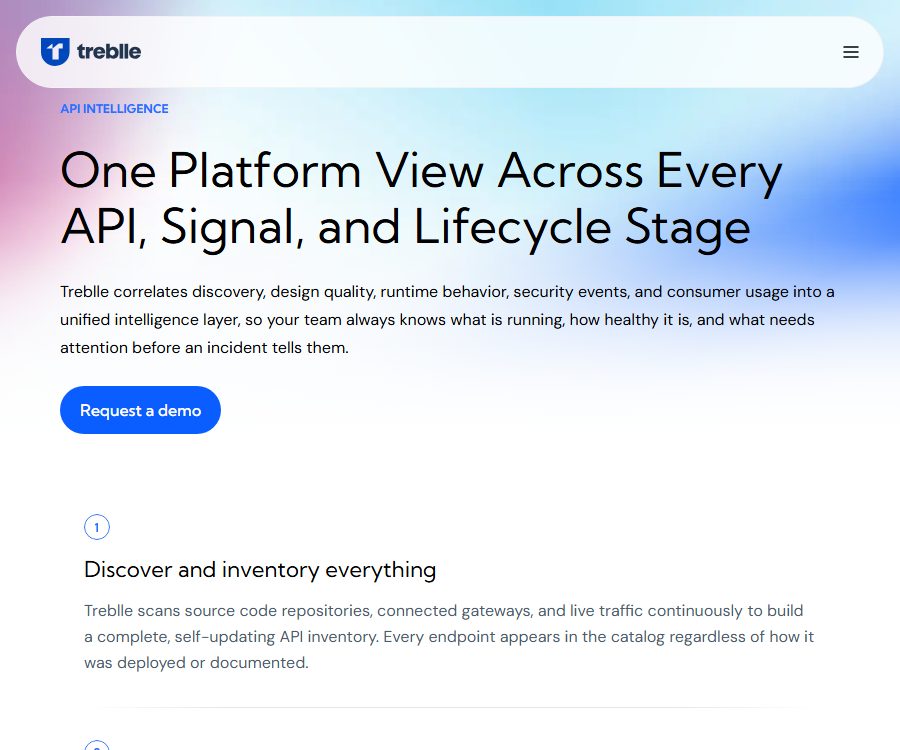
API Intelligence is a unified intelligent solution provided by Treblle for enterprise API teams. It brings together API discovery, design quality, operational performance, security incidents, documentation, compliance aspects, as well as data related to user usage, all in one platform.
Traditional monitoring primarily checks whether an interface is online, what the latency is, and how many errors occur. API Intelligence, on the other hand, connects different signals together to help teams understand the reasons behind risks. It is not a standalone, general-purpose AI chat tool.
Main functions of Treblle API Intelligence
Unified API discovery
Treblle continuously scans code repositories, API gateways, and actual traffic to create an automatically updated list of APIs. Even if interfaces are not fully registered or documented, they can still be identified through deployment and traffic data.
Global API view
The Holistic Overview provides a centralized view of APIs across different teams, environments, clouds, and gateways. Platform administrators can view the number of APIs, their health status, and any distribution patterns at an organizational level.
Automatic API scoring
The system assigns automatic scores based on criteria such as design quality, operational performance, security status, completeness of documentation, and compliance level. These scores help determine priorities, but they should not replace concrete evidence of specific issues.
Composite API Heartbeat
The Composite API Heartbeat combines multiple dimensions to generate a signal indicating the readiness of the system, and this signal is updated continuously as new data becomes available. Teams can thus monitor trends rather than relying on just a single static assessment.
Real-Time API Vitals
Real-time performance metrics include latency, error rate, and throughput, and they directly affect the API health score. Sudden increases, fluctuations, and regional differences still require analysis in conjunction with infrastructure monitoring.
Design-to-Runtime
This capability compares the OpenAPI design with the actual behavior in production, identifying any discrepancies between the expectations and what actually happens during operation. It helps to detect new endpoints that are used to bypass reviews, as well as changes in fields and deviations in implementation.
Cross-signal safety analysis
Treblle links security findings to design quality, consumer behavior, and operational performance, thereby providing a more comprehensive view of the associated risks. High-risk findings still require security engineers to determine the attack vectors and their impacts.
Consumer Intelligence
Consumers can intelligently identify callers, integration types, and abnormal usage patterns, which helps determine which clients are contributing to failures or security risks. When collecting consumer data, it is necessary to comply with privacy and contractual requirements.
Predict risk
Predictive Risk Detection uses scoring trends, traffic growth, security status, and design drift to identify APIs that may be deteriorating. Predictions can only serve as a warning; they do not guarantee that a particular event will occur or will not occur.
Management Dashboard
Executive Dashboards convert API health, compliance trends, security risks, and adoption levels into formats that are easy for management to understand. The technical team should still retain the underlying metrics and evidence of requests.
Other platform capabilities of Treblle
- API Observability: Monitor requests, responses, errors, latency, and throughput.
- API Documentation: Generate and maintain interface documentation based on the actual endpoints.
- API Analytics: Analyze performance, usage, and consumer behavior.
- API Testing: Conducting interface testing and verification from the platform.
- API Security: Detects threats and correlates request context.
- API Governance and Compliance: Implementing quality standards and compliance checks.
- API Catalog: Provides a centralized display of the organizational API assets that are available.
- Agentic AI and API Assistant: Provide AI-assisted capabilities in advanced solutions.
Two access methods
| Access method | Suitable scenarios | Features |
|---|---|---|
| SDK integration | New API, small and medium-sized teams, service-by-service integration | With the addition of application middleware, there is more metadata available and the configuration options are more detailed. |
| API gateway integration | Enterprises, multiple APIs, centralized infrastructure | Automatic discovery and monitoring at the gateway layer, reducing the need to modify the code manually for each case. |
| GitHub App | Teams that need to locate APIs in the warehouse | Scan the selected warehouse, conduct AI-based review, and provide improvement suggestions. |
Supported development frameworks
The official SDKs are available for various ecosystems such as Node.js, Python, PHP, Java, .NET, Go, and Ruby. Common frameworks include Express, NestJS, FastAPI, Django, Flask, Laravel, Spring Boot, and ASP.NET Core.
Supported API gateways
The official documentation lists AWS API Gateway, Azure API Management, Kong, MuleSoft, WSO2, Traefik, and Apigee. Different gateways have varying requirements regarding deployment permissions, data capture, and versioning.
Treblle usage tutorial
- Create Treblle accounts and workspaces to plan for development, pre-release, and production environments.
- Choose among SDK, API gateway, or GitHub App as the integration method.
- Add the API name, base address, framework, and environment type.
- Obtain the SDK Token and API Key from the console, and store them in the key management system.
- Configure default and custom masking rules for sensitive fields.
- Send a request in the testing environment to confirm that the data appears on the dashboard.
- Check the endpoint list, request details, errors, delays, and auto-documents.
- View API ratings, Heartbeat, security, and drift detection.
- Set up alerts for key metrics and invite relevant team members.
- After confirming the costs and privacy requirements, gradually expand production coverage.
Ways to improve the quality of monitoring
- First, connect to the non-sensitive services to verify the configuration of masks and blocking paths.
- Do not send tokens, passwords, card numbers, or identity data to the logging platform.
- Set exclusion rules for health checks and high-frequency, unimportant endpoints.
- Retain environment, version, consumer, and deployment identifiers to facilitate the tracking of changes.
- Connect API alerts to the duty and incident management processes.
- Regularly compare the OpenAPI specifications with the actual endpoints in order to eliminate shadow APIs.
Which teams are suitable?
- Companies that need to view their multi-cloud and multi-gateway API assets in a unified manner.
- The platform engineering team responsible for API observability, governance, and security.
- Architecture teams that wish to identify API and specification drift in shadow systems.
- The person responsible for reporting on the health of APIs and their level of adoption must inform management.
- Engineering teams that are responsible for maintaining critical business APIs and need to predict risks.
- Small and medium-sized API teams that wish to generate documents, conduct analyses, and run tests quickly.
Product advantages
- Place discovery, design, operation, security, and consumer signals in the same view.
- SDK and gateway types of access solutions are suited to organizations of different sizes.
- Heartbeat summarizes the overall production readiness using a trend signal.
- It supports multi-cloud, gateway, and on-premises deployment scenarios.
- The official GitHub provides SDKs in multiple languages, a CLI, and some integration code.
Usage restrictions and precautions
- The SDK captures the request and response data and sends it to Treblle for analysis; data classification must be completed first.
- The default mask cannot cover all business-sensitive fields; it is necessary to add organization-specific rules.
- Automatic scoring and risk prediction can lead to false positives or false negatives; it is necessary to take into account the original request as well as infrastructure metrics.
- Monitoring agents and gateway plugins should first be tested under load to determine their impact on latency, memory, and queues.
- Shadow APIs rely on code, gateways, or actual traffic; interfaces without visible signals may be missed.
- The current price page shows different packages compared to the earlier billing documents, so the old prices cannot be used.
- Making the SDK or CLI available publicly does not mean that Treblle’s full commercial platform has been open-sourced.
Treblle API Intelligence pricing
As of August 26, 2026, the official pricing page lists three tiers: Core, Growth, and Enterprise. The Core tier is billed on an annual basis, while custom quotes are required for the other two tiers. Taxes, discounts, and contractual benefits are specified on the settlement page or in the quote.
| Plan | Price | Capacity | Key capabilities |
|---|---|---|---|
| Core | $ | 1 workspace, 5 APIs, 500 requests per minute, 5 million requests per month, 30 days of retention | API Intelligence, documentation, analytics, testing, and observability |
| Growth | Custom quote | 1 workspace, custom API and requests per minute, 50 million requests per month, custom retention period | All Core capabilities, plus API Security and Agentic AI |
| Enterprise | Custom quote | No limits on work areas or requests per month; the number of APIs and the retention period can be customized. | All capabilities of Growth, including SSO, local or BYOC options, API Assistant, and enterprise support. |
The monthly cost of Core is calculated based on an annual contract; if the price remains at $233 per month throughout the year, the annual amount would be $2,796. However, the actual amount deducted shall be as specified in the settlement page of the contract.
Explanation of old price information
The official billing documents as of March 2026 still list the old tiers of Free, Starter, Team, and Enterprise, which are different from those shown on the current pricing page. The prices listed in the document should be those from the current pricing page at the time of verification; the prices in the old documents cannot be considered as the current package prices.
Safety and compliance
Treblle enables the masking of passwords, API keys, card numbers, and other fields at the SDK or gateway level, and allows for the addition of custom keywords. Teams can also prevent certain endpoints from being monitored.
The official documentation lists the certifications or compliance statements related to ISO 27001, SOC 2, GDPR, CCPA, PCI DSS, and HIPAA. When making a purchase, companies should still obtain information regarding the scope of application, the date of reporting, and any contract attachments.
Open source and GitHub status
The official Treblle GitHub repository provides SDKs, CLI tools, documentation, and gateway integrations in multiple languages such as Node and Laravel. Developers can view the code, versions, and licenses of each repository.
These open-source or publicly available components are used to integrate data into commercial platforms; they do not demonstrate that the Treblle console, the analysis engine, and all the backend components are open source. The possibility of hosting them on one’s own depends on the enterprise solution and the formal contract in place.
Frequently Asked Questions
What is the difference between API Intelligence and API monitoring?
Monitoring primarily tracks latency, errors, and throughput; API Intelligence also takes into account design quality, security, documentation, compliance, and consumer behavior, in order to help identify risks and trends.
How did Treblle discover the Shadow API?
The platform continuously scans code repositories, API gateways, and actual traffic, adding any endpoints that exist but are not registered or documented to a list and marking them accordingly.
Can I use the free version?
The official website allows users to start using the service for free, but the pricing page does not specify the exact long-term quota for the free tier. For actual production use, the current balance in the account shall determine the available limits.
How much is the Core plan?
The current price page shows a cost of $233 per month on an annual basis; it includes up to 5 APIs, 5 million requests per month, and 30 days of data retention.
Will Treblle see the content of the request?
The SDK and gateway capture requests and responses and send them to the platform for analysis. It is necessary to implement masking of sensitive fields, exclusion of certain endpoints, and compliance approvals.
Is Treblle an open-source platform?
The complete business platform is not made open source as a result of this. The official team provides SDKs in multiple languages, CLI tools, and some integration code, but the console and analysis services remain hosted services.
Tools similar to API Intelligence





 Guigong Network Security Registration No. 45132202000164