






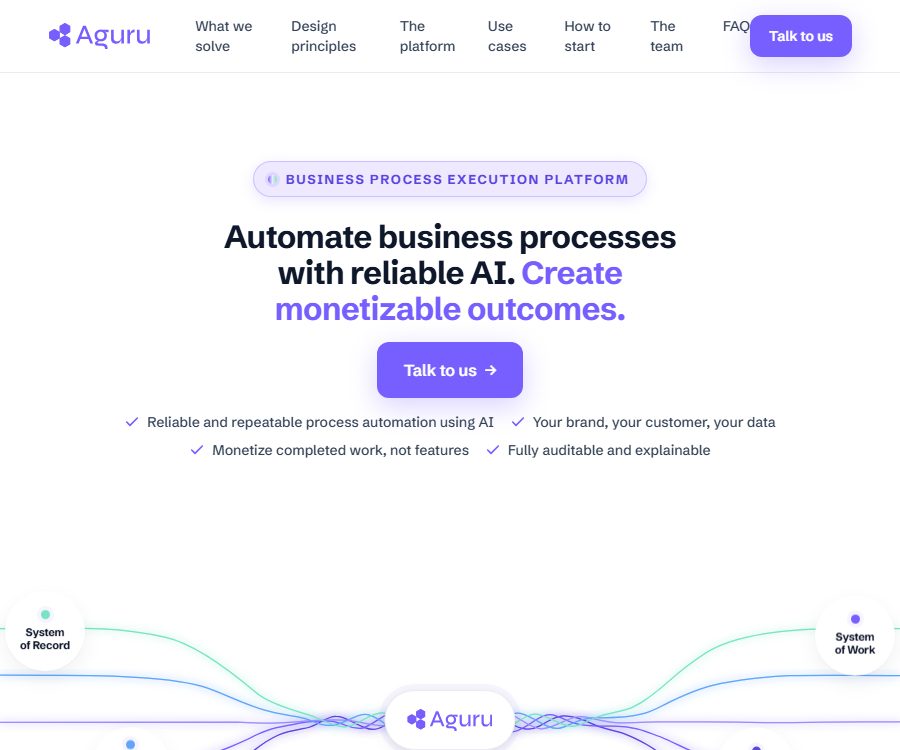
What is Aguru?
Aguru is an AI-based business process execution platform designed for enterprises; it helps ISVs and their partners transform complex manual processes into reproducible, outcome-oriented services. It focuses on the entire process from start to completion of the business outcome, rather than just automating a single instruction or task.
Aguru refers to such processes as Job of Work, abbreviated as JoW. A JoW may span multiple systems, organizations, and stakeholders, lasting days, weeks, or even months, and it involves waiting, follow-ups, approvals, and handling of exceptions.
Main functions of Aguru
1. Mapping of the Job of Work process
The team first identifies the business outcomes for which customers are willing to pay, and then outlines the tasks, systems, participants, risks, and conditions for success. The mapping phase is used to determine whether the process is suitable for execution with AI assistance and to assess its commercial value.
2. Durable execution engine
The execution engine represents business tasks in the form of task diagrams, and it manages data, context, user approvals, and task status on an ongoing basis. The process can resume from its previous state even in the event of server failures, interface errors, or long waiting times.
3. Small-scale AI focusing steps
Aguru does not delegate the entire process to a general-purpose large model; instead, it selects the appropriate model for each specific step within a deterministic graph. This makes it easier to control accuracy, costs, and the extent of errors.
4. Automatic recovery and manual upgrade
The platform assumes that models, interfaces, and external parties may encounter errors; therefore, it provides error detection, retry mechanisms, automatic recovery, and human intervention for resolution. Exceptions that cannot be resolved reliably are handed over to designated personnel for handling.
5. Stakeholder communication
The system contacts customers, suppliers, technical staff, or approvers through appropriate channels, understands their responses, and follows up on any missing actions. Exceptions are routed to those who have the authority to make decisions.
6. Auditing and Explainability
The task steps, AI outputs, manual corrections, any abnormalities, and the final result all form a traceable record. This allows companies to understand why a process came to a halt, which step failed, and what corrective actions were taken.
7. Execute the data flywheel
The platform keeps track of the model’s performance, the adjustments made, the costs incurred, and the results achieved, which is used to compare different models and optimize workflows. Partners can utilize this data to improve their own performance; the specific rights in this regard are defined by the deployment agreement.
8. White-label result-based services
The partners retain the brand, customer relationships, and industry expertise, while Aguru provides the underlying execution environment. Companies can sell the results of tasks such as renewing security certificates, conducting due diligence, or submitting subsidy applications as paid services.
Typical use cases
- Renewal of property safety certificate: coordinating landlords, tenants, technicians, invoices, and compliance records.
- Supplier delays in resuming operations: Monitor delivery dates, analyze the impacts, and escalate to make key decisions.
- Abnormal order fulfillment: Investigate inventory, carriers, and order status, and coordinate corrective actions.
- Purchase order confirmation: Tracking supplier responses and changes in prices and dates.
- Enhance customer due diligence: collect evidence, verify ownership, assess risks, and address exceptions.
- Pension tax exemptions or agricultural subsidies: determining eligibility, collecting necessary documents, and managing subsequent communications.
Which organizations are suitable?
- Vertical software companies that aim to introduce paid service offerings alongside existing SaaS products.
- Brand partners that possess industry expertise and customer networks.
- Companies that need to automate long-term processes across different employees and systems.
- Scenarios that require a high level of reliability cannot accept a situation in which the universal Agent succeeds sometimes and fails other times.
- Product teams that prefer to charge based on results rather than simply adding more functional slots.
Cooperation phase and cost model
As of August 24, 2026, Aguru does not disclose any standard subscription fees or unit prices per task. The costs are determined based on the commercial value of the process, the volume of work carried out, the level of integration required, and the nature of the partnership.
| Phase | Expected cycle | Public fee details | Main goal |
|---|---|---|---|
| Process mapping | 2 to 4 weeks | No cost for ISVs | Choose JoW, which has the greatest commercial potential. |
| The first pilot project | It will be available in about 4 to 8 weeks. | Payment is made after value delivery, with the amount customizable. | Verify requirements, reliability, and commercial value |
| Charging as a result | Run continuously | Charging is based on usage, with revenue sharing available. | Use the completion results as customer service sales. |
| Scale-up | Advance by project | Predictable platform fees, customizable terms | Increase the volume of executions and add more JoWs. |
It needs to be confirmed during the discussions.
- What conditions constitute a successfully completed and billable result?
- How are failure, manual intervention, repeated executions, and customer cancellation charged?
- Revenue sharing ratio, platform fees, minimum commitment, and settlement cycle.
- Costs for initial integration, dedicated infrastructure, and subsequent process changes.
- Whether the usage of models, communication, storage, and third-party systems is included.
- Ownership of the data, execution trajectories, and improvement outcomes.
Cooperation launch process
- List the complex business outcomes for which the customer has already paid for manual completion.
- Select candidate processes that have clear boundaries, sufficient evidence, and quantifiable value.
- Commonly map tasks, systems, personnel, wait points, failure modes, and compliance requirements.
- Define the success criteria, manual escalation rules, and actions that are not allowed to be performed automatically.
- Build the first pilot around the existing system; there is no need to rewrite the core product.
- Use real but controlled cases to verify completion rates, costs, and customer experience.
- Determine the final price, platform fees, and revenue sharing model.
- It is launched under the partner’s brand, with continuous monitoring of any abnormalities and of the amount of manual work required.
- Increase the volume of executions and add more JoWs only after the first process has proven its value.
Reliability design
- Long-term tasks make use of persistent states and checkpoints to prevent loss of progress after the service is restarted.
- Each AI step covers a small range, which facilitates the detection and correction of errors.
- Retry and recovery mechanisms are used when external interfaces fail.
- Exceptions with low confidence or high risk are escalated for manual processing.
- The task diagram retains the input, output, corrections, and status for each step.
- Models can be compared and replaced based on accuracy and cost.
Product advantages
- It is designed to achieve business outcomes, rather than merely providing generic conversations or single-step automation.
- Suitable for complex processes that last several weeks and involve waiting and communication among multiple parties.
- Reliable execution, recovery, and manual upgrades contribute to improving production reliability.
- The partner retains the brand and customer relationships, without the need to recreate the core products.
- The initial mapping incurs no cost for ISVs; it is possible to assess the potential opportunities first before proceeding with a pilot project.
- The execution trajectory helps with auditing, comparing models, and optimizing costs.
Usage restrictions and precautions
- Aguru is not a general-purpose Agent tool that individual users can register for immediately.
- There is no fixed public price, and the procurement process as well as the costs associated with contract negotiations are high.
- The first process usually requires several weeks for mapping and implementation, and it is not suitable for small tasks that need to be completed in one go.
- The quality of the results still depends on process design, system data, and manual upgrade mechanisms.
- Cross-system integration may be constrained by legacy interfaces, permissions, and data quality issues.
- Unclear definitions of revenue sharing and outcomes can lead to settlement disputes.
- High-risk industries require additional verification of regulatory, liability, and human oversight requirements.
Data, Privacy, and Governance
According to the official website, the operational data of the partners belongs to those partners, while the workflow data is used for operating, monitoring, and improving JoW. Matters related to AI tracking, adjustments, privacy, security, and data ownership must be specified in the specific deployment agreement.
- Identify the systems and fields that can be read from and written to for each task.
- Apply the principle of least privilege to personal data, financial information, and compliance evidence.
- Specify the retention period for executed data, model outputs, and manual corrections.
- Record every external communication, approval, and significant business change.
- Manual confirmation is required for automatic payments, application submissions, or legal commitments.
- Request the security architecture, sub-processors, and incident response materials prior to making a purchase.
API and open-source status
As of the date of verification, Aguru does not provide publicly available developer APIs, SDKs, or standard pricing for calls. System integration is part of a collaborative project and must be designed according to specific JoW requirements.
At the same time, no official open-source repository or open-source license for the Aguru platform itself was found. The ability to integrate it into a customer’s infrastructure does not mean that the source code of the execution engine is made available publicly.
Frequently Asked Questions
What is the difference between Aguru and ordinary AI agents?
It breaks down complex processes into controlled task diagrams, uses AI only at the appropriate stages, and ensures continuous execution until the result is achieved through persistent states, recovery mechanisms, and manual upgrades.
Can it be registered and used directly?
Currently, the partnership approach is used; it is necessary to first complete the JoW mapping and pilot phase, and there is no public process for self-service activation.
How does Aguru charge?
The mapping phase incurs no cost for ISVs; pilot projects are billed based on their value. Once at a larger scale, pricing models such as usage-based fees, revenue sharing, and platform fees can be applied, with the specific amounts to be determined through negotiation.
What to do if the process fails?
The platform makes use of checkpoints, error detection, retry mechanisms, and automatic recovery; when reliable handling is not possible, the task is escalated to human intervention.
Is Aguru an open-source platform?
No official evidence indicating that the core of this platform is open source has been found; therefore, it should be regarded as a commercial service provided by a company.
Summary
Aguru is suitable for ISVs and industry partners who wish to transform long-term, cross-system manual processes into pay-per-result services. It places emphasis on reliable execution and business outcomes, but it is necessary to clearly define the completion standards, responsibilities in case of issues, data rights, as well as charging mechanisms and revenue sharing before starting any collaboration.
Tools similar to Aguru





 Guigong Network Security Registration No. 45132202000164