






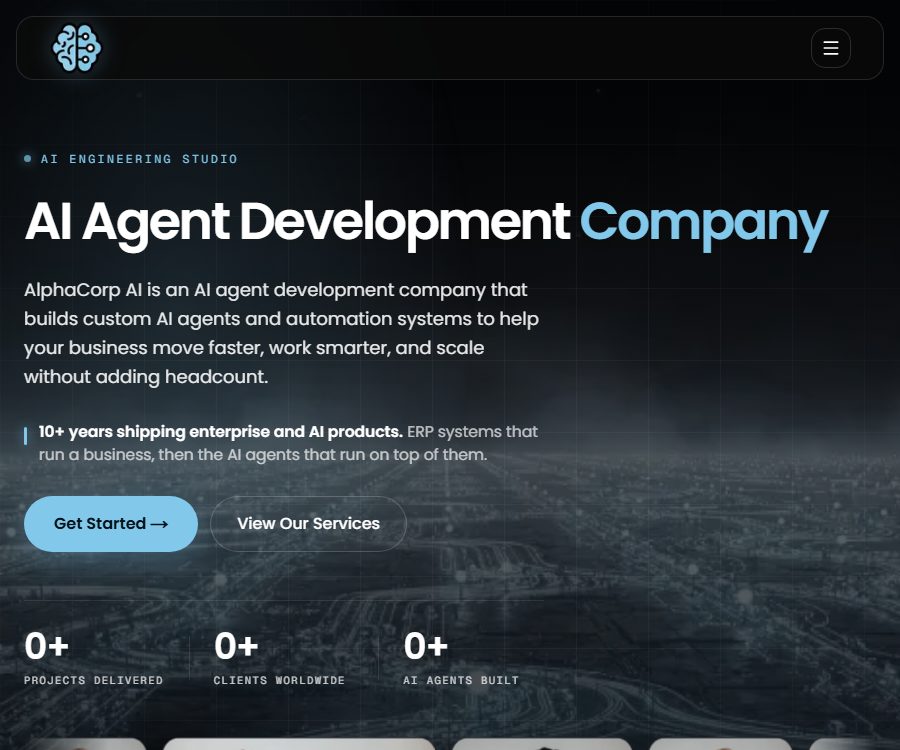
What is AlphaCorp AI?
AlphaCorp AI is an AI engineering and custom development company based in Rio de Janeiro, Brazil. It provides enterprises with agents, RAG retrieval systems, generative AI applications, and automated processes. It offers project-based development services, rather than standardized SaaS tools that can be used immediately after registration.
The team emphasizes deploying prototypes in a real production environment, incorporating elements such as evaluation, monitoring, manual approval, and failover mechanisms. The official website indicates that its clients are located in the United States, Europe, and the Asia-Pacific region, with working hours aligned with the Eastern Time Zone in the United States.
A one-sentence summary
AlphaCorp AI develops, designs, and maintains customized AI agents for businesses, enabling them to connect with real-world data and business systems.
Main services
Custom AI agents
A team can design reasoning processes, tool calls, memory management, permissions, fallback mechanisms, and security boundaries for specific tasks. Agents are capable of reading data, invoking interfaces, and carrying out multi-step tasks; high-risk operations can require manual approval.
Development of RAG knowledge base
The RAG service connects large models to corporate documents, databases, and business knowledge, enabling responses to be based on retrievable content. Such projects typically involve data ingestion, chunking, embedding, vector retrieval, answer generation, and providing traceable evidence.
Generative AI applications
AlphaCorp AI can be used to develop tools for content generation, document processing, internal search, and industry-specific assistants. The scope of delivery may include the backend, frontend, interfaces, authentication mechanisms, as well as cloud infrastructure.
Model fine-tuning
When prompt engineering and RAG are not sufficient to ensure stable control over format, tone, or specific task behaviors, the team offers fine-tuning methods such as LoRA, QLoRA, DPO, and RAFT. Before starting a project, it is necessary to compare the costs and relevance of fine-tuning approaches versus retrieval-based approaches.
Process automation
Intelligent automation is suitable for high-frequency tasks such as invoice matching, order entry, document classification, and ERP data processing. Automation systems should include exception queues and manual review mechanisms to prevent errors from being directly entered into the core business systems.
Software Engineering and Integration
The services include APIs, consoles, data pipelines, cloud deployment, and connections to third-party systems. Agents can integrate with CRM systems, ERP systems, databases, and existing enterprise cloud services, and they support authentication and error handling.
MLOps and DevOps
The team offers continuous integration, automatic deployment, infrastructure management, model monitoring, and production alerts. The focus is on monitoring accuracy, latency, costs, and model drift, rather than merely checking whether the servers are online.
AI Auditing and Consulting
Companies can first purchase services related to workflow optimization, AI-driven audit, or strategic consulting, in order to identify the tasks that are suitable for automation and the expected benefits. At this stage, it is necessary to define verifiable goals, risk boundaries, data requirements, and an implementation roadmap.
Which companies are suitable?
- Companies that already have defined workflows and wish to use agents to reduce manual tasks.
- Teams that need to enable large models to access internal documents and databases securely.
- The experimental prototype has been completed, but it lacks the capability for production deployment.
- Organizations that need to connect to CRM, ERP, ticketing systems, or other business interfaces.
- Customers with specific requirements regarding logging, evaluation, manual approval, and compliance.
- Companies in the healthcare, government, finance, hospitality, logistics, and software services sectors.
Services and Quotes
AlphaCorp AI uses a project-based pricing model; the specific costs depend on the requirements, data involved, integration needs, risks, and the scope of maintenance. As of the verification on August 24, 2026, the official website indicated typical price ranges. The final price, taxes, payment deadlines, and ongoing costs will be determined in accordance with the project agreement signed by both parties.
| Project type | Public starting range | Typical range | Suitable scenarios |
|---|---|---|---|
| Single-task agent | 15,000 to 30,000 dollars | A clear process, a few tools, and basic monitoring. | Ticket categorization, document extraction, or internal Q&A |
| Enterprise multi-agent systems | Over 50,000 to 150,000 dollars | Complex orchestration, multi-system integration, permissions, and evaluation | Inter-departmental automation and core business processes |
| Complex production-grade generative AI | Evaluate by project | RAG, fine-tuning, front-end and back-end, cloud deployment, and operations | Industry-specific platforms |
| Consulting and Integrated Auditing | Custom quote | Process analysis, risk assessment, and roadmap | Companies that have not yet determined the technical solution |
What factors usually influence quotes?
- The number of steps that need to be completed automatically and the abnormal branches.
- The difficulty of integrating external interfaces, databases, and legacy systems.
- Document size, format quality, and update frequency.
- Does it involve fine-tuning, speech, images, or real-time processing?
- Authentication, permissions, auditing, and compliance requirements.
- Accuracy, latency, concurrency, and availability goals.
- Monitoring, maintenance, and model costs after going live.
Costs that must be separated during procurement
| Cost | Items that need to be confirmed |
|---|---|
| Discovery and Design | Workflow optimization, data auditing, architecture, and acceptance criteria |
| Development and implementation | Agents, RAG, interfaces, front-end and back-end, and testing |
| Clouds and models | Reasoning, vector database, storage, logging, and network costs |
| Third-party services | Model platforms, voice, data, and commercial software licenses |
| Ongoing operation and maintenance | Monitoring, fault handling, model upgrading, and knowledge updating |
| Security and compliance | Penetration testing, legal assessments, audits, and data processing agreements |
Cooperation process
- During the first communication, explain the business objectives, current processes, and main pain points.
- List the available data, system interfaces, user roles, and legal restrictions.
- Jointly determine the success metrics, failure conditions, and manual approval steps.
- Sign the project agreement to clarify the scope, delivery, timeline, costs, and intellectual property rights.
- Complete the architecture design by selecting the model, retrieval method, tools, and deployment environment.
- Prototypes are developed on a short-cycle basis, with iterations made each week based on feedback from real-world cases.
- Use automatic evaluation and manual testing to cover accuracy, latency, and edge cases.
- Deploy to the customer’s environment and configure logging, tracking, alerts, and access control.
- After going live, continuous monitoring is carried out for drift, costs, failure rates, and business outcomes.
How to prepare project requirements
- It provides information on the current manual processes and the time required for each step.
- Prepare 20 to 100 real task examples, including failed cases.
- Indicate which data can be used and which must be masked or prohibited from processing.
- It indicates the scope of the system that the agent is allowed to read, modify, and send data to.
- Define accuracy, latency, cost, and labor savings targets.
- List the high-risk actions that require manual decision-making.
- Identify the persons responsible for the validation dataset and for operations after it goes live.
Technology stack
| Hierarchy | Common techniques |
|---|---|
| Development language | Python, Rust, TypeScript |
| Base model | Anthropic, OpenAI, Gemini, Llama, Mistral, Hugging Face |
| High-speed inference | Groq, Cerebras, OpenRouter, Replicate, Ollama, vLLM |
| Agent Orchestration | LangGraph, LangChain, LlamaIndex, CrewAI, n8n |
| Vectors and memory | Milvus, Pinecone, pgvector, Chroma, Weaviate, Redis |
| Models and multimedia | ElevenLabs, ComfyUI, PyTorch, LoRA, Modal |
| Cloud and delivery | AWS, Azure, Google Cloud, Docker, Kubernetes, Vercel |
| Evaluation and Monitoring | LangSmith, Langfuse, Weights & Biases, Grafana |
A list of technologies indicates that the team has relevant experience in using them, but it does not mean that every project will include all of those components. The architecture should be chosen based on factors such as data volume, latency, compliance requirements, and maintenance capabilities, rather than by simply using popular frameworks.
Product advantages
- It covers the entire process, from requirement auditing to production deployment and ongoing monitoring.
- It possesses capabilities in AI, backend development, frontend development, cloud technologies, and enterprise system integration.
- Emphasis is placed on automatic assessment, tracking, and fault recovery.
- It supports multi-model solutions, reducing reliance on a single model provider.
- It can be deployed within the customer’s infrastructure and connected to existing systems.
- The contract specifies that once the full payment is made, the customized product becomes the property of the customer.
- Free communication is provided for the first time, to help determine whether the project is suitable for implementation.
Usage restrictions and risks
- It is a customized service with a high price point, and it is not suitable for individual users who only need a simple chatbot.
- The prices listed on the official website represent only typical ranges; complex projects may have significantly higher costs.
- In addition to development costs, there are also ongoing expenses for models, cloud services, and maintenance.
- When an agent is connected to a real system, it may cause incorrect writes or external operations.
- Changes in model suppliers, interfaces, and prices can affect long-term operation and maintenance.
- Marketing cases and efficiency figures should be verified using the customer’s own validation data.
- Cross-border cooperation involves Brazilian law, data transfer, and jurisdiction in case of disputes.
- The current GitHub organization does not have any public repositories; the open-source content available on its official website needs to be verified separately.
How to verify an agent
- Freeze a real test set that has not been used for development.
- Test normal, missing, conflicting, and malicious inputs separately.
- Check the permissions, parameters for each tool invocation, and the fallback measures in case of failure.
- Calculate the success rate, error rate, latency, and cost per transaction of the computing task.
- Unavailable simulation models, interface timeouts, and database failures.
- Verify whether high-risk actions always require manual approval.
- Check whether the logs can restore decisions, retrieved content, and tool results.
- Real traffic will be gradually released once the written metrics are met.
Safety and compliance
AlphaCorp AI states that it will take into account the NIST AI Risk Management Framework, generative AI profiles, the EU’s AI regulations, and relevant OWASP standards. Alignment with these frameworks does not equate to an independent certification; therefore, purchasers should request project-specific evidence.
- Establish role permissions and the principle of least privilege, and prohibit agents from sharing administrator accounts.
- Manual approval is required for sending messages, making payments, and deleting data.
- Save audit records of prompts, searches, tool calls, and decision pathways.
- Tests are conducted for prompt injection, privilege escalation, data leakage, and supply chain risks.
- Define the data areas, retention periods, and deletion procedures for models and logs.
- The contract should specify the procedures for notifying about safety incidents, the time limits for repairs, and the scope of responsibilities.
Key points of the privacy policy
The official website may collect information such as name, email address, company, and message from the contact form, as well as IP address, browser type, time of access, page navigation patterns, and approximate location. The site also uses enterprise visitor identification to determine the organization to which a visitor belongs based on their IP address.
Messages from the AI assistant on the site are processed through OpenRouter. The website states that these messages will not be used to train models, and conversations are not saved after the browser session ends. The contact form may be retained for up to 12 months after a query has been handled, in the absence of any cooperation between the parties; server logs, on the other hand, are kept for a maximum of 30 days.
Services such as Vercel, OpenRouter, Resend, Google, and Apollo may process data in the United States. Customers based in the European Union or Brazil should verify the data processing agreements, cross-border mechanisms, and the subcontractors involved in the actual production process before starting a project.
Intellectual property and contracts
The terms of service state that customers receive the custom code, models, and deliverables created specifically for a particular project after making full payment. AlphaCorp AI retains the generic methods, tools, libraries, and frameworks that were developed independently prior to any project.
Open-source components remain subject to their respective licenses, and the purchaser should request a software bill of materials. The obligation of confidentiality generally persists for two years after the end of the partnership; if the industry requires a longer period, this should be specified in the project agreement.
Open-source status
The official website states that RustyRAG is a project whose source code is available under the Elastic License 2.0, and it is described as a real-time RAG system implemented in Rust. However, as of August 24, 2026, the GitHub organization page for AlphaCorp AI shows no public repositories, making it impossible to verify the current code directly through that organization.
Therefore, the entire AlphaCorp AI company or its customer deliverables cannot be labeled as open source. If it is necessary to evaluate RustyRAG prior to signing a contract, it is essential to request information regarding the current repository, version, license text, and maintenance status.
Company and platform information
| Project | Content |
|---|---|
| Company name | AlphaCorp AI |
| Legal entity | Ignas Vaitukaitis e CIA LTDA |
| Location | Rio de Janeiro, Brazil |
| Service method | Remote project-based development and consulting |
| Primary language | English, Portuguese, Spanish |
| Price pattern | Free initial consultation and customized project quotes |
| Ownership of the deliverables | Upon full payment, it is returned to the customer in accordance with the contract. |
| Public API products | It does not belong to a standardized self-service API platform. |
| Open-source status | The company’s services are not open source, and the public repositories cannot be verified at the moment. |
| Recommendation score | 4.0 points |
Frequently Asked Questions
Is AlphaCorp AI an AI tool that can be registered directly?
No, it mainly offers custom development and consulting services. Customers need to communicate their requirements and sign a separate project agreement.
How much does it cost to develop an AI agent?
Single-task agents typically cost between $15,000 and $30,000, while complex multi-agent systems for enterprises cost around $50,000 to $150,000 or more. The final price depends on the requirements as well as ongoing maintenance needs.
How long does a project usually take?
The official website states that for some projects, it is possible to move from the idea stage to production within 2 to 4 weeks, but complex integrations generally require more time. The milestones specified in the project agreement should be followed.
Does the customer have the source code?
The terms stipulate that upon full payment, the customer receives the code, models, and deliverables created specifically for the project; the general frameworks and existing tools remain in the possession of their original owners.
Is private deployment supported?
The team can be deployed on the customer’s infrastructure, but the specific cloud, on-premises environment, and data locations need to be determined as part of the project. It cannot be assumed from the official technology stack that all solutions support complete offline operation.
Is AlphaCorp AI an open-source company?
No, custom services and customer-specific systems do not belong to open-source products. The official website mentions the licensing terms for RustyRAG’s source code, but there is no public repository on GitHub at the moment; it is necessary to verify this separately.
Summary
AlphaCorp AI is suitable for companies that already have clear business challenges, possess the necessary data and budget, and wish to integrate agents into their production systems. Its advantages include coverage in areas such as RAG, agents, software engineering, and monitoring; however, the purchaser still needs to define through a contract the pricing, acceptance criteria, intellectual property rights, handling of cross-border data, and responsibilities for ongoing maintenance.
Tools similar to AI Agent Development Company





 Guigong Network Security Registration No. 45132202000164