






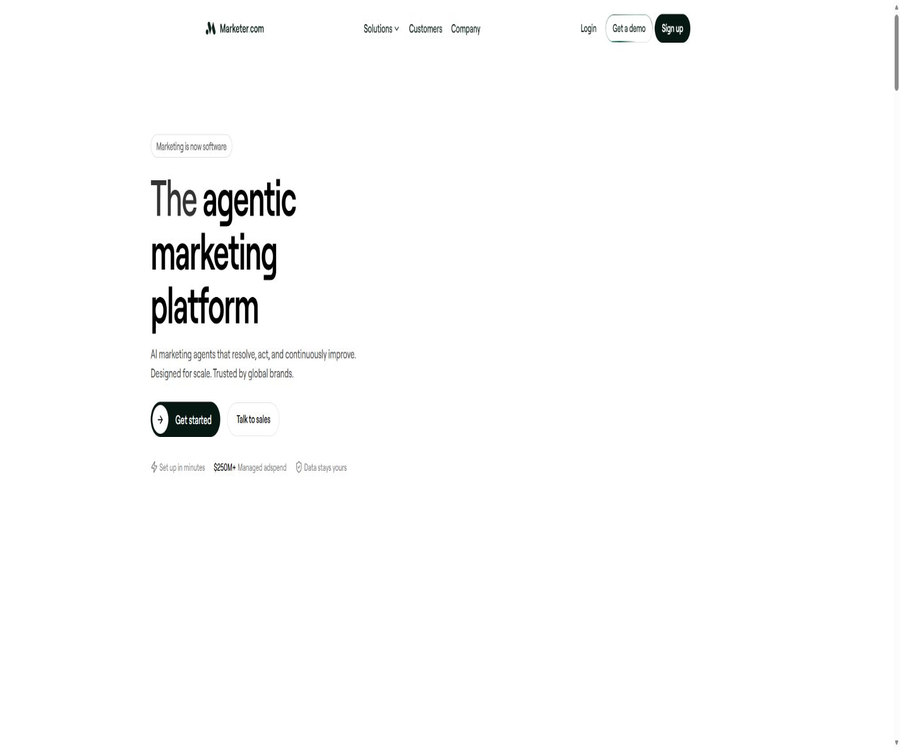
What is a Marketer?
Marketer is an intelligent marketing operations platform provided by Marketer.com AS for e-commerce brands; its former company name was indicated as Metric in the terms. It brings together advertising accounts, store data, creative assets, analysis tools, and action capabilities within a single system, aiming to address the various decisions and tasks that advertising teams need to handle on a daily basis across different channels.
The platform is not a general-purpose chatbot, nor is it a reporting tool that merely provides suggestions. The AI system continuously monitors the performance of the account and suggests actions such as suspending ad groups, adjusting budgets, removing certain keywords, or launching new ads; these actions can be carried out automatically based on the account’s permissions, or they can be submitted to the user for approval and modification.
Main functions
- Continuous account monitoring: The agent regularly retrieves data on advertisements, products, and revenues from the connected channels, identifying changes in costs, returns, material fatigue, and budgets. It generates detailed reports on any abnormalities, along with priorities and actionable recommendations, thereby replacing the need for manual oversight of multiple systems on a frequent basis.
- Natural language marketing operations: Users can ask about weekend revenues, performance of various channels, profits from products, or what actions should be taken next; they can also issue commands such as suspending inefficient ads or increasing budgets. The system provides analyses or prepares necessary actions, and any changes to real accounts must be approved within the authorized scope.
- Advertising account execution agent: It can pause ad groups with poor performance based on certain rules and objectives, redirect the budget to the more effective ad groups, remove negative keywords from Google Performance Max, and create or publish new ads. Each action is recorded in the activity log, allowing the team to view, modify, or review past decisions.
- Cross-channel data connections: The current product supports connections to advertising platforms such as Shopify, Meta, Google, Snapchat, Slack, and OpenAI, as well as integration with e-commerce tools like Klaviyo. The data that can be read from or written to via different connections, the approval processes involved, and regional availability may vary; it is necessary to check the scope of permissions before establishing such connections.
- Advertising creative production: It is possible to create new images, videos, or UGC ads based on the available product catalog and high-performing assets already in use, with the creatives and their actual implementations stored in the same database. The platform’s Ember creative service also offers the option of having human experts or teams handle the production of the final products, with the exact volume of work to be carried out specified in the contract.
- Research and creative strategies: The system utilizes search trends, competitor ads, audience feedback, and account history to determine the approach for creating advertisements, rather than generating ideas randomly based on a single set of keywords. The findings derived from such research may still contain timing or contextual errors; it is therefore necessary to verify the facts and relevant rights before publishing them.
- Analysis and Marketer Health: Provides a unified view of channel metrics, attribution data, revenue, advertising expenses, and account health, and transforms any anomalies into actionable steps. It is useful for making operational decisions; the average returns or customer examples shown in the platform’s examples should not be considered as guarantees.
- Creative Database: A platform for uploading, organizing, and reusing product images, videos, UGC content, and advertising assets, along with performance data. Teams can develop new versions based on previously successful materials, thereby saving time on searching for files and repeating creative work.
- Slack collaboration: Morning reports, account summaries, and actions awaiting approval are sent to the team chat, allowing users to keep track of progress in their usual communication environment. For instructions related to budgets and releases, clear role permissions and manual review processes must be in place.
- Advertising budget wallet: Users can deposit their advertising budget on the platform, and the system will use it to purchase ads on third-party advertising networks on their behalf. The funds in this wallet are distinct from the software subscription fees; once the advertising service starts and the funds are allocated to external platforms, refunds are generally not possible.
Input, processing, and output
| Stage | Enter | System processing | Output |
|---|---|---|---|
| Store management | Background on Shopify products, orders, inventory, revenue, and profits | Performance of related products and advertising investment | Growth opportunities, product priorities, and budget recommendations |
| Advertising account | Data on activities, audience, keywords, and costs for Meta, Google, Snapchat, etc. | Continuous monitoring, anomaly detection, and cross-channel comparison | Actions such as pausing, expanding, adjusting prices, removing keywords, and creating new campaigns |
| Creative assets | Product images, videos, UGC, brand guidelines, and past ads | Study performance and create or develop new variants. | Advertising materials that can be reviewed, published, and tracked |
| Natural language | Problems, objectives, budget constraints, and operational instructions | Formulate plans or execution steps by taking into account the account context. | Explanations, predictions, plans, approval items, and operation results |
| Team feedback | Approval, modification, rejection, as well as restrictions related to brand knowledge and strategies | Update the current action and subsequent context. | A continuous operation process that better meets the team’s requirements |
| Channel feedback | Clicks, conversions, revenue, returns, and ad review results | Create a performance cycle and identify winning or exhausted elements. | Suggestions for subsequent budgeting and creative iterations |
Usage process
- Schedule a demonstration and provide details on the brand’s scale, monthly advertising expenditure, target regions, distribution channels, internal team, as well as the tasks you expect the platform to carry out.
- After obtaining the contract and quote, verify each item such as the annual duration, implementation costs, delivery of creative materials, advertising budget, number of users, distribution channels, and rules for early termination.
- Create an account and connect to Shopify, Meta, Google, or other platforms, granting only the minimum permissions necessary to complete the assigned tasks.
- Import the brand positioning, product catalog, profit constraints, restrictions on what cannot be used, as well as existing ideas, to ensure that the agent understands the boundaries of the business.
- Start by operating in suggestion or approval mode to verify the metrics definition, attribution window, budget targets, and the quality of actions, before considering enabling automatic execution.
- View activity logs, morning reports, and pending suggestions via the dashboard or Slack, and approve, edit, or reject each actual campaign change.
- Evaluate weekly the revenue, profit generated, cost of acquiring customers, returns, material fatigue, and growth in channels, in order to avoid focusing solely on superficial metrics from a single platform.
- Regularly review connection permissions, automation rules, wallet balances, contract usage levels, and personal data; revoke access promptly when employees leave or suppliers change.
Enable checks before automatic execution
- Set upper and lower limits for single budget adjustments, daily expenses, channel proportions, and ad group suspensions.
- Mandatory manual approval is required for new products, healthcare products, financial services, children’s products, or regulated goods.
- Ensure that the gross profit of the products, inventory levels, refund rates, and promotional periods are taken into account when making decisions, so as to avoid expanding business volume solely based on advertising returns.
- Establish emergency stop and recovery procedures, and ensure that the platform’s operation logs can be verified against those in the advertising channel’s backend system.
Manta Growth Planning Assistant
Manta is the AI marketing assistant within the Marketer system; it can be used on standalone web pages, within Marketer itself, and on iPhone. By connecting e-commerce and advertising data, it identifies potential profits and creates growth plans that include objectives, expected impacts, required resources, and steps for implementation.
- Profit forecast: Estimate the untapped growth opportunities and required investments to help the team compare options before taking action.
- Plan generation: Transform actual products, channels, and business objectives into detailed, step-by-step growth plans that can be reviewed, rather than providing only general suggestions.
- Dialogue adjustment: Users can provide additional information such as gross profit, inventory levels, seasonal factors, and budget constraints, and request reductions in costs or suggestions for alternative approaches.
- Execution options: The free trial allows you to view and adjust the plan; if you want Manta to carry out the execution through its connection services, a valid Marketer subscription is required.
- Cross-device continuity: Web pages, the Marketer workspace, and the iPhone app share context, data, and campaign status.
Price and contract
| Package or version | Price | Billing cycle | Core benefits or quota | Suitable for users |
|---|---|---|---|---|
| Annual partnership with marketers | Custom quote | Annual | Complete platform, all designated channels, strategy managers, creative production, analytical reports, brand-customized AI agents, implementation, and unlimited number of users | E-commerce brands that already have product-market matching and actual growth budgets |
| Enterprise | Contact sales | Customization | Dedicated Shopify and marketing team, brand intelligence agents, custom integrations, priority support, and performance-based collaboration framework | Companies with high advertising spending, multiple brands, or operations in various regions |
| Basic Manta experience | Free download and use | No fixed cycle | Connect data, identify profit opportunities, create and adjust growth plans | E-commerce operators who wish to conduct analysis and planning first |
| Execution of the Manta plan | Requires a Marketer subscription | In accordance with the relevant contract | Submit the confirmed plan to the connected channel for execution. | Teams that need to move from planning to actual implementation. |
The current main pricing page describes the Marketer package as an annual agreement; the cost is determined based on scale, channel, and objectives, with no fixed monthly fee specified. Some older pages that are still accessible listed figures such as $499 per month for the Starter package and around $1,499 per month for the Pro package, but these figures conflict with the current annual pricing structure and therefore cannot be used as the current settlement rates.
Trial, renewal, and refunds
- The terms allow the platform to offer free trials that require payment information under certain circumstances, but the current main pricing page does not specify a uniform trial period or eligibility criteria.
- Subscriptions are automatically renewed by default; if no fixed duration is specified in the contract, future renewals can be canceled through the Customer Success team or the payment portal.
- The subscription fee for the current billing cycle is non-refundable, and the fees paid in advance for three, six, or twelve months are also non-refundable; the service can generally be used until the end of the paid period.
- For subscriptions purchased through the app store, cancellation and refunds are handled in accordance with the app store’s rules.
- The funds in the wallet or the advertising budget, once used to initiate campaigns on third-party platforms, cannot be refunded; in case of suspected unauthorized transactions, contact the platform immediately.
- In the event of disputes regarding the results of advertising services or their pricing, the terms require that explanations and evidence be submitted within 72 hours after the campaign is completed.
Which users are it suitable for
- E-commerce brands that are already running campaigns on platforms such as Meta, Google, and Snapchat, and that seek to unify their data and operations.
- There is already product-market alignment and a real budget, but the growing team lacks centralized capabilities for internal media purchasing, creative work, and analysis.
- It is hoped that AI-driven advertising campaigns will be managed through activity logs and approval mechanisms, rather than being left entirely in the hands of marketing managers at those black-box agencies.
- Consumer brands that require a large number of new ideas, adjustments to budgets across different channels, and regular monitoring of accounts.
- Companies that manage multiple brands and locations, have substantial advertising expenses, and need customized agents, dedicated staff, as well as integrated solutions.
Advantages
- By bringing insights, creativity, budgeting, and execution together within the same closed loop, it is possible to directly convert them into actions awaiting approval.
- Whenever an automatic or manual action is recorded in the activity log, the team can see what has happened and make the necessary decisions.
- Connect to mainstream e-commerce and advertising platforms to reduce the need for manual report exports and switching between multiple accounts.
- It also offers software agents and strategies, as well as creative services, suitable for brands that wish to have a partner take on more of the operational tasks.
- Manta provides a simpler entry point for working with complex systems; users can first understand the opportunities and required efforts before deciding whether to proceed.
Capabilities boundaries and limitations
- The platform cannot guarantee advertising returns, revenue growth, accurate attribution, or results within a specific time frame; customer success stories and average metrics cannot be considered as commitments.
- Agents rely on the quality of the data from connected accounts; missing pixels, different attribution windows, delays in refunds, and offline revenue can all affect their judgments.
- Automatically adjusting the budget or suspending advertisements can have real business consequences; humans are still needed to set limits regarding profits, inventory, brand image, and regulatory requirements.
- The current main method of sales is through customized annual partnerships, which is not suitable for brands that only want to purchase inexpensive self-service tools or that are just starting out in this field.
- The contract costs, the volume of creative work to be delivered, the scope of services, and the distribution channels are not made publicly available in a standardized manner; therefore, written quotes must be used when comparing suppliers.
- Third-party advertising platforms can reject creative materials, restrict accounts, or change their APIs, and marketers are unable to eliminate these external risks.
Platforms and connections
| Platform or connection | Uses | Support methods | Precautions |
|---|---|---|---|
| Marketer web application | Dashboard, Chat, Activities, Creativity, Analytics, and Account Management | Desktop and mobile browsers | Account and contract permissions are required. |
| Manta website | Profit analysis, growth plans, and strategic adjustments | Independent web pages and embeddable in Marketer | The execution plan requires a subscription. |
| Manta iPhone app | Move to view insights, review plans, and track growth | iOS native apps | A newer version of iOS is required at present; free installation does not mean that the service is provided for free. |
| Shopify | Products, orders, and business context | Account connection | Read and write permissions should be restricted. |
| Meta, Google, Snapchat | Ad analysis, creation, and optimization | Advertising account authorization | Subject to policies, approvals, and interface restrictions from various channels |
| Slack | Morning reports, reminders, approvals, and team collaboration | Workspace connection | Control the visibility of sensitive metrics and operation commands |
| Android native apps | Not confirmed yet | Websites can be used. | The current official Google Play app was not found. |
API, SDK, and open-source status
Currently, no Marketer API documentation available to customers, no official SDKs, no guides for plugin development, and no source code repository for the product can be found. The account connection and custom integration options mentioned on the website are part of the product’s features or contractual services; therefore, it cannot be inferred that there are public APIs that can be registered and used independently.
- Enterprise allows discussions regarding customized integrations, but the authentication methods, endpoints, call restrictions, service levels, and additional costs are not yet available publicly.
- It has not been confirmed that the Marketer product code is governed by any open-source license; therefore, the platform should be considered proprietary commercial software.
- The Marketer, The Marketer, or individual GitHub projects with the same name that were found are not the same as this product; therefore they cannot be used as its official SDK or open-source version.
Privacy, Security, and Data
- The platform handles account contact information, device and usage logs, as well as business and online activities, geographical location data, and any potentially sensitive information required to connect to stores and advertising channels.
- The data can be used to provide services, manage accounts, get in touch with users, conduct analysis, carry out marketing activities, ensure security, fulfill contracts, and improve products; it may also be shared with service providers, related parties, and those involved in business transactions.
- The privacy policy states that personal information will not be sold in the usual sense, but the use of data by certain advertising, marketing, and analysis services may be considered as selling or sharing under California law; users can submit requests to opt out.
- Personal data is retained as required by business and legal considerations, with no fixed uniform period specified; usage logs are usually kept for a short time, but security reasons, improvements to functionality, or legal obligations may extend that period.
- Users can modify or delete certain information within their accounts, and they can also request access to such information, as well as its correction, deletion or restriction of processing; however, when legal obligations exist, the platform may retain the necessary records.
- Data may be processed across borders, and the platform pledges to apply appropriate controls prior to such transfers; companies should still request a data processing agreement, a list of sub-processors, and security certifications when making purchases.
- The terms state that the platform will perform regular backups of the content, but it does not guarantee that no data will be lost or that restoration will always be successful; important creative works, reports, and account settings should be saved separately.
Content, copyright, and advertising responsibilities
- Users must have the right to upload product images, videos, UGC, trademarks, and other content, and must ensure that no privacy, portrait, or intellectual property rights are violated.
- The original software, functions, and content available on the platform are owned by Marketer.com AS or its licensors; the subscription does not transfer the source code of the products nor the underlying intellectual property rights.
- Automatically generated ads still need to be checked for their accuracy, the effectiveness of the products, prices, inventory levels, expiration dates of promotions, and any necessary disclosures; platform operations cannot replace legal review.
- Uploading content that is illegal, abusive, discriminatory, spammy, related to gambling, or intended to disrupt the system is prohibited; third-party advertising platforms also have their own policies regarding the materials and accounts used.
- The marketing team should keep records of material authorizations, approval processes, and campaign logs to handle cases of ad rejections, consumer complaints, or rights disputes.
Summary
The core value of a marketer tool lies in enabling AI entities to create a continuous operational cycle that involves \"identifying problems, proposing actions, approving their execution, and recording the results\" based on real e-commerce and advertising data. It functions more like an annual marketing partnership or an operating system, rather than a low-cost self-service application; when purchasing such a tool, it is important to carefully examine the contract, the funds allocated for advertising, refund policies, permissions for automatic execution, and responsibilities related to data processing.
Tools similar to Marketer





 Guigong Network Security Registration No. 45132202000164