






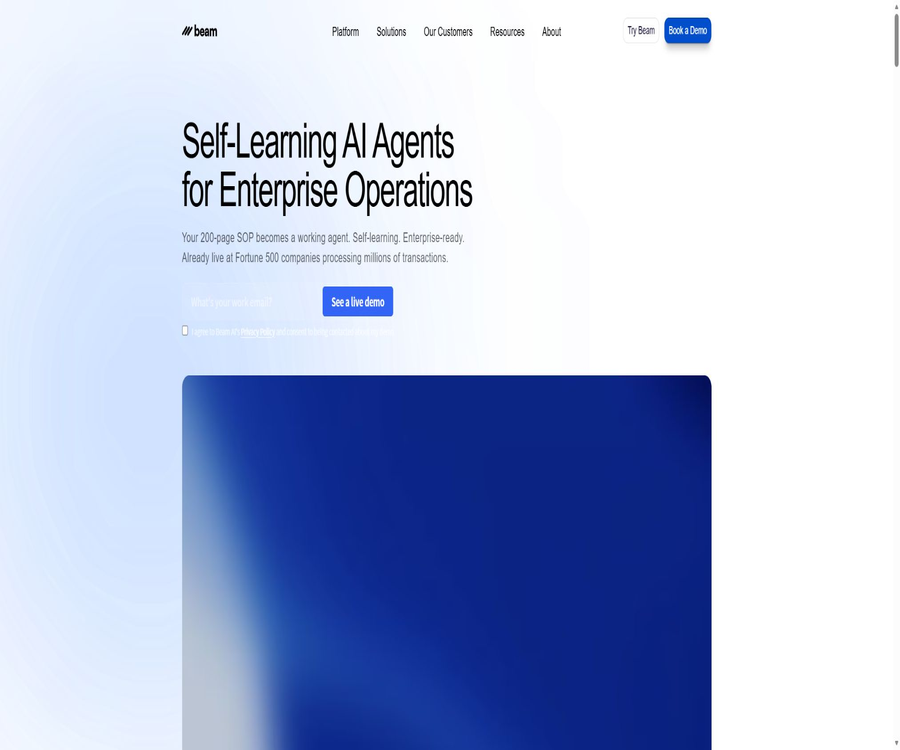
What is Beam AI?
Beam AI is an intelligent automation platform designed for enterprise operational processes, operated by Beam AI Inc. It brings together the creation of AI agents, process visualization, various tools, memory functions, enterprise integration, evaluation, monitoring, and deployment within a single workspace.
The old name in the database was merely a marketing slogan; the actual name is Beam AI. It is designed to handle complex processes such as those related to finance, human resources, customer service, sales operations, and document processing, rather than simply providing a chatbot.
Core competencies
- Quickly create common business agents using templates.
- Describe the requirements in natural language and generate an editable workflow.
- Configure nodes, branches, loops, and merges on the visualization canvas.
- Set goals, roles, tools, memory, and upgrade paths for the agent.
- It connects more than 1,500 enterprise software and data services.
- Combine deterministic steps with AI reasoning within the same workflow.
- Pause before performing sensitive actions and request manual approval.
- Automatic evaluation and retry are set for nodes and the entire process.
- Organize multiple specialized agents to work together to handle complex tasks.
- Create, manage, and execute proxy tasks through APIs.
- Choose SaaS, dedicated instances, self-hosted, or on-premises deployment.
Three ways to create proxies
| Creation method | Working methods | Estimated time to get started | Suitable for users |
|---|---|---|---|
| Template creation | Start by making changes to customer service, data processing, reports, or email templates. | About 5 to 15 minutes | Teams using it for the first time or those with a standard process |
| Dialogue creation | Describe inputs, actions, and outputs in natural language; the system generates the process. | About 10 to 20 minutes | Business professionals who wish to develop prototypes quickly |
| Custom creation | Configure tools, branches, and variables node by node on an empty canvas. | About 30 to 90 minutes | Complex processes and advanced automation teams |
Visual workflow
Each agent in Beam operates through Flow, which is a graph composed of nodes, connections, conditions, and endpoints. Teams can define the steps that must be carried out strictly, and they can also incorporate model inference when it’s necessary to process unstructured input.
| Process components | Main function | Typical example |
|---|---|---|
| Trigger | Start the proxy and provide initial input. | New emails, scheduled tasks, Webhooks, or manual submissions |
| Tool node | Execute AI processing, data operations, or actions in external systems | Extract invoices, update CRM, or send messages |
| Conditional branching | Select the path based on data and rules. | Route by amount, risk, or customer type |
| Parallel path | Execute multiple independent tasks simultaneously | Synchronously verify suppliers, tax IDs, and duplicate records. |
| Merged node | Aggregate results from different paths | Generate a unified review conclusion. |
| End node | Output structured results or perform the final action | Write to ERP, create tickets, or generate reports |
Tools and variables
A process node is typically assigned a tool, which receives the variables from previous nodes and outputs data that can be used by subsequent nodes. The parameters can come from AI-generated values, fixed values, user input during execution, proxy memory, or the results of the previous node.
- System tools are responsible for files, databases, and basic communication operations.
- The integration tool invokes the configured enterprise service actions.
- Custom GPT tools are used for classification, extraction, decision-making, and content generation.
- Custom integrations connect to internal APIs, legacy systems, and proprietary services.
- Structured output helps subsequent nodes to read fields stably.
- Multiple connections allow the same service to use production, testing, or customer accounts separately.
Over 1,500 integrations
Beam offers pre-built connectors for CRM, email, office applications, documents, storage, ticketing systems, as well as business and development tools. The platform handles common tasks such as authentication, rate limiting, error handling, and retry mechanisms; users still need to select the appropriate account and grant only the minimum necessary permissions.
| Category | Representative system | Actions that can be executed automatically |
|---|---|---|
| CRM and Sales | Salesforce, HubSpot, Pipedrive, Zoho | Query, create, and update customers and opportunities |
| Email and communication | Gmail, Outlook, Slack, Teams | Read, categorize, draft, send, and notify |
| Office and documents | Google Workspace, Microsoft 365, Notion | Read files, update tables, and create pages |
| Storage | Google Drive, Dropbox, Box, SharePoint | Search, download, upload, and organize files |
| Operations and Tickets | ServiceNow, Zendesk, Jira, Asana | Create tickets, route tasks, and update statuses |
| Business and Payments | Shopify, WooCommerce, Stripe, PayPal | Read orders, verify payments, and initiate subsequent processes |
| Development and data | GitHub, GitLab, databases, and custom APIs | Handle code events, query data, and call internal services |
| Model services | OpenAI, Anthropic, and Hugging Face | Select a reasoning or generation model based on the task. |
Self-learning and evaluation
Beam enables the setting of evaluation criteria for entire workflows, individual steps, and key variables. If the output falls below a certain threshold, automatic retries can be carried out; the results that have been manually corrected can also be included in the test set, thereby helping to identify failure patterns and improve the agent over time.
- Define business correctness standards using natural language.
- Calculate an accuracy score ranging from 0 to 100 for each node.
- Automatic retry or a backup path is triggered when the value is below the threshold.
- Save the results of manual correction as the desired output.
- Run test data in batches and perform regression comparisons.
- View the completion rate, average score, and performance changes.
- Run the failed historical tasks again after modifying the rules.
Manual approval
For payments, high-value invoices, contract modifications, customer upgrades, and external communications, the process can be paused via the Consent node, with pending tasks being sent to a unified Inbox. The team can request approval for each case first, and then gradually increase the level of autonomy granted to agents based on stable performance data.
| Execution mode | Behavior | Suitable for tasks | Risk control |
|---|---|---|---|
| Fully automatic | Nodes can operate directly without manual confirmation. | Low-risk classification, format conversion, and internal queries | Set input validation, limits, and abnormal shutdown. |
| Approval is required. | Pause execution upon reaching the node and wait for a decision. | Payment, sending emails, modifying contracts, and deleting data | Specify the approval role and retain operation records. |
| Code execution | Code is generated by tools and executed to process data. | Calculation, aggregation, searching, and sorting | Restrict environment, network, files, and execution time |
| Mixed autonomy | Under normal circumstances, it is handled automatically; for abnormal cases or large amounts, manual processing is required. | Most production and operational processes | Define threshold, upgrade, and rollback rules. |
Multi-agent orchestration
Complex processes can be divided among multiple specialized agents: one agent is responsible for reading invoices, another for verifying compliance, yet another for handling the approval process, and a different agent is tasked with entering the data into the ERP system. A coordination agent is in charge of transmitting status updates, managing dependencies, and compiling the results.
- Define clear responsibilities and input/output boundaries for each agent.
- Prevent multiple agents from modifying the same business record at the same time.
- Tools and tasks are exchanged with external proxy platforms via MCP.
- Set a structured format for data transmitted across proxies.
- Design compensation actions for timeouts, failures, and repeated executions.
- Maintain complete tracking to identify the responsible nodes.
Typical business scenarios
| Scene | Steps for proxy execution | Responsibilities for manual retention |
|---|---|---|
| Invoice processing | Collection, extraction, deduplication, supplier matching, account coding, routing, and posting | Approval of high amounts and handling of abnormal suppliers |
| Order processing | Read orders, verify information, update inventory, create documents, and notify customers | Abnormal prices, stockouts, and credit risk determine it. |
| Customer service | Categorizing knowledge, searching for it, generating responses, updating tickets, and upgrading | Sensitive complaints, legal issues, and important customer relationships |
| Recruitment screening | Read resumes, extract skills, conduct initial screening based on criteria, and arrange further steps. | Fairness review, interviews, and final hiring decision |
| Sales Operations | Add detailed clues, update CRM, create follow-ups, and assign responsible persons | Qualification assessment, negotiation, and customer communication |
| Documents and Compliance | Read contracts, examine fields, check against rules, and generate reports | Legal interpretation, approval, and oversight of submissions |
Deployment method
| Deployment method | Infrastructure location | Main advantages | Suitable for organizations |
|---|---|---|---|
| SaaS cloud | The shared cloud environment managed by Beam | Fast deployment and low maintenance effort | Standard processes and initial pilots |
| Managed Service | Dedicated infrastructure managed by Beam | Higher isolation with retained hosting support | Companies that require a dedicated environment |
| Private instances | Specify the area or customer’s cloud environment. | More flexible data location and network control | Teams with high cross-border and security requirements |
| Self-hosted or locally deployed | Customer-owned infrastructure | Maximize network, data, and operational control | Finance, manufacturing, and regulated industries |
| Hybrid deployment | Cloud control combined with internal systems | Taking into account both rapid iteration and internal data boundaries | Large enterprises with complex old systems |
API capabilities
Beam offers a formal API that enables authentication using keys and workspace identifiers. Developers can programmatically create, manage, and execute proxy tasks, and integrate Beam processes into existing applications, event systems, or backend services.
- Use API keys to authenticate requests.
- Specify the current workspace in the request to maintain isolation between different organizations.
- Create a proxy task and check its execution status.
- The process is triggered via Webhook or business events.
- Write the results of structured tasks back to one’s own system.
- Different keys and workspaces are used for the production and testing environments.
- Set rules for key rotation, revocation, and minimum usage scope.
API integration steps
- Create a Beam workspace and verify the API access permissions.
- Generate a dedicated API key in the account; do not include it in the client code.
- Record the identifier of the target workspace and configure server-side secret management.
- First, verify the identity, input format, and return structure through test tasks.
- Create or select a proxy, and prepare the task input fields.
- After submitting a task, poll the status or receive event callbacks.
- Handle timeouts, duplicate submissions, rate limiting, and retry on failures.
- Record the task identifier, version, cost, and final business outcome.
Complete deployment process
- Choose processes that are high-frequency, have clear rules, and yield measurable results.
- Organize SOPs, examples, exceptions, approval thresholds, and compliance requirements.
- Create the first version of the agent from a template, dialogue generation, or a blank canvas.
- Connect to the test account and restrict it to read-only operations or low-risk actions.
- Define inputs, outputs, evaluation, and failure handling for the node.
- Use historical tasks to create normal, abnormal, and boundary test sets.
- In the initial stage, all key actions required manual approval.
- Compare accuracy, cost, and processing time in small-batch production tasks.
- The correction failed, and the scope of automatic execution was gradually expanded.
- Continuously monitor quality, tokens, permissions, business outcomes, and data retention.
Prices and billing
The price information was verified on August 23, 2026; the actual amounts, taxes, exchange rates, and discounts may vary, and the final figures will be those displayed on the settlement page.
Beam adopts an enterprise-based pricing model that takes into account usage levels and customized solutions; there are no fixed packages available for all scenarios. The reference figure provided on the order processing page is around $499 per month, which covers approximately 2,000 orders, while the cost of custom AI agent implementation services starts at $10,000.
| Package or version | Price | Billing cycle | Core benefits or quota | Suitable for users |
|---|---|---|---|---|
| Reference solution for order processing on the platform | Starting at $499 | Monthly | The platform agent handles around 2,000 orders; the actual range depends on the specific scenario. | An operational team with a clear order volume |
| Custom AI agent settings | Starting from $10,000 | Implementation in a single go or as agreed in the project | Process design, integration, configuration, and deployment support | Enterprises that require professional implementation |
| Usage plan | Quotation based on usage amount | By token or contract cycle | Expanded based on models, tasks, and actual consumption | Teams with large fluctuations in usage |
| Custom solution | Custom quote | Contractual agreement | By task frequency, data volume, integration, deployment, and service configuration | Complex processes and large enterprises |
| Private or on-premises deployment | Custom quote | Contractual agreement | Dedicated infrastructure, security, operations management, and enterprise support | Regulated or organizations with strict data boundaries |
Items whose price needs to be confirmed
- How is each task or order counted?
- Whether model tokens are included in the platform price.
- Whether failure, retry, evaluation, and manual return are charged.
- Are there any additional limits on integrated connectors, APIs, and Webhooks?
- Custom proxy settings specify the number of processes and modification rounds.
- Additional costs for dedicated instances, on-premises deployment, and regional hosting.
- Minimum contract amount, unit price for excess usage, support levels, and exit fees.
- The method for adjusting prices after transitioning to production on a pilot basis.
Safety and compliance
Beam offers enterprises role-based permissions, approval processes, audit tracking, layered security measures, as well as various deployment options. It boasts compliance with SOC 2 Type II, ISO 27001, and GDPR standards, and supports hosting in the European Union, private instances, and on-premises deployment.
| Controls | Platform capabilities | The company remains responsible. |
|---|---|---|
| Identity and permissions | Workspace isolation, role-based permissions, and integrated authentication | Regularly recycle revoked and expired permissions |
| Sensitive actions | Consent node, unified approval Inbox, and audit records | Define amounts, roles, and two-person approval rules. |
| Data deployment | Cloud, EU, private, and on-premises options | Confirm data location, backup, and cross-border contracts |
| Model security | Hints for injection prevention and jailbreak protection, as well as multiple layers of security controls | Test business-specific attack and data leakage scenarios |
| Monitoring | Execution tracking, tokens, performance, and LangFuse integration | Establish alerts, responsible persons, and incident response procedures. |
| Compliance certificate | SOC 2 Type II and ISO 27001 statements | Ask for the scope of application and the latest reports at the time of purchase. |
Privacy and data processing
Beam processes account, business, usage, and technical information based on website visits, platform usage, and participation in sales or events. The privacy policy emphasizes customers’ control over the lifecycle of their data; nevertheless, companies should still specify in contracts the rules regarding data deletion, retention, use by subcontractors, cross-border transfers, and modeling.
- Upload only the minimum amount of data required to complete the process.
- Create separate connections for production, testing, and different customers.
- Mask personal information and keys in the logs and evaluation sets.
- The scope of the contract, which ensures that customer data will not be used to train public models.
- Define the retention periods for task records, outputs, attachments, and tracking data.
- Establish processes for access, correction, export, and deletion requests.
- Export proxy, process, evaluation, and audit materials before exiting the service.
Workspace and team management
The workspace is used to isolate agents, tasks, connections, and settings belonging to different organizations, and it supports roles such as administrators, editors, and viewers. Shared resources facilitate teamwork, but agents, keys, and production connections should not be available to all members by default.
- Separate development, testing, and production tasks.
- Grant administrator, editor, and read-only permissions based on responsibilities.
- Use different connections to distinguish between departments, customers, and environments.
- Approval is required for the release of proxies and for any key modifications.
- Regularly check for unused proxies, keys, and connections.
GitHub and the open-source status
No official open-source repository for the core code of the Beam AI commercial platform has been identified; therefore, the product should be classified as a closed-source enterprise service. The availability of public APIs and development documentation does not mean that Agent OS, Studio, or the cloud platform agents are open source.
| Project | Status | Label correctly |
|---|---|---|
| Beam AI platform | Closed-source commercial services | Whether it is open source is marked as no. |
| Beam API | Provide public documentation | Programmable access is not the same as open source. |
| Official SDK | No independent public SDK was found. | It can be connected directly using REST interfaces. |
| Official GitHub core repository | Not verified. | Do not associate projects with the same name in the blockchain or computing power network space. |
| Self-hosted deployment | Enterprise deployment options | Having the capability to deploy something does not mean having the source code. |
Which organizations are suitable?
- Companies that wish to automate the processing of invoices, orders, and shared service tasks.
- Operational teams that need to combine AI-based reasoning with deterministic approval rules.
- Organizations with a large number of SaaS, ERP, CRM systems, as well as the need to connect to legacy systems.
- Regulated industries that require manual approval, audit tracking, and quality assessment.
- It is hoped that business professionals can be included in the automation process through a no-code interface.
- Companies that need the collaboration of multiple specialized agents to carry out end-to-end processes.
- Technical teams that require APIs, private instances, or on-premises deployment.
Product advantages
- It covers the entire lifecycle of proxy creation, operation, evaluation, monitoring, and deployment.
- Templates, dialogues, and custom canvases are adapted to different levels of skill.
- More than 1,500 integrations reduce the work associated with connecting common systems.
- Deterministic nodes and AI reasoning can be incorporated into the same process.
- Node-level evaluation and automatic retry support continuous improvement.
- The Consent node allows human decision-making to remain in place for high-risk actions.
- It supports multi-agent, MCP, API, and custom internal integrations.
- The deployment scope covers SaaS, dedicated infrastructure, and on-premises environments.
Restrictions and Precautions
- There is no unified fixed package or publicly available total price that applies to all businesses.
- $
- Complex processes still require SOP development, integration, testing, and change management.
- Agent self-learning cannot replace the manual establishment of correct business standards.
- There may be differences in the performance and stability of more than 1,500 types of connectors.
- Automatic retries may increase the costs associated with models, tasks, and external systems.
- Agents with high permissions pose risks of data miswriting, duplicate executions, and data leakage.
- Closed-source platforms can generate costs related to process, data, and integration migration.
Pre-purchase checklist
- Select a pilot process with clear volume of activity and cost metrics.
- Provides genuine SOPs, exception cases, historical data, and approval rules.
- A demonstration of the complete execution chain, from triggering to system write-back, is required.
- Verify the costs associated with platform agents, implementation, models, integration, and deployment.
- Confirm the task count, failure retry settings, and overage billing definitions.
- Check the specific actions, permissions, and error handling for the required connectors.
- Request information on the scope of security certification, subcontractors, and data processing agreements.
- Test hints include injection, repeated execution, privilege escalation, and manual takeover.
- Agree on the methods for data export, process migration, deletion, and contract termination.
- Expansion is determined by accuracy, processing time, labor rate, and total cost.
Frequently Asked Questions
Is Beam AI a no-code platform?
It supports templates, natural language generation, and visualized workflows, allowing business users to carry out many configurations without writing code. However, complex integrations, APIs, data schemas, security aspects, and production deployment still require the involvement of engineers.
How much does Beam AI cost?
The reference pricing for order processing starts at $499 per month, covering around 2,000 orders; custom proxy settings cost starting from $10,000. For other processes, pricing is based on usage or customized quotes, and it is necessary to check the total cost at the time of purchase.
Is an API provided?
It provides API keys and the identifier of the current workspace for authentication, enabling the creation, management, and execution of proxy tasks. For production use, the keys must be stored on the server side, and mechanisms for rate limiting, retry handling, and idempotency must be in place.
Can it be deployed locally?
You can choose between SaaS, dedicated hosting, self-hosting, on-premises, or hybrid deployment. The specific responsibilities regarding infrastructure, methods of upgrading, model integration, and support costs must be specified in the enterprise contract.
Will Beam AI approve payments entirely automatically?
It is possible to configure automatic or manual approval according to the established process, but high-value transactions and sensitive operations are better handled by using the Consent node for suspension. Companies need to define their own approval roles, thresholds, dual-control mechanisms, and audit rules.
Is Beam AI open source?
Business platforms are not open-source products; there is no official public repository for the core platform. Public APIs, documentation, and the option of self-hosting cannot be considered as an open source code.
Summary
Beam AI is suitable for companies that wish to transform complex operational SOPs into functional intelligent agent processes. It offers capabilities such as no-code creation, extensive integration options, manual approval processes, automatic evaluation, multi-agent orchestration, and various deployment methods. The value of this platform lies in the fact that it enables AI to not only generate suggestions but also to utilize tools within controlled processes and integrate those results back into business systems.
The effectiveness of implementation depends on the clarity of the processes, data quality, access rights, evaluation criteria, and the design for human intervention. The most prudent approach is to start with a single, high-frequency process, maintaining a high level of approval at first; only afterward should it be decided whether to increase the degree of autonomy based on the actual failure rate and total costs.
Tools similar to the Leading Platform for Agentic Automation & AI Agents





 Guigong Network Security Registration No. 45132202000164