






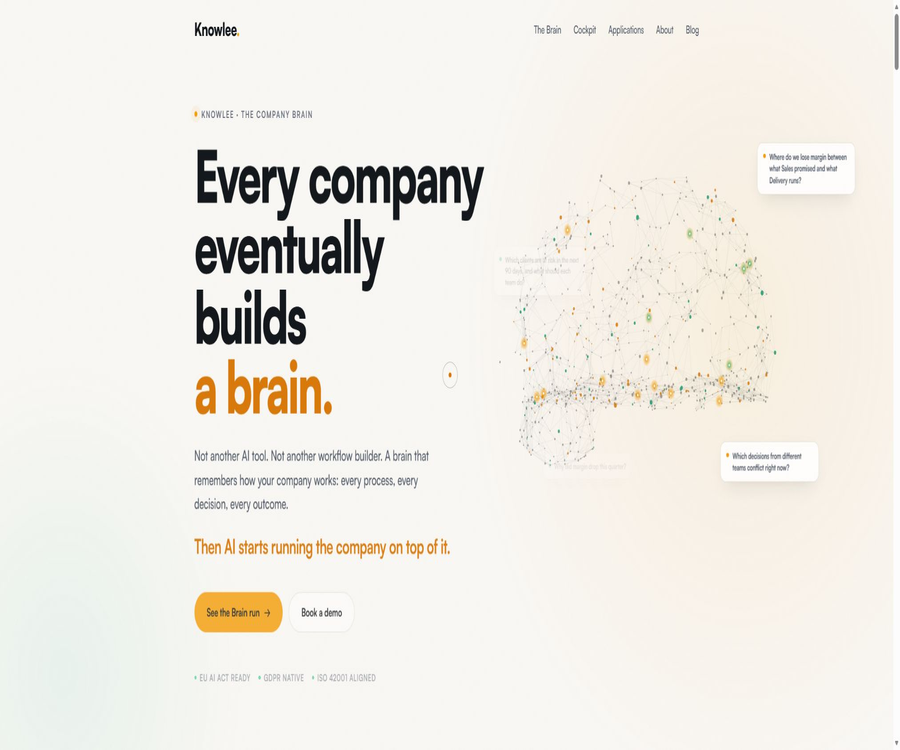
A one-sentence summary
Knowlee is a Company Brain and AI work platform designed for enterprises; it is used to transform organizational processes, decisions, and outcomes into a continuously updated corporate context, enabling governed intelligent agents to carry out actual tasks under human oversight.
What is Knowlee?
Knowlee is currently composed of three components: Company Brain, which is responsible for managing the corporate context; Knowlee OS, which handles coordination between humans and AI employees; and the deployment team, which focuses on integrating the platform with customers’ existing tools, data, and business processes. It functions more like a layer for operating enterprise AI solutions and providing implementation services, rather than a generic chatbot that can be used right after registration.
In its early stages, the product focused on functions such as personal AI assistants, knowledge networking, and automated agents; today it is positioned as an enterprise-level Company Brain. The old tutorials, the free tier, and the prices associated with third-party services cannot be used to describe the current commercial offerings.
Three-tier product structure
| Components | Main function | What do businesses gain? | Key boundary |
|---|---|---|---|
| Company Brain | It represents processes, decisions, outcomes, and their relationships. | Continuously accumulated enterprise context | Accurate data and maintenance mechanisms are required. |
| Knowlee OS | Coordinate parallel conversations, decisions, tasks, and AI employees | Unified dashboard and work records | High-risk actions should await approval. |
| Deployment team | Streamline processes and integrate CRM, email, calendar, and documents | Operational enterprise-customized systems | The scope of implementation and costs must be confirmed through a contract. |
Knowlee emphasizes that the model itself is not the main product; the true value lies in the governed corporate context. The processes, customer knowledge, and skills acquired by an organization remain at the disposal of the customer after delivery, but ownership of the specific data, configurations, and code should still be specified in the contract.
Company Brain: The enterprise knowledge brain
Company Brain is not a regular document repository; rather, it represents in a dynamic manner how a company functions. It connects the processes of different departments, past decisions, outcomes of those actions, and the interactions between them, enabling managers and AI-assisted employees to understand why a certain decision was made, what consequences it had, and who might need to take action next.
- Record sales, recruitment, delivery, operational, and financial processes.
- Save important decisions, participants, and approval criteria.
- Feed back the execution results to the existing enterprise context.
- Link cross-departmental tasks and interdependencies.
- Identify recurring issues, conflicting decisions, and potential risks.
- Enable different AI employees to share authorized company knowledge.
- Provide new employees and managers with a comprehensive understanding of the business context.
Connecting business data does not automatically lead to correct causal conclusions. In cases involving declining profits, customer risks, and inter-departmental conflicts, relevant evidence, timelines, and alternative explanations should be presented, with the business leader making the final decision.
Knowlee OS console
Knowlee OS is described as the \"Operating Room\" for enterprise AI, offering a centralized platform that includes parallel sessions, a decision inbox, an execution dashboard, and Company Brain. AI employees first formulate proposals, which wait for approval before being executed; the results of these executions are then sent back to Brain.
| region | Uses | Users need to handle it. |
|---|---|---|
| Parallel Sessions | Allow multiple AI employees to handle different tasks in parallel. | Avoid task conflicts and redundant operations |
| Decision Inbox | Display proposals awaiting approval in a centralized manner | Verify impacts, permissions, and evidence. |
| Execution Board | Track the execution status of approved tasks | Processing failure, dependencies, and timeouts |
| Company Brain | View enterprise context and continuous learning results | Correct erroneous nodes and expired rules |
| Monitoring | Monitor operations, risks, and business outcomes | Distinguish between system success and true business value |
| Audit and Rollback | Record actions and revert reversible changes | Identify which external actions cannot be restored with a single click. |
Human-machine collaboration and approval
By default, the platform emphasizes the concept of Human-in-the-loop, allowing companies to decide which tasks can be carried out automatically and which require human approval. Approval processes should be applied not only at the final stage of sending something out, but also to key intermediate steps such as setting prices, drafting contracts, handling recruitment matters, managing finances, and fulfilling customer commitments.
- AI employees read the authorized corporate context.
- Generate plans, suggestions, or actions to be taken based on the task.
- The system sends sensitive or highly impactful proposals to the decision inbox.
- The person in charge reviews the data, risks, objects, and expected outcomes.
- Approve, modify, reject, or forward to other personnel.
- Approved tasks run on the execution dashboard.
- The system records tool calls, results, and exceptions.
- If necessary, roll back the reversible actions and update Company Brain.
Manual approval is effective only when the reviewers have sufficient context and time to examine the proposals. If the system generates a large number of low-quality proposals, approval processes turn into mere mechanical clicks; therefore, it is necessary to monitor the rejection rate, the rate of revisions, and the time required for approval.
Business execution capability
Knowlee hopes that its AI employees will not only identify what has happened, but also propose actions in line with the company’s rules and coordinate the necessary corrections. The public applications focus on sales and recruitment, and there are plans to extend this same technology to areas such as law, finance, procurement, marketing, projects, and operations.
| Business areas | Executable tasks | Required corporate data | Main risks |
|---|---|---|---|
| Sales | Searching for clues, networking, scheduling meetings, and following up on leads | CRM, emails, calendar, and product information | Unnecessary external contacts, false promises, and compliance issues |
| Recruitment | Candidate search, screening, and interview scheduling | Positions, resumes, standards, and calendar | Discrimination, privacy, and wrongful elimination |
| Delivery | Track project, task, and customer risks | Contracts, plans, work orders, and communication | Error priority and customer impact |
| Operation | Coordinate request, inspection, and repetition processes | SOPs, forms, system status | Unauthorized writing and process interruption |
| Law | Search for contracts and policies and prepare a draft. | Contractual obligations, precedents, and regulatory requirements | It cannot replace a lawyer’s judgment. |
| Finance | Account reconciliation, monitoring, and reporting support | Accounting, invoices, and business data | Risks of numerical errors and fraud |
| Procurement | Supplier comparison, approval, and renewal reminders | Quotations, contracts, and supplier records | Deviations, conflicts of interest, and authorities |
| Marketing | Collaboration on activities, content, and analysis | Brand, audience, and channel data | Copyright, factual, and brand risks |
The current page clearly indicates that 4Sales and 4Talents are applications that run on Brain; the capabilities of other departments include the areas already mentioned as well as potential future developments. When making purchases, it is necessary to ask the team to distinguish between ready-made modules, those that require custom development, and those planned for future use.
Inter-departmental decision analysis
The differentiating aspect of Company Brain is its ability to address questions that individual departments cannot answer, such as the profit losses that arise between sales promises and actual delivery, decisions that conflict among different teams, and identifying in which system customer risks first appear.
- Link sales promises to delivery costs.
- Look for cross-system signals prior to customer churn.
- Identify the conflicting decisions being made by different departments.
- Examine the long-term costs resulting from a certain historical decision.
- Compare the business outcomes before and after the process change.
- Identify the person responsible for addressing the issue and the steps to take for collaborative resolution.
- Write the new results back to the enterprise context.
This type of analysis tends to mistake correlation for causation. Companies should require that the original records, the calculation logic, the time frame, and any manual interpretations be kept; model outcomes should not be used directly to make financial or HR decisions.
Deployment process
The typical time frame for going live, as indicated on this page, is 3–4 weeks; the focus is on integrating the existing platform with the company, rather than developing a new software system from scratch. The actual time required varies depending on the quality of the data available in each company, the connectors used, the security checks that need to be carried out, and the complexity of the processes involved.
| Phase | Main tasks | Delivered results | The customer needs to make an investment. |
|---|---|---|---|
| Week 1 | Streamline processes, tools, and departmental handovers | Flowcharts, tool relationships, and the initial Brain nodes | Interviews with business managers and relevant documents |
| Weeks 2–3 | Connects CRM, email, calendar, and documents; includes coding programs and approval rules. | Enterprise context and AI employee allocation | Permissions, test data, and security reviews |
| Week 4 | Operation console launch, approval process, and initial operation procedures | Operational AI work system | Acceptance, training, and production authorization |
| Sustained phase | Monitoring results, updating knowledge, and optimizing processes | Weekly changes and iterations | Business review and error correction |
Earlier versions of the website mentioned a time frame of 4–8 weeks, while the current homepage indicates 3–4 weeks. For official projects, the scope description, milestones, dependencies, acceptance criteria, and project schedule should be taken as the guiding factors; marketing timelines cannot be used as a guarantee.
Perform preparation steps
- Select a process that offers clear cross-departmental value and has controllable risks.
- Designate the business owner, data owner, and approver.
- Review existing steps, exceptions, tools, and manual handovers.
- Remove duplicate, expired, and conflicting data.
- Define the entities and relationships that Company Brain is intended to represent.
- Define read-only, recommended, draft, write, and send permissions.
- Configure approval, logging, monitoring, and shutdown mechanisms.
- Test using historical cases, abnormal scenarios, and malicious inputs.
- Verify business results on small-scale production tasks.
- Continuously correct Brain and extend it to adjacent processes.
System integration and data
Knowlee connects Company Brain to CRM systems, inboxes, calendars, documents, as well as the customer’s existing tools. The official website does not provide a complete list of connectors, API specifications, SDKs, event models, or rate limits; therefore, the extent to which each application can be integrated natively and customized needs to be determined through a technical assessment.
| System type | Common inputs | Possible output | Key points of control |
|---|---|---|---|
| CRM | Customers, opportunities, activities, and phases | Update records, tasks, and risks | Field-level permissions and bulk writing |
| Threads, attachments, and participants | Summary, draft, and follow-up | Sending approvals and sensitive content | |
| Calendar | Meetings, participants, and available time | Scheduling and Reminders | Time zones, conflicts, and external invitations |
| Document | SOPs, contracts, policies, and reports | Search, summarization, and process rules | Version, effective date, and access control |
| Recruitment system | Positions, candidates, and interviews | Filtering, sorting, and arranging | Fairness, explanation, and data protection |
| Financial system | Invoices, costs, and revenues | Reconciliation, exceptions, and reports | Accuracy, approval, and auditing |
| Project tools | Tasks, progress, and blockers | Status updates and coordination | Avoid automatically overriding human decisions. |
Companies should establish a stable object ID, synchronization frequency, conflict resolution rules, and mechanisms for retrying failed attempts. Any writes across different systems require idempotent control to prevent the same AI task from sending emails repeatedly, creating customers, or changing their status.
Governance and auditing
Knowlee incorporates human oversight, action auditing, risk classification, and rollback as part of its platform design. Every AI action is recorded, and its execution is monitored in real time; sensitive actions are subject to approval processes.
- Define responsibilities and prohibited behaviors for each AI employee.
- Decide whether approval is required based on the risk level.
- Record input, plans, tool calls, approvers, and results.
- It provides monitoring for task failures and abnormal states.
- Retain the one-click rollback capability for reversible actions.
- Add a second confirmation for irreversible external actions.
- Randomly inspect approved and rejected proposals on a regular basis.
- Implement version control for knowledge, permissions, and model changes.
Rollback is not applicable to all tasks; emails that have already been sent, external commitments, payments, or notifications to candidates may not be able to be revoked. Companies should identify actions that are reversible, compensable, and irreversible before carrying them out.
Security and compliance status
The current homepage highlights GDPR, the design of the EU AI Act, alignment with ISO 42001, human oversight, and tenant isolation as key aspects of its governance framework, and it states that customer data remains within its own infrastructure. The platform also claims to use end-to-end encryption and a zero-trust architecture.
| Project | Current wording | Correct understanding |
|---|---|---|
| GDPR | Declare compliance and adopt tenant isolation and DPIA frameworks. | The processing protocols, roles, and data flows should be verified. |
| EU AI Act | Designed in accordance with regulatory requirements, and includes auditing and human oversight. | The actual obligations depend on the specific usage scenario. |
| ISO 42001 | Claims to align with and cover most technical controls. | Alignment does not equate to certification. |
| ISO 27001 | The formal audit is included in the roadmap for the first quarter of 2027. | It cannot be marked as authenticated at the moment. |
| SOC 2 Type II | Verification included in the roadmap for the fourth quarter of 2026 | It cannot be marked as completed at the moment. |
| Encryption and Zero Trust | It has been stated externally that it has been adopted. | Architectural, testing, and audit evidence should be obtained. |
| Audit and rollback | Logs AI actions and supports monitoring as well as rollback. | It is necessary to confirm the retention period and irreversible actions. |
Some of the older pages on the website listed SOC 2 Type II as having achieved certification, which is in conflict with the current roadmap. Based on the current situation and the latest homepage content, it should be considered that this task is still part of the roadmap, and the purchaser should request the official report once it is completed.
Privacy and data processing
The privacy policy is issued by Knowlee, Inc., and it lists various types of data such as account information, contact details, payment information, user inputs, device and usage data. The policy mentions the use of cloud services, models, payment systems, monitoring tools, authentication mechanisms, communication solutions, analysis tools, and knowledge infrastructure providers, and it also notes that data may be transferred across borders.
- Identify what personal and business data is contained within the company’s Brain.
- Apply the principle of least privilege to connections such as Google Workspace.
- Verify the roles of the model, cloud platform, and vector storage in processing.
- Set the retention periods for processes, decisions, results, and logs.
- Establish mechanisms for accessing, correcting, deleting, and objecting to requests.
- Terminate the connection when personnel leave or a project comes to an end.
- Limit the scope of data for marketing, analytical, and research purposes.
- Confirm the complete export and deletion proof after the contract is terminated.
The Privacy Policy was last updated in 2024; the descriptions of suppliers and services listed may be based on an architecture that is older than the current Company Brain structure. Companies should request an up-to-date list of sub-processors, data flow diagrams, processing protocols, and details regarding the infrastructure.
Pricing and Business Model
Knowlee does not currently provide any publicly available pricing tables based on monthly or annual billing, or based on the number of seats, AI employees, or volume of usage. The official website offers 30 minutes of free consultation, and customized solutions are developed through enterprise diagnosis, deployment, integration, and ongoing optimization.
| Phase or plan | Price | Included content | Suitable for users |
|---|---|---|---|
| Official website and on-site control panel | Free access | View product positioning and interactive demonstration | Get a preliminary understanding of the platform |
| 30-minute consultation | Free | Discussion process, issues, and preliminary map of Company Brain | Assess the direction of the project |
| Process diagnosis | Custom quote | Processes, tools, handovers, and value analysis | Companies preparing for an AI transformation |
| Company Brain deployment | Custom quote | Platform configuration, data connection, approval, and deployment | Organizations that need an enterprise-level AI runtime layer |
| Business applications | Custom quote | AI employees in sales, recruitment, or other departments | Teams that need production-grade automation |
| Ongoing optimization | Custom quote | Monitoring, weekly reports, processes, and AI-driven employee upgrades | Long-term operating customers |
The free or pricing starting at $19 available in the older third-party catalogs is not applicable to the current Company Brain service. The official quote must specify the implementation fees, platform fees, amount of models used, connectors, support services, SLA terms, data hosting costs, and costs associated with exiting the service.
Ownership and exit arrangements
Knowlee emphasizes that the customer’s processes, as well as their knowledge and skills, remain the property of the customer; the system continued to be used by the customer after the handover. Since the public pages do not contain the full text of the contract, it is still necessary to specify in detail the rights related to data, configurations, proxy settings, custom code, and third-party components.
| Assets | Rights that should be recognized | It is required when exiting. |
|---|---|---|
| Original company data | The customer retains ownership. | Complete export and deletion proof |
| Company Brain structure | Can entities, relationships, and history be exported? | Open format and relationship description |
| Processes and skills | Can the customer continue to run and modify it? | Documents, configurations, and versions |
| Custom proxy | Assignment of hints, rules, tools, and test sets | Migratable deliverables |
| Custom code | Source code, license, and maintenance responsibilities | Warehouse, build, and deployment instructions |
| Models and third-party services | The right of use is subject to external terms. | Alternative suppliers and key rotation |
| Audit logs | Customer access and saving scope | Compliance retention and export |
GitHub and the open-source status
No official public source code repositories for Company Brain, Knowlee OS, or the business applications developed by Knowlee have been identified. Public websites, operational consoles, and enterprise API connections do not constitute proof that the products are open source; therefore, they should be classified as commercial, closed-source products with custom deployments.
Enterprises that require privatization, source code hosting, or emergency takeover should specify in the contract the delivery of the code, a list of open-source dependencies, licenses, escrow arrangements, the build methods, and the rights to continue operating after the supplier withdraws.
Which companies are suitable?
- Medium-sized companies whose processes are spread across multiple departments and tools.
- Teams that wish to use AI-powered employees to enhance their sales or recruitment capabilities.
- Organizations that need to link corporate knowledge with the actual execution of tasks.
- Regulated enterprises that require human approval, auditing, and rollback.
- Companies that wish to deploy AI on top of their existing CRM, email, calendar, and document systems.
- Management that needs to conduct cross-departmental analysis of the consequences of decisions and business risks.
- Companies willing to invest in process optimization, data governance, and collaborative implementation.
Product advantages
- Organize processes, decisions, and outcomes into a continuously evolving corporate brain.
- AI employees share the governed corporate context.
- The console handles parallel operations such as approval, execution, and monitoring.
- By default, emphasis is placed on human supervision and approval for sensitive actions.
- Provides auditing and reversible operation rollback for AI actions.
- The platform, combined with deployment services, reduces the need for companies to assemble systems on their own.
- It can be extended to more departments beyond sales and recruitment.
- Customer processes, knowledge, and skills are explicitly regarded as corporate assets.
Main limitations
- There is no standard public price; companies need to request a quote through consultation.
- The project requires 3–4 weeks or more to implement; it is not an instant self-service tool.
- Connecting data from multiple departments increases complexity regarding permissions and privacy.
- Cross-departmental causal analysis can still lead to incorrect judgments.
- There are few public connectors, APIs, and technical documents available.
- ISO 27001 and SOC 2 Type II remain on the roadmap.
- The privacy policy was updated before the current product architecture.
- The core platform is not an open-source software that has been confirmed.
- Automatic outreach, recruitment, and financial tasks carry a high level of compliance risk.
- Manual approval can lead to fatigue from having to confirm too many proposals.
Purchase and acceptance checklist
- Confirm the current contract entity, deployment method, and service area.
- Select the first process and quantify the time, cost, and quality baselines.
- It is required to distinguish between existing functions, custom development, and the roadmap.
- List all data channels, sub-processors, and cross-border transmissions.
- Verify the read, write, send, and approval permissions of AI employees.
- Test erroneous data, unauthorized requests, and irreversible actions.
- Verify audit logs, monitoring, rollback, and incident response.
- Request the latest information on security audit and certification progress.
- Include the price, model fees, maintenance costs, SLA requirements, and costs for exceeding limits in the contract.
- Clarify the ownership of Company Brain, configurations, code, and intellectual property.
- It can be verified that data, logs, and proxy configurations can be exported in their entirety.
- Acceptance is based on actual business results rather than demo metrics.
Frequently Asked Questions
What product is Knowlee now?
The current AI operation platform consists of Company Brain, Knowlee OS, and enterprise deployment services. It makes corporate processes, decisions, and outcomes available for use by governed AI employees.
Is Knowlee an ordinary knowledge base?
It’s not just document retrieval. Company Brain focuses on processes, decisions, outcomes, and inter-departmental relationships, while Knowlee OS is responsible for approval, execution, monitoring, and rollback.
How much is Knowlee?
There is no publicly available price for subscriptions. The official website offers 30 minutes of free consultation; however, services such as diagnosis, platform deployment, business application development, and ongoing optimization require quotes based on the scale of the enterprise.
How long before it can go live?
The typical time frame indicated on the home page is 3–4 weeks, and this includes process mapping, tool integration, configuration of programs and approval processes, as well as the launch of the system into production. More complex projects may require more time.
Which departments are supported?
Currently, the focus is on showcasing sales and recruitment applications, while law, finance, procurement, marketing, projects, delivery, and operations are listed as areas for further development within the same framework.
Will all AI actions be executed automatically?
No. The platform defaults to a Human-in-the-loop approach: sensitive proposals are sent to the decision inbox, and only after approval by human staff are they executed on the dashboard.
Has Knowlee passed SOC 2 Type II?
The current homepage lists the SOC 2 Type II audit as part of the roadmap for the fourth quarter of 2026; it cannot be marked as completed. The formal ISO 27001 audit is scheduled for the first quarter of 2027.
Is Knowlee open source?
No official publicly available core source code for Company Brain and Knowlee OS has been found; therefore, they should be regarded as commercial, closed-source platforms. Enterprises can negotiate the terms regarding deployment, code delivery, or hosting arrangements through contracts.
Who owns the customer knowledge?
Knowlee emphasizes that the customer’s processes, as well as their knowledge and skills, remain the property of the customer. The scope of what can be exported in terms of actual data, Brain structures, configurations, and custom code should be specified clearly in the contract.
Summary
Knowlee is suitable for organizations that wish to integrate fragmented processes, cross-departmental decisions, and business outcomes into a unified corporate framework, with AI-assisted employees carrying out tasks under approval. Company Brain, Knowlee OS, and the implementation team together form a complete pathway from knowledge representation to actual action.
Before adoption, it is necessary to verify the value of the actual process, the permissions of the connectors, the burden associated with manual approval, as well as the capabilities for audit rollback and data withdrawal. Public pricing information and technical documentation are limited, and security certification is still part of the future plans; therefore, contract terms, architecture, and compliance checks are key aspects to consider during procurement.
Tools similar to Knowlee · The Company Brain





 Guigong Network Security Registration No. 45132202000164