






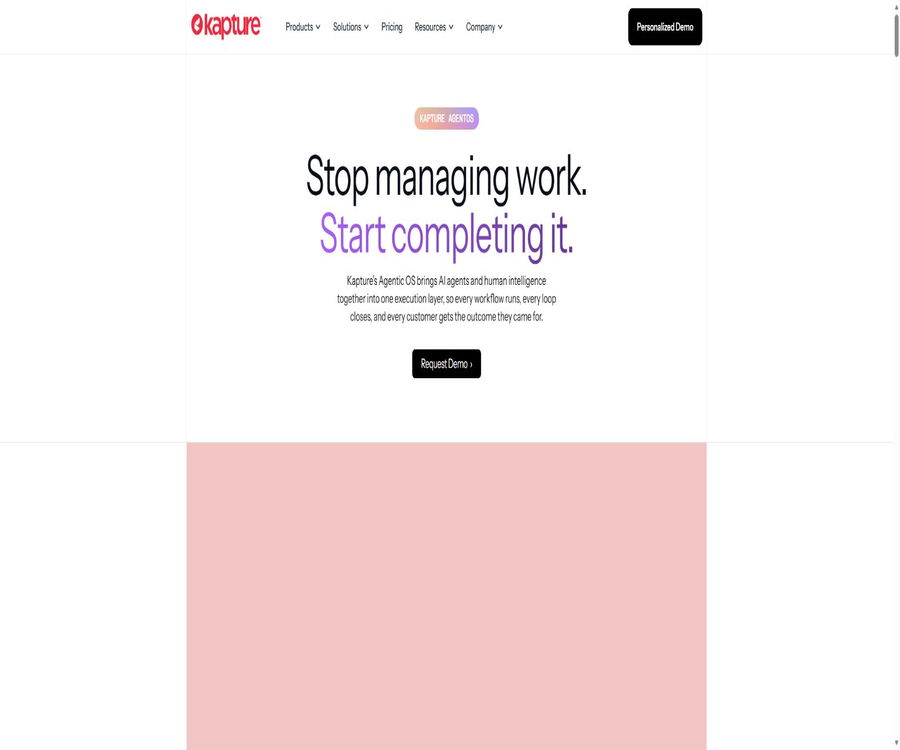
A one-sentence summary
KaptureCX is an AI-powered customer experience platform designed for corporate customer service teams, contact centers, and internal service units; it utilizes AgentOS to coordinate AI agents, human intervention, ticket handling processes, quality audits, and cross-system operations.
What is KaptureCX?
Developed by Adjetter Media Network Private Limited, KaptureCX was initially designed as a cloud-based CRM and ticketing system; today its scope has expanded to include an AI-driven platform for enhancing customer experience and supporting business operations. It aggregates interactions from various channels such as voice calls, chats, emails, social media, and messaging apps into a single workspace.
The platform is designed to serve enterprises that have complex processes, high levels of interaction, and the need for integration of multiple systems. Its value lies not only in answering questions but also in enabling access to business systems, facilitating the completion of tasks, assigning high-risk tasks to human reviewers, and continuously assessing the quality of both AI-based and human-generated services.
AgentOS core architecture
| AgentOS module | Main function | Key capabilities | Suitable for the character |
|---|---|---|---|
| VITOS | Build and deploy AI agents | Code-free creation, channel configuration, multi-step orchestration, and boundary testing | Customer service operations, process managers, and AI team |
| COMMAND | Define the artificial intervention layer | Manual review, approval routing, real-time takeover, and exception handling | Management, quality control, and compliance teams |
| CALIBRATE | Unified auditing and evaluation | Monitoring AI interactions with humans, scoring criteria, and continuous calibration | Quality Management and Operational Analysis Team |
| Execution layer | Connecting agents, human users, and business systems | Cross-system tasks, status tracking, and closed-loop processing | Enterprise service organizations |
VITOS is responsible for creation and orchestration, COMMAND determines where humans should perform reviews, approvals, or take over tasks, while CALIBRATE continuously evaluates the quality of execution. Together, these elements help to reduce the risk that AI customer service systems provide only answers without carrying out the necessary subsequent actions.
Product Suite Overview
| Product suite | Includes capabilities | Primary usage target |
|---|---|---|
| Self-Serve | Voice AI, non-voice AI, observability, and experience testing | Allow customers to resolve common issues on their own. |
| Agent Suite | Advanced ticketing, report analysis, and AI assistants for the customer service team | Improve the efficiency of handling tasks by human agents |
| Insights | Quality auditing, conversational intelligence, generative surveys, and feedback management | Identifying service issues and customer trends |
| Employee Experience | Work area, service desk, and AI agents for employee support | Automatically handle internal HR and IT requests. |
| AgentOS | Agent construction, manual control, and audit layer | Unified management of end-to-end agent execution |
Omni-channel customer service and intelligent ticketing
KaptureCX can convert interactions from various customer channels into unified tickets, while preserving the customer’s history and the context of those interactions. Routing rules enable issues to be assigned to the appropriate agent or human operator, based on factors such as intent, sentiment, priority, skills, and other business criteria.
- Voice calls interact with contact centers.
- Web chat, in-app chat, and messaging channels.
- Email ticketing and auto-reply processes.
- Instant messaging platforms such as WhatsApp.
- Social media platforms such as Instagram, Facebook, X, LinkedIn, and YouTube.
- Google Play and App Store review tickets.
- Internal sub-tasks, side-by-side collaboration, and cross-team escalation.
Advanced ticket handling capabilities
The ticketing system offers intelligent routing, a knowledge base, side conversations, sub-tickets, AI-generated summaries, sensitive language detection, and operational dashboards. For complex issues, collaboration can take place among customer service, technical, logistics, financial, or other departments, while the context of the main ticket is maintained.
Voice AI agent
Voice AI agents are designed for telephone customer service and call centers; they can understand the intent behind incoming calls, retrieve customer and business-related information, carry out predefined tasks, and transfer calls to human agents when certain conditions are not met or when there is a high level of risk. Companies can use them to handle inquiries about order status, make appointments, provide basic after-sales support, and manage calls during peak times.
- It supports 24/7 handling of common calls.
- Provide contextual answers by referencing customer records.
- Business steps that are carried out after authentication.
- Upgrade to the appropriate skill group based on the rules for human agents.
- Record the conversations, outcomes, and reasons for unresolved issues.
- Use observability and quality tools to check actual performance.
Voice bots involve recording, transcription, authentication, and potentially sensitive business operations. Before going live, it is necessary to determine the rules regarding recording notifications, consent mechanisms, data retention, handling of emergency situations, and procedures for human intervention in the relevant region.
Non-voice AI agents
Non-voice agents handle chat, emails, social media, and in-app support; they can generate responses that reflect the brand’s tone, cite relevant knowledge, maintain context across multiple conversations, and carry out actions according to predefined workflows. They can serve customers directly or act as a supporting tool for human agents.
- Understanding natural language intent and conversation context.
- Retrieve relevant answers from the enterprise knowledge base.
- Draft emails, chats, and social media replies.
- Follow the procedures for querying refunds and checking order status in accordance with policy implementation.
- Route to human agents in cases of uncertainty, sensitivity, or out-of-scope issues.
- Write the processing summary and next steps back into the ticket.
The product page claims that it can automatically handle a large number of common requests, but the actual level of automation depends on the quality of the knowledge available, system connectivity, the scope of the processes involved, and the distribution of customer issues. When making a purchase, one should rely on the results of actual business trials, rather than considering the advertised percentages as a guarantee.
AI assistant for human agents
Agent Suite provides chat summaries, knowledge recommendations, draft responses, suggestions for next steps, and intelligent routing for human customer service agents. Agents do not need to repeatedly copy customer information across different interfaces; they can view historical data, collaboration records, and related business information in the same workspace.
| Assistant capabilities | Reduced manual work | Manual confirmation is required. |
|---|---|---|
| AI ticket summary | Reading long conversations and repeating handovers | Key facts, commitments, and omissions |
| Knowledge recommendation | Manually search for policy and operation documents | Version, applicable regions, and exceptions |
| Reply draft | Rewrite the standard response repeatedly | Tone, facts, and compliance content |
| Next steps recommended | Determine the conventional processing path | High-risk operations and customer exceptions |
| Intelligent routing | Manually assign tickets | Skills, priorities, and load rules |
| Sensitive language detection | Identify inappropriate expressions one by one. | Context and disposal criteria |
Quality auditing and session intelligence
The Insights suite enables automatic analysis of calls, chats, tickets, and survey feedback, helping companies expand the scope of quality inspection. It can assess interactions based on metrics defined by the company, identify emotions and underlying causes, and generate suggestions for improvement.
- AI quality auditing and automatic scoring.
- Unified analysis of calls and digital sessions.
- Identification of customer emotions, intentions, and topics.
- Analysis of root causes, trends, and recurring issues.
- Real-time skill coaching and agent feedback.
- Predictive and prescriptive operational insights.
- Generative surveys and feedback management.
Automatic quality inspection is suitable for screening large-scale interactions, but scoring criteria, language differences, and business exceptions can affect the results. Companies should regularly calibrate the models using manual samples, and establish mechanisms for appeals, reviews, and version control.
Knowledge base and self-service
The knowledge base provides unified content for AI agents, human agents, and customer self-service interfaces. For a high-quality deployment, it is necessary to specify the content owner, approval status, release date, applicable products, regions, and expiration date, in order to prevent the agents from using outdated policies.
- Organize existing help articles, process documents, product policies, and frequently asked questions.
- Remove duplicate content and mark the authoritative version.
- Add product, region, language, and expiration date information to the document.
- Establish processes for editing, reviewing, publishing, and invalidating.
- Configure the scope of knowledge that the AI agent is allowed to use.
- Use real-world questions to test retrieval, citation, and refusal behaviors.
- Analyze unresolved issues and continuously address knowledge gaps.
Integration and open interfaces
KaptureCX offers REST APIs as well as a large number of pre-built integrations that enable connection to CRM systems, ERP systems, telephone services, messaging platforms, social media sites, and app stores. The pricing page states that the platform supports over a thousand API integrations; most of the common integrations are included in the quotes, while special connections can be customized by the integration team.
| Integrated categories | Represents a system or channel | Common uses |
|---|---|---|
| CRM and tickets | Salesforce, Zendesk, Freshdesk, Zoho, HubSpot, Jira | Synchronize customers, tickets, upgrades, and campaigns |
| Telephones and calls | Twilio, Exotel, Genesys, Knowlarity, Ozonetel, Airtel | Calls, text messages, pop-ups, and call records |
| Messages and Social Networking | WhatsApp, Facebook, Instagram, X, LinkedIn, Line | Convert messages, comments, and private messages into customer service tasks |
| Application evaluation | Google Play, App Store | Import comments and create tickets. |
| Enterprise systems | CRM, ERP, and proprietary business services | Query order, account, payment, and delivery status |
| Custom integration | Enterprise-specific systems | Connect via REST API or custom development |
“Support for integration” does not mean that two-way synchronization of all fields is available right out of the box. Before making a purchase, it is necessary to verify individually the authentication methods, field mapping, call limits, retry options in case of failures, data retention period, update delay, and any customization fees.
Employee experience and internal services
The Employee Experience suite utilizes similar AI agents and ticketing capabilities for internal HR, IT, and shared services. Employees can submit requests through a single entry point; the AI handles standard inquiries first, while those that require specific permissions or expert judgment are forwarded to human teams.
- Internal IT failures and access requests.
- Inquiries regarding HR policies and benefits.
- Automatic execution of cross-platform tasks.
- Ticket and status tracking for employee service desks.
- Manual approval, exceptions, and permission control.
- Internal knowledge search and step-by-step guidance.
Typical usage process
- Analyze customer channels, level of interaction, service languages, and existing systems.
- Select Self-Serve, Agent Suite, Insights, or the Employee Experience module.
- Import knowledge and establish content review and expiration rules.
- Connects CRM, telephone, messaging, order, and other business systems.
- Configure agent goals, tools, and multi-step processes in VITOS.
- Set the conditions for approval, transfer to a human agent, suspension, and takeover in COMMAND.
- Conduct pre-launch testing using historical cases, boundary scenarios, and high-risk issues.
- Start with pilot projects in limited channels or business areas, and then gradually expand the scope of operations.
- The performance of AI and human operators is continuously evaluated using CALIBRATE and Insights.
- Adjust knowledge, permissions, prompts, and workflows based on the reasons for failure.
Pricing and contract models
KaptureCX does not disclose fixed pricing for any packages; instead, it offers customized quotes on a modular basis. The price is determined by the selected products, the number of users, the level of interaction, AI features, additional modules, and any custom requirements.
| Billing plan | Public billing method | Features of the contract | Suitable for businesses |
|---|---|---|---|
| By agent | Charging is based on the number of human users on the platform. | It can be adjusted according to the team size. | Teams with a high proportion of human customer service staff |
| By interaction volume | Charged based on calls, messages, or other interactions | Costs vary with the volume of business. | Teams with a high proportion of automation and self-service solutions |
| Mixed billing | Take into account both the number of agents and the level of interaction. | Combining human effort with AI usage patterns | Omni-channel large-scale contact center |
| AI and additional modules | Quotation is based on the selected agent, analysis capabilities, or other functions. | Compared to the basic product portfolio | Companies that adopt AI in a phased manner |
| Custom integration and configuration | Include the cost based on complexity. | It is necessary to clarify the scope of implementation and the acceptance criteria. | Companies with numerous systems or complex processes |
The contract can be structured on an annual or multi-year basis, and discounts may be available for larger volumes and longer-term commitments. The price details specify that no refunds are provided in case of downgrading or cancellation; therefore, it is necessary to clarify the minimum commitment period, additional fees for exceeding limits, price increases upon renewal, procedures for exiting the contract, and what happens to any unused portions before signing.
What is included in the support services?
The published price details state that corporate clients will receive assistance with going live, training, and a dedicated success manager, as well as round-the-clock support. The actual response time, channels for support, service level, number of customizations, and on-site services must still be specified in the contract.
Privacy, Security, and Compliance
KaptureCX’s privacy policy covers data related to website visitors and service users, stating that the information collected will not be sold or rented out. Users have the right, in accordance with the law, to request access to their data, to have it corrected or deleted, to object to its processing, or to limit such processing; they can also withdraw their consent at any time.
| Security or compliance matters | Public status | Key points for procurement verification |
|---|---|---|
| ISO/IEC 27001:2022 | The platform lists them publicly. | Certificate subject, scope, location, and validity period |
| SOC 2 Type II | The platform lists them publicly. | Audit cycle, exceptions, and coverage systems |
| GDPR | The platform states that it supports the relevant requirements. | Handling roles, cross-border mechanisms, and data subject processes |
| HIPAA | The platform lists them publicly. | Applicable modules, regions, and business partner agreements |
| Access control | Includes physical, organizational, and permission-related measures. | Roles, minimum permissions, multi-factor authentication, and audit logs |
| Event management | The privacy page indicates that an event management procedure is in place. | Notification deadlines, scope of responsibilities, and evidence collection support |
Companies should not rely solely on the compliance indicators displayed on a website to conduct security audits. In sectors such as finance, healthcare, audio recording, and cross-border data transfers, it is necessary to obtain current certifications applicable to the products and regions in question, as well as data processing attachments, lists of sub-processors, and mechanisms for data deletion.
API, GitHub, and open-source status
KaptureCX offers REST APIs and supports custom integrations, but it has not been confirmed that its core platform is released under an open-source license. No official repository containing the complete source code for AgentOS, the ticketing system, or the cloud services could be found through public searches; therefore, this product should be classified as closed-source enterprise software.
| Developer capabilities | Current status | Selection recommendations |
|---|---|---|
| REST API | Already provided | Confirm the list of interfaces, authentication methods, rate limits, and versioning policies. |
| Ready-made connectors | Covers categories such as CRM, phone, social media, and messaging. | Test bidirectional synchronization and field ranges item by item. |
| Custom integration | It can be developed by the integration team. | Include the project timeline, costs, maintenance requirements, and ownership of the source code in the contract. |
| Official SDK | Public information does not provide a complete confirmation. | Do not assume that the required language SDK exists. |
| Open-source core platform | No | Evaluate based on closed-source SaaS and subscription licensing. |
| Private deployment | The public pricing page does not specify any standard options. | Confirm the architecture and responsibilities with sales when needed. |
Which companies are suitable?
- Companies that have a large customer service team and multiple channels for interaction.
- A contact center that requires unified management of both voice and digital customer service.
- Service organizations that wish to use AI agents to carry out cross-system processes.
- Operational teams that need to expand the scope of quality audits.
- Companies that use complex CRM, ERP, and industry-specific systems.
- Teams in industries such as finance, retail, travel, energy, and durable consumer goods.
- Organizations that need automation in areas such as internal IT, human resources, and shared services.
- High-risk scenarios that require manual approval, takeover, and audit tracking.
Product advantages
- Integrate AI agents, human intervention, and quality auditing into a unified execution framework.
- It covers voice, chat, email, messages, and social media channels at the same time.
- It provides complete work orders, a knowledge base, routing capabilities, and collaboration tools.
- VITOS supports code-free agent creation and multi-step orchestration.
- COMMAND can define approval, takeover, and exception processes.
- CALIBRATE and Insights support continuous quality assessment.
- It can be connected to a large number of CRM, telephone, and enterprise systems.
- Modular pricing is suitable for expanding the product range in stages.
- It covers both external customer service and internal employee support.
Main limitations
- Since there is no fixed public price, it is difficult to calculate the total cost before engaging in sales discussions.
- Large-scale deployments require knowledge organization, integration, and process restructuring.
- Custom configurations increase the complexity of implementation, testing, and long-term maintenance.
- The effectiveness of AI automation depends heavily on the quality of a company’s data and knowledge.
- The figures regarding automation and return on investment mentioned in the promotions are not guaranteed by the contract.
- Multi-channel recording and personal data entail higher compliance requirements.
- No refunds are available in the case of downgrade or cancellation.
- The level of integration and the associated costs for certain components need to be determined on a case-by-case basis.
- The core platform is closed-source, so customers rely on the supplier’s pathways and service continuity.
- Public information does not specify a standard privatized deployment scheme.
Pre-purchase checklist
- List the number of agents, monthly interaction volume, channels, languages, and growth forecasts.
- Identify the product suites, AI modules, and additional capabilities that need to be purchased.
- Use representative tickets and calls to test understanding, routing, and resolution rates.
- Verify each field and direction of the integration between CRM, telephone, and business systems.
- Confirm the complete calculation methods for billing by agent, by interaction, or in a hybrid manner.
- Verify implementation, migration, training, customization, and additional costs.
- Include the minimum commitment period, renewal terms, downgrading options, cancellation procedures, and refund policies in the contract.
- Obtain the security certificate, audit scope, sub-processors, and data processing attachments.
- Set up manual approval, takeover, and rollback for high-risk actions.
- Agree on service levels, recovery objectives, data export methods, and exit strategies.
Frequently Asked Questions
Are there public pricing plans for KaptureCX?
There is no fixed price list. The platform provides customized quotes based on product modules, agents, level of interaction, AI features, and additional services; billing can be done on a per-agent basis, per-interaction basis, or in a mixed manner.
Is multi-channel customer service supported?
Supported. The platform covers phone calls, chat, email, WhatsApp, social media, app reviews, and other digital channels, and integrates all interactions within the context of tickets and customers.
What is the difference between AgentOS and ordinary chatbots?
AgentOS not only generates responses but also emphasizes multi-step business execution, manual approval and takeover, cross-system coordination, as well as continuous quality auditing. It is more aligned with the operation and governance aspects of enterprise agents.
Can it be integrated with existing CRM and phone systems?
The platform lists a variety of integrations such as Salesforce, Zendesk, HubSpot, Twilio, Genesys, etc., and offers REST APIs as well as custom integration services. The specific fields and costs need to be verified separately.
Is KaptureCX suitable for small teams?
The product positioning and pricing approach are geared more towards medium and large enterprises. Small teams with simple requirements and limited channels should first consider the implementation costs, the minimum contract duration, and the number of modules actually needed.
Does the platform support quality audits?
Supported. Insights and CALIBRATE can assess interactions between AI and humans, analyze emotions and underlying causes, and provide quality scores along with suggestions for improvement; however, the automatic scores still need to be calibrated by humans.
Is KaptureCX open source?
No. REST APIs can be used for integration, but the core AgentOS, ticketing platform, and cloud services are not released under an open-source license.
Can I get a refund if I cancel my subscription?
The price details clearly state that no refund is applicable in the event of a downgrade or cancellation. Companies should confirm the minimum commitment period, termination date, renewal conditions, and the handling of unused fees before signing the contract.
Summary
KaptureCX is suitable for companies that wish to integrate AI-powered customer service, human agents, ticketing systems, business processes, and quality control mechanisms within a single platform. Its structured architecture, along with capabilities for manual control and auditing, make it more appropriate for complex service workflows than standard chatbots.
The main challenges in making a selection lie in custom pricing, system integration, data management, and the complexity of implementation. Companies should use real-world pilot projects to assess the effectiveness of solutions and determine the need for manual intervention; moreover, they must include details such as pricing formulas, scope of implementation, security guarantees, service levels, and exit procedures in the contract.
Tools similar to KaptureCX





 Guigong Network Security Registration No. 45132202000164