






A one-sentence summary
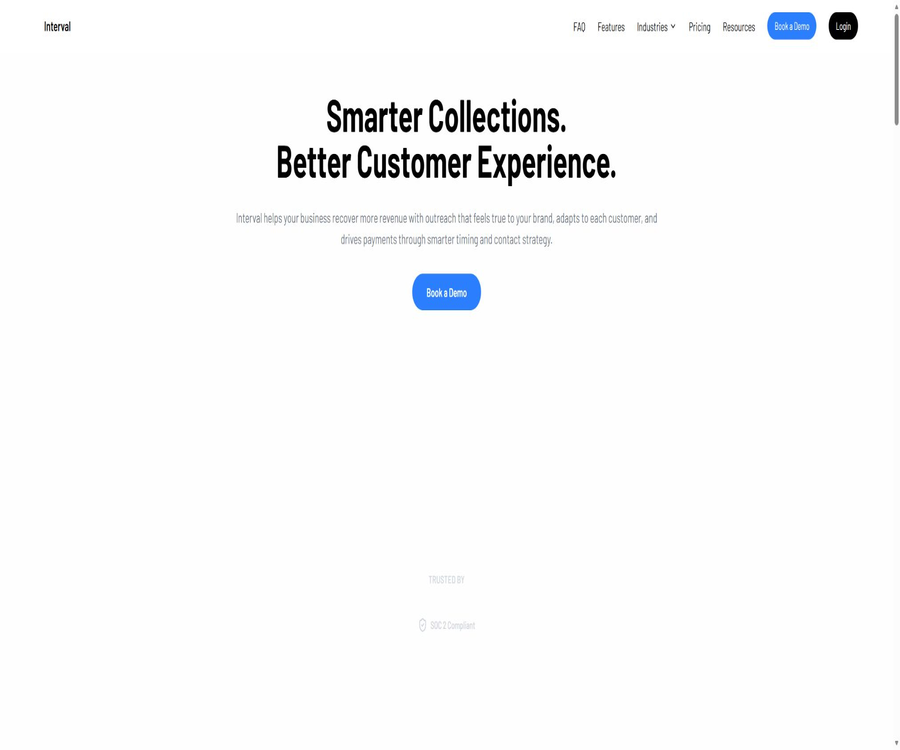
Interval AI is an AI-based collection platform designed for businesses dealing with overdue accounts receivable; it can automatically contact customers via phone, text message, and email to discuss payment arrangements, and it aggregates all relevant updates in a real-time dashboard.
Tool Introduction
Interval AI Corporation positions its product as a first-party collection software; companies use their own brand and customer relationship management systems to deal with overdue payments, rather than handing over the accounts to traditional third-party collection agencies. The platform focuses on improving the efficiency of debt collection, enhancing the customer experience, and reducing the amount of manual work required.
It is suitable for companies that already have a certain number of overdue customers and wish to automate repeated reminders, payment communications, and status tracking. Before adopting it officially, it is necessary to conduct a compliance assessment taking into account the business regions, types of debts, customer consent, and industry regulations.
Product workflow
| Phase | System actions | Companies need to get prepared. | Main results |
|---|---|---|---|
| Import data | Connect to CRM, accounting systems, or upload forms | Customers, bills, balances, expiration dates, and contact information | Create a queue for accounts to be followed up on. |
| Develop strategies | Analyze the appropriate time, channels, and communication methods. | Brand tone, aging segmentation, and contact rules | Establish an automatic pacing for outreach. |
| Automatic communication | Stay in touch through phone calls, text messages, and emails. | Payment policies, common questions, and upgrade criteria | Answer questions and facilitate payment. |
| Processing results | Record payment commitments, plans, disputes, and information updates | Acceptable solutions and authorization boundaries | Achieve a structured disposal status |
| Real-time monitoring | Display sessions, payments, commitments, and risk warnings | Person in charge and manual takeover mechanism | Monitor progress closely |
| Ongoing optimization | Adjust the timing and strategies based on historical performance. | Quality sampling inspections and business feedback | Increase cash inflows and reduce repetitive manual work. |
Automatic outreach through multiple channels
AI agents can handle calls, text messages, and emails around the clock, eliminating the need for companies to rely on human staff to make calls or send reminders one by one. The frequency of communication, the combination of channels used, and the tone of communication are still determined jointly by the company and the platform.
- The phone is suitable for explaining complex bills, verifying identities, and discussing payment arrangements.
- Text messages are suitable for sending short reminders, payment links, and follow-up confirmations.
- Email is suitable for providing bill details, official notifications, and more comprehensive explanations.
- Account status should be shared across different channels to prevent customers from continuing to receive collection requests after they have already made a payment.
- Once a customer declines certain types of communication, their preferences and blocking rules should be updated promptly.
Phased AI agents
Interval adopts different communication strategies depending on the stage of overdue payment; the approach is usually more gentle in the early stages, and it becomes more assertive as the amount owed increases. This helps to avoid damaging customer relationships resulting from all customers receiving the same strict communication template.
| Account stage | Key points of communication | Suggestive tone | Conditions for human intervention |
|---|---|---|---|
| Approaching expiration or slightly overdue | Remind about bills and check if anything has been forgotten. | Friendly and service-oriented | The customer reported an incorrect bill. |
| Persistent overdue status | Understand the reasons and provide viable payment options. | Clear, collaborative | The customer is facing financial difficulties or does not meet the required criteria. |
| Payment commitment has been made. | Remind and confirm the results around the scheduled date. | Concise, confirmatory | The promises were not fulfilled on multiple occasions. |
| There is controversy. | Collect issues and stop inappropriate repeated pressure. | Neutral, cautious | Contractual, legal, or business judgment is required. |
| High risk or long-term overdue | Upgrade and dispose in accordance with corporate policies. | Formal, compliant | Complaints, legal representation, or situations involving regulatory sensitivity |
Payment plan and payment commitment
The platform can record the amount and date that customers have committed to paying, as well as track whether those commitments are fulfilled. Businesses can also establish acceptable payment plans, providing customers with a clear path forward in cases where making a one-time payment is difficult.
- Define the minimum down payment, the number of installments, and the maximum time required to complete it.
- Clarify the scope in which AI can give approval directly, as well as the exceptions that require manual approval.
- Send reminders before the payment date to reduce further delays.
- When payment fails, retry the attempt according to the preset rules or switch to a human agent.
- Synchronize commitments, breaches of contract, and actual payment status back to the business system.
Update payment details
In some cases of overdue payments, it is not the customer who refuses to pay, but rather the expiration of the credit card, changes in account information, or failures in automatic payment processing. Interval can prompt the customer to update their card or banking details, thereby restoring the account to a state where payments can be made.
Companies should not collect complete and sensitive payment information during ordinary conversations. Approved secure payment processes must be used, and attention should be paid to the payment processors, tokenization methods, access controls, and logging procedures.
Dispute Management and Manual Escalation
AI can answer common billing questions, identify the types of disputes, and pass complex or sensitive matters to human agents. Proper escalation rules prevent the system from continuing to apply pressure when it lacks sufficient information.
- Automatic reminders are suspended in case of disputes over the bill amount, service delivery, or contract terms.
- Disclosure of account details is prohibited when the customer’s identity cannot be confirmed.
- Complaints from customers, requests for manual assistance, or mentions of legal representatives should be escalated immediately.
- Difficult customers and vulnerable groups should be routed to specialized manual processing procedures.
- All manual decisions should be fed back into the system simultaneously to prevent the AI from asking repeated questions.
Real-time monitoring dashboard
Managers can view each session, payment, payment commitment, and risk alert in one place, thereby knowing which accounts the AI is currently handling. The value of the dashboard lies not only in showing the total amount collected, but also in helping the team identify incorrect contacts and failed processes.
| Indicators | Representative meaning | Usage notes |
|---|---|---|
| Amount recovered | Payments completed as a result of automated processes | Comparison with bank deposits and the original business system |
| Payment commitment | The customer stated that they would make the payment at the specified time. | It cannot be equated with actual cash receipt. |
| Commitment fulfillment rate | Percentage of commitments fulfilled on schedule | Segmented by channel, age of accounts, and agency strategy |
| Average payment time | From the date of overdue or breach to the date of receipt of funds | Maintain consistency in statistical methods |
| Labor saves time | Reduced dialing, messaging, and follow-up efforts | Taking into account the costs of manual review and exception handling |
| Disputes and complaints | The customer raises objections regarding the statement or communication. | As indicators for compliance and experience monitoring |
| Contact success rate | Percentage of successful connections or responses received | Exclude incorrect numbers and duplicate accounts. |
Multilingual communication
The platform states explicitly that it supports over 60 languages, making it suitable for companies with customers spread across various languages. Multilingual support involves not only translation but also ensuring consistency in amounts, dates, payment terms, and legal wording.
- Choose the language based on the customer’s preferences, rather than relying solely on their name or region.
- Use structured fields for amounts, currencies, dates, and payment terms.
- Prepare manually reviewed brand terminology and prohibited expressions for the primary language.
- When the confidence level is low or there are difficulties in understanding dialects, the task is handed over to a human.
- Evaluate the complaint rate, compliance rate, and error rate for each language separately.
Access and data preparation
Interval allows customer data to be imported from CRM systems, accounting systems, or spreadsheets; the official website provides approximately 40 minutes as a reference for a quick setup. The actual time required for deployment depends on the quality of the fields, system permissions, payment processes, and compliance requirements.
| Data category | Examples of required fields | Check before going live |
|---|---|---|
| Customer identity | Customer ID, name, company name | Remove duplicates and verify the debtor’s identity. |
| Contact information | Phone, email, language, and preferences | Validity verification, consent, and stop-contact status |
| Accounts receivable | Invoice number, balance, expiration date, and age of account | Consistent with the general ledger and customer records |
| Payment status | Paid, partially paid, failed, and refunded | Establish a mechanism for timely synchronization. |
| Contracts and Services | Products, service period, and notes on disputes | Only the information necessary for processing is made available to the AI. |
| Connect with history | Time, channels, outcomes, and commitments | Avoid overclocking, repetitive, or contradictory communication. |
Deployment steps
- Calculate the number of overdue accounts, the outstanding balances, the age distribution of these accounts, and the main types of customers.
- Confirm the applicable region, the identity of the party responsible for collection, consent for contact, and industry restrictions.
- Choose between CRM, accounting system, or table import, and remove duplicate and erroneous data.
- Configure the brand’s tone, language, preferred times for communication, frequency, and channel priorities.
- Set limits for the payment plans, discounts, and data updates that AI can offer.
- Establish an automated escalation process for customers with disputes, difficulties, unusual identities, and complaints.
- Start with a small number of accounts for a trial run, to verify each interaction, payment, and status update.
- The scope for expansion is determined based on indicators such as revenue collection, complaints, incorrect contacts, and labor hours.
Pricing method
The price information was verified on August 23, 2026; the actual amounts, taxes, exchange rates, and discounts may vary, and the final figures will be those displayed on the settlement page.
Interval does not provide a public, standardized list of monthly fees or fixed package options; instead, it prepares quotes based on the amount of accounts receivable and the number of overdue customers that need to be dealt with. The pricing page uses a questionnaire along with an appointment booking process.
| Quotation process | Information to be provided | Possible impact on prices |
|---|---|---|
| Size of accounts receivable | 0–10,000, 10,001–50,000, 50,001–150,000, or over 150,000 dollars | Determine the basic scale of the project |
| Team size | Current number of staff in charge of finance and debt collection | Reflects the needs for automation and collaboration. |
| Third-party situation | Whether to use external collection services or other solutions | Affects the scope of migration and process design |
| Contact information | Information on companies and their managers | Used for qualification verification and quotation communication |
| Demonstration and evaluation | Business systems, number of accounts, channels, and compliance requirements | Determine the final scope of services and the contract terms |
The public page does not indicate whether the pricing is based on accounts, amounts recovered, messages, phone minutes, or a fixed platform fee. When placing an order, it is necessary to ask the seller to include in the quote the basic fee, usage fees, implementation costs, the duration of the contract, and the conditions for early termination.
Quotation evaluation checklist
- Verify whether there are limits set on the number of accounts to be processed each month and on the outstanding balances.
- Ask whether phone calls, text messages, emails, and payment processing are charged separately.
- Clarify whether a percentage fee is charged for successful collection of payments and the attribution window.
- Check whether there are additional charges for data integration, configuration, training, and subsequent support.
- Learn about the minimum contract duration, automatic renewal, price adjustments, and rules for exporting data.
- Estimate the total cost using real historical data, and compare it with manual and third-party solutions.
Safety and compliance
The website states that it is SOC 2 Compliant, but it does not indicate on its public pages the type of report, the audit period, or the scope of controls. When making a purchase, companies should request the current report or proof, and verify that it covers the products actually in use, the sub-processors involved, and the data environment.
The platform states that it will inform customers clearly during the communication process that they are interacting with AI. Such disclosures cannot replace the company’s independent judgment regarding automatic dialing, consent via text messages, timing of contacts, requests to stop communication, disclosure of debt information, and recording rules.
| Control domain | Requirements for going live | Audit evidence |
|---|---|---|
| AI identity disclosure | The automated identity is clearly specified at the start of the conversation. | Call and message samples |
| Contact authorization | Consent applicable for saving phone numbers, text messages, and emails | Agree on the time, method, and scope. |
| Frequency and time period | Restrict outreach by region and customer status | Policy configuration and contact logs |
| Stop contacting. | Quickly identify unsubscribes, rejected calls, and attorney representation. | Blocking list and processing records |
| Authentication | Verify the customer’s identity before disclosing financial information. | Verification steps and fallback in case of failure |
| Dispute resolution | Suspension of inappropriate automatic collection for disputed accounts | Disputed queues and manual conclusions |
| Payment security | Sensitive payment information is processed through controlled procedures. | Payment provider compliance and permission records |
Privacy and customer data
The collection system needs to handle sensitive business data such as identity information, contact details, account balances, payment history, conversations, and disputes. Public websites provide only general information on the privacy measures in place; companies should obtain complete details regarding data processing before signing a contract.
- Determine whether Interval acts as a processor, a co-controller, or an independent controller in the business relationship.
- Understand the locations where data is stored, as well as the measures related to encryption, backup, and cross-border data transfer.
- Restrict access to account information by employees, AI agents, and sub-processors.
- Specify the retention period for call recordings, transcriptions, text messages, and emails.
- Provisions for accessing, correcting, deleting, exporting data, and handling it after the contract is terminated.
- It is prohibited to import large quantities of customer data that is not related to debt collection into the platform.
APIs, Integration, and GitHub
The current product page states that it can be connected to CRM systems, accounting systems, and spreadsheets, but it does not provide a complete list of available connectors, nor any documentation on public APIs or SDKs. Companies need to confirm details such as their own system requirements, synchronization frequency, retry mechanisms in case of failures, and the way in which data fields are updated during demonstrations.
No official GitHub repository belonging to Interval AI Corporation’s collection tools was identified. The GitHub organization named Interval is primarily related to another internal application development platform; therefore, this product cannot be considered open source based on that.
Which companies are suitable?
- Service companies that have stable monthly bills and a certain number of customers in arrears.
- Growing companies that wish to reduce the amount of work related to repeated dialing, sending texts, and emails for their finance staff.
- First-party collection teams that need to maintain customer relationships through their own brand.
- Companies with diverse customer bases that require communication in over 60 different languages.
- Organizations that wish to centrally manage payment commitments, installment plans, disputes, and contact records.
- A mature operations team capable of allocating resources to compliance, data governance, and manual upgrades.
Product advantages
- It covers calls, text messages, and emails, without being limited to just one method of notification.
- It can handle payment commitments, installment plans, data updates, and common disputes.
- Phased agents can adjust their tone and handling strategies based on the account age.
- It supports over 60 languages and offers round-the-clock automatic communication.
- A unified workflow is established from data import, customer engagement, conversations to the payment status.
- It emphasizes the first-party brand experience, and is suitable for companies that wish to maintain customer relationships.
Usage restrictions and risks
- There is no fixed public price; it is necessary to submit company information and schedule a demonstration.
- Details on public integration, APIs, data retention, and security certifications are limited.
- Automatic calls and text messages are subject to regional legal requirements; one cannot rely solely on the statements provided by the platforms regarding compliance.
- Incorrect customer information can lead to unnecessary follow-ups, excessive contact, or privacy breaches.
- AI cannot independently resolve complex contracts, difficult clients, and legal disputes.
- A payment commitment does not equate to the actual arrival of funds; it must be verified against accounting and bank records.
- No open-source or proprietary deployment versions of the product have been identified.
Ongoing governance after going live
- Check every day whether customers who have made payments have been removed from the collection queue in a timely manner.
- Sample calls, texts, and emails to check disclosure, tone, and factual accuracy.
- Monitor complaints, cancellations, incorrect contacts, and accounts with abnormally high activity.
- Review disputes and manual upgrades to update AI knowledge and authorization boundaries.
- Compare the collection results by channel, age of accounts, customer type, and language.
- Regularly verify connectors, payment processes, permissions, and data deletion mechanisms.
Frequently Asked Questions
What does Interval AI do mainly?
It helps businesses to automatically follow up on overdue accounts receivable, communicating with customers via phone, text messages, and email, while also keeping track of payments, commitments, plans, and disputes.
Is Interval AI a third-party debt collection agency?
The product describes Interval AI Corporation as the first-party collection agency; the software assists companies in recovering payments through their own customer relationships. The specific contractual roles and legal responsibilities applicable in such cases need to be determined at the time of purchase.
Which languages does it support?
The current product description claims support for over 60 languages. Companies should conduct manual testing in the languages of their main customers, paying special attention to amounts, dates, payment terms, and sensitive wording.
How much does Interval AI cost?
There is no unified public price. The quotation depends on the volume of accounts receivable, the number of customers in arrears, as well as the team and scope of implementation; it is necessary to fill out a questionnaire and schedule a demonstration.
Is CRM and accounting system support available?
Data import is supported via CRM, accounting systems, or spreadsheets; however, a complete list of available integrations is not provided on the public page. It is necessary to verify the specific products, the direction of data synchronization, and the range of fields before making a purchase.
Does Interval AI provide APIs?
To date, no public API or SDK documentation has been identified. Companies that need automated integration should verify the capabilities of the interfaces, the relevant limits, and the level of technical support through demonstrations and contracts.
Is Interval AI open source?
It is not an open-source product that has been verified, and no official code repository corresponding to the identity of this collection platform was found. The Interval project with the same name available on the Internet belongs to another product.
Can AI completely replace manual debt collection?
It is not suitable for complete replacement. Repeated reminders and common issues can be handled automatically, but disputes, complaints, difficult customers, unusual identity situations, and legally sensitive matters require human judgment.
Summary
Interval AI is suitable for companies that wish to upgrade their first-party collection processes from manual tracking to automated multi-channel approaches. It integrates account import, staged communication, payment commitments, dispute management, and real-time monitoring into a single process.
The key to making procurement decisions lies not in focusing solely on the figures related to cash inflows, but rather in evaluating the total cost, the quality of service, data security, and compliance measures. Only by establishing accurate synchronization mechanisms, opportunities for manual intervention, and regular audits can automation help improve cash flow while simultaneously safeguarding customer relationships.
Tools similar to Interval AI





 Guigong Network Security Registration No. 45132202000164