






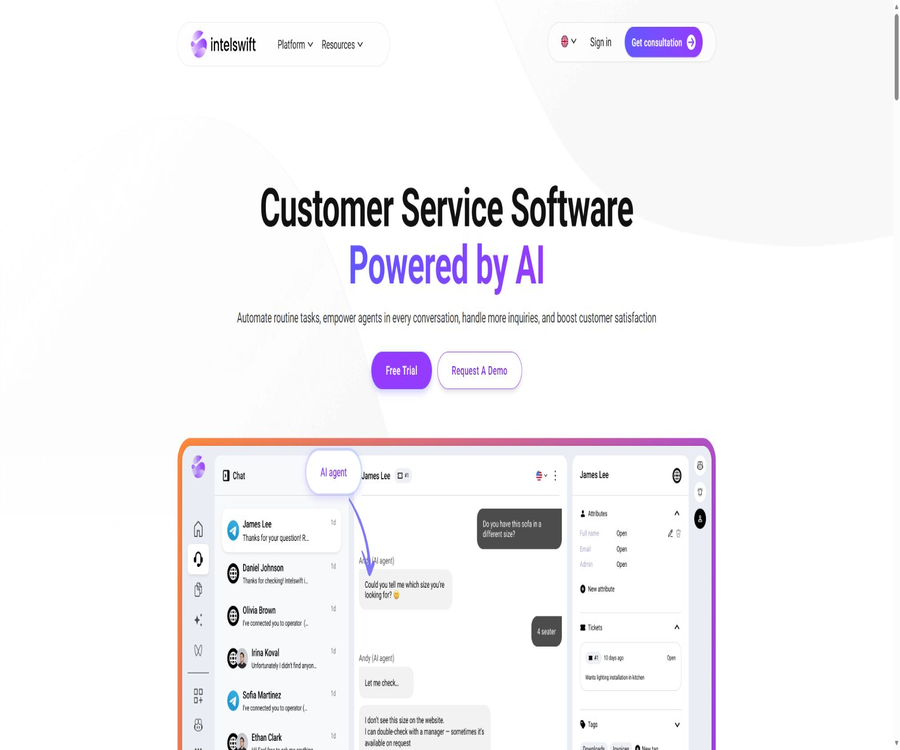
A one-sentence summary
Intelswift is an AI service platform designed for customer service centers and customer operations teams; it allows intelligent agents, human agents, shared inboxes, tickets, knowledge bases, voice robots, and customer service analytics to be integrated within the same system.
Tool Introduction
Intelswift is operated by Intelswift OÜ in Estonia. Its core concept is to gather customer messages from various channels, after which AI agents handle repetitive inquiries, access business systems, or forward complex issues to human staff.
It is not just a website chatbot; it also covers text, voice, agent assistance, and backend processes. Companies can first upload their documents and rules to the knowledge base, test the responses in a sandbox environment, and then gradually enable automated replies and business actions.
Product composition
| module | Main function | Typical users |
|---|---|---|
| AI Agent | Answer questions based on the company’s knowledge and carry out the predefined business actions. | A customer service team that needs to automate first-line inquiries |
| AI Chatbot | Provide 24/7 text services via websites and messaging channels | E-commerce, services, and online businesses |
| Shared Inbox | Receive emails, chats, messages, and call records in one place | Multi-agent customer service center |
| Ticketing | Convert complex requests into work orders that can be assigned, tracked, and escalated. | Interdepartmental service team |
| Swift Docs | Manage internal knowledge and publish self-service help content | Head of Knowledge Operations and Customer Service |
| Swift Copilot | Provides response suggestions and contextual hints for live agents. | Teams that need to improve efficiency while retaining human decision-making |
| AI Voice Bot | Answer calls, identify needs, respond to questions, and route to the appropriate agent | Call center and appointment services |
| Analytics | Analyze conversations, responses, satisfaction, and team performance | Customer service managers and operational staff |
AI customer service agent
Generate answers based on corporate knowledge.
AI agents use retrieval-enhanced generation to access a knowledge base containing customer configuration details, and then generate responses based on those details. The quality of the policies, product descriptions, and procedures provided by the company directly affects the accuracy of the responses.
Execute AI Actions
In addition to answering questions, the agent can also utilize integrated calls to business systems in order to execute queries, create or update records, and trigger predefined workflows. All actions are determined by the parameters and permissions configured by the customer.
Automated transfer to manual handling
When the issue is complex, the level of confidence in the solution is low, or certain upgrade rules are met, the system can transfer the conversation to a human agent. The team can set policies such as giving priority to AI, giving priority to humans, enabling the use of human agents during peak hours, or only during off-peak times.
sandbox testing
Before going live, the agent can be tested in a sandbox environment to determine whether it understands the business context. It is recommended to use a real set of questions that cover normal, ambiguous, unauthorized, and abnormal scenarios, rather than only testing ideal question formats.
Omni-channel shared inbox
The shared inbox brings emails, web chats, Telegram, WhatsApp, Messenger, Viber, and voice calls together in one workspace. Agents can view contact information, history across different channels, and the current status of tasks.
- Organize conversations such as bills, complaints, and sales opportunities using tags and custom groups.
- Requests are assigned to the appropriate agent or department through routing rules.
- Receive new messages and status alerts while working on other pages.
- View customer contact information and past interactions to avoid repeated inquiries.
- Automatically translate customer messages and convert agent responses into the customer’s language.
A unified inbox helps reduce the need to switch between multiple message windows, but before connecting to each external channel, it is still necessary to verify the permissions for that platform, as well as the message templates and data usage rules.
Work orders and manual collaboration
The ticketing system is used to handle issues that cannot be resolved within a single conversation; it allows for the recording of the status of these tasks, the assignment of responsible persons, and the tracking of their progress. AI can first identify the topic and priority of a request, and then forward it to the team with the appropriate skills to deal with it.
- Convert conversations into trackable service tasks to prevent requests from getting lost in the message flow.
- Assign responsible persons based on theme, channel, customer, or business rules.
- Maintain context between AI and humans to reduce the need for customers to repeat explanations.
- Allow managers to view unresolved issues, processing speed, and agent load.
Knowledge base and self-service
Swift Docs can serve as a search database for AI agents, as well as a platform for publishing self-service content intended for customers. Companies need to keep track of versions, expiration dates, and scope of application in order to prevent older policies from influencing the responses provided.
- Organize the product descriptions, service policies, standard procedures, and frequently asked questions, removing any duplicate or conflicting content.
- Add files or instructions to the knowledge base, and assign clear titles and boundaries to important rules.
- Use the sandbox question set to examine search results, citation context, and refusal behaviors.
- The person in charge of the business corrects the errors, and only after verification is done does the agent get in touch with the actual client.
- The knowledge base is continuously updated based on new products, policies, and discussions about failures.
Swift Copilot agent assistant
Swift Copilot provides suggestions for responses and context-related recommendations to human agents, helping them to organize their statements, adjust the tone of their messages, and avoid repeating information. The decision as to whether to adopt these suggestions and what actions to take remains with the human user.
This approach is suitable for high-value, sensitive issues that require judgment, as it allows teams to leverage AI to speed up processes while still maintaining clear boundaries regarding approval and responsibility. It cannot replace professional judgments in fields such as law, medicine, finance, or other areas.
AI voice robot
Voice robots can answer calls, understand voice inquiries, provide assistance, and route calls to the appropriate staff members. Once business integrations are set up, they can also retrieve product information or carry out predefined actions such as making appointments.
- Handle frequent phone inquiries regarding business hours, order status, store information, etc.
- If the issue cannot be resolved, transfer the call to a human agent while retaining the information already collected.
- Share knowledge and management interfaces with text-based customer service to reduce fragmentation across different channels.
- Reduce misoperations caused by speech recognition errors by clearly defining the verification steps.
For actions related to cancellation, refunds, order modifications, or changes to personal information, it is necessary to obtain additional confirmation from the customer, and the fields accessible to robots should be restricted. Audit records should also be kept for important operations, along with human oversight as a backup.
Language and Translation
AI agents support over 30 languages, and the shared inbox offers built-in translation capabilities. Companies can have their agents respond in languages they are familiar with, with the system then translating those responses into the language of the customer.
Multilingual support does not guarantee accurate usage of all industry terms and regional expressions. Before going live, it is necessary to test the target language, the level of formality, number formatting, date formatting, and compliant wording separately.
Integration capability
The shared inbox offers over 140 integrations, covering customer relationship management, sales, e-commerce, payment processing, scheduling, communication, and automation tools. Among the integration partners highlighted on the official website are HubSpot, Shopify, Stripe, Salesforce, Calendly, Pipedrive, Zoom CRM, and Webhook.
| Integration type | Representative system | Realizable workflows |
|---|---|---|
| CRM | HubSpot, Salesforce, Pipedrive | Query customer records, synchronize conversations, and update fields |
| E-commerce | Shopify | Query order, product, and customer information |
| Payment | Stripe | Assist in verifying transaction status and billing issues |
| Schedule | Calendly | Create or query information related to appointments |
| Meetings and Communications | Zoom CRM and messaging channels | Link communication records with agent workflows |
| Custom connection | Webhook and API actions | Trigger predefined processes or connect to internal systems |
Specific connectors, field permissions, and AI actions may be subject to the constraints of the subscription plan. Before integrating with the production system, it is advisable to apply the principle of minimum permissions: start by enabling read-only queries, and then gradually assess the possibility of enabling write operations and trigger actions.
Analysis and Management
The customer service analysis module is used to monitor the duration of conversations, response times, customer satisfaction levels, and the performance of the team. Managers can use metrics such as the rate of automatic handling, the rate of cases transferred to human agents, the rate at which issues are resolved in one attempt, and the rate of incorrect actions to determine whether AI truly improves the quality of service.
- Statistically analyze separately the conversations resolved by AI, those resolved manually, and those referred to human agents, in order to avoid focusing only on the overall number.
- Randomly select low-scoring responses and long conversations to identify knowledge gaps and incorrect routing.
- Track the success, failure, and manual cancellation of automatic actions.
- Include time savings and customer satisfaction in the evaluation process, to avoid focusing solely on the level of automation.
Deployment process
- Identify the target channels, types of inquiries, service hours, and high-risk scenarios that require human intervention.
- Create a Swift Docs knowledge base, and configure roles, permissions, and processing rules for different business areas.
- Connects web chat, messaging channels, email, phone, and essential business systems.
- Test responses, translations, routing, and AI Actions in a sandbox, and record the failed cases.
- First, AI is made available for a small volume of traffic, while manual monitoring and one-click takeover options remain in place.
- Continuously analyze conversation and action logs to adjust knowledge, prompts, and permissions.
Which companies are suitable?
- A customer service team that manages website chats, emails, social messaging, and telephone channels all at the same time.
- High-frequency inquiries are concentrated among e-commerce or service companies dealing with orders, delivery, reservations, accounts, and service policies.
- It is hoped that AI will handle repetitive tasks first, allowing human staff to focus on complex communications in a team that is constantly growing.
- A contact center that requires unified management of customer service knowledge, tickets, agent suggestions, and data analysis.
- International businesses that require multilingual support and are willing to invest in knowledge maintenance and quality control.
If a company only needs a simple web-based chat interface, a full-fledged platform might seem overly complex. Teams that lack dedicated personnel to manage knowledge, permissions, and metrics also find it difficult to harness the benefits of AI-driven actions and cross-channel collaboration.
Price and trial version
Intelswift uses a mixed pricing model; the costs may include both seat licenses and the amount of AI usage. The fixed amounts, seat limits, conversation quotas, and costs associated with AI actions need to be checked in the order or account calculator.
| Project | Billing method | Public price | Items that need to be confirmed | Suitable situations |
|---|---|---|---|---|
| Free trial | Limited-time experience | Free | The Shared Inbox page states 14 days; the overall trial period depends on the account settings. | Verify channels, knowledge, and agent processes |
| Agent license | By license or seat | Fixed amount not disclosed | Full seats, lightweight seats, range of roles and functions | Human customer service agents and supervisors |
| AI usage | Based on AI usage | Fixed unit price not disclosed | Dialogue, generation, voice, actions, or other measurement units | Auto-replies and business actions |
| Integration and advanced features | According to the plan or order | Customization | Connectors, API actions, analysis, security, and support scope | Complex system integration |
| Corporate procurement | Order quote | Contact sales | Service levels, migration, training, data, and contract terms | Medium to large customer service centers |
The current public pricing interface does not display the standard package amounts that can be verified; therefore, the old quotes available on the catalog platform should not be considered as the current prices. When placing an order, it is necessary to obtain a complete quote that includes details regarding seats, AI usage fees, overage charges, voice service fees, integration costs, and taxes.
Subscription, cancellation, and refunds
- Subscriptions are prepaid for a selected period, which can be daily, weekly, monthly, or annually.
- At the end of the subscription period, it will be automatically renewed under the same terms, unless the customer or the platform cancels it.
- Customers can cancel auto-renewal in their account settings, or they can contact the platform to handle it.
- After cancellation, it can usually be used until the end of the current payment cycle.
- Payments made for the current period are generally not refundable, unless otherwise specified.
- The price adjustment will take effect after the current cycle ends, and the platform should provide reasonable notice in advance.
Free trials and regular orders may have different rules. Before submitting a payment, it is necessary to confirm whether the trial will automatically convert to a paid version, the date of renewal, the deadline for cancellation, and whether any extra usage will incur immediate charges.
Mobile devices and supported platforms
| Platform | Support status | Primary uses |
|---|---|---|
| Web management platform | Support | Configure AI, channels, knowledge, tickets, agents, and analytics |
| Website chat component | Support | Provide online services, either via AI or by human staff, for visitors. |
| iPhone and iPad | Support | Move to view the conversation and handle customer requests |
| Android | Support | Use HelpDesk in outdoor scenarios |
| Telephones and voice | Support | AI for answering calls, providing inquiries, and routing. |
| Public self-registration | Support | A free trial is available; full permissions depend on the account. |
| Private deployment | Not clearly made public | It is necessary to confirm the architecture and data requirements with sales. |
Mobile applications are designed for customer service staff and business managers; their main advantage is the ability to view and respond to messages from various channels at any time. Complex tasks such as agent training, integration, and permission settings are better handled through the web-based management interface.
API, SDK, and open-source status
| Project | Current situation | Explanation |
|---|---|---|
| Built-in integration | Support | Offers a wide range of CRM, e-commerce, payment, and communication solutions |
| API-driven AI Actions | Support | Records in external systems can be read, created, or updated with authorization. |
| Public developer API documentation | Not confirmed | It should not be assumed that all customers can access it freely. |
| Official SDK | Not confirmed | No confirmed generic development package. |
| Official GitHub | Not confirmed | Warehouses belonging to the same organization or individual with the same name cannot be used as product codes. |
| Open-source platform | No | The core services do not disclose the complete source code nor an open-source license. |
Intelswift is a hosted SaaS platform. If companies need to customize APIs, private connectors, dedicated environments, or opt for on-premises deployment, they must obtain written clarification during the technical assessment and ordering phase.
Privacy and data processing
The platform may handle account information, content from knowledge bases, customer conversations, integrated data, and data related to AI activities; it also collects names, email addresses, IP addresses, browser details, device information, and usage records. Companies must ensure that they have the authority to upload and process this customer data.
- Personal data can be used to provide services, manage accounts, fulfill contracts, communicate with users, and improve products.
- The data may be shared with service providers, affiliated companies, and business partners, or it may be transferred as part of corporate transactions.
- Data will be retained for as long as is necessary to achieve the intended purposes, fulfill legal obligations, resolve disputes, and enforce agreements.
- The processing locations may be in countries or regions different from those where the user is located, and the protection rules may vary.
- Users can request access to, correction of, or deletion of their data through their account or by contacting the platform, but legal obligations may require that certain records be retained.
- The service is not intended for children under 13, and their personal information should not be collected intentionally.
After connecting to messaging channels and business systems, customer enterprises are responsible for data control, notification, authorization, and minimizing risks. In sensitive areas such as finance, healthcare, and human resources, it is necessary to further verify the data processing protocols, sub-processors, and regional requirements.
Safety and compliance
Intelswift’s Trust Center lists SOC 2, ISO 27001:2022, and GDPR as frameworks that meet the required standards. When making purchases, companies should still verify the scope of the certifications, the audit cycles, the products covered, and any available security-related materials.
- Assign different permissions to administrators, agents, knowledge maintainers, and integrated accounts.
- Apply the principle of least privilege to AI actions, and add confirmations for write, delete, and transaction-related operations.
- Keep an independent data backup, as the platform does not guarantee that the data will not be lost or damaged under any circumstances.
- Regularly review sub-processors, cross-border data transfers, security incident notifications, and data deletion procedures.
- Conduct sample audits on auto-responses and actions, and promptly deactivate any abnormal rules.
Product advantages
- Bring chat, email, messaging apps, and voice together in a unified customer service workspace.
- AI agents not only answer questions but can also carry out actual business actions under controlled conditions.
- It supports a complete set of collaboration features such as knowledge bases, sandbox testing, handoff to human agents, and Copilot for agents.
- Offers over 30 languages, built-in translation, and more than 140 integrations.
- It covers Web, iOS, and Android simultaneously, enabling agents to handle requests on the go.
- It includes information on tickets, analytics, and security frameworks, making it suitable for systematic customer service operations.
Usage restrictions and risks
- The AI-generated output may be incorrect, incomplete, or unsuitable for specific customers; the platform does not guarantee its accuracy.
- AI actions may modify records or initiate processes, and incorrect configurations can increase business risks.
- The fixed package prices and the AI-based unit pricing are not fully displayed on the current public page.
- Some connectors, API capabilities, and security features may be available only in specific orders.
- Conflicts, expiration, or absence of knowledge base entries can directly affect the quality of responses and automated processing.
- High automation cannot replace human judgment in matters such as complaints, refunds, legal disputes, and dealing with high-value customers.
Go-live acceptance checklist
- Verify the access permissions, message templates, and methods for manual intervention for each channel.
- Evaluate AI using test sets that cover common, ambiguous, malicious, and sensitive issues.
- Separate permissions and confirmation steps are set for querying, writing, deleting, and transaction actions.
- Check the seats, AI usage, voice services, integration options, migration processes, and any additional fees included in the quote.
- Establish processes for handling incorrect responses, failed actions, low ratings, and data requests.
- After going live, continuous monitoring is carried out on the resolution rate, the rate of cases transferred to human agents, customer satisfaction, and the error rate in performed actions.
Frequently Asked Questions
Is Intelswift just a chatbot?
No. It also includes a shared inbox, tickets, a knowledge base, agent Copilot, voice robots, analytics, mobile apps, and business integration.
Can AI agents operate business systems?
Queries can be performed, records can be created or updated, and predefined workflows can be triggered, all under the customer’s configuration and authorization. In a production environment, permissions must be restricted and confirmation required for high-risk actions.
Which channels are supported?
It is clear that web chat, email, Telegram, WhatsApp, Messenger, Viber, and voice calls are all covered. Specific regions, account types, and interface requirements need to be verified depending on the channel in question.
How much is Intelswift?
The platform uses a mixed pricing model that takes into account both the number of seats and the amount of AI usage; at present, there are no publicly available fixed package prices. The actual cost must be determined using the account calculator or by checking the order quote.
Is it possible to try it for free?
A free trial can be requested; the feature of sharing inboxes is available for 14 days. The scope of the trial for the entire platform, whether a payment is required, and the rules regarding automatic billing should be confirmed at the time of registration.
Is Intelswift open source?
It is not an open-source platform. Although it supports integration and API functions, there is no official core code repository, public SDK, or open-source license available.
Can AI responses be trusted directly?
No. The terms of service clearly state that no guarantee is provided regarding the accuracy, completeness, or suitability of the AI-generated output; customers are responsible for maintaining their own knowledge base, setting permissions, and making decisions based on human judgment.
Summary
Intelswift is suitable for companies that wish to integrate multi-channel customer service, AI automation, and human agent collaboration within a single system. Intelligent agents, shared inboxes, tickets, Swift Docs, Copilot, voice capabilities, and integrations together form a comprehensive customer service framework.
The focus of procurement should be on ensuring coverage through legitimate channels, knowledge management, permissions for AI-related actions, and overall costs, rather than focusing solely on the rate of automated processing. Running the entire set of tests in a trial environment, and specifying details such as usage amounts, refund policies, as well as security and technical support in the orders, can significantly reduce the risks associated with going live.
Tools similar to Intelswift





 Guigong Network Security Registration No. 45132202000164