






A one-sentence summary
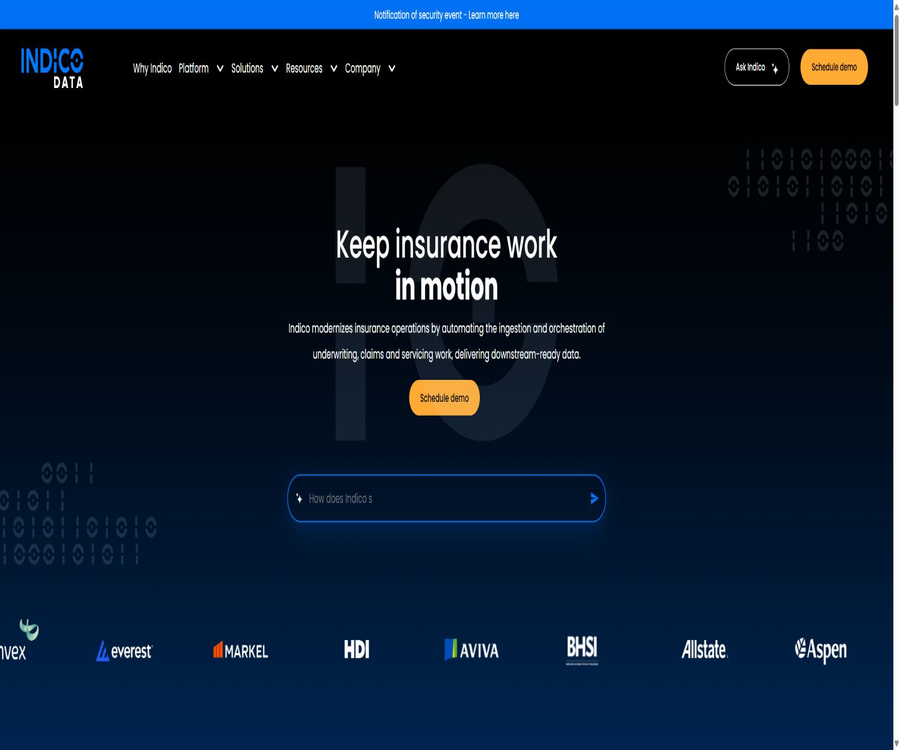
Indico Data is an AI-based platform for order processing and task scheduling, designed for insurance companies. It transforms the underwriting, claims handling, and policy-related materials that are scattered across emails, attachments, and document repositories into structured tasks that have been verified and can be directly fed into the core systems.
What is Indico Data?
At present, Indico Data focuses on supporting insurance operations, rather than providing general OCR or chatbot services to ordinary users. The platform handles large volumes of insurance documents that are in inconsistent formats and require auditing, through three processes: ingestion, completion, and orchestration.
The product integrates pre-configured agents, custom agents, visual workflows, human-machine review, business rules, and enterprise integration. Customers can start with existing insurance processes and then gradually expand them by using their own data structures, prompts, validation logic, and downstream systems.
Core working method
| Phase | Platform actions | Typical results |
|---|---|---|
| Ingestion | Connect email accounts, document repositories, and object storage to separate emails from their attachments. | Create documents and work packages awaiting processing. |
| Classify classification | Identify the document type and unpack complex packages. | Distinguish between ACORD, loss records, SOV, and other materials |
| Extract extraction | Read fields from text, tables, images, and handwritten content | Generate structured insurance data |
| Enrich completion | Classification details, retrieval of external data, generation of summaries, and filling in missing items | Obtain a more complete and contextual record |
| Validate verification | Apply field rules, confidence levels, and manual verification | Mark fields with anomalies, missing values, and low confidence. |
| Normalize standardization | Convert the fields to the structure required by the target system. | Standardize dates, codes, tables, and hierarchies |
| Orchestrate orchestration | Route to teams or systems based on conditions and business rules | Facilitate the continuous flow of underwriting, claims processing, and service tasks |
| Output | Generate JSON, Excel, CSV, or system records | Includes audit trail and confidence level information |
Main functions
Insurance document acquisition and unpacking
The platform can automatically retrieve materials from shared email accounts, document repositories, and object storage, as well as process nested emails and their attachments. Complex submission packages are split according to the document type, which reduces the need for manual opening, naming, and archiving.
Multi-format document understanding
It can process structured, semi-structured, and unstructured information, including email bodies, PDFs, tables, Excel files, ACORD forms, loss records, SOV files, images, compressed archives, and handwritten content. Different scan qualities, formats, and languages still need to be verified using actual samples.
Extraction Agents extraction agents
It extracts the relevant fields from insurance-related documents using proxy recognition techniques, and combines the dispersed information into a unified structure. The platform places emphasis on specialized training for insurance purposes as well as pre-built capabilities, rather than simply applying general large-scale models to such documents.
Enrichment Agents – completion agents
Complementary agents can categorize details, add context, answer questions from underwriters, generate summaries, or retrieve additional data through external APIs. Each completion must be governed by business rules, permissions, and data contracts.
Agent Gallery agent library
Agent Gallery offers hundreds of pre-configured agents and workflows, enabling insurance teams to bypass the need to train everything from scratch. Customers can deploy them directly, copy them to create new versions, or use these ready-made agents as a starting point for custom solutions.
Agent Studio Agency Studio
Agent Studio enables the configuration of agent behavior, input/output handling, data structures, prompts, and field-level validation logic. Versioned agents allow for isolated testing, followed by controlled deployment to a shared agent library.
Visualizing Agentic Workflows
Users can arrange multiple agents in a drag-and-drop canvas, and define conditional branches, sequencing, and data routing. Workflows are ideal for combining task submission and reception, field validation, error handling, manual review, and downstream data writing into a complete decision-making process.
Human-in-the-loop human verification
Fields with low confidence, cases of verification failure, and business exceptions can be sent for manual inspection; after modifications are made, the process can continue. The platform integrates manual verification into the production workflow, thereby preventing all AI-generated results from being used in high-risk insurance decisions without any oversight.
Data lineage, confidence, and explanation
The platform keeps track of the relationship between the fields and the original documents, as well as of manual and automated actions, versions, and pipeline logs. Auditors can determine which document a particular output value comes from, what processes were applied to it, and why an exception was triggered.
Enterprise system integration
Indico adopts an API-first architecture that supports REST, GraphQL, Webhook, messaging, and polling mechanisms. Customers can have the platform output data in JSON or table format independently, or they can send the processed results to insurance core systems, data warehouses, and automation platforms.
Headless and embedded deployment
The Headless mode enables companies to integrate Indico’s capabilities into their existing user interfaces and workflows, without requiring business users to access a separate front-end. Teams that need a full-featured workspace can also make use of the platform’s own proxies, workflow, and review interfaces.
Supported insurance documents
| Material type | Representative content | Common treatments |
|---|---|---|
| Emails and attachments | Shared mailboxes, nested emails, multiple attachments | Automatic acquisition, unpacking, classification, and routing |
| ACORD form | Standard insurance application and business forms | Field extraction, validation, and system mapping |
| Loss Runs | Record of historical losses | Identify event, amount, date, and trend fields |
| SOV | Statement of Values exposure list | Processing multi-page tables, location, and asset information |
| MRC and contract materials | Market reform contracts and related documents | Extracted clauses and underwriting fields |
| FNOL material | First loss notification, images, and descriptions | Claim classification, completion, and priority routing |
| Excel and tables | Open balance sheets, lists, and broker reconciliation documents | Structuring, standardizing, and verifying tables |
| Scans and handwritten text | Images, low-structure documents, and handwritten content | OCR, field extraction, and manual review |
| compressed package | Multiple file packages in a single submission | Expand, group, and process by document type. |
Current capacity scale
| Indicators | Public explanation | Correct understanding |
|---|---|---|
| Insurance product line | Covers over 120 product lines | It doesn’t mean that no adjustments are needed for every customer scenario. |
| Insurance data points | Training and configuration involve over 20,000 data points specific to insurance. | Mapping of custom fields is still required. |
| Language | Supports over 70 languages | The effects of handwriting, scanning, and terminology should be measured empirically. |
| Insurance document types | Covers over 900 different document types | Type coverage and field accuracy are different metrics. |
| Pre-trained models | More than 80 model libraries are available for loss records and SOVs, etc. | The model can be used as is or further customized. |
| Agents and workflows | The proxy library offers hundreds of pre-built projects. | The specific content available depends on the version and contract. |
Four key business scenarios
Underwriting submission and order acceptance
Indico can separate the files from brokerage emails and submission packages, extract fields such as the policyholder, risk, loss, location, and SOV, and pass any missing or uncertain information to underwriters for further review. The structured data resulting from this process can be fed into the underwriting workstation or the core system.
Claims Processing and FNOL
The platform handles initial loss notifications, emails, attachments, images, and related materials; it extracts information from these elements and classifies, completes, and assigns them according to established rules. The claims handlers remain responsible for confirming the key facts and making the final decisions.
Mid-term adjustment of the policy
Changes in addresses, assets, personnel, or coverage amounts within emails, PDFs, and attachments can be identified and routed to the appropriate service teams. This helps to reduce duplicate entries and backlog, but it is necessary to ensure consistency with the rules of the existing policy management system.
Broker reconciliation
Inconsistent remittance lists and reconciliation packages can be structured, standardized, and matched with downstream records. The finance team can process cash applications more quickly, while still keeping track of any anomalies and carrying out manual verifications.
Implementation process
- Select an insurance process with clear volume of business, available data, and a quantifiable baseline.
- Collect real, anonymized samples representing different brokers, regions, languages, formats, and quality levels.
- Define target fields, validation rules, exception types, and the data structure of downstream systems.
- Select a nearby agent and workflow from the Agent Gallery, or create a custom version.
- Configure the upstream email account, document repository, or object storage, and connect it to the target system.
- In Agent Studio, adjust the data structure, prompts, field rules, and confidence thresholds.
- Use the isolated version to test accuracy, missed detections, false positives, and abnormal routing.
- Configure manual review and escalation procedures for fields with low confidence and high risk.
- Start with a proof of concept or a pilot project, and then gradually introduce production traffic.
- Continuously monitor the version, processing volume, rate of manual modifications, latency, and business outcomes.
From pilot testing to the acceptance methods for production
- Calculate the field accuracy, document classification accuracy, and the pass rate for complete work packages separately.
- Create test sets with common, edge, low-quality, and malicious inputs in various proportions.
- Check whether each field can lead to the original document and page.
- Determine whether to enter the security queue in cases of failed validation rules, proxy failures, and system unavailability.
- Compare the processing time, rework rate, and backlog volume of the manual baseline.
- Determine how manual modifications will affect the current records, subsequent versions, and the model.
- Conduct tests for permissions, auditing, data export, backup and recovery, as well as deletion.
- Verify the retry and idempotency of REST, GraphQL, Webhook, or message interfaces.
- It goes live after being signed off by the business leader, the IT team, the security team, the legal team, and the model risk team.
Connection between the upstream and downstream sections
| Direction | The listed connections | Uses |
|---|---|---|
| upstream | Shared email address | Automatically receive submission, claim, and service emails |
| upstream | Box, ImageRight, Azure Blob, AWS S3, and Documentum | Fetch materials from a document repository or object storage. |
| External completion | Accessible third-party APIs | Add risk, address, or business context |
| Downstream insurance system | Guidewire, Salesforce, and Duck Creek | Write insurance, claims, and customer records |
| Downstream data | SQL, Snowflake, OneDrive | Analysis, archiving, and data exchange |
| Automation | UiPath, Automation Anywhere and Blue Prism | Connect to existing RPA processes |
| Universal integration | REST, GraphQL, Webhook, Messages, and Polling | Create a customized two-way process |
| Independent output | JSON, Excel, and CSV | A delivery method that does not require direct writing to the core system |
Deployment method
| Method | Main features | Suitable situations | Confirmation is needed. |
|---|---|---|---|
| Indico hosting | It usually runs on AWS and is managed by Indico. | Insurance companies that wish to reduce the costs associated with platform maintenance | Region, capacity, backup, SLA, and upgrade window |
| Customer area hosting | It is possible to select the customer’s region. | Multinational companies with data localization requirements | Optional regions, cross-border transmission, and sub-processors |
| Customer self-hosting | Deploy customer instances according to environmental specifications | Organizations that require stronger control over their infrastructure | Hardware, upgrades, security boundaries, and support responsibilities |
| Headless embedding | Embed existing experiences through interfaces | There is no desire to expand the team responsible for the front end of independent services. | Authentication, permissions, error handling, and interface responsibilities |
| Independent platform | Use a full proxy, workflow, and review interface. | The business team is responsible for its own configuration and operation. | Member roles, auditing, and management processes |
The platform operates on a single-tenant model, with each customer’s account being isolated from those of other customers. While this single-tenant approach facilitates isolation, it is still necessary to conduct a comprehensive assessment taking into account factors such as the network, keys, roles, logs, backup procedures, and operational permissions.
Prices and procurement models
Indico Data does not disclose a fixed monthly fee nor offers pre-defined packages that can be purchased based on the number of seats; instead, each customer receives a customized quote. The price is determined primarily by the number of submissions processed each year, as well as the number of users and administrators, along with the specific workflow, deployment, and service requirements.
| Pricing or cost factors | Public status | It should be confirmed at the time of purchase. |
|---|---|---|
| Annual submission volume | Core pricing factors | Submit definition, number of pages, attachments, and excess unit price |
| Users and administrators | Factors affecting the custom price | Definitions for business users, reviewers, developers, and administrators |
| Agents and workflows | Combine as per specific requirements | Pre-built, custom, number of versions, and number of production environments |
| Deployment method | Hosting options include managed, regional, or self-hosted. | Responsibilities for infrastructure, operation and maintenance, upgrades, and security |
| Integration | Ready-made connections and custom interfaces | Implementation fees, connector maintenance, and change costs |
| Launch the service | Optional implementation and consulting | Scope, deliverables, milestones, and acceptance |
| Support | 24/7 assistance available | Response level, dedicated personnel, and service discounts |
| Concept validation | Encourage POCs or pilots | Whether there is a fee, sample size, deadline, and ownership of the results |
Commercial terms in the open license template
The public templates for corporate licenses indicate that the subscription fee, activation fee, and consultation fees will be specified in the order or project description; these fees are generally non-refundable, except in cases where the platform fails to fulfill its obligations, in which case a refund may be given for the remaining period. The actual customer contract may stipulate different terms, and it is the document signed by both parties that shall prevail.
Service availability
The public template sets a monthly target of 99.95% for the Indico hosting environment, and offers different service discounts depending on whether the achievement level is below 99.95%, 99%, or 5%. Requests for these discounts must be submitted within 30 days after the end of the relevant month, and they represent the main remedy for instances of unavailability.
Launch time and support
| Project | Public explanation | Reasonable expectation |
|---|---|---|
| The first use case was launched. | It usually takes companies 6 to 12 weeks. | It depends on the sampling, integration, approval, and security processes. |
| Concept validation | Supports POC or pilot projects | First, agree on the accuracy rate, range, and exit criteria. |
| Production success rate | The platform claims that 97% of the projects proceed to production. | It is part of the manufacturer’s overall metrics; individual projects are not guaranteed. |
| Support duration | 24/7 assistance | The specific severity levels and response procedures are specified in the contract. |
| Support channels | Phone, email, and real-time chat | The available channels for the account depend on the service arrangements. |
| Integrated partners | It is possible to work with existing system integrators or recommend partners. | It is necessary to clarify the responsibilities of all parties and the pathways for escalation. |
Security and Governance
| Ability or statement | Current instructions | Purchase verification |
|---|---|---|
| SOC 2 | SOC 2 Type II certification | Request reports and exceptions within the valid period |
| ISO 27001 | Security controls are aligned with ISO 27001. | Alignment is not equivalent to having obtained certification. |
| GDPR | Data processing practices in line with GDPR | Confirm roles, DPA, and cross-border mechanisms |
| Cloud infrastructure | AWS Enterprise Cloud Infrastructure | Verify account, region, encryption, and operation boundaries. |
| Isolation | Single-tenant customer environment | Isolate the testing network from identities |
| Permissions | Strict RBAC | Verify minimum permissions, administrator, and service accounts |
| Encryption | End-to-end encryption statement | Confirm the scope of static, transmission, keys, and backups. |
| Audit | Complete workflow and manual operation trajectories | Confirm retention period, export, and tamper resistance |
| Model governance | Proxy monitoring, version control, rollback, and generative AI transparency | Include model risk and change approval. |
| Customer data training | Do not use customer data to train the model. | The contract is drafted, and it is confirmed that the sub-processors are also subject to such restrictions. |
Data retention and privacy boundaries
- The standard order-handling approach allows for direct processing, without storing business data on the platform for an extended period.
- Options such as Underwriting Clearance and Triage allow data to be stored for a period selected by the customer.
- For managed environments, a selection of regions is available; self-managed options allow for further adjustments to the boundaries of data control.
- The platform claims that it does not use customer data to train models.
- Customers still need to confirm third-party models, logs, caching, backups, and access to technical support.
- The website’s privacy policy was last revised in 2023; when placing orders, it is necessary to obtain the current DPA as well as a list of sub-processors.
- Some contact addresses listed in the website’s privacy policy are in internal placeholder format and should not be used as the sole means of communication.
- Insurance documents often contain information regarding health, finances, identity, and social security, and should be handled at the highest level of sensitivity.
Data security incidents in 2026
Indico disclosed publicly that it became aware of a cybersecurity incident on May 7, 2026; investigations revealed that its online repository may have been accessed without authorization, and it contained information related to its corporate clients. The personal information at risk includes names, addresses, and social security numbers.
The company states that it has initiated an incident response plan, hired external cybersecurity experts, changed access credentials, enhanced monitoring and tightened access controls. It also provides credit monitoring and identity restoration services for some of the affected individuals. A public announcement says that the review of the data is still in progress, and customers should ask whether their organization has been affected and what the results of the corrective actions are.
How should companies assess this incident?
- Inquire about the affected systems, time frame, attack path, and the extent of the data leakage.
- Verify whether the company’s data, test samples, logs, backups, and support attachments are involved.
- Request third-party verification for credential rotation, enhanced monitoring, and access control improvements.
- Reassess repository permissions, service accounts, key lifecycle, and development environment isolation.
- Include in the contract the time limits for notifying of incidents, cooperation in collecting evidence, as well as responsibilities and credit monitoring.
- Decide whether additional audits are needed based on the insurance coverage, regulatory requirements, and customer commitments.
- Do not skip due diligence regarding an incident based solely on a SOC 2 or single-tenant statement.
Which organizations are suitable?
- Commercial insurance companies and reinsurance institutions that process a large number of broker-submitted packages each year.
- It is necessary to accelerate the operations of the FNOL, classification, and case allocation teams responsible for claims processing.
- The underwriting team that manually processes SOV, Loss Runs, and ACORD forms.
- Companies that need to transfer emails and attachments to Guidewire, Duck Creek, or Salesforce.
- Regulated industries with strict requirements for human-machine verification, data lineage, and auditing.
- Insurance groups that require single-tenant, regional hosting, or customer self-hosting.
- Teams that have in-house development and integration capabilities and require REST, GraphQL, or SDKs.
- The platform operations team hopes to reuse agents and workflows across multiple product lines.
Situations that are not very suitable
- Individuals, freelancers, and ordinary users who only need OCR occasionally.
- Small teams that wish to start using the service with a fixed monthly fee as soon as they complete the online registration.
- Projects that lack sufficient real-world samples, business rules, and definitions for downstream fields.
- Companies that only want to acquire general chat or content writing skills.
- Teams that demand complete open source and the ability to modify the core code of the platform on their own.
- Organizations that lack resources for security, legal affairs, model risk, and integration.
- Projects that require custom procurement, have long implementation cycles, and involve ongoing version management are not acceptable.
- Companies are prohibited from adding new suppliers until the special assessment of security incidents for 2026 is completed.
Main advantages
- Moving beyond general document processing, it focuses more on the semantics and entities related to insurance operations.
- It covers the entire process chain of ingestion, classification, extraction, completion, verification, and routing.
- Pre-built agents and workflows reduce the cold start cost for the first insurance use case.
- Agent Studio supports fine-grained control over structures, prompts, and field rules.
- Human-machine review, confidence levels, data lineage, version control, and auditing are suitable for high-risk operations.
- It supports REST, GraphQL, Webhook, messaging, polling, and various SDKs.
- Options include managed, regional, self-managed, Headless, and standalone platforms.
- Single-tenant, RBAC, and model governance meet the basic control requirements of enterprises.
- It can be connected to major insurance systems, data platforms, and RPA tools.
Usage restrictions and precautions
- There is no fixed public price; the budget must be determined through sales, scope, and contract evaluations.
- The manufacturer’s claims regarding accuracy, absence of illusions, and production success rates cannot replace customer testing.
- The first use case usually still requires 6 to 12 weeks; it is not a plug-and-play consumption tool.
- More than 70 languages and over 900 types of documents do not mean that every field will yield the same results.
- Custom proxies, integrations, and self-hosting increase the complexity of implementation and maintenance.
- The data retention rules for direct processing and persistence solutions are different.
- The public privacy policy is outdated, and some contact details need to be reconfirmed.
- Security incidents in 2026 that involve potentially sensitive personal information must be included in the procurement review.
- The open-source nature of the SDK does not mean that the enterprise platform or insurance models are also open source.
- High-risk underwriting and claims decisions still require clear human responsibilities and appeal processes.
APIs, SDKs, and GitHub
| Development approach | Current status | Explanation |
|---|---|---|
| REST API | Support | Used for integrating platform data and workflows; permissions and endpoints are tailored to the customer’s environment. |
| GraphQL API | Support | The platform client and integrations can communicate via GraphQL. |
| Webhooks and messages | Support | Used for asynchronous status and downstream event connections |
| Python SDK | Official open-source client | MIT license; a valid Indico environment and credentials are still required. |
| C# SDK | Official open-source client | MIT license, suitable for .NET enterprise integration |
| Java SDK | Official open-source client | Implemented based on Kotlin, under the MIT license |
| RPA components | Some open-source connection projects are available. | Projects related to Blue Prism, UiPath, and Automation Anywhere |
| Self-hosting | Enterprise contracts are optional. | Obtaining the right to deploy does not mean gaining access to the source code. |
The official GitHub organization hosts a large number of public repositories, many of which contain projects that are no longer actively maintained. There is still ongoing maintenance for Python, C# and Java clients, but it is necessary to check the platform version, authentication methods and support details before using these SDKs.
Open-source status
- The Indico Data enterprise platform, Agent Studio, the agent database, and insurance models are not open-source products.
- The Python, C# and Java clients are made available under the MIT license.
- Some RPA connectors, examples, and research code are also available under different licenses.
- The historical indico.io client should not be confused with the current insurance platform.
- The fact that a warehouse is in an open state does not mean it is still supported by the current products.
- Self-hosted deployments are subject to corporate licensing and ordering restrictions, and cannot be freely redistributed.
- Platform access fees, implementation fees, and consultation fees are not waived just because the SDK is open source.
Basic information
| Project | Content |
|---|---|
| Tool name | Indico Data |
| Operating entity | Indico Data Solutions Inc. |
| Current location | Insurance order processing and task scheduling platform |
| Main process | Ingestion, classification, extraction, completion, verification, standardization, and routing |
| Business scenarios | Underwriting, claims processing, mid-policy adjustments, and broker reconciliation |
| Deployment | AWS-hosted, regionally deployed, customer-hosted, and headless |
| Isolation | Single tenant |
| Interface | REST, GraphQL, Webhook, Messages, and Polling |
| SDK | Python, C#, and Java |
| Price | Submitted volume, users, administrators, and plan customization on an annual basis |
| Trial | POC or pilot projects are supported, but the conditions must be confirmed. |
| Support | 24/7 assistance |
| SOC 2 | Type II certification |
| Open-source platform | No |
| Open-source SDK | Yes, the main clients use the MIT license. |
Frequently Asked Questions
Is Indico Data a general-purpose OCR?
It’s not just OCR; it is designed for insurance order processing and operations, bringing together functions such as document acquisition, classification, field extraction, completion, verification, manual review, and downstream workflow management in a single platform.
Which files are supported?
It can process email bodies, PDFs, tables, Excel files, ACORD forms, Loss Runs, SOVs, images, compressed files, and handwritten text. The specific size limits, number of pages, and quality constraints must be determined based on the customer’s environment.
Is it necessary to write code?
Business teams can use pre-built agents, code-free configuration, and drag-and-drop workflows, so programming is not always necessary. Complex integrations, external data integration, and headless applications usually still require developers.
How long before it can go live?
The typical production timeline for the first use case provided by the platform is 6 to 12 weeks. Factors such as sample preparation, system integration, security reviews, field complexity, and acceptance criteria all influence the progress.
What is the price?
There is no fixed public price. Quotations are determined primarily based on the number of submissions per year, as well as by the user and administrator, along with factors such as agents, workflows, deployment, integration, and the scope of services.
Is a trial version available?
Companies can discuss concept validation or pilot projects, but there are no immediate free accounts available for individuals. Whether a pilot project is charged, its duration, the amount of data involved, and the expected outcomes must be confirmed in writing by both parties.
Will the insurance documents be kept?
The standard order-processing scheme can be retained in a direct manner without any long-term storage, while certain underwriting-related cleanup and routing schemes are kept for the period selected by the customer. Logs, backups, sub-processors, and self-hosted rules require separate confirmation.
Will the model be trained using customer data?
The current security architecture specifies that customer data will not be used to train models. Companies should still include this restriction, the requirements regarding third-party models, and the procedures for verification before deletion in the contract.
Is self-hosting supported?
Customers are allowed to deploy their own instances in accordance with the environment specifications provided by Indico. Self-hosting entails additional responsibilities regarding infrastructure, security, upgrades, and version support, and it does not mean that the platform is open source.
Are APIs provided?
REST and GraphQL endpoints are provided, in addition to support for Webhook, messaging, and polling integrations. The specific interfaces, permissions, rates, and available capabilities depend on the customer’s environment and the contract terms.
Is the platform open source?
The platform itself is not open source, but the official Python, C# and Java SDKs are made available under the MIT license. The older clients, research repositories and RPA components do not reflect the licensing terms of the core platform.
What are security incidents?
In May 2026, the company identified a cybersecurity incident: the online database might have been accessed without authorization, and the information at risk included names, addresses, and social security numbers. Purchasers should request information on the scope of the impact, the measures taken to address it, and any third-party verification.
Summary
Indico Data is suitable for large and medium-sized insurance companies that need to convert large volumes of insurance-related emails, submission packages, SOVs, loss records, and claims documentation into data that can be used in subsequent processes. Its key advantages include specialized insurance handling tools, end-to-end workflow management, human-machine verification, tracking of data origins, and various options for enterprise deployment.
When making procurement decisions, it is necessary to consider factors such as the accuracy of data fields, abnormal routing patterns, integration costs, customized pricing, the boundaries between single-tenant and self-hosted solutions, old privacy policies, and security incidents that may occur by 2026. While the SDKs and interfaces offer comprehensive functionality, the platform remains a proprietary commercial system subject to corporate contracts.
Tools similar to Indico Data





 Guigong Network Security Registration No. 45132202000164