






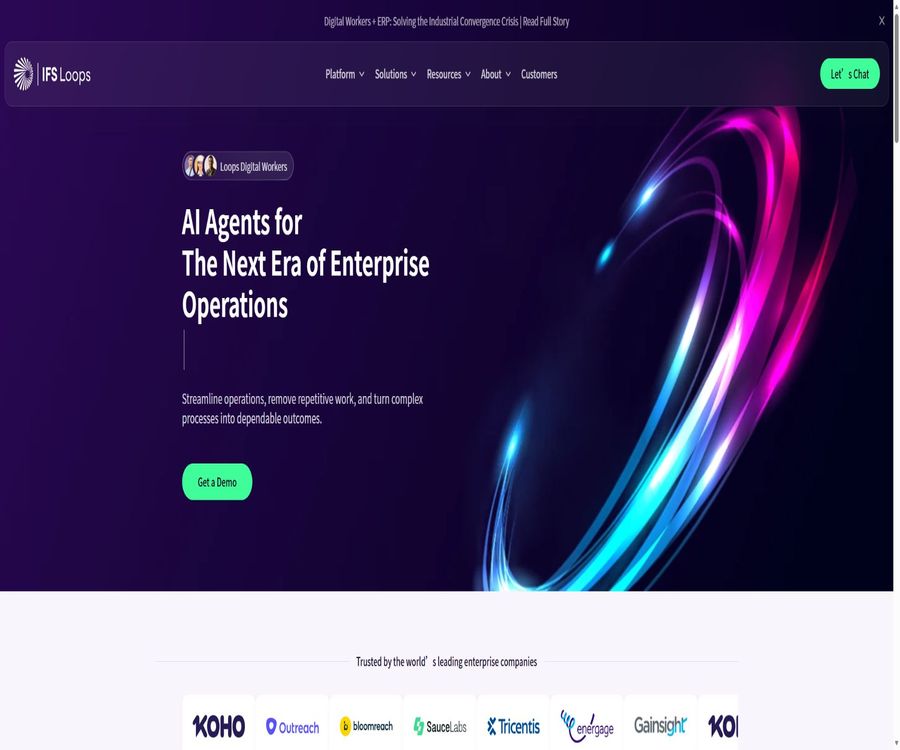
A one-sentence summary
IFS Loops is an agent platform designed for complex corporate and industrial operations; it enables the deployment of governed digital employees to carry out multi-step tasks across CRM, ERP, customer service, knowledge management, inventory, procurement, and field service systems.
Tool Introduction
The platform was originally known as TheLoops, and in its early days it focused on providing support to customers as well as assisting their success. After IFS completed its acquisition in June 2025, it expanded the capabilities of this platform to include areas such as manufacturing, telecommunications, energy, utilities, aircraft maintenance, and other critical business processes; it also adopted the IFS Loops brand for this platform.
It is not an ordinary chatbot or a single customer service plugin; rather, it combines context, enterprise connectors, reusable skills, approval processes, auditing functions, and cross-system execution to create an enterprise agent layer. Organizations can start with advisory suggestions and gradually increase the level of automatic execution.
Evolution of brands and products
| Phase | Brand | Main positioning | Current understanding |
|---|---|---|---|
| Before the acquisition | TheLoops | Customer support, customer success, and CX agents | The existing CX products remain an important part. |
| June 2025 | IFS acquires TheLoops | Introduce agent capabilities into industrial and mission-critical processes | The product enters the IFS ecosystem. |
| Current | IFS Loops | Enterprise agents, industrial digital workers, and OEM engines | It covers both CX and industrial operations. |
Core architecture of the platform
| Hierarchy | Key capabilities | Problems solved | Governance requirements |
|---|---|---|---|
| Connection layer | Connects ERP, CRM, customer service, knowledge management, data warehouses, and monitoring systems | Information dispersion and system switching | Least privilege, credential rotation, and data scope |
| Context layer | Understanding work orders, assets, customers, inventory, and business rules | The generic model lacks a corporate context. | Data quality, permission inheritance, and semantic validation |
| Skill level | Q&A, analysis, categorization, prediction, notifications, and transaction actions | Repetitive tasks make it difficult to reuse. | Version, testing, and responsible person |
| Layer of digital employees | Coordinate multiple skills to achieve business objectives | Disconnections across departments in multi-step processes | Approval points, exception handling, and rollback |
| Governing body | Guardrails, permissions, auditing, observability, and explanation | Risk of autonomous actions | Separation of duties, logging, and compliance audits |
What are digital employees?
A Digital Worker is an intelligent agent application designed to achieve specific business objectives; it can carry out tasks, coordinate processes, and trigger events within corporate systems just like team members. It consists of multiple reusable skills and operates at the level of autonomy chosen by the organization.
What is a skill?
A skill is the ability to carry out tasks within a particular step of a workflow, such as summarizing tickets, identifying anomalies, parsing emails, generating follow-ups, or creating purchase orders. Multiple skills can be combined, in accordance with certain rules and context, to create more complex digital employees.
Industrial digital workforce directory
| Digital employees | Main goal | Key actions | Typical departments of use |
|---|---|---|---|
| Supplier Order Manager | Managing supplier collaboration and order tracking | Supplier selection, confirmation, communication delays, and email parsing | Procurement and Supply Chain |
| Customer Order Manager | Improve the accuracy and transparency of customer orders | Intelligent order reception, order processing, status notifications, and issue resolution | Sales Operations and Customer Service |
| Inventory Replenisher | Reduce stockouts and excess inventory | Demand forecasting, inventory assessment, supplier verification, and purchase order creation | Inventory and planning |
| Material Replenisher | Find and supply the necessary components for on-site tasks. | Part identification, cross-site searches, and recommendations for transfer or procurement | Maintenance and on-site services |
| Dispatcher Assistant | Optimize routes, scheduling, and SLAs | Conflict resolution, resource matching, and service deadline protection | Scheduling and service operation |
| Supplier Invoicing Manager | Automated processing of supplier invoices | Invoice analysis, three-invoice matching, discrepancy explanation, and abnormal routing | Accounts Payable and Finance |
| Knowledge Manager | Identify and maintain corporate knowledge | Q&A, generation, integration, trimming, and reasoning | Customer service, operations, and knowledge teams |
Customer Experience Agent
- Agent Assist Copilot provides summaries, suggestions for the next steps, and draft responses in the customer service dashboard.
- Auto QA Analyst analyzes human-robot interactions in accordance with the company’s quality inspection standards.
- AI Autopilot utilizes case history, customer context, and knowledge to provide self-service.
- Knowledge Generation identifies knowledge gaps and generates draft articles at the end of a ticket.
- Ask and AI Search retrieve context related to the current question from multiple systems.
- The CX Analyst consolidates topics, sentiment, risks, product feedback, and trends.
- Agent Catalog offers combinable skills for classification, routing, upgrade forecasting, and reporting.
Agent Assist Copilot
Copilot is integrated into the existing customer service workspace; it aggregates customer inquiries, past attempts at resolving issues, and possible solutions, and generates responses that are in line with the brand’s tone. It can also identify requests related to product features, create draft answers, and help managers prioritize handling high-risk cases.
Auto QA Analyst
Auto QA enables the analysis of all or a large portion of customer service interactions based on corporate scoring criteria, providing real-time guidance as well as predictive indicators of customer satisfaction. The term \"100% coverage\" refers to the ability to automatically analyze all incoming tickets; it does not mean that no human intervention is needed for each score.
AI Autopilot
Autopilot is designed to enable customers to resolve issues on their own, by combining corporate knowledge, customer data, and past cases to generate dynamic responses; it can be upgraded to human assistance when needed. Built-in automatic quality checks and safeguards are used to monitor the quality of responses and to facilitate continuous improvement.
Knowledge generation
The platform identifies issues that occur repeatedly but are not covered in the knowledge base, and creates draft articles when the corresponding ticket is closed. A human expert in charge of the knowledge base must review the facts, versions, permissions, scope of application, and expiration date before publishing the article.
Customer service analysis and forecasting
| Ability | Analysis content | Can trigger an action | Key points for manual review |
|---|---|---|---|
| Case Classification | Topics, symptoms, products, and impacts | Labels, routing, and reporting | Does the classification match the business glossary? |
| Predictive Escalation | Complexity, risks, and historical patterns | Upgrade in advance or get in touch proactively | False positives, deviations, and customer impact |
| Support Risk Score | Ticket and account risks | Adjust priority | Score explanation and exceptions |
| Sentiment Analysis | More than 37 types of emotional signals | Adjust the tone and handling strategies | Language culture and misinterpretation of satire |
| Voice of Customer | Feedback topics and trends | Product and operational improvements | Sample representativeness |
| Product Feature Request | Product requirements in the ticket | Synchronized product team | Repeated requests and true priority |
| Backlog Management | Backlog, SLAs, and potential impacts | Dynamic queue sorting | Man-made commitments and legal time limits cannot be ignored. |
Cross-system search and context
Ask and AI Search bring together tickets, error logs, product feedback, alerts, events, and knowledge within the customer service workflow, thereby reducing the need to switch between multiple pages. Copilot supports the analysis of topics, symptoms, impacts, emotions, and feedback in over 22 languages.
- Read customer and account status from CRM.
- Read the current case and past processing from the ticket system.
- Search the knowledge base for solution steps and policies.
- Identify faults and events using the monitoring and logging systems.
- Extract defects and feature requests from the product system.
- Return visible content based on user permissions, rather than enabling unrestricted searching.
Integrated ecosystem
IFS Loops claims to offer more than 65 enterprise connectors, and it simplifies the process of integration through a code-free approach. Its public catalog includes categories such as ERP, CRM, customer service, collaboration, knowledge management, cloud services, data warehouses, monitoring, analytics, and API management.
| Category | Public examples | Primary uses |
|---|---|---|
| ERP and industry | IFS Cloud | Assets, services, manufacturing, and business affairs |
| Customer Service and CRM | Zendesk, Salesforce, ServiceNow, HubSpot, Front | Ticketing, customer, and service processes |
| Engineering and Projects | Jira, Shortcut | Defects, tasks, and product feedback |
| Collaboration and knowledge | Microsoft Teams, Slack, Notion, Google Drive | Communication, documentation, and knowledge retrieval |
| Data and analysis | Snowflake, Amplitude | Corporate data and product analysis |
| Cloud platform | Amazon Web Services, Microsoft Azure | Infrastructure, storage, and services |
| Monitoring and Alerts | DataDog, PagerDuty, Amazon CloudWatch | Logs, events, and responses |
| API management | Kong | Service connection and interface management |
A connector does not equate to plug-and-play functionality.
Even with predefined connectors, production deployment still requires field mapping, identity management, permission settings, network configuration, data quality controls, business rules, and exception handling. When write operations are involved, mechanisms for idempotency, approval processes, rollback capabilities, and auditing must also be in place.
Deploying digital employee processes
- Choose a business process that has a clear responsible person, baseline metrics, and a high degree of repeatability.
- Draw the current manual steps, systems, data, approval processes, and exception paths.
- Connect the necessary systems and limit read and write access to the minimum required level.
- Combine pre-set skills or create custom skills, and define input, output, and failure conditions.
- Set the level of autonomy; high-risk actions require manual confirmation.
- Use historical data to conduct offline testing of accuracy, coverage, deviation, and anomaly handling.
- Launch it in a small team or a single queue on a gradual basis, to assess quality, costs, and response time.
- Adjust the rules based on audit logs and manual feedback, then gradually expand the scope.
Process for bringing the customer service team online
- A ticketing system and a limited knowledge base have been selected as the first to be integrated.
- Define classification, summary, response, quality inspection, and upgrade standards.
- Use historical tickets to establish a baseline, and identify high-risk, sensitive, and erroneous cases.
- First, enable read-only summaries and suggestions, so that the agent cannot automatically change the customer’s status.
- Customer service experts conduct sample comparisons between AI and human judgments in order to calibrate the scoring scale.
- Re-enable draft knowledge, queue sorting, or low-risk responses.
- Finally, determine whether Autopilot can handle the entire self-service process.
- Continuously monitor customer satisfaction, repeat contacts, upgrades, errors, and manual intervention.
Autonomy level and control
| Level | Agent behavior | Suitable for tasks | Essential control |
|---|---|---|---|
| Observe | Only read and aggregate | Search, reporting, and trends | Permission inheritance and logging |
| Suggestions | Provide the next step or draft | Customer service responses, knowledge, and purchasing advice | Manual confirmation |
| Controlled execution | Write or trigger within the rules | Categorization, notifications, and low-risk updates | Approval, idempotency, and rollback |
| High autonomy | Complete multi-step transactions | Mature and monitorable repetitive processes | Guardrails, exception queues, shutdown switches, and auditing |
Organizations should not move straight to a high level of autonomy just because the platform supports Agentic AI. The best approach is to start with tasks that are observable, reversible, and low-risk, and to increase permissions only after stability has been proven through real data.
OEM and embedded capabilities
IFS Loops OEM enables software manufacturers to integrate enterprise agent capabilities into their own products, with the option to use a white-label version or a co-branded version. The solution offers pre-installed functions, SDKs, integration frameworks, a modular architecture, as well as ongoing platform maintenance.
- Integrate digital employees into existing SaaS or industry software.
- Use the customer’s own brand to showcase the agent experience.
- Access the enterprise environment via over 65 connectors.
- Reuse auditing, permissions, safeguards, and observability capabilities.
- Reduce the maintenance of the infrastructure needed to build intelligent agent platforms on one’s own.
- The SDK, interfaces, deployment, and commercial terms are determined through a sales assessment.
Safety and compliance
| Skills or certifications | Public explanation | The purchaser still needs to confirm. |
|---|---|---|
| SOC 2 Type 2 | It has passed third-party auditing with an unqualified opinion. | Report scope, period, and exceptions |
| HIPAA | Compliance verification is carried out by Prescient Assurance in accordance with the relevant frameworks. | Whether to sign a BAA and the specific scope of workloads |
| SSO | Supports Okta, Google, and Microsoft. | Identity lifecycle, MFA, and emergency accounts |
| Fine-grained permissions | It allows control over application settings, integrations, as well as user and financial data. | Separation of default roles and responsibilities |
| Vulnerability scanning | Automatic and manual inspections are used during the development cycle. | Penetration test scope and remediation SLA |
| Incident response | It features upgrade, fast processing, and review functions. | Notification deadlines and customer responsibilities |
| Audit trail | Log agent operations to support explanation and compliance. | Log storage, export, and tamper prevention |
Certification does not equate to automatic compliance.
SOC 2 and HIPAA certifications specify certain controls and scope, but they do not ensure that a customer’s implementation meets all regulatory requirements automatically. The customer still needs to establish rules regarding permissions, data minimization, retention periods, usage restrictions, and human oversight.
Privacy and data processing
The current privacy policy still designates THELOOPSAI, Inc. as the GDPR data controller, providing an address in San Mateo, United States. Since the brand has been integrated into IFS, business purchases should specify in the contracts and data processing agreements who the actual contracting party is, what role the processor plays, and who the subcontractors are.
| Data category | Example | Primary uses | Saving instructions |
|---|---|---|---|
| Identity and contact information | Name, company, position, address, email, and phone number | Accounts, contracts, support, and marketing | Usually, during the duration of the customer relationship |
| Transactions | Payment, subscription, and communication records | Delivery orders and management fees | In accordance with contractual and legal requirements |
| Technology | IP, login, browser, time zone, location, and device | Security, troubleshooting, and service operation | The policy does not set a fixed deadline. |
| Behavior | Service usage and online interest inference | Analysis, trial evaluation, and marketing | The period required to achieve the intended purpose |
| Marketing preferences | Subscription and communication options | Event and related product information | During the duration of the customer relationship |
- Data may be obtained from credit agencies, social media platforms, affiliated companies, analytics firms, advertisers, and data brokers.
- The website uses cookies for essential purposes, functionality, analysis, advertising, and social media.
- Some service providers are located in the United States and Europe, involving cross-border processing.
- The policy specifies that EU-approved adequacy decisions or standard contracts are used to ensure the protection of cross-border data transfers.
- Access is limited to employees with a business need and is subject to confidentiality obligations.
- There is no unified and fixed retention period specified for behavioral data and technical data.
Contract and license boundaries
The website still provides the EULA for the desktop application from 2021, which grants a limited, non-transferable, non-exclusive, non-sub licensable, and revocable license for its use. Current enterprise deployments are typically governed by separate orders, main service agreements, data processing agreements, and security attachments.
The old EULA and the previous privacy policies do not fully reflect the business structure following the acquisition; therefore, a purchase review cannot be carried out solely based on public web pages. The contract should clarify the responsibilities, data handling, support services, exit procedures, and migration arrangements related to IFS and the former TheLoops entity.
Price and procurement methods
The price information was verified on August 23, 2026; the actual amounts, taxes, exchange rates, and discounts may vary, and the final figures will be those displayed on the settlement page.
IFS Loops does not disclose any standard pricing based on the number of users, agents, tickets, or calls made; it also does not offer a free version or a self-service trial. At present, customized solutions are provided through options such as Requesting a Demo, Booking a Call, and the corporate sales process.
| Plan type | Public price | Billing cycle | Core scope | Suitable for customers |
|---|---|---|---|---|
| IFS Loops Platform | Custom quote | Contractual agreement | Agent platforms, skills, governance, and integration | Companies that deploy digital employees across different systems |
| AI for CX | Custom quote | Contractual agreement | Copilot, quality inspection, Autopilot, knowledge and analysis | Customer service team for high volume of tickets |
| Industrial Digital Workers | Custom quote | Contractual agreement | Procurement, orders, inventory, scheduling, invoices, and on-site service | Manufacturing and asset-intensive enterprises |
| OEM | Custom quote | Cooperation agreement | SDKs, integration frameworks, white-label solutions, and embedded engines | Software vendors and industry platforms |
What variables are usually required for a quote?
- Number of digital employees and skills.
- Monthly volume of tickets, incidents, or transactions.
- Connectors, environment, and data scope.
- The autonomy level for reading, suggesting, or automatically executing.
- Language, region, and data residency requirements.
- Levels of implementation, migration, training, and support.
- Security, auditing, BAA, and SLA requirements.
Information to obtain before making a purchase
- Costs for platforms, implementations, connectors, and models, broken down by volume of activity.
- Model provider, inference region, data training, and zero-retention option.
- SOC 2 reports, HIPAA compliance, penetration testing, and security whitepapers.
- DPA, list of subcontractors, data residency, and proof of storage and deletion.
- Agent action permissions, approval, auditing, rollback, and shutdown switch.
- Acceptance criteria for accuracy, quality inspection consistency, and exception handling.
- Version upgrades, interface changes, availability, and response SLAs.
- Arrangements for data export, workflow migration, and deletion after the contract is terminated.
How to set performance indicators
| Business scenarios | Baseline indicators | Metrics after going live | Quality indicators that cannot be ignored |
|---|---|---|---|
| Customer service assistance | Average processing time, first response time, and escalation rate | Time savings and fast problem resolution | Incorrect advice, repeated contact, and customer satisfaction |
| Automatic quality inspection | Proportion of manual sampling and time required | Coverage rate and speed of issue detection | Consistency with manual scoring and appeals |
| Self-service | Transition to manual handling and repeated inquiries | Automatic resolution rate | Error resolution, customer abandonment, and missed detection of high-risk situations |
| Knowledge generation | Knowledge gaps and update cycles | Draft output and adoption rate | Accurate facts, expiration, and privilege leakage |
| Restocking inventory | Out of stock, excess inventory, and time-consuming manual planning | Increased availability and reduced cycle time | Incorrect procurement, capital occupation, and supply risks |
| Invoice processing | Processing time and manual error rate | Automatic matching and throughput | Duplicate payments, tax issues, and errors in triple matching |
API, SDK, GitHub, and open-source status
- The OEM solution mentions SDKs and integration frameworks, but it does not provide complete developer documentation or pricing details.
- The platform offers over 65 connectors that enable integration with enterprise interfaces and event systems.
- No official open-source repository or license for the core IFS Loops platform has been identified.
- The EULA on the website states that the core application is licensed for commercial use.
- Third-party examples, connector names, or recruitment codes cannot prove that the platform is open source.
- Companies that need such an interface should obtain information regarding authentication, rate limits, version details, and sandbox settings through the sales process.
Which companies are suitable?
- Companies with a large number of customer service tickets and that wish to expand the scope of quality inspection.
- Teams that need to carry out processes among CRM, ERP, knowledge, and monitoring systems.
- Key operational organizations in areas such as manufacturing, communications, energy, utilities, and aircraft maintenance.
- Companies that wish to use governed digital employees for handling procurement, inventory, scheduling, and invoicing.
- Software manufacturers that need to incorporate enterprise agents with a custom brand into their products.
- Medium to large organizations that possess capabilities for security, access control, auditing, and human oversight.
Situations that are not very suitable
- It is intended for small users who only need for personal chatting, writing, or simple Q&A.
- Teams that wish to see a fixed, publicly available price and activate the service by using their own credit cards.
- Early automation projects without clear processes, responsible parties, and available data.
- Organizations that require complete open-source code as well as self-maintenance by local communities.
- Enterprises that are unable to provide security assessments, permission configurations, and ongoing model monitoring.
- Teams that hope to be able to carry out high-risk tasks without any supervision from the moment they go live.
Main advantages
- Expanding from the customer experience to procurement, inventory, scheduling, invoicing, and industrial processes.
- Digital employees can combine multiple skills to carry out tasks across different systems.
- More than 65 connectors reduce the effort required to build integrations from scratch.
- It supports different levels of autonomy, approval processes, safeguards, auditing, and observability.
- It offers a complete CX ecosystem that includes Agent Assist, automated quality inspection, Autopilot, and knowledge generation.
- It features SOC 2 Type 2 certification, HIPAA compliance, and enterprise SSO capabilities.
- The OEM solution supports SDKs, white-labeling, and embedded agent platforms.
- Upon integration with IFS, it can be combined with IFS Cloud and the industrial software ecosystem.
Usage restrictions and precautions
- There is no fixed standard price; the budget needs to be assessed by sales.
- A large number of connectors does not mean that production integration is unnecessary.
- Automated quality checks, as well as emotion and prediction scores, may still exhibit inaccuracies.
- Actions involving writing data into ERP, CRM, and financial systems require strict approval and the ability to revert such changes.
- The old privacy policy and EULA still refer to the entity prior to the acquisition; a contract is required to determine the current party responsible.
- There is no unified and fixed retention period for behavioral and technical data.
- The product is not an open-source platform; the SDKs and interfaces require commercial partnerships.
- The efficiency gains seen in marketing examples cannot be considered a guarantee for all companies.
Basic information
| Project | Content |
|---|---|
| Tool name | IFS Loops |
| Original brand | TheLoops |
| Company affiliation | IFS will acquire TheLoops in 2025 |
| Product type | Enterprise agents, industrial digital workers, and CX automation platforms |
| Core products | Digital Workers, Agent Assist, Auto QA, Autopilot, Knowledge, and OEM |
| Integration | Over 65 enterprise systems |
| Language | Copilot’s analysis capability supports more than 22 languages. |
| Safety | SOC 2 Type 2, HIPAA compliance, SSO, and fine-grained permissions |
| Price | Schedule a demo and get a customized quote |
| APIs and SDKs | Provided through partnerships between enterprises and OEMs; self-service documentation is not available publicly. |
| Open-source status | Not open source |
Frequently Asked Questions
What is the relationship between TheLoops and IFS Loops?
In June 2025, IFS acquired TheLoops and expanded its agent technology to become IFS Loops. The existing CX products remained in use, while the new focuses were industrial digital workers and the IFS ecosystem.
Is IFS Loops just a customer service tool?
No. It offers not only customer service tools such as Copilot, quality inspection, knowledge bases, and self-service functions, but also digital employees for handling procurement, orders, inventory, materials, scheduling, and invoicing.
Will digital employees carry out tasks automatically?
Transactions can be executed and system events can be triggered within the authorized scope, but the level of autonomy is determined by the enterprise. High-risk actions should be subject to approval processes, rollback mechanisms, and exception handling.
Which systems are supported?
The platform claims to offer more than 65 connectors, with examples including IFS Cloud, Zendesk, Salesforce, ServiceNow, Jira, Slack, Teams, Snowflake, AWS, and Azure.
Is multi-language customer support available?
Agent Assist states that it can analyze topics, symptoms, impacts, emotions, and feedback in over 22 languages. The quality of the output in each language, as well as the accuracy of the business-related terminology used, still requires separate testing.
How much is IFS Loops?
There are no fixed public packages; the platform, CX, industrial digital workers, and OEM services all rely on scheduled demonstrations and customized quotes. The price is usually influenced by usage volume, connectors, skills, level of autonomy, and the scope of implementation.
Is it compliant with HIPAA?
The security page indicates that the platform has completed the HIPAA framework validation. Healthcare institutions still need to verify the BAA, the scope of processing, the data configuration, and their own compliance responsibilities.
Are APIs and SDKs available?
The OEM solution provides SDKs and integration frameworks, but no self-development documentation is available publicly. Companies need to obtain the specific interface details through sales or partnership processes.
Is IFS Loops open source?
The official open-source repository and license for the core platform have not been identified; it is a service provided under enterprise contracts and commercial licenses.
Can it completely replace human customer service?
It should not be understood in that way. The platform can handle low-risk processes automatically and expand its coverage, but complex, sensitive, regulated, or high-value cases still require human judgment and further processing.
Summary
What sets IFS Loops apart is its ability to integrate customer service agents, industrial digital workers, cross-system orchestration, and enterprise governance within a single platform. Following the acquisition of TheLoops, it retained its advanced CX capabilities while also expanding into the areas of manufacturing, asset, and service management where IFS excels.
It is suitable for medium to large enterprises that have well-defined processes, data management capabilities, and robust governance structures, rather than being a ready-to-use personal AI tool. Before making a purchase, it is necessary to test the quality of the service through a pilot project on a small scale, and the contract should specify the price, responsible parties, data handling procedures, interfaces, security measures, SLAs, and exit protocols.
Tools similar to the IFS Loops Enterprise Agentic AI Platform





 Guigong Network Security Registration No. 45132202000164