






A one-sentence summary
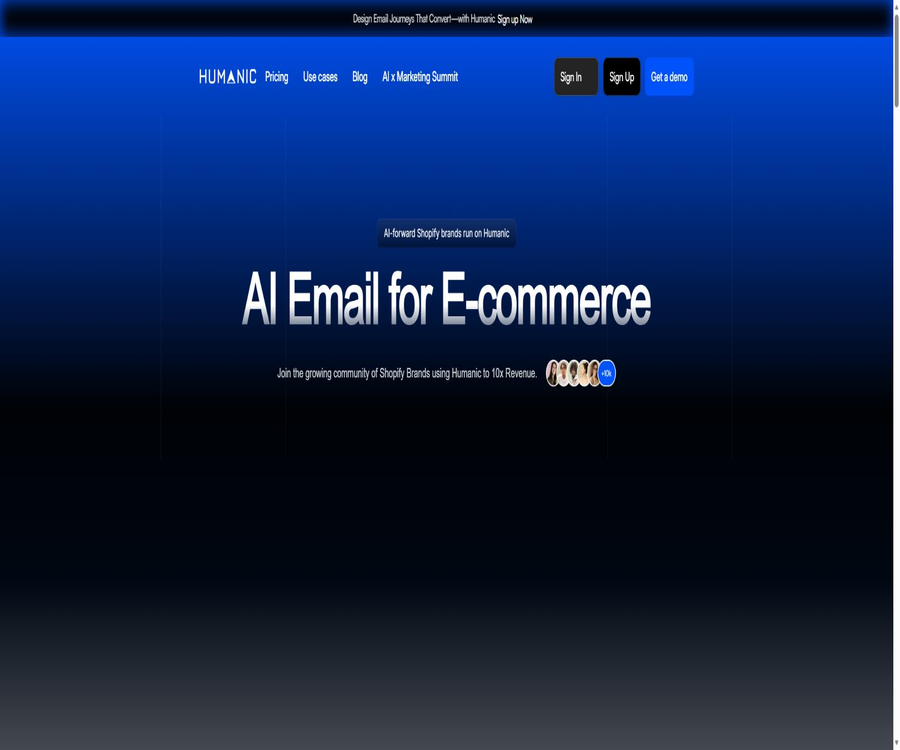
Humanic is an AI-driven lifecycle email marketing platform that integrates prompt creation, audience segmentation, domain-based sending, automated workflows, delivery verification, and performance analysis within a single workspace.
Tool Introduction
Humanic AI is operated by Humanic AI, Inc. Its official website is designed to serve Shopify e-commerce brands, creators, small businesses, and teams focused on product growth. It enables users to create individual emails or entire email sequences using natural language, which can then be sent directly to customers whose behavior and characteristics match those specified, eliminating the need to copy content back and forth between conventional AI tools and traditional email platforms.
The product is not only designed for writing emails, but it also includes features such as the domain name from which emails are sent, contact information, segmentation, campaign management, data connectivity, and analysis tools. The official website presents it as an AI-driven alternative to tools like Mailchimp, Customer.io, and Klaviyo; however, it is still necessary to examine in detail the requirements related to transactional emails, multi-channel communication, A/B testing, and enterprise governance before making the switch.
Core functions
Prompt generation email
The user enters the target audience, brand background, and requirements for the campaign, selects a language model recommended by the platform, and this allows for the creation of an email subject, body text, and structure. All versions are retained in the workspace, making it easy to compare different iterations and make further edits.
Individual emails and sequences
Humanic can create one-time Single Send messages, as well as generate various sequential messages for purposes such as welcome, activation, retention, cart recovery, and re-engagement. Users can choose to have the messages generated by AI or written manually, and they can adjust the subject, content, target audience, and timing before sending them.
Multi-model selection
The platform will test and identify the models that are most suitable for generating emails, and users can also choose their own underlying models. Different models vary in terms of brand tone, handling of long texts, translation quality, cost, and stability; for critical campaigns, manual review is still necessary.
Brand content library
Teams can upload brand assets and existing marketing materials to provide the AI with information regarding the product, tone, and visual style. A content library helps ensure consistency, but customer lists, unreleased products, and contract documents included in it should still adhere to the principle of minimizing data usage.
Iteration, variants, and translation
Humanic emphasizes the need to iterate on the copy, rhythm, and frequency of delivery in order to create variants tailored for different users, and to localize them according to market language, prices, and context. The translated results should not be considered equivalent to fully compliant localization; it is still necessary to review aspects such as currency, dates, commitments, and regional laws.
AI recommendations and automatic optimization
The system can analyze historical activities and the performance of different customer groups in order to identify more effective content patterns; it also offers Auto-Tune and scaled testing as part of its premium packages. The algorithmic recommendations can assist in decision-making, but they cannot replace causal experiments or long-term brand assessments.
Audience and personalization
Import contacts
Contacts can be imported via CSV, manual entry, or Webhook; before sending, it is possible to preview the field mappings and the recipients. The list of contacts imported must have a legitimate basis, and invalid addresses, duplicate contacts, as well as records lacking consent should be removed.
LLM clustering
Users can describe the target audience in natural language, and the system will then create Cohorts by taking into account the attributes of the contacts as well as their behavior data. These groups can be further categorized based on factors such as country, language, life cycle stage, product events, and e-commerce attributes, which enables more precise targeting.
Behavior and e-commerce attributes
Humanic can combine product events from tools such as PostHog with Shopify’s purchase data in order to identify users who have viewed items but not purchased them, those with high intent to buy, repeat buyers, users at risk of churning, and those who use certain features. Behavior-based signals need to be defined accurately; otherwise, automated emails will be sent to the wrong users at the wrong times.
| Cluster dimension | Example | Suitable for emails | Key points of inspection |
|---|---|---|---|
| Countries and regions | Users from France, the United States, or Japan | Regional events and delivery notifications | Taxes, time zones, and local regulations |
| Language | English, French, or Japanese | Localized welcome messages and promotions | Translation quality and cultural context |
| Life cycle | New subscriptions, active users, churn risk | Welcome, activation, and recovery | Phase definition and exit conditions |
| Product behavior | Use features or achieve milestones | Education, upgrades, and reminders | Event name and synchronization delay |
| E-commerce attributes | Purchase history, average order value, product categories | Repeat purchases, cross-selling, and restocking | Order status and return data |
| Custom list | CSV specified audience | Event invitations and customer notifications | Approval proof and field mapping |
Activity creation and sending
Sender configuration
Before sending messages officially, it is necessary to set the sender’s name and the available methods of sending; it is also possible to use one’s own domain name. The official introductory guide mentions the path for connecting to Gmail as well. For a custom domain name, the DNS records must be configured correctly, and once verification is complete, the volume of messages sent can be increased gradually.
Test email
The platform allows for the sending of test emails before an event starts, so as to check the layout, links, sender address, and reply address in real email accounts. A successful test in the test inbox does not guarantee consistency across all clients; it is also necessary to test on major devices and various email service providers.
Send officially
The user selects a contact, cohort, milestone, or stage from the People section, and then activates a one-time campaign or an automated journey. Humanic is responsible for actually sending the messages and tracking their status; therefore, it is more than just a text generator.
Replies and inbox
According to the official documentation, Humanic does not provide a unified inbox for receiving emails; users can set a Reply-To address to direct replies to an existing email address. Teams that need customer service interactions and multi-channel message management should use other systems instead.
Delivery rate tool
Spam scoring
The Spam Score analyzes the content before it is sent to determine whether it is likely to be identified as spam, helping to identify high-risk words and patterns. This score serves only as a warning indicator; the actual rate at which messages end up in the spam folder is also influenced by the quality of the address list, the reputation of the domain name, complaints received, the frequency of sending messages, and interactions with recipients.
Email compatibility check
Compatibility testing is used to observe how emails appear in common clients, thereby reducing issues related to layout, fonts, and media. Complex templates still need to be tested on actual devices, especially Outlook and mobile devices.
Link verification
Linter checks whether the links in emails are valid, thereby reducing the number of dead links and incorrect redirects. Before going live, it is also necessary to verify the tracking parameters, redirection settings, permissions for the target pages, as well as the regional settings.
Domain name verification
The official documentation requires that DNS records such as DKIM, SPF, and MX be added according to the specified configuration, and it advises placing these records in the appropriate subdomains. DNS records need time to propagate; incorrect auto-completion, quotation marks, or truncated values can all lead to verification failures.
Open and click tracking
Tracking via page views is disabled by default for domain names, but users can enable it. Tracking through transparent pixels is used for page view tracking, while click tracking involves modifying links and passing them through redirect servers; this thus raises issues related to privacy disclosure, data accuracy, and the delivery of transaction-related emails.
| Check items | Platform capabilities | The team is still responsible. |
|---|---|---|
| Content | AI-generated, Spam Score, and copy iteration | Authenticity, brand, and legal verification |
| Layout | Compatibility check and email editor | Random sampling of real clients |
| Link | Automatic Linter | Landing pages, parameters, and permissions |
| Identity verification | Domain verification status | Properly configure DNS and maintain records. |
| List quality | Email returns, unsubscribing, and credit monitoring | Agreement, cleansing, and suppression lists |
| Sending reputation | Shared or enterprise-exclusive IP capabilities | Stable frequency, complaint control, and preheating |
Data integration and automation
The Humanic documentation lists connection methods such as product analysis, e-commerce, data warehouses, marketing automation, and Webhooks, stating that the platform can support a large number of data connectors. The actual integrations available may vary depending on the package and version; it is therefore necessary to check the read/write capabilities and synchronization frequency of the systems required before making a purchase.
| Integrated categories | Example | Primary uses | Permission risks |
|---|---|---|---|
| E-commerce | Shopify | Grouping of orders, products, and customer attributes | Reading of customer and transaction data |
| Product analysis | PostHog, Amplitude, Mixpanel | Event triggers, milestones, and lifecycle | Access to API keys and behavioral data |
| Customer communication | Intercom | Synchronize user and marketing data | OAuth read and write permissions |
| Existing email platforms | Customer.io | Import Journeys and emails | Bearer Token and historical data |
| Data pipeline | Segment | Unified event and identity data | Destination configuration and field governance |
| Custom processes | CSV and Webhook | List import and automatic triggering | Falsification incidents, duplicates, and field errors |
Synchronization and data quality
The connection card will show the synchronization status or the last synchronization time; once the initial synchronization is completed, the platform can use this information to create Cohorts and Milestones. Before automating the deployment process, it is necessary to simulate delays, missing events, duplicate records, and identity merging errors.
MCP and AI agents
Humanic offers officially hosted MCP servers that enable compatible AI clients to create, activate, pause, and monitor activities; to query audiences, generate emails, perform analyses, manage contacts, and check domain names. It is suitable for agent-based marketing workflows, but approval mechanisms must be in place for actual message sending.
| Ability | MCP executable operations | Risk | It is recommended to exercise control. |
|---|---|---|---|
| Campaigns | Create, activate, pause, and monitor | Incorrect delivery or widespread reach | Default to draft and require manual approval before activation. |
| Audiences | Query behavior and Cohort | Reading personal data without authorization | Restrict accounts and task context |
| Email Generation | Prompt generation and personalization | Fiction, discrimination, or unfair promises | Template rules and content moderation |
| Analytics | Read data on opens, clicks, and deliveries | Misinterpretation of indicators | Standardize the terminology and indicate tracking restrictions. |
| Contacts | Phase of creating and managing contacts | Incorrect writing or duplicate records | Field validation and idempotency |
| Domains | Check the domain name and delivery status | Exposed tissue configuration | Minimum access and log auditing |
Authentication and keys
For individual connections, Clerk OAuth can be used, while for automation, Bearer API keys are employed. According to the official documentation, these keys grant full MCP permissions at the organization level; there are no read-only options or fine-grained scope settings. The plaintext version of the key is displayed only once during creation, and it expires after one year.
Key management
It is recommended to create a separate key for each integration, store it in a key management system, and monitor any abnormal usage based on the last usage time. In the event of a key leakage, it should be disabled and replaced immediately, with rotation carried out before its expiration to prevent disruptions in automated processes.
Usage process
- Register for Humanic and check your free quota or the package you need.
- Set organization members, sender name, and reply address.
- Connect your own domain name and add the DNS authentication record correctly.
- Import contact or connection behavior data that includes legitimate consent.
- Create Cohorts using attributes, events, and lifecycle rules.
- Enter detailed prompts to generate a single email or a complete sequence.
- Review facts, brands, layout, cancellation options, and privacy-related content.
- Run spam, compatibility, and link checks, and send test emails.
- After activating the campaign, monitor deliveries, opens, clicks, conversions, and complaints.
- Adjust the content, frequency, grouping, and stopping conditions based on the data.
Agent onboarding process
- Confirm whether to use OAuth or a dedicated API key.
- Create separate credentials for each AI client and store them securely.
- Connect to the MCP server and expose only the necessary organizations.
- First, test read-only queries and draft creation.
- Personnel approval is required to activate, pause, or write settings for contacts.
- Log tool calls, activity IDs, audience scope, and the person who carried out the action.
- Conduct regular audits of Last used and rotate keys that are about to expire.
Pricing
The price information was verified on August 23, 2026; the actual amounts, taxes, exchange rates, and discounts may vary, and the final figures will be those displayed on the settlement page.
Humanic uses a Credits-based billing system; both the creation of prompts and their actual transmission consume credits. The official website offers four subscription tiers: Starter, Growth, Scale, and Enterprise. The core prices are the same on the pages showing monthly and annual payment options, but promotions, discounts, and settlement fees may vary.
| Package | Monthly fee | Credits and number of emails | Key capabilities | Suitable for users |
|---|---|---|---|---|
| Starter | $ | 1000 Credits, approximately 1000 emails | Infinity Campaign: around 10 Credits are requested for each request, with 1 Credit charged per message sent; no credits carry over. | Trial and small list |
| Growth | 20 dollars | 10,000 Credits, approximately 10,000 emails | No limit on domain names; ability to create Cohorts, use a Spam Checker, and remove Humanic identifiers. | Growth-oriented creators and small teams |
| Scale | 100 dollars | 100,000 Credits, approximately 100,000 emails | Scale testing, Auto-Tune, localization, and data integration | Modern Marketing and Growth Team |
| Enterprise | Contact sales | Custom quota | Enterprise security, data integration, dedicated support, and more | Large brands and regulated organizations |
Credits rules
The official website indicates that generating a prompt with Starter costs around 10 Credits, while sending an email costs 1 Credit; it is also specified that the free credit allowance does not carry over. Complex iterations will consume additional credits for generation, and the actual number of messages that can be sent should be determined based on the account’s billing details.
Dedicated IP and enterprise fees
A shared IP is used by default; customers who meet the requirements regarding the volume of data sent and their subscription plan can request to have a dedicated IP pool allocated to them by the team. This feature is listed as an Enterprise capability in the documentation. A dedicated IP requires prior preparation, consistent traffic, and sound operational practices – it cannot simply be obtained through payment to increase the rate at which messages are delivered.
Cancellation and refund
The details of the fulfillment policy can be found in the account settings under the subscription cancellation option; such cancellation takes effect at the end of the current billing cycle, and a partial refund is not provided for certain cycles. In the event of an unintended charge, you can contact support for review. The documentation states that refund processing usually takes several business days, but this does not guarantee a refund in all cases.
Which users are it suitable for
- Marketers who need AI to generate and send lifecycle emails directly.
- Brands that operate Shopify stores and focus on repeat purchases, customer retention, and recovering abandoned carts.
- Growing teams looking to migrate from Mailchimp or Customer.io.
- PLG teams that require detailed segmentation based on product behavior and e-commerce attributes.
- Multinational businesses that wish to generate variants, translations, and localized emails in bulk.
- Operators who need to check for spam, compatibility, and links before sending them.
- Technical marketing teams that use MCP to have AI assistants manage email activities.
- Data teams that need to connect to PostHog, Amplitude, Mixpanel, or Segment.
It is not very suitable for which users
- It is only for individuals who need to write an email temporarily without having to send it through the system.
- A multi-channel team that relies primarily on text messages, WhatsApp, push notifications, and in-site messages.
- Customer service teams that need a built-in unified inbox to handle customer responses.
- Experimental teams must use the traditional visual A/B testing configuration.
- Senders of unsolicited emails without the recipient’s consent, as well as those involved in cancellation processes and data governance procedures.
- Organizations that cannot allow customer behavior and email data to be processed by the United States or its service providers.
- Highly secure environments that require fine-grained read-only MCP keys.
- Companies that require the entire platform to be self-hosted or have open-source auditing capabilities.
Product advantages
- It forms a complete loop, ranging from prompt creation to actual sending and analysis.
- Supports single email, full sequences, and lifecycle automation.
- Different language models can be selected, and multiple generated versions can be retained.
- Grouping is carried out by combining product behavior, Shopify attributes, and natural language.
- Built-in Spam Score, compatibility, and link checking.
- The free version includes 1000 Credits, which is useful for small-scale testing.
- The prices for Growth and Scale are relatively clear, and they increase based on the number of Credits.
- The official MCP covers Campaign, Audience, Contact, and Domain.
- The help documentation covers domain names, delivery rates, data connections, and migration.
- Provides open-source AIxMarketing reference projects and email marketing skills.
Usage restrictions and precautions
- AI-generated emails may contain factual errors, brand misrepresentations, and false promises.
- Each regeneration consumes Credits, and frequent iterations reduce the amount of data that can be sent.
- Starter Credits are not carried over, and the unused quota expires at the end of the cycle.
- The platform currently only supports email; it does not offer notifications via other channels such as WhatsApp.
- Official documentation indicates that traditional A/B testing configurations are not supported yet.
- There is no unified inbox; responses must be sent to an external email address.
- Domain name authentication errors, poor quality of the list, and complaints can affect the delivery rate.
- The open rate is affected by image blocking and privacy measures, so it cannot be considered an absolute fact.
- Clicking to track will modify the link; be cautious when enabling tracking for emails containing sensitive transactions.
- The MCP API key grants full organizational permissions and does not have a read-only scope.
- Errors in merging identities across systems may result in emails being sent to the wrong recipients.
- Cold emails should be sent in small quantities, and the policies regarding consent, cancellation of subscriptions, and platform guidelines must be followed.
- Members in the same domain are grouped into the same organization; it is necessary to check the visibility range.
Privacy and data security
As the data processor for its customers, Humanic may handle names, email addresses, job titles, work addresses, phone numbers, meeting information, data related to application usage, IP addresses, as well as other personal information that customers upload or provide. The data can also come from customers’ own systems, technical integrations, and third-party data brokers.
| Data object | Primary uses | Potential risks | It is recommended to exercise control. |
|---|---|---|---|
| Contact person | Grouping and sending | No consent-based marketing or data leakage | Record the legal basis, cancellation, and suppression status |
| Behavioral events | Prediction, triggering, and personalization | Excessive profiling or mismatched identity | Limit fields and validate event definitions |
| Email content | Generate, send, and optimize | Leakage of trade secrets or personal information | Desensitization prompts and content library |
| Integrated credentials | Synchronize Shopify with analytics systems | Unauthorized access to upstream data | Minimum privileges, rotation, and revocation |
| MCP key | Organizational-level agent operations | Bulk misdelivery and data reading | One integration: key, approval, and auditing. |
| Tracking data | Open, click, and conversion analysis | Insufficient disclosure of privacy information and metric deviations | Inform by region and enable selectively |
Processing and Sharing
The privacy policy states that personal information may be transferred to infrastructure providers, data brokers, and analysis services providers, some of whom are located outside the United States; Humanic operates primarily in the United States and India. Customers subject to regulations such as GDPR should review the DPA, the cross-border mechanisms, and the list of sub-processors.
Deletion cycle
The platform states that it will delete the personal information submitted by a customer within one month after the end of the partnership. Companies should also ensure that activity logs, backups, analysis data, aggregated data, and copies in third-party systems are deleted following the same timeline.
Request from the data subject
The data subject should usually first contact the customer who submitted their information to Humanic; it is the controller who handles requests related to accessing, correcting, or deleting data, as well as requests to withdraw consent or refuse sharing. The team is responsible for managing the authentication process and the forwarding of such requests.
GitHub and the open-source status
The Humanic main platform is a commercial, closed-source SaaS solution, but the official GitHub repository provides documentation related to MCP as well as a reference project for AIxMarketing. The MCP repository is licensed under the MIT license and contains mainly connection documentation rather than the source code for the server side; AIxMarketing, on the other hand, is a functional reference implementation of Claude Code’s email marketing capabilities.
| Components | Status | Uses | Open-source assessment |
|---|---|---|---|
| Humanic platform | Commercial hosting | Creation, sending, grouping, analysis, and automation | Not fully open source |
| Humanic MCP | Official hosting service | Allow the AI client to manage the organization. | The server address is not publicly available; the repository uses MIT license. |
| MCP Document Repository | Public GitHub repository | Authentication, client configuration, and security instructions | MIT License |
| AIxMarketing | Official publicly available reference projects | Claude Code emails: Skills and lifecycle processes | MIT License |
| GitBook documentation | Public Help Center | Product configuration and best practices | Making a document public does not mean that the product is open source. |
AIxMarketing reference project
This project includes skills such as brand briefs, email sequences, cart recovery, re-engagement, email previews, copy QA, and multi-model chains; it can also be pushed to Humanic via MCP. It is suitable for researching and customizing workflows, but when multiple models and external materials are used, it is necessary to manage keys, costs, and data policies separately.
Basic information
| Project | Content |
|---|---|
| Tool name | Humanic |
| Operating company | Humanic AI, Inc. |
| Tool type | AI-based email marketing and lifecycle automation |
| Key scenarios | Shopify e-commerce, PLG, creators, and growth teams |
| Free version | 1000 Credits per month |
| Minimum payment amount | Growth: $20 per month |
| Sending service | The platform is responsible for carrying out the actual sending of emails. |
| Delivery service provider | The official documentation lists it as Resend. |
| Data integration | E-commerce, product analysis, data pipelines, email platforms, and Webhooks |
| Agent interface | Host MCP server |
| MCP certification | Clerk OAuth or organization-level API key |
| Is it open source? | The main platform is not open-source; some of the official reference repositories use MIT. |
| Interface and documentation | English is the primary language. |
Frequently Asked Questions
What is Humanic?
It is an integrated platform that covers everything from AI-driven email generation to segmentation, domain-based sending, as well as automation and analysis; it currently focuses on serving e-commerce and lifecycle marketing.
Is Humanic free?
The Starter plan costs $0 per month and includes 1,000 Credits as well as unlimited Campaigns. Both prompt generation and email sending consume Credits, and the free credit amount is not carried over to subsequent months.
Does Humanic only generate emails?
No. It can create, edit, and group emails, as well as send them; it also tracks various metrics such as delivery status, opens, clicks, and conversions.
Is it necessary to connect to the sender’s domain name?
For official sending, it is usually necessary to connect to and verify the domain name, or use other sending methods provided by the platform. The authorities strongly recommend sending a test email first and completing the DNS authentication.
Which data connections are supported?
The help documentation covers categories such as Shopify, PostHog, Amplitude, Mixpanel, Segment, Intercom, Customer.io, and Webhook; the specific availability of these resources should be checked within the account.
Does it support A/B testing?
The official documentation indicates that traditional A/B testing setups are not supported; instead, content is generated and optimized using language models. Teams that require a rigorous experimental design should opt for external methods.
Can I receive replies via email?
A unified inbox is not provided, but a Reply-To address can be set up so that recipients can send their replies to an existing email address.
Is there an MCP?
Yes. The official MCP allows for managing events, audiences, contacts, email generation, analysis, and domain names; it also supports authentication via OAuth or API keys.
Is the MCP key secure?
The key grants full organizational-level access and does not have a read-only scope; it must be managed using the highest-level authentication credentials. Each integration should use its own separate key, which should be replaced before it expires after one year.
Is Humanic open source?
The main platform and the servers that host MCP services are not fully open sourced. The MCP documentation repository made available by the developers, as well as the AIxMarketing reference project, are licensed under the MIT license.
Is it suitable for sending cold emails?
The platform is primarily designed for emails from Nurture that the user has agreed to receive; the documentation indicates that only small-scale outbound emails can be sent. Users must still comply with anti-spam, privacy, and unsubscribe policies.
Can I cancel my subscription?
It can be canceled in the account settings; this change usually takes effect at the end of the current billing cycle, and no refund is given for the unused portion of that cycle.
Summary
The value of Humanic lies in integrating AI-powered email creation, behavioral segmentation, data integration, actual sending of emails, and governance related to delivery all within the same process. For Shopify brands and PLG teams, it represents a more comprehensive lifecycle marketing system than simple text-generation tools.
When making a selection, it is important to verify the amount of Credits consumed, the reputation of the domain name, any necessary integrations, the lack of traditional A/B testing, the absence of a unified inbox, and the existence of MCP full-access keys. Any automated sending process must include checks to ensure the legitimacy of the recipient list, the sending of test emails, manual approval, mechanisms for handling cancellations, and procedures to address unexpected outages.
Tools similar to Humanic





 Guigong Network Security Registration No. 45132202000164