






A one-sentence summary
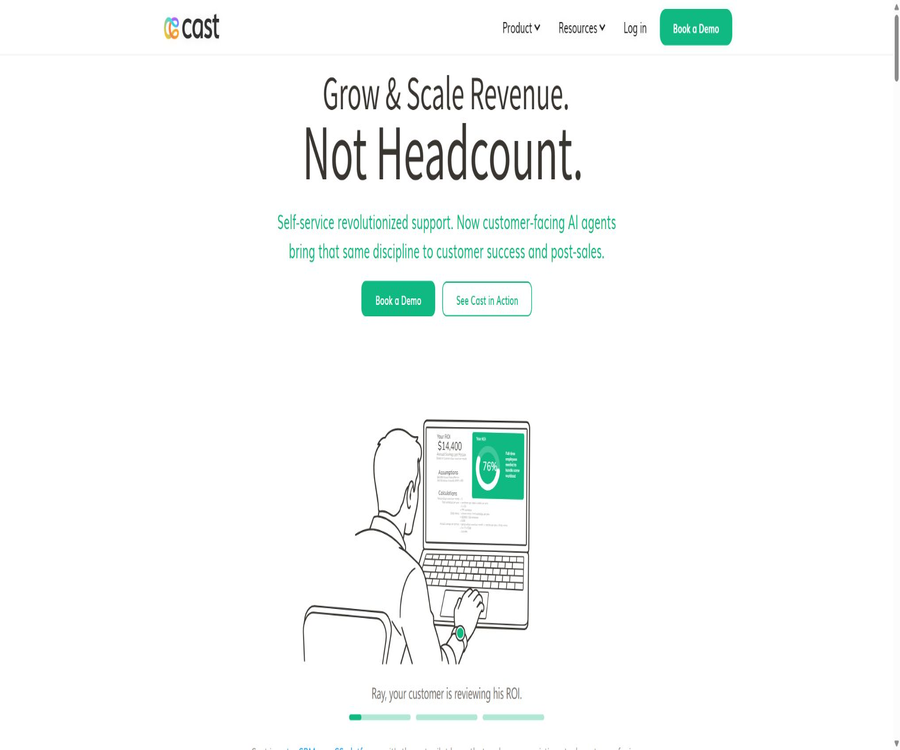
Cast.app is an AI-based customer success and account management platform designed specifically for B2B customers, partners, and management; it can generate personalized business reviews, address account-related issues, and facilitate adoption, retention, renewal, and expansion.
Tool Introduction
Cast.app was developed by Cast Corporation; its core component is an AI agent designed for customer use. This agent connects CRM systems, customer success platforms, ticketing systems, data related to product usage, data warehouses, and knowledge bases, thereby transforming the data from various accounts and contacts into a customer experience that can be delivered directly to the customers.
The platform can generate voice-enabled business reviews and personalized web pages for each client, and it also allows viewers to ask questions during the presentation. The AI responds based on the data available in the authorized accounts, and it forwards any new risks, feedback, actions, or opportunities for further development to the relevant teams.
Product positioning
Cast.app emphasizes that it is not intended to replace CRM systems or traditional customer success platforms as internal tools. It operates on top of existing technology stacks, transforming internal data and processes into experiences that customers can see, hear, inquire about, and take action based on.
| Comparison items | CRM or customer success platform | Cast.app | Actual relationship |
|---|---|---|---|
| Primary users | CSM, sales, administration, and operations teams | Customers, partners, executives, and end-users | One is for managing internal data, and the other is for delivering an external experience. |
| Core tasks | Record, analyze, and allocate internal tasks | Proactively present business reviews, Q&A sessions, and next steps. | Cast reads data without the need to replace existing systems. |
| Delivery method | Dashboard, tasks, tickets, and reports | Mail inbox, within apps, chats, and CSM main interface demonstration | Provide one-on-one content based on the customer’s contact information |
| Automated objects | Internal team efficiency | Customer lifecycle actions | The focus is different. |
| Artificial characters | Managing a large number of daily tasks | Handling complex negotiations, high-risk situations, and those that require empathy | A clear handover between AI and human beings is necessary. |
| Billing logic | Frequently use internal seats | By number of customer accounts | The cost varies depending on the scale of customers served. |
Main functions
Personalized AI presenter
Cast.app can generate narrated business reviews, onboarding guides, and executive updates based on data related to the products, usage, objectives, outcomes, support, and renewal status of each account. The content can have its language, metrics, recommendations, and actions adjusted to suit different roles.
Real-time Q&A at the account level
The AMA feature allows customers to interrupt the AI demonstration at any time and ask questions. Responses are not based solely on public knowledge bases; it is also possible to consult CRM, customer success, support, as well as product and analysis data, within the limits of permitted access.
AI agents throughout the entire lifecycle
The platform can proactively carry out processes such as onboarding, usage encouragement, value assessment, preparation for contract renewal, identification of expansion opportunities, and sending referral invitations, based on the status of the account. Unlike support chatbots that merely wait for questions to be asked, its approach is to take an active role in managing the various stages related to customer success.
Business Review and Value Presentation
AI can organize information on product usage, outcomes, benchmarks, return rates, and recommendations for next steps into a customized review. Such content is suitable for quarterly or annual business reviews, and it can also be used to explain the value of the products to executives who do not have access to the business system.
Feedback intelligence
Customers can submit forms, provide feedback through conversations, or respond to specific suggestions as part of this personalized experience. The platform can aggregate topics, concerns, requirements, and changes in sentiment, and pass the resulting information on to the product, support, customer success, or management teams.
Renewal and revenue intelligence
Cast.app combines account usage, stakeholders, proof of value, customer feedback, and progress on actions in order to identify risks related to contract renewal as well as opportunities for expansion. AI can suggest the next steps, but decisions regarding prices, contracts, discounts, and important commitments should still be approved manually.
Multi-channel delivery
Personalized content can be sent via email to executives and inactive users, or it can be integrated into web applications, mobile apps, portals, and dashboards. The platform also supports chat sessions as well as demonstrations led by CSMs, which helps to ensure an appropriate level of human intervention for different accounts.
Multilingual and voice capabilities
The official website currently offers 17 speaking or voice options, including English, French, Portuguese, Spanish, German, Japanese, Hindi, Simplified and Traditional Chinese, Korean, and other languages. The Startup version features highly realistic voices, while the Enterprise version provides cloned voices as well as virtual avatars with synchronized speech.
Personalized web pages and slides
The platform can convert data, variables, code snippets, and AI prompts into web pages, presentations, forms, emails, text messages, and in-app content tailored for each contact. Enterprise versions offer branded links, custom avatars, and more advanced visual elements.
Data connections and technology stack
The Cast.app website claims to offer more than 60 native data connectors, which enable access to its own products and internal systems via standard REST and JSON connectors. It does not require customers to create a new CRM system for AI; instead, it allows existing data sources to be combined to form account-level contexts.
| Data type | Common systems | Import content | Typical uses |
|---|---|---|---|
| CRM | Salesforce, HubSpot | Accounts, contacts, business opportunities, contracts, and renewals | Object recognition and business context |
| Customer Success | Gainsight, Totango | Health, outcomes, goals, CSM, and surveys | Successful planning and risk assessment |
| Support for ITSM | Zendesk, ServiceNow | Tickets, topics, status, and upgrades | Feedback, support trends, and troubleshooting |
| Data warehouse | Snowflake, BigQuery, Databricks, Redshift | Usage, adoption, account, and product metrics | Business Review and Data Analysis |
| Relational database | Postgres, MySQL, Microsoft SQL Server | Custom business data | Account-level queries and transformations |
| NoSQL and search | MongoDB, DynamoDB, Elasticsearch, etc. | Product events, documents, and observable signals | Real-time context and anomaly detection |
| Proprietary products and APIs | Universal REST, JSON, OAuth 2.0, and Basic Auth | Product usage, configuration, and custom objects | Integrate customers’ actual behaviors into AI |
| Knowledge and static data | Knowledge base, documents, and policies | Product description, process, best practices, and terms | Answer public and organization-specific questions |
Workflow
Deploy an AI customer success project
- Identify the first business scenario, such as onboarding, adoption, business review, or renewal.
- Define the target account, contact roles, success metrics, and the thresholds that require manual intervention.
- Connect CRM, customer success, tickets, product usage, and knowledge data to the platform.
- Configure account and contact permissions to ensure that the AI can only access information visible to the current entity.
- Create datasets, transformations, brand tone, variables, and generation prompts.
- Generate a set of internal previews to check data accuracy, narrative, voice, accessibility, and actions.
- Complete security, privacy, legal, customer success, and stakeholder reviews.
- First, run a paid pilot with a controlled group of customers to track views, questions, actions, upgrades, and satisfaction.
- Based on the results of the pilot, modify the data, scripts, and rules for manual handover before expanding coverage.
Release a personalized business review
- Select the target account, as well as the executives, administrators, and end users who need to be covered.
- Extract information on purchased products, objectives, usage volume, adoption rate, tickets, outcomes, and renewal details.
- Select data, tone, language, business priorities, and recommended actions based on the contact’s role.
- Generate slides, personalized web pages, narrations, and account-specific Q&A contexts.
- Check the return rate, the amount saved, whether the indicators used are valid, and whether the predictions are traceable.
- It is ensured that AI will not expose the data of other accounts or internal notes to a particular customer.
- Delivered to the appropriate recipient via email, within the app, through chat, or managed by a CSM.
- Track views, questions, feedback, meeting bookings, and follow-up actions, and escalate them to human agents in a timely manner.
Which users are it suitable for
- B2B SaaS companies: Automatically deliver onboarding, adoption, and business reviews to a large number of customers.
- Customer Success Leadership: Expand account coverage and reserve human CSMs for highly complex scenarios.
- Account Management Team: Presents data on value, risk, renewal, and expansion to stakeholders.
- Revenue Operations Team: Connects CRM, product, ticket, and contract data to unify the customer context.
- Customer Marketing and Development Team: Creates personalized content based on product usage and outcomes.
- Partner Team: Implements personalized success processes for channel partners, delivery partners, and indirect customers.
- Large enterprises: Scaling delivery to meet the requirements of single tenant, SSO, security audits, and unlimited data connections.
- It is not suitable for small teams that only need chat bubbles for customer service on a single website; such needs generally do not require account-level data or automation for customer success.
Typical use cases
- Quarterly business reviews are generated for all customers, rather than only those with high-value accounts.
- Convert product usage and goals into onboarding, adoption, and next steps.
- Show customer executives the return on investment, trends in results, and the untapped value.
- Before renewing the contract, any deficiencies, unresolved tickets, changes in stakeholders, and value gaps are identified in advance.
- Identify product expansion opportunities based on new usage patterns, team growth, and unmet requirements.
- Active users receive it within the app, while inactive users or executive contacts receive it via their inbox.
- Provide role-based business reviews and Q&A sessions for channel partners and indirect customers.
- Use conversational feedback to supplement the background that cannot be explained by NPS and standard surveys.
Product advantages
- Deliver the experience directly to customers, rather than acting merely as a co-pilot who drafts content for internal CSMs.
- Generate one-on-one business reviews, recommendations, and Q&A by account and contact.
- It covers scenarios such as onboarding, adoption, feedback, retention, renewal, expansion, and referrals.
- It offers multi-channel delivery and the ability to ask questions during the process, making it more interactive than static PDFs or emails.
- It offers over 60 native connectors and universal interfaces to cater to complex B2B data stacks.
- It supports multiple languages, highly realistic voice synthesis, branded links, and virtual corporate avatars.
- The Enterprise version offers unlimited accounts, contacts, datasets, and native integration.
- The authorities disclose the status of the SOC 2 Type II and SOC 3 reports, stating that they comply with GDPR and WCAG 2.2 AA.
Limitations and procurement risks
- The platform offers only annual contracts; there is no monthly payment option. The initial assessment must be carried out through a paid pilot program.
- The Startup price is applicable only to companies with fewer than 25 employees or a yearly recurring revenue of less than $5 million.
- Charging on a per-customer account basis means that costs increase as the coverage area expands; it is not possible to compare the unit price solely with that of CSM seat tools.
- Going live requires multiple data sources, permissions, identities, transformations, and coordination among stakeholders; it is not an instant-ready generic chatbot.
- AI may misinterpret customer data, generate inaccurate recommendations, or display inappropriate information to the wrong contacts.
- Account-level data isolation, field permissions, in-app embedding between customers, and manual handover must all undergo specialized testing.
- AI should not be allowed to promise prices, discounts, SLAs, product roadmaps, renewal terms, or legal positions without approval.
- The official figures regarding ROI, revenue growth, and task automation come primarily from customer cases and marketing materials, and cannot be applied directly to all companies.
- The public terms of service were last updated some time ago; therefore, when placing orders, it is necessary to rely on the latest orders, the data protection appendices, and the corporate contracts.
Price comparison and package comparison
As of August 23, 2026, Cast.app charges based on the number of customer accounts rather than the number of internal CSM positions. The calculator on its official website uses 200 customer accounts as an example, with a cost of $2 per account per month, resulting in a total monthly fee of $400.
The platform only offers annual contracts; therefore, the annual fee for 200 accounts is $4,800. Prices for the Enterprise version, paid trials, multi-year contracts, and large-scale accounts require confirmation by the sales team.
| Package | Applicable conditions | Customer account | Contact person | Price | contract |
|---|---|---|---|---|---|
| Startup | Fewer than 25 employees or an ARR of less than $5 million | Pay-as-you-go; 200 account examples available on the official website | 7 people per account | $ | Approximately only that amount; for example, 4,800 dollars per year. |
| Enterprise | Large, complex organizations or those with high security requirements | Infinity | Unlimited per account | Custom price | Annual or multi-year contract |
| Paid pilot program | Verify specific use cases | As defined by the project | As defined by the project | Contact sales | Case-by-case consultation |
Functional comparison
| Functions | Startup | Enterprise |
|---|---|---|
| Account-level AI Q&A | Includes | Includes |
| Native data connection | Up to 3 | 60+ connectors, with no limit on the number |
| Dataset | 100 pieces | Infinity |
| Native product connection | The plan needs to be confirmed. | Includes standard REST and JSON connections. |
| Personalized demonstrations and websites | Includes | Includes |
| Voice | High-fidelity voice | Cloned voices and highly realistic voices |
| Voice-synchronized virtual avatar | Not marked | Includes customization capabilities |
| Personalized brand link | Not marked | Includes |
| API access | Additional payment | Includes |
| Support | Emails and AI chats | Email, live chat, and phone calls |
| Statement on Safety and Accessibility | Basic security measures | Corporate capabilities such as SOC 2 Type II, GDPR, and WCAG 2.2 AA |
Implementation and launch
- The annual plan currently includes implementation and onboarding at no cost, but the official website states that this policy may change in the future.
- The first version is usually ready in about 7 days.
- A full rollout that includes permissions and feedback from stakeholders usually takes 2 to 3 weeks.
- Paid pilots are offered on a project basis to validate specific use cases and commercial value.
- Volume discounts on capacity can be negotiated for multi-year contracts and large clients.
Cancellation and refund
The terms of service state that purchases are generally non-refundable, and cancellations take effect at the end of the current payment period. Given that the current pricing is offered on an annual basis, it is necessary to specify in the order the conditions related to testing, acceptance, renewal notifications, early termination, data return, and refunds.
Privacy, AI, and data security
The data processed by Cast.app may include information about customer companies, contacts, product usage, support tickets, contracts, renewals, revenue, as well as feedback and behavioral signals. This data is often more sensitive than the data related to customer service on ordinary websites, and it is necessary to conduct reviews regarding enterprise security and data protection.
Officials state that customer-specific data is not used for training or fine-tuning the platform’s LLMs, and that AI functions operate in a securely isolated environment. For actual deployment, models from OpenAI, Anthropic, or Google can be used; voice and translation services may also involve other service providers, and companies should verify each of these subcontractors using the latest list available.
| Security and Privacy Projects | Current official statement | Purchase or deployment recommendations |
|---|---|---|
| Security audit | SOC 2 Type II and SOC 3 | Request the latest report, scope, period, and exceptions. |
| Data protection | Claims to comply with GDPR | Complete DPA, cross-border data transfer, and data subject rights assessment |
| Accessibility | Claims to comply with WCAG 2.2 AA | Acceptance is carried out using the own page, voice, subtitles, and keyboard inputs. |
| Transmission encryption | TLS 1.2 or an equivalent protocol with higher security levels | Check internal connections, proxies, and export channels. |
| Model training | Customer-specific data is not used for training or fine-tuning LLMs. | Cover all models, voice services, translation functions, and log processing methods in the contract. |
| Common LLMs | OpenAI, Anthropic, and Google | Configure according to the provider and regional restrictions allowed by the enterprise. |
| Voice and translation | ElevenLabs, Amazon Polly, and Google Translate can be used. | Confirm consent for voice cloning, cross-border processing, and retention period |
| Bring your own key | The customer’s OpenAI key, as well as a proxy or a custom base path, can be used. | Ensure that key storage, rotation, billing, and access logging comply with internal standards. |
| Retention of personal data | It only states that retention is carried out for the necessary period of time and in accordance with legal requirements. | Specify in the DPA the expiration dates for accounts, usage, sessions, logs, and backups. |
| Isolation of corporate accounts | The authorities claim that secure isolation boundaries are in use. | Perform negative permission tests across accounts, contacts, and roles. |
Security deployment recommendations
- Create a data flow diagram that includes all data sources, fields, contact roles, AI processors, and output channels.
- Use a connector with minimal permissions to avoid importing fields and historical data that are not related to the initial scenario.
- Establish separate access rules for customers, partners, internal leaders, and various contacts.
- Maintain version and approval records for each data transformation, tip, demonstration, Q&A session, and next steps.
- Conduct security tests using fake accounts, incorrect permissions, similar company names, and malicious queries.
- Set prices, contracts, legal matters, product commitments, complaints, and high-risk renewals as scenarios that require manual handling.
- Clearly indicate the AI identity to the customer, and provide options for switching to a human agent, correcting errors, filing complaints, and deleting data.
- Continuously monitor incorrect responses, unauthorized data exposure, customer complaints, manual escalations, and actual business outcomes.
How to interpret the case examples and performance figures
The Cast.app website states that over 200,000 business review presentations are created each month, and it claims that in cases using Pure Storage, this leads to a $1.6 million improvement in financial results per year as well as a 30-fold return on investment. These figures help us understand the problems the product is designed to solve, but they are not guarantees of results for every customer.
When evaluating one’s own ROI, it is necessary to keep separate records of the baseline account coverage, CSM hours worked, product adoption rates, renewal rates, expansion activities, manual upgrades, as well as the costs associated with deployment and data engineering. Only by placing the pilot group and the comparable baseline within the same time period can the true incremental value of AI agents be determined.
APIs, protocols, GitHub, and open-source aspects
Cast.app offers API access, but there are significant differences between its various packages. Startups are required to pay an additional fee, while Enterprise versions include the API as part of the package; specific permissions, rate limits, writing capabilities, audit features, and SLAs must be specified in the technical documentation and contracts.
The platform also covers MCP data connections, MCP proxies for legacy systems, generic queries, A2A, ACP, as well as protocols for the handover between AI and human operators. These capabilities are used to ensure stability in data agreements and proxy interactions; not all of these protocols are available by default in every package.
At present, no open-source repositories for the core platform, model weights, or open-source licenses that have been confirmed by the Cast.app official website can be found. The platform supports open protocols, multiple models, and its own encryption keys, but the core product itself remains a commercial, closed-source service.
| Developer projects | Current status | Important notes |
|---|---|---|
| Startup API | Available for additional purchase | For prices and quotas, please contact sales. |
| Enterprise API | Includes | Endpoints, frequency limits, permissions, and SLAs are subject to the contract. |
| Universal REST and JSON connectors | Provide | Used for proprietary products and custom data sources |
| MCP and proxy protocol | Official description support | Check the availability based on deployment, package, and contract. |
| Built-in model keys and proxy | Supports certain models and voice tools. | Facilitates enterprises’ control over billing and network exits |
| Official SDK | No public software packages were found. | Do not equate connector documentation with open-source SDKs. |
| Official GitHub | The core warehouse confirmed on the official website was not found. | Do not associate with open-source projects of the same name |
| Core source code | Not disclosed | The product is not open-source. |
| Customer self-hosting | Unpublished standard self-hosted version | Custom networks and model proxies do not equate to the delivery of complete source code. |
Supported platforms and delivery channels
| Platform or channel | Support status | Key capabilities | Precautions |
|---|---|---|---|
| Web design and management interface | Support | Data, templates, processes, generation, preview, and management | An account and a contract are required. |
| Customer inbox | Support | Send personalized experiences to executives, inactive users, and partners. | Manage sender identity, unsubscribe, and anti-spam rules |
| Embedding in web applications | Support | Include the business review and AI Q&A in the product. | It is necessary to test identity, session, and field permissions. |
| Mobile app embedding | Supports use as an embedded experience | Show personalized content to mobile users | No separate Cast applications designed for regular customers were found. |
| Chat and voice | Support | Account-level Q&A, voice presentation, and actions | Manual assistance and error correction should be provided. |
| CSM-led model | Support | Review of business delivery through human effort and AI together | Suitable for high-value and complex accounts |
| APIs and connectors | Supported by package | Import data, connect proprietary products, and integrate workflows | Startup API comes with an additional fee, while Enterprise includes it. |
| Desktop client | No standalone applications were found. | Use via the web interface | Do not download software with the same name. |
Basic information
| Project | Content |
|---|---|
| Tool name | Cast.app |
| Operating company | Cast Corporation |
| Founder and CEO | Dickey Singh |
| Product type | AI customer success, AI account management, customer experience and revenue retention platform |
| Core users | B2B customer success, account management, RevOps, customer marketing, and partner teams |
| Core competencies | AI business review, account inquiries, full lifecycle agency, feedback, renewal, and expansion |
| Primary delivery channels | Inbox, within apps, chats, and CSM main interface demonstration |
| Language and Speech | The official website lists 17 options for spoken or voice input. |
| Pricing unit | Number of customer accounts, not based on CSM seats |
| Sample price for startups | 200 customer accounts at 400 dollars per month, which amounts to about 4,800 dollars per year. |
| Enterprise Edition | Custom price |
| pilot | Provide paid pilots on a case-by-case basis |
| Contract period | Only for one year; multi-year contracts and pricing based on capacity can be negotiated. |
| Data connection | 60+ native connectors and universal REST/JSON connections |
| Safety and compliance | SOC 2 Type II, SOC 3, and claims compliance with GDPR and WCAG 2.2 AA |
| Customer data training | Officials claim it is not used for training or fine-tuning LLMs. |
| API | Startup requires an additional payment; Enterprise includes it. |
| Official GitHub | No public repository for core products was found. |
| Is it open source? | No |
| Technical patents | The official website shows U.S. Patent 11,064,252. |
| Verification date | August 23, 2026 |
Recommendation score
Recommendation score: 4.3 / 5. Cast.app is suitable for B2B companies that already have CRM systems, customer success tools, and product data, but are unable to assign a dedicated CSM to each account.
Its main difference is that AI delivers business reviews, account inquiries, and lifecycle actions directly to customers.
The requirements for making a choice are also high: an annual contract is needed, as well as data integration, permission management, legal and security reviews, and deployment across different teams. It is recommended to start with a measurable paid pilot project, in order to verify the value through actual contract renewals, adoption rates, labor hours spent, and customer feedback.
Frequently Asked Questions
What is Cast.app?
It is an AI-powered customer success and account management platform designed for customers. It connects to existing data systems, generates business reviews, recommendations, and real-time answers for each account, and proactively manages the customer lifecycle.
Is it a CRM or a customer success platform?
It is not the official definition. CRM and customer success platforms are designed primarily for use by internal teams, while Cast.app builds on top of them to transform data into AI-driven experiences that are delivered directly to customers and partners.
What’s the difference from ordinary customer service chatbots?
While ordinary chatbots primarily respond to questions passively, the Cast AI agent takes the initiative to provide business reviews, implementation suggestions, and renewal processes. Its AMA feature also enables it to answer account-specific questions by drawing on CRM, CS, support, and product data.
How does Cast.app charge fees?
The platform charges based on the number of customer accounts rather than the number of internal seats. In the example provided on the official website, there are 200 accounts, at a cost of $2 per account per month; thus the total cost is $400 per month or $4,800 per year.
Is it possible to pay monthly?
No. The official website clearly states that only annual contracts are offered; for multi-year contracts and pricing based on capacity, it is necessary to contact sales for discussions.
Is there a free trial?
The official website does not offer a free, self-service trial. The platform can provide paid trials on a case-by-case basis, to test specific use cases, data, and business outcomes.
How long will it take to implement?
The official website states that the first version can usually be prepared within 7 days, while a comprehensive rollout that includes permissions and feedback from stakeholders takes 2 to 3 weeks. Complex data, security audits, and customized workflows may prolong the timeline.
Which data sources are supported?
The official website lists over 60 native connectors, covering Salesforce, HubSpot, Gainsight, Totango, Zendesk, Snowflake, BigQuery, as well as various other databases. The universal REST and JSON connectors enable connections to customers’ own products and internal systems as well.
Can customers ask the AI follow-up questions?
Yes. AMA allows customers to interrupt the AI’s responses and ask questions specific to their account; the system will then provide answers using the authorized data.
Are customer data used to train AI?
Officials claim that customer-specific data will not be used for training or fine-tuning LLMs. Companies should still confirm, through the DPA and order documents, the specific rules regarding context transmission, logging, caching, voice processing, translation, and all sub-processors.
Has it passed SOC 2?
The official statement confirms that a SOC 2 Type II audit has been completed and that a SOC 3 report is available. When making purchases, it is necessary to obtain the current report, and to check the audit period, the scope of the systems, as well as any additional user controls and exceptions.
Is API support available?
Supported. Access to the API for Startup plans requires an additional fee, while the Enterprise plan includes the API at no extra cost; the permissions, rate limits, and technical support associated with each plan are specified in the contract and the developer documentation.
Is Cast.app open source?
It is not open source. It supports open protocols, APIs, multiple model providers, and built-in keys, but the source code of the core platform, the model weights, and the full self-hosted version are not available under an open license.
Summary
Cast.app transforms business reviews, adoption guidance, renewal discussions, and account-related inquiries – tasks that previously required manual preparation and oversight by CSMs – into AI-driven experiences that can be deployed on a large scale. Its core value lies not merely in saving time on drafting, but also in enabling personalized service for accounts that otherwise would not have access to such service.
This also means that it deals with more in-depth data related to customers, business operations, products, and revenue compared to ordinary AI chatbots. Companies should prove its effectiveness through paid pilot trials before making annual purchases, and formal contracts should outline data isolation, the role of the AI processing party, manual handover processes, renewal terms, refund policies, and data deletion procedures.
Tools similar to Grow and Preserve Revenue with AI Agents





 Guigong Network Security Registration No. 45132202000164