






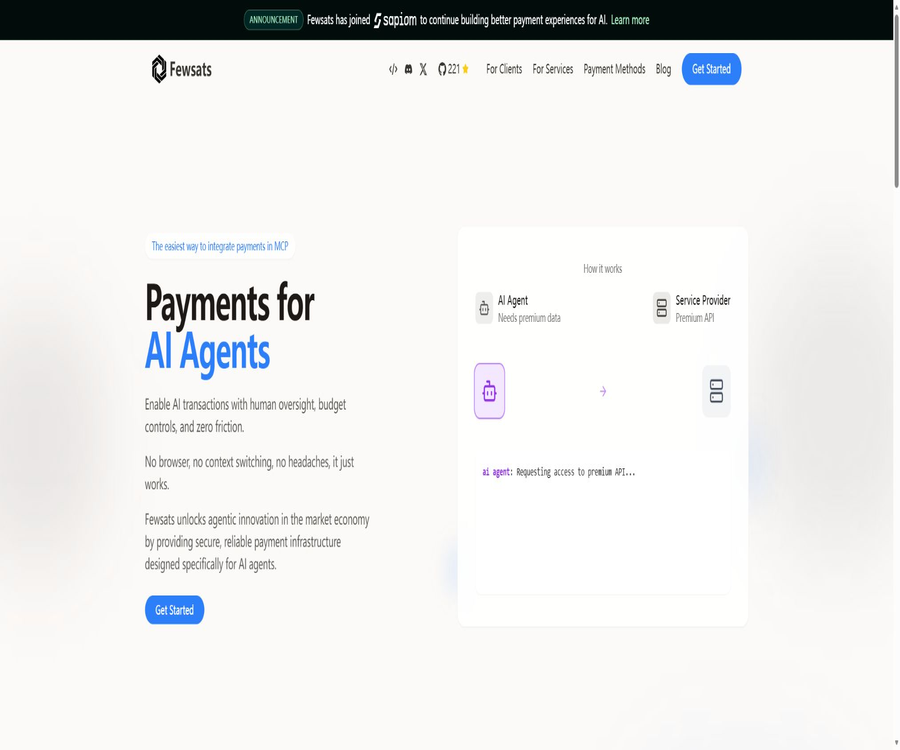
A one-sentence summary
Fewsats is a payment infrastructure designed for AI agents, enabling them to purchase data, APIs, digital services, or other paid resources while being subject to budget limits, transaction thresholds, and manual approval requirements.
Current status
On June 11, 2026, Sapiom announced the acquisition of Fewsats and integrated its native payment capabilities into the agent execution layer. The Fewsats website and GitHub repository are still accessible, and some SDKs and MCP projects remain available publicly; however, details regarding accounts, pricing, and migration procedures for the standalone brand have not been fully disclosed.
Therefore, Fewsats is better classified as a \"purchased agent payment technology and development tool,\" rather than having early demonstrations or old integrations continued to be described as standalone commercial services that have not undergone any changes. New projects should evaluate both Sapiom’s current capabilities and the availability of Fewsats’ older interfaces.
| Verification items | Current conclusion | Usage suggestions |
|---|---|---|
| Fewsats official website | Still online, with information on AI-powered agent payments | You can learn about the principle behind the product. |
| Separate account | The old data contains registration and key entry points. | Verify whether to keep it open before official integration. |
| Acquisition status | Acquired by Sapiom in June 2026 | For new projects, the migration route must be determined first. |
| Public price | No current standalone packages or rate tables were found. | Confirm all costs with the operator. |
| Python SDK | Public, Apache 2.0 license | Code and prototype integration can be reviewed. |
| MCP server | It is public; it allows users to check their balance and make payments. | Add approval before payment. |
| Core hosting services | There is no complete open-source verification. | It cannot be considered a self-hosted payment platform. |
Tool Introduction
Fewsats is designed around the question of \"how AI agents can make payments securely.\" The agents do not obtain the full details of bank cards or wallets; instead, they use controlled interfaces to check balances, select prices, submit payments, and receive information regarding the status of those transactions.
The platform serves both buyers and service providers. Buyers add payment tools to the agents, while service providers package data, interfaces, or digital resources into quotes that can be understood by machines.
Main functions
AI agent-controlled payments
Fewsats enables agents to make payments during conversations or while carrying out tasks, without the need to switch to a browser to manually copy billing information. Payments are still subject to the budget limits, maximum amounts per transaction, and approval rules set by the user.
- Budget control: Limits the total amount that an agent can use within a given period.
- Transaction limit: Sets the maximum amount that can be approved automatically for a single payment.
- Manual approval: Important transactions are placed in a pending review status, with humans deciding whether to approve the payment.
- Payment records: Keep track of the status and details of transactions to facilitate the auditing of agency activities.
- Credential isolation: The proxy does not need to read the complete payment information.
402 Process for Paid Resources
When a proxy requests a resource for which payment is required, the service can return a 402 Payment Required status along with one or more quotes. The Fewsats client reads these quotes, selects one of them and completes the payment, after which it accesses the resource again.
| Process elements | Function | Risks that need to be checked |
|---|---|---|
| Quotation | Indicate the amount, currency, title, and items purchased. | Is the content accurate and necessary? |
| Payment context | Link this resource request to the payment. | Whether it has been duplicated or altered |
| Approval status | Decide whether to make an automatic payment or wait for manual processing. | Is the threshold too wide? |
| Payment result | Returns success, failure, or pending review. | Does retrying after a failure result in duplicate charges? |
| Resource access | Obtain data or services after the payment is completed. | Do the results match the quote? |
Multiple payment networks
The official website lists payment methods such as bank cards, bank transfers, and encrypted assets; early versions of the SDK also supported Lightning invoices and the L402 process. The available options depend on factors such as region, account type, merchant, and the arrangements related to the products after acquisition, so it is not possible to determine them solely based on example code.
Payment by the service provider
The service provider can create a one-time quote for paid resources, including the amount, currency, details, and the available payment methods. After making the payment, it is possible to check the status or receive notifications via Webhook.
MCP payment server
The public Fewsats MCP server converts payment capabilities into tools that can be invoked by agents. It is suitable for clients that support MCP such as Claude Desktop, and it can also serve as an example for developers to understand controlled payment processes.
| MCP tool | Functions | Safety recommendations |
|---|---|---|
| balance | Check wallet balance | Only return the information required for the task. |
| payment_methods | View available payment methods | Do not expose full credentials to the model. |
| pay_offer | Make the payment in accordance with the quotation details. | First, verify the amount, currency, and merchant. |
| payment_info | Query specified payment details | Used for auditing and error troubleshooting |
Python SDK
The Python SDK offers interfaces for managing accounts, balances, payment methods, quote-based payments, Lightning invoices, receipt quotes, payment status, and Webhooks. It can also convert certain methods into AI-native tools that can be used by agents capable of making function calls.
Payment strategy engine
The official website lists custom rules as a core feature; it is possible to decide whether such rules should be applied automatically or require manual approval, based on the amount and type of transaction. In a production environment, a merchant whitelist, currency restrictions, daily limits, thresholds for abnormal activity, and strategies for retrying failed transactions should also be included.
Micro-payments and pay-per-use
Fewsats is suitable for designing single interface calls, datasets, content, or small digital services as services that can be purchased on a per-use basis. It eliminates the need to register and subscribe to each provider separately, but transaction fees and minimum payment amounts still affect the cost structure.
Working principle
- Developers configure the Fewsats key for the agent and, in the background, set the payment methods that are allowed to be used.
- Set a total budget for the agent, a maximum amount per transaction, as well as thresholds for merchant approval and manual approval.
- The agent requests a particular paid resource, and the service returns a machine-readable quote along with the payment details.
- The agent checks the quote and invokes the payment tool; the policy engine decides whether to handle it automatically or place it on hold for further review.
- After the payment is successful, the agent requests the resources again and continues with the original task.
- The system saves the results of transactions, and developers carry out auditing and subsequent processing through queries or Webhooks.
Access tutorial
Create a prototype using the Python SDK
- First, verify that the old Fewsats accounts and key management services are still available for new projects, and understand the scope of support provided after the acquisition.
- Install the feewsats Python package in an isolated testing environment; do not connect it directly to the production payment systems.
- Keys are provided through environment variables, preventing them from being included in code repositories or logs.
- Read the account details, balance, and payment methods to verify that the test identity and currency are correct.
- Use test quotes with minimal amounts to verify payments, failures, requests awaiting approval, and duplicate requests.
- Add restrictions on merchants, amounts, and frequency, and then expose the payment tools to agents.
- Record each tool invocation, the approver, a summary of the quote, and the final transaction identifier.
Connect to the MCP client
- Install the public fewsats-mcp package and verify its version as well as its dependencies.
- In the MCP client, server commands are configured to pass in a separate, low-privilege key via environment variables.
- First, only the inquiry of balance and payment details will be available, to ensure that the client tool functions properly.
- Enable pay_offer in the sandbox and set all transactions to require manual approval.
- The amount, currency, quote identifier, and merchant information will be clearly displayed before approval.
- After completing the security tests, small-value automatic payments should be enabled gradually; do not lift all restrictions at once.
Create a paid quote for the service.
- Define the actual resources delivered, the unit of measurement, the amount, the currency, and the conditions for refunds.
- Return a 402 status code along with a machine-readable quote in unpaid requests.
- Save the payment context to ensure that the same quote is not redeemed repeatedly.
- Payment completion can be confirmed through status checks or Webhooks.
- Resources are returned only after successful verification, and the delivery and transaction logs are retained.
- Provide clear, machine-processable errors for timeouts, amount changes, and payment failures.
Which users are it suitable for
- AI agent developers: Enable agents to purchase interfaces, data, and digital services as part of tasks.
- MCP tool developers: To enable clients that support MCP to incorporate controlled payment capabilities.
- API provider: Designs individual calls or subscription packages as quotes that machines can purchase.
- Data service providers: Sell data resources on a per-use basis to research or analysis agencies.
- Automation Platform Team: Provides unified management of the budgets, approvals, and transaction records for multiple agents.
- Researchers in payment infrastructure: Understand L402, micro-payments, and machine-native business processes.
Typical use cases
- The system allows agents to purchase data temporarily, rather than having users manually subscribe to suppliers.
- The programming agent charges a one-time fee for each build, deployment, or invocation of a third-party interface.
- Content agents purchase access rights to individual articles, images, audio files, or other digital resources.
- Shopping agents complete payments for low-risk items after manual approval.
- The service provider charges per machine call and delivers the results automatically after payment is made.
- Companies set different budgets and trading permissions for multiple agents.
Product advantages
- Payments are processed within the agent workflow, reducing the need to switch browsers and manually copy information.
- Agents do not need to have access to the full bank card or wallet details, which reduces the risk of direct leakage.
- Budgets, limits, and approvals can keep automation capabilities within acceptable bounds.
- It takes into account both the buyer and the service provider, and supports machine-readable quotes and payment status.
- It provides a Python SDK and MCP server to facilitate integration with various proxy frameworks.
- It supports small, one-time purchases, offering a billing method other than subscription for one-off digital services.
- Some development tools have open-source code, allowing developers to examine the implementation and make extensions.
Usage restrictions and risks
- Fewsats has been acquired by Sapiom, and the old accounts, interfaces, and support policies may continue to change.
- No public prices, transaction fees, refund, or dispute resolution details for the current standalone service were found.
- The official website does not provide clear access to the current privacy, data retention, and compliance documents.
- Payment tools represent a high-risk capability; the model may misinterpret quotes, select incorrect products, or make repeated calls.
- The behavior of the example SDK, which defaults to selecting the first quote, is not suitable for untested production environments.
- If an agent key is leaked, it could be used to view balances or make payments; therefore, the principle of minimum privileges and a mechanism for key rotation should be applied.
- Automatic retries can lead to duplicate payments; therefore, the server must employ idempotent controls.
- Cryptocurrency assets and Lightning payments may lack the same refund protection as traditional bank cards.
- Cross-border payments, stablecoins, tax, and anti-money laundering requirements vary depending on the region and type of business.
- Examples in public repositories, older integrations, and archived projects are not necessarily still maintained.
- The Amazon MCP repository has been archived and its maintenance has been completely ceased; it should not be used as a solution for official purchasing purposes.
- AI cannot independently decide on transactions that involve large amounts of money, are irreversible, or pertain to regulated goods.
Prices and fees
As of August 22, 2026, no information is available regarding the subscription plans, platform fees, transaction costs, or corporate pricing offered by Fewsats’ standalone service. The official website only describes the capabilities of the product, and the acquisition announcement does not specify how fees will be calculated for existing customers after they migrate to this new service.
| Cost items | Current public information | It needs to be confirmed before connecting. |
|---|---|---|
| Platform subscription | Not disclosed | Is the account or team charged on a monthly basis? |
| Transaction fees | Not disclosed | Proportionally, based on fixed fees, or according to network costs |
| Bank cards and bank transfers | The supported directions have been displayed. | Region, currency, rules for chargebacks and refunds |
| Lightning or cryptographic assets | It appears in the SDK and documentation. | Exchange rates, network fees, and irreversibility risks |
| Corporate support | Not disclosed | Service levels, compliance audits, and technical support |
| Sapiom’s subsequent plans | Charged separately | Whether Fewsats capabilities are already included and how to migrate them |
The fact that micro-payments are supported should not be interpreted as meaning that the platform is free of charge. Developers need to include in their budget the costs associated with the platform itself, payment network fees, currency conversion, refunds, disputes, as well as the price of the resources being purchased.
APIs, SDKs, and open-source status
| Project | Status | License or instructions |
|---|---|---|
| Managed payment backend | Business services | There is no complete open-source verification. |
| Python SDK | Public | Apache 2.0 |
| Fewsats MCP server | Public | No clear license file is displayed for the warehouse. |
| Marketplace example | Public | For open-source market projects, it is necessary to check the licenses for each repository individually. |
| Amazon MCP | Public but archived | Maintenance has been stopped; it is not recommended for use in production. |
| L402 Old Warehouse | Some warehouses have been discontinued or archived. | New projects should check alternative implementations. |
The open-source nature of the Python SDK means that the client libraries can be viewed, modified, and redistributed, but it does not imply that the account management, settlement, risk control, and payment processing systems can be deployed on one’s own. Before using other Fewsats repositories, it is necessary to check their licenses and maintenance status one by one.
Security practices
- Create a separate key and a separate budget for each agent; the full-privilege production key is not shared.
- Keys are stored only in secure environment variables or key management services.
- By default, manual approval is required; very small automatic payments are enabled only after verification with actual data.
- At the same time, verify the amount, currency, merchant, resource summary, and payment context.
- An idempotent key is set for the payment interface to prevent duplicate deductions caused by network retries.
- Set limits for the daily amount, transaction frequency, individual merchants, and abnormal failures.
- Separate the prompt words from transaction authorization; external web pages or documents cannot directly change the payment policies.
- Record the quote, approver, tool parameters, results, and resource delivery status.
- Regularly revoke unused keys, payment methods, and Webhooks.
- In the event of an acquisition or platform migration, recheck the data processors, terms, and access rights.
Basic information
| Project | Content |
|---|---|
| Tool name | Fewsats |
| Tool type | AI agent payment infrastructure |
| Core protocol | 402 Paid Response and Processes Related to L402 |
| Key capabilities | Payment, receipt, budgeting, approval, transaction status, and Webhooks |
| Current status | Acquired by Sapiom in June 2026 |
| Price pattern | The current independent price is not available. |
| Is an account required? | Hosting services usually require an account and a key. |
| Payment recipient | Bank cards, bank transfers, stablecoins, and Lightning, etc. |
| API | Yes |
| Python SDK | Yes, the Apache 2.0 license. |
| MCP server | Yes |
| Is it open source? | Some SDKs and tools are open source; the hosting platform is not fully open source. |
| Suitable for users | AI agents, MCP, and paid API developers |
| Main risks | Incorrect payments, duplicate payments, key leakage, and migration after acquisition |
Recommendation score
Recommendation score: 3.6 / 5. Fewsats was among the first to integrate AI-based payment processing, machine-readable quotes, budgeting, and manual approval processes into a single set of developer tools; its Python SDK and MCP servers are also easy to understand and use for experimentation.
The biggest variable at present is the product roadmap after the acquisition; the prices, terms, scope of accounts, and details regarding migration are not transparent enough. Production projects should first receive clear commitments of support, with priority given to assessing the subsequent implementation in Sapiom.
Frequently Asked Questions
Can Fewsats still be used?
The official website, as well as certain accounts and SDK materials, are still accessible, but Fewsats has been acquired by Sapiom. New projects should not rely on old documents to determine the continuity of service; instead, it is necessary to verify first whether registration, keys, payment options, and support services are still available.
What does Fewsats do?
It allows AI agents to purchase paid data, APIs, and digital services under controlled conditions, and it also helps service providers create quotes that can be understood by machines as well as collect payments.
Can AI see the information on a bank card directly?
The goal of product design is to prevent agents from having direct access to the complete payment details. Agents use controlled tools to retrieve the necessary information and submit quotes for payment, but developers still need to protect the keys and backend accounts.
Which payment methods are supported?
The official website lists options such as bank cards, bank transfers, and encrypted assets; the SDK also includes Lightning and L402 payment methods. The actual available options depend on the region, account type, and current operational policies.
Is Fewsats free?
It cannot be confirmed. There is no publicly available table detailing the independent subscription and transaction fees; it is necessary to consult the service provider in order to find out the costs related to the platform, networking, and resources before using it.
Are APIs and SDKs available?
It provides APIs, a Python SDK, and an MCP server. The Python SDK can be installed using a package manager, and it is licensed under the Apache 2.0 license.
Is Fewsats open source?
Some client SDKs, MCPs, and example projects are made available publicly, but there is no conclusive evidence that the payment processing platform as a whole is open source. The availability of public SDKs does not equate to the open source nature of the entire platform.
What is L402?
L402 is an access process that combines payment requirements, authentication credentials, and Lightning payments; after making the payment, the client receives the authorization needed to continue accessing the resources.
Can the agent make the payments completely automatically?
Technically, it is possible to automatically process small transactions in accordance with the established rules, but it is not advisable to allow full autonomy from the outset. It is better to set budgets, limits on the amount of each transaction, restrictions on merchants, and require manual approval.
Can the Amazon shopping integration still be used?
The relevant official organization’s warehouses have been archived and no longer receive maintenance; they should not be used as options for current purchasing needs. When a purchasing solution is required, it is necessary to choose integrated systems that are still under maintenance and have clear payment terms.
After the acquisition, should Fewsats or Sapiom be chosen?
Current Fewsats users should first verify the arrangements regarding migration and compatibility; new projects are better assessed using Sapiom’s current documentation and support resources. Do not conflate the prices, interfaces, and service commitments of the two brands.
Summary
Fewsats demonstrates how AI agents can purchase machine services without revealing full payment details, while control is maintained through budgets, limits, and manual approval. Its SDK and MCP tools still hold significant value for learning and prototyping.
However, it is now in the transition phase following Sapiom’s acquisition; before full integration, it is necessary to verify the current accounts, interfaces, pricing, data terms, and support commitments. Any automatic payments should start with the lowest possible permissions, minimal amounts, and require manual approval.
Tools similar to Fewsats





 Guigong Network Security Registration No. 45132202000164