






A one-sentence summary
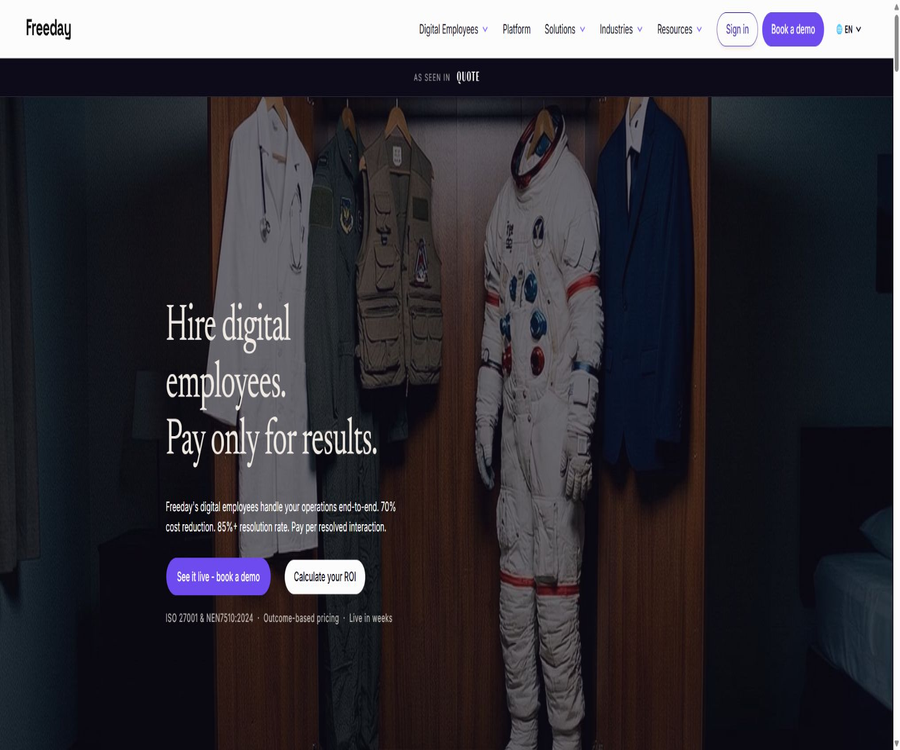
Freeday is an enterprise-grade AI Agent and digital employee platform that can understand requests through voice, chat, and email channels, invoke existing business systems, and handle end-to-end processes such as customer service, accounts payable, KYC, and document processing.
Tool Introduction
Freeday refers to AI Agents that are capable of carrying out certain business processes on a continuous basis as Digital Employees. They are not merely chatbots that answer questions; rather, they can query CRM or ERP systems, process documents, update records, and fulfill requests within the predefined permissions, and they transfer tasks to human operators in complex or high-risk situations.
The platform operates on a managed service model: the company is responsible for defining processes, policies, permissions, and success metrics, while the Freeday team handles implementation, integration, training, optimization, and operational support. The target customers are large and medium-sized organizations that deal with a high volume of customer inquiries, have a large amount of documentation, or are subject to regulatory requirements.
How digital employees work
| Architecture layer | Key capabilities | Business function |
|---|---|---|
| Interface Layer | Voice, chat, email, and natural language understanding | Receive customer, employee, document, or system events |
| Intelligence Layer | Intent, context memory, business rules, and workflow inference | Determine the request content and subsequent actions. |
| Action Layer | System connections, network requests, Webhooks, and RPA fallback | Execute tasks in CRM, ERP, ticketing systems, and backend systems |
| Learning Layer | Feedback loops, knowledge optimization, and model updating | Continuously improve coverage and quality through real interactions. |
| Governance Layer | Role permissions, power limits, manual takeover, and auditing | Limit what agents can do while maintaining traceability |
Main functions
Multi-Agent Orchestration
The platform allows for the deployment of multiple dedicated digital employees, which can coordinate with each other to carry out various processes across different systems and departments. Customer service agents can check inventory levels, financial agents can verify payment conditions, and compliance agents can examine documents; if necessary, tasks can be assigned to another agent or a human employee.
Omni-channel customer interaction
Digital employees can operate via channels such as Web chats, WhatsApp, email, and voice calls, while retaining the context of their work when switching between these channels. The specific channels, numbers, languages, and geographic areas that will be supported need to be determined as part of the project scope.
End-to-end action execution
An agent can not only generate responses but also read corporate data, update CRM systems, create tickets, handle requests, verify documents, and initiate subsequent actions. For each capability, it is necessary to define the scope of the data involved, the permitted actions, the amount thresholds, and the conditions under which escalation is required.
Document Intelligence
Document intelligence is used for extracting, verifying, and processing invoices, identification documents, and other operational documents. It can be integrated with financial or KYC processes to transfer information from unstructured documents into structured formats as well as into relevant systems and approval workflows.
Knowledge base and business rules
The implementation team sets up a knowledge base, decision rules, process steps, and upgrade pathways. Continuous improvement is achieved through the revision of knowledge, analysis of dialogue patterns, and updates to the underlying models; however, this does not mean that the Agent can change financial or compliance policies on its own without proper oversight.
Model-agnostic architecture
Freeday states that the platform allows the use of various AI models, thereby preventing business processes from being tied to a single model provider. The available models, data flow patterns, regions, and switching permissions should be specified in the technical and data processing documents.
Over 100 types of enterprise integrations
The public pages list enterprise systems such as Salesforce, SAP, Epic, Zendesk, ServiceNow, Oracle, Microsoft Dynamics, AFAS, etc., and support custom interfaces. Some of these pages utilize over 100 different integrations, while the home page offers access to more than 3,000 applications; when making purchases, it is necessary to distinguish between native connectors and those applications that can be accessed indirectly through an automation layer.
RPA rollback
When the system lacks appropriate interfaces or tasks that require use of the older interface, the platform can rely on RPA as a fallback solution. RPA is more sensitive to changes in page layouts; therefore, it is necessary to implement mechanisms for detecting such changes, restarting processes, allowing human intervention, and testing any resulting modifications.
Real-time portal and monitoring
The Freeday Portal is used to monitor the volume of conversations, the level of automation, cost impacts, skill performance, and any changes that require attention. Companies can oversee multiple digital employees through this single portal, rather than relying on periodic manual reporting.
Quality and Upgrade Analysis
The platform provides metrics such as Conversation Quality Score, Escalation Insight, First-time Fix Rate, and Knowledge Gaps. Teams can see at which points the case is escalated to human agents, why it wasn’t resolved on the first attempt, and which knowledge gaps keep reappearing.
Core solution
Automated customer service
Digital customer service agents can answer questions, check orders and inventory levels, handle returns, exchanges, and warranty issues, as well as update tickets, ensuring consistency across voice, chat, and email communications. Requests that require judgment, further escalation of complaints, or actions beyond their scope of authority can be forwarded to human agents along with all relevant context.
Automation of accounts payable
The financial agent can receive invoices, extract relevant fields, verify suppliers and payment terms, match business records, and send any abnormalities for approval. Payment instructions, changes to banking details, and transactions involving large amounts must be subject to strict multi-person oversight.
KYC verification
Compliant digital employees can request documents, send status updates, carry out identity and liveness verification procedures, and assist with sanctions screening and audit tracking. It is still the responsibility of the company’s compliance team to determine whether the requirements related to AML, KYC, or identity verification in specific countries are met.
Voice AI Agent
A voice agent can answer calls, understand questions, carry out tasks in the backend system, generate transcripts and summaries, and transfer calls to a human operator in real time when necessary. Before deployment, it is necessary to test aspects such as accents, noise, interruptions, authentication, audio notifications, and emergency handling.
Documents and operational processing
In addition to invoices and KYC, the platform can use document extraction as a skill for other operational processes. The compatibility with different file types, the accuracy of fields, as well as the ability to handle handwritten content and low-quality scans should be verified using corporate samples.
Industry scenarios
| Industry | Representative process | Main requirements |
|---|---|---|
| Financial services and Fintech | Customer service, account requests, KYC, and compliance documents | Auditing, identity, permissions, and regulatory rules |
| Healthcare | Patient services, scheduling, information processing, and back-office operations | NEN 7510 – Control of privacy and sensitive health data |
| Tourism and Hotels | Reservations, check-in, ticket changes, documents, and travel inquiries | Multilingual support, capacity during peak seasons, and real-time system data |
| Retail and consumer electronics | Troubleshooting, warranty, returns, orders, and product registration | Inventory, logistics, product data, and manual upgrades |
| Government and public services | Applications, documents, inquiries, and status updates | Interpretability, accessibility, identity, and public responsibility |
| Energy and Utilities | Meter reading, billing disputes, switching, and contract renewal | Account verification, billing accuracy, and complaint handling |
Complete workflow
- Customers, employees, documents, or system events reach the platform via chat, voice, email, or backend channels.
- The agent identifies identity, intent, language, and context, and draws on knowledge, rules, and historical data.
- The system determines whether a task needs to be queried, verified, calculated, updated, or created, and checks the permission boundaries.
- Agents execute actions within business systems through native connectors, custom interfaces, Webhooks, or RPA.
- Cases with high risk, low confidence, policy exceptions, or customer requests for manual handling are escalated along with the relevant context.
- After completion, record the results, evidence, time taken, costs, and quality metrics, and provide feedback to the user.
- The operations team reviews failures, upgrades, and knowledge gaps in the portal, and updates the knowledge and rules upon approval.
Deployment method around the perimeter
| Phase | Main tasks | Deliverables | Corporate responsibility |
|---|---|---|---|
| Week 1: Assessment | Organize processes, quantities, exceptions, and success metrics | Scope, baseline, and target | Provide processes, data, and responsible persons |
| Week 2: Configuration | Establish a knowledge base, decision rules, permissions, and upgrade paths. | Testable digital employees | Confirm policy and authorization boundaries |
| Week 3: Integration | Connect the business systems and get them working in the testing environment. | End-to-end testing process | Provide secure access and acceptance samples |
| Week 4: Go live | Gradually introduce production traffic and monitor it. | Portal, alerts, and operational mechanisms | Approve deployment and handle early exceptions. |
Different pages on the official website use expressions such as 2 to 4 weeks or 14 days; the actual time required depends on the complexity of the process, the interfaces involved, the data needed, compliance requirements, and the speed at which the company can respond. The marketing timeline cannot replace the implementation plan and acceptance criteria specified in the contract.
Usage tutorial
Select the first process.
- Count the number of processes, their costs, average processing time, resolution rate per attempt, escalation rate, and current quality.
- Choose a single process that features stable rules, a high degree of repetition, accessible data, and the ability to recover from errors.
- List all normal paths, exceptions, manual judgments, regulatory requirements, and customer complaint points.
- Define quantifiable outcomes, such as resolved conversations, verified documents, or processed invoices.
- Set automation goals, quality thresholds, stop conditions, and the team responsible for manual tasks.
Design permissions and manual takeover
- List the data that can be read, created, modified, and accessed denied for each skill.
- Set thresholds for amounts, transactions, identities, and risks; any transaction that exceeds these limits requires manual approval.
- Mandatory escalation is established for complaints, legal threats, vulnerable users, medical emergencies, and security incidents.
- Define the manual takeover channels, response times, and the dialogue and system context that must be included.
- Use service accounts with the minimum required permissions, and maintain processes for revocation, rotation, and retirement.
Testing and deployment
- Real but protected historical cases are used to cover normal, ambiguous, malicious, and extreme inputs.
- Verify each item separately: responses, system actions, financial results, identity verification, and audit records.
- Verify in the testing environment failures, timeouts, duplicate requests, and changes to the RPA page.
- First, release a small amount of traffic or serve low-risk customer groups to observe the resolution rate, upgrade frequency, and error rate.
- Once the acceptance criteria are met, gradually expand the scope; do not assign the entire process to the Agent at once.
Ongoing optimization
- Check daily for severe errors, reasons for upgrades, knowledge gaps, and abnormal permission requests.
- Samples of complete conversations and system operations are taken on a weekly basis, with an emphasis not only on the level of automation.
- Changes to knowledge, rules, and models are reviewed by the business owner before being deployed to the production environment.
- Track reverse metrics such as customer satisfaction, restart rate, refunds, complaints, and compliance incidents.
- Regularly verify the definitions of billing results to ensure that the platform and the company agree on what constitutes a successful completion.
Governance and control
| Control | Platform capabilities | Implementation suggestions |
|---|---|---|
| Role permissions | RBAC controls configuration, monitoring, and override operations. | Separate administrators, operators, and reviewers according to their responsibilities |
| Authority Limits | Amount, transaction, and operation thresholds | Multi-level approval is required for high-risk actions. |
| Manual takeover | Immediate upgrade with context included | Specify the receive queue and service level. |
| Audit trail | Record each interaction, decision, and action. | Retained until the contractual and regulatory deadlines are met. |
| Real-time monitoring | View metrics, changes, and anomalies | Enable the execution of alerts rather than just displaying them. |
| Knowledge update | Improvement through gaps and feedback | It is published after approval by the business owner. |
| Model switching | Model-agnostic architecture | Repeat accuracy, security, and regional assessment before switching |
Which users are it suitable for
- Corporate Customer Service Center:Handle a large number of repetitive inquiries, while requiring agents to query and update the backend system.
- Financial Operations Team:Automatically extract, verify, and process supplier invoices and any abnormalities.
- Compliance and KYC Team:Manage a large number of identity documents, status notifications, and approval queues.
- Medical institutions:Automate patient and backend processes in accordance with European data standards and NEN 7510 requirements.
- Tourism and retail businesses:Handle peak seasons, multiple languages, returns and exchanges, as well as booking and after-sales requests.
- Head of Operations and IT:We hope to retain the existing CRM, ERP, and ticketing systems, while adding a governable AI execution layer.
Product advantages
- Extending from dialogue to system actions and the completion of results provides a more comprehensive coverage than chatbots that merely generate responses.
- Voice, chat, and email are integrated, making it suitable for cross-channel customer service and operations.
- It supports existing enterprise systems and custom interfaces, without the need to replace the entire infrastructure.
- Managed services include implementation, integration, continuous optimization, and support, thereby reducing the burden on in-house operational teams.
- Charging based on results links costs to the amount of work completed, thereby avoiding the purchase of unused capacity merely based on the number of seats.
- Role permissions, power limits, manual intervention, as well as auditing and monitoring are suitable for regulated processes.
- Data processing in Europe, along with ISO 27001 and NEN 7510, represents attractive options for businesses and healthcare institutions in Europe.
Restrictions and risks
- As a result, the unit price is not disclosed, making it impossible to compare the total cost of ownership of different suppliers solely based on their official websites.
- Digital employees may still misinterpret intentions, use outdated knowledge, or perform incorrect actions within the system.
- Automation rates, reduced costs, and time to market are aspects related to suppliers’ achievements and goals; it is not possible to ensure that every company can achieve the same results.
- System integration, identity data, medical records, and financial transactions can amplify risks related to permissions and the supply chain.
- RPA rollback may fail when the interface changes, requiring continuous monitoring and regression testing.
- Model independence does not mean that all models meet the same requirements regarding region, privacy, accuracy, and compliance.
- If billing based on results is not clearly defined, disputes may arise regarding repeated contacts, re-opened tasks, or only partial resolutions.
- Managed services reduce internal technical tasks, but they also increase reliance on the supplier’s operational capabilities and exit procedures.
Prices and billing methods
As of August 22, 2026, Freeday does not disclose a fixed price per outcome. The platform employs an outcome-based pricing model tailored to each company; it does not charge based on traditional seats, licenses, or fixed subscriptions, with the specific rates determined by the workflow, volume, complexity, and objectives involved.
| Plan or cost item | Price | Basis for billing | Make the content public | Suitable for users |
|---|---|---|---|---|
| According to the result plan | Custom quote | Dialogs resolved, documents verified, or invoices processed. | Voice, chat, basic integration, email support, and monthly reports | Companies that deploy a single process for the first time |
| Growth Plan | Custom quote | Scale and annual commitment | More email workflows, over 100 integrations, priority optimization, and a real-time portal | Expanding organizations with multiple processes |
| Implementation | Claim to contain | Depending on the deployment plan | Discovery, strategies, configuration, integration, and training | Deployment in all enterprises |
| Optimization and support | Claim to contain | Ongoing service | Performance optimization, 24/7 support, and portal access | Enterprises that require managed operations |
| Minimum spending amount | Not disclosed | Contractual agreement | It depends on the workflow, quantity, and business objectives. | It must be confirmed at the time of purchase. |
Automation assurance
Freeday has pledged to achieve at least 75% automation; if this target is not met, free optimization will continue, with customers paying only for actual results. Companies should include in the contract details such as the measurement period, sample range, exclusions, quality standards, remedies, and termination rights, rather than relying solely on information provided on websites.
How to define billable results
- It has been resolved whether the conversation requires the customer not to contact again within a specified time period.
- Whether manual handling, partial responses, repeated requests, and system failures are charged.
- Document verification includes checking the accuracy of fields, ensuring compliance with rules, and conducting manual inspections.
- Does invoice processing require successful booking, completion of approval, or merely completion of extraction?
- Are refunds, complaints, errors, and rework deducted from the volume of results?
- How sudden increases in traffic, levels below the minimum threshold, and annual commitments affect the unit price.
Safety and compliance
Freeday displays the certification marks related to ISO 27001:2022 and NEN 7510-1:2024, targeting regulated sectors such as healthcare, finance, and government. On its English security page, some of the FAQs refer to the second standard as ISO 27009, which is inconsistent with the information provided on the certificate images and on the Dutch-language page regarding NEN 7510; therefore, it is necessary to obtain the original certificate along with details on its scope of application when making a purchase.
The platform states that customer data is processed in the European Union or the European Economic Area by default, and it uses AES-256 for static encryption as well as TLS 1.3 for transmission encryption; it also offers MFA, role-based permissions, real-time monitoring, tamper-proof audit logs, and incident response capabilities.
Boundary of non-persistent storage
The security page states that customer data is not stored permanently in the Freeday system after passing through the processing pipeline; however, the platform does provide dialogue metrics, comprehensive auditing, transcription summaries, and portal analytics. Companies need to determine for themselves the actual retention period for original content, derived data, logs, backups, and external models.
Training data
The Voice Agent page states that customer data will not be used to train AI models. This commitment should apply to all channels, sub-processors, continuous learning mechanisms, and manually optimized samples as part of the data processing agreement, and not only to voice-related products.
| Security projects | Public statement | Purchase verification |
|---|---|---|
| Authentication | ISO 27001:2022, NEN 7510-1:2024 | Certificate subject, scope, validity period, and exceptions |
| Data region | Default processing by the EU or the European Economic Area | Specific cloud regions, accessible providers, and cross-border sub-processors |
| Encryption | AES-256 for encryption at rest, TLS 1.3 for transmission | Key management, backup, and log overwrite scope |
| Identity and permissions | RBAC, mandatory MFA, and power limits | SSO, approval processes, account recovery upon departure, and service accounts |
| Audit | Unalterable logs and real-time alerts | Log fields, export, retention, and customer visibility |
| Storage | Customer data is not stored permanently. | The original text, transcripts, derived data, cache, and backups are each verified separately. |
| AI risks | Protection mechanisms such as adversarial training and anomaly detection | Test evidence, model list, and red team scope |
Platforms, interfaces, and integration
| Project | Support status | Explanation |
|---|---|---|
| Web Portal | Support | Monitor digital employees, metrics, costs, and improvement signals |
| Voice | Support | Call handling, transcription, summarization, and manual routing |
| Web chatting and WhatsApp | Support | Focused on customer conversations and task execution |
| Support | Processing requests, documents, and status notifications | |
| Enterprise connector | Support | Salesforce, SAP, Epic, Zendesk, Oracle, and others |
| Custom interface | Support | Connects the enterprise backend to dedicated systems |
| Webhooks and RPA | Support | Used for event-driven systems and older systems that lack interfaces. |
| Public developer API | No complete self-service documentation was found. | Enterprise integration is determined by the implementation plan. |
| Official SDK | No public SDK was found. | Do not mistake the enterprise interface for an open-source SDK. |
APIs, SDKs, and open-source status
Freeday connects to customer systems via interfaces, Webhooks, pre-built connectors, and RPA; however, as of the time of verification, no complete developer portal or official SDK available to the public was found. Details regarding authentication, rates, events, sandboxes, and data models must be obtained through enterprise implementations.
The platform, the environment in which digital employees operate, and model orchestration are part of commercial, closed-source services; no official open-source code or model weights have been made available. The model-agnostic architecture allows suppliers to switch between or combine different models, but this does not mean that the product is open-source or can be deployed privately by users.
Basic information
| Project | Content |
|---|---|
| Tool name | Freeday |
| Tool type | Enterprise AI Agents, Digital Employees, and Managed Automation Platforms |
| Main process | Customer service, accounts payable, KYC, voice and document processing |
| Primary channels | Web chat, WhatsApp, email, and voice calls |
| Price pattern | Custom solutions for businesses, with billing based on the results achieved |
| Deployment mode | Hosting services usually have a target time frame of 2 to 4 weeks. |
| Is registration required? | Companies need to purchase, implement, and manage accounts. |
| Chinese support | Complete Chinese-language product and implementation support have not been confirmed. |
| APIs and SDKs | Supports enterprise APIs and custom integrations; no public SDK available. |
| Is it open source? | No, it is a commercial, closed-source platform. |
| Data area | The authorities emphasize that the EU or the European Economic Area should handle it. |
| Safety | ISO 27001, NEN 7510, RBAC, MFA, and audit trails |
Recommendation score
Recommendation score: 4.4 / 5. Freeday is suitable for European companies that wish to delegate large-volume, repetitive customer service, financial, or compliance tasks across different systems to managed AI agents, and that are willing to evaluate the value provided based on outcomes.
The main barriers are the lack of transparency in pricing, high requirements for implementation and management, and the need to verify automated marketing metrics using one’s own data. Individual users, small teams, and those who only need simple chatbots are not suitable for such enterprise solutions.
Frequently Asked Questions
What is Freeday?
It is a platform for corporate AI agents and digital employees; it can handle requests via voice, chat, and email, and it can utilize CRM, ERP, ticketing systems, and other systems to carry out the entire process.
Is Freeday free?
There is no public free version or fixed trial period. Companies can schedule a demonstration or use the ROI calculator for an assessment, after which they can receive a customized quote based on the process, volume, and complexity involved.
How is the pricing?
Charging is based on outcomes such as resolved conversations, verified documents, or processed invoices, rather than on seats or traditional licenses. The specific unit prices, minimum quantities, and definitions of outcomes are determined by the contract.
Is there an additional cost for implementation and support?
The public pricing page states that implementation, integration, optimization, 24/7 support, and portal access are included in the deployment. Enterprises should still verify in the order the scope, hours of service, special interfaces, and any additional conditions.
How long before it can go live?
Officials usually provide a timeframe of 2 to 4 weeks; in some cases it is 14 days. The actual duration depends on the processes, data, interfaces, security checks, and corporate approvals, and it cannot be considered a fixed commitment for all projects.
What’s the difference from chatbots?
Chatbots typically answer questions, while Freeday digital employees can also query systems, process documents, update records, and fulfill requests. Cases that exceed their capabilities or involve complexity are escalated to human agents.
Which systems are supported?
Representative systems include Salesforce, SAP, Epic, Zendesk, ServiceNow, Oracle, Microsoft Dynamics, and AFAS, and they support custom interfaces. The actual number of native connectors and their capabilities need to be determined on a case-by-case basis.
Will customer data be used for training?
The page for voice products states that customer data will not be used to train AI models. Companies should demand that this commitment apply to all channels, ongoing improvements, and all sub-processors, and it should be included in the data processing agreement.
Will the data be saved?
The official security page states that customer data is not stored permanently in their systems, but auditing, portals, transcription, and derived metrics require certain processing. It is necessary to determine separately the retention periods for the original content, logs, cache, backups, and outputs.
Is private deployment supported?
No publicly available local installations or downloadable private versions were found. The company emphasizes data processing and enterprise integration in Europe; any special deployment requirements must be confirmed separately with the sales team.
Are public APIs or SDKs available?
The platform can integrate with enterprise systems via interfaces, Webhooks, and custom connections; however, no public API documentation or official SDKs have been found. The range of developers is determined by the specific enterprise project.
Is Freeday open source?
It is not open source. The digital employee platform and model orchestration are commercial, closed-source services; the fact that models are not exposed does not mean that the source code or model weights are made available.
Summary
The core of Freeday is not to add another robot for answering questions, but rather to deploy digital employees capable of carrying out various processes within existing business systems. Multi-channel interaction, system automation, intelligent document handling, real-time portals, and human oversight make it suitable for use in customer service, finance, and compliance operations.
Pricing based on outcomes can make costs more aligned with actual output, but the value depends on how outcomes are defined, the quality standards required, and the costs associated with exceptions. Companies should start with pilot projects using limited processes to verify accuracy, integration, security, data retention, and the need for human intervention, before expanding automation to more areas.
Tools similar to the Enterprise AI Agent Platform





 Guigong Network Security Registration No. 45132202000164