






A one-sentence summary
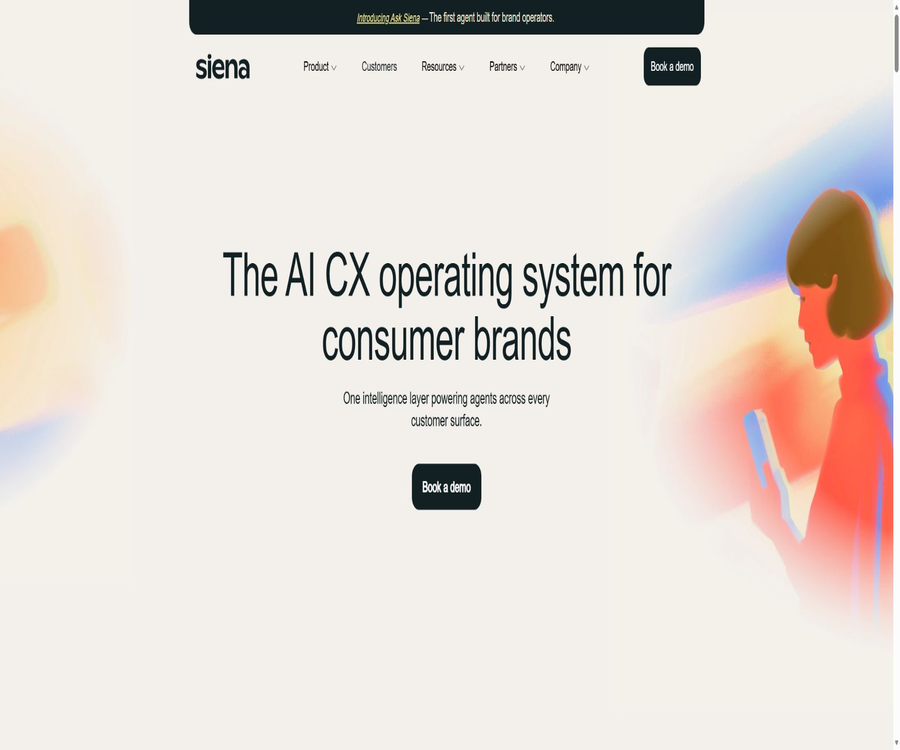
Siena AI is an AI-based customer experience platform designed for e-commerce and consumer brands; it utilizes agents for customer service, shopping, social interactions, voice communication, quality assessment, and data analysis to answer questions, process orders, and analyze customer feedback across various channels.
Tool Introduction
Siena AI is operated by the American company Siena Labs Inc. It is not designed to function as a standalone support system; rather, it acts as an intelligent layer that integrates with a brand’s existing support systems, e-commerce platforms, subscription services, return processes, logistics facilities, and payment systems. It enables the retention of customer context across different channels, and it can carry out actions such as issuing refunds, changing delivery addresses, canceling orders, or adjusting subscriptions, whenever the rules permit it.
In its early stages, the product focused on \"empathetic AI customer service,\" but it has since evolved into a multi-Agent platform that covers the entire customer journey. In addition to the Agents designed to assist consumers, Ask Siena and Siena Insights also help brand managers analyze conversations, develop new Agents, and continuously improve business operations.
Agent product line
| Agent or module | Primary target | Core tasks | Typical output |
|---|---|---|---|
| Customer Service Agent | Post-sale customers | Order processing, returns, exchanges, logistics, and subscription support | Responses, system operations, and manual upgrades |
| Shopping Agent | Customers who browse and make purchases | Product discovery, recommendations, troubleshooting, and conversion | Product recommendations, links, add-to-cart options, and revenue attribution |
| Social Agent | Social media users | Private messages, comments, and brand interactions | Public or private replies and upgrades |
| Voice Agent | Telephone customers | Voice customer service and cross-channel context | Voice response, operation, and transfer |
| QA Agent | Customer Service Manager | Check the quality of AI and manual processing. | Scores, reasons, trends, and suggestions for improvement |
| Ask Siena | Brand management staff | Analyze customer feedback and assist in setting up agents. | Answered with evidence, Playbooks, and configuration updates |
| Siena Insights | Insights and Product Team | Categorize feedback, emotions, and anomalies | Trends, themes, and Slack reminders |
Main functions
Omni-channel customer service automation
Siena can function through emails, text messages, web chats, WhatsApp, Instagram, Facebook, TikTok, voice calls, and other channels, while striving to retain the historical context related to each customer. Brands do not need to replace their existing support systems just by using Siena.
Brand Personas
Teams can assign Personas to different channels, brands, or tasks, so that responses adhere to a specified tone, vocabulary, and style of service. Personas cannot replace factual knowledge and policy rules; brands still need to test sensitive expressions, commitments, and upgrade conditions.
Customer Service Agent
The customer service agent is responsible for handling inquiries related to orders after purchase, logistics issues, cancellations, returns and exchanges, changes to subscriptions, as well as common questions about the products. It can not only provide answers but also utilize connected systems to carry out necessary actions, subsequently returning the results to the original chat interface.
- Check the status of orders, shipments, and returns.
- Cancel orders, update addresses or emails.
- Handle refunds, replacements, and price adjustments in accordance with the brand’s rules.
- Skip, pause, restart, or adjust the subscription frequency.
- Upgrade tickets that require judgment, exceptions, or emotional support to human agents.
- Retain customer history and completed actions across channels.
Shopping Agent
The shopping agent operates during the pre-purchase phase, offering recommendations based on real-time product catalogs, customer preferences, and past conversations. It can display product links and add-to-cart buttons within chats, and it tracks the attribution of revenue from those conversations to actual orders.
- Proactively initiate conversations related to the page’s intent.
- Answer questions regarding the material of the product, its dimensions, how to use it, and compatibility issues.
- Products are recommended based on needs, preferences, and purchase history.
- Open the pre-filled dialog on the product page, category page, or under frequently asked questions.
- Convert the recommendation into a link, add it to the cart, or proceed with checkout.
- Track the impact of conversations on conversion and revenue.
Social and comment processing
Siena can handle social messages, comments, and reviews, helping brands to maintain a rapid response time in channels with high traffic. Public responses carry higher risks than private customer service; negative reviews, crises, as well as medical and legal issues require manual intervention.
Voice customer service
The official website lists Voice as part of the unified Agent system, emphasizing continuous context across different channels. The actual phone numbers supported, as well as the countries, languages, transfer options, recording features, and phone call costs, need to be determined during the contract negotiation and implementation phases.
Ask Siena
Ask Siena is designed for brand managers; it can answer natural language questions based on conversations, orders, subscriptions, reviews, and knowledge. Each key finding can be linked to the actual query and the original conversation, which facilitates verification by the team rather than relying solely on summaries.
- Analyze trends in returns, cancellations, sentiment, and product feedback.
- At the same time, provide quantitative changes as well as qualitative evidence such as the customer’s original words.
- Draft the brand tone based on historical tickets.
- Identify the Journey elements that are reducing the automatic resolution rate and suggest changes.
- Automated processes for uniformly updating knowledge and policies related to dependencies.
- Convert repetitive issues into Playbooks that run according to a schedule or events.
Playbooks
Playbooks allow an analysis task to be turned into a scheduled or trigger-based process; for example, generating customer feedback reports on a weekly basis, monitoring a sudden increase in certain types of complaints, or pushing the results to Slack. Playbooks that interact with external systems require proper permissions, approval procedures, and mechanisms for rolling back changes.
QA Agent
The QA Agent examines all conversations in accordance with the brand’s specific criteria, rather than only sampling a small number of tickets. It can score each conversation based on factors such as the brand’s tone, the way issues are resolved, compliance with policies, customer effort, and other standards, and it provides reasons for each score given.
Intelligent follow-up
Intelligent Follow-ups automatically sends emails to follow up with customers when there is no response for an extended period of time. Once the set number of attempts has been reached, it is possible to switch to manual intervention or disable this feature, thereby reducing the number of pending tickets for an extended time.
Multilingual support
According to Siena’s public information, it is capable of handling customer interactions in over 100 different languages. However, the number of languages does not imply that the quality of service is the same in every market; brands should test terminology, courtesy levels, scripts, policies, and the process of human intervention separately.
Integrated ecosystem
| Category | Representative integration | Executable tasks |
|---|---|---|
| Help desk | Zendesk, Kustomer, Gorgias, Dixa, Gladly, Intercom | Sending and receiving messages, maintaining queues, and manual collaboration |
| E-commerce | Shopify, Fulfil | Query orders, cancel, get refunds, change delivery addresses, and view product details |
| Subscribe | Recharge, Ordergroove, Prive, Skio, Smartrr, Stay AI | Skip, Cancel, Restart, Change Product, and Modify Frequency |
| Return goods | Loop Returns | Create return, reshipping labels, cancel, and check status |
| Logistics | AfterShip, ShipBob, ShipMonk, Wonderment | Check on fulfillment and shipping progress |
| Evaluation and Loyalty | Yotpo, Okendo | Evaluation review, responses, and points inquiries |
| Payment | Stripe | Payments, subscriptions, and invoice requests |
| Marketing and Communication | Klaviyo, Slack | Responses to SMS campaigns, reminders, and internal notifications |
| Knowledge materials | Google Docs, Google Sheets | To provide documentation and structured data for answering questions. |
| Custom system | Custom API | Connect to internal orders, CRM, or fulfillment systems |
Shopify operations
Shopify integration allows for the retrieval of order history, product information, and purchasing patterns; it also enables actions such as cancellation, refunds, reshipping, address changes, or price adjustments, all in accordance with the set parameters. All write operations must be subject to constraints regarding time limits, amounts, order status, and customer verification requirements.
Subscription operation
Taking Recharge as an example, the Agent can cancel or restart a subscription, skip a delivery, or modify the address, frequency, date, and products. When it comes to preserving discounts, offering refunds, setting a minimum number of deliveries, and respecting restrictions on regulated products, it is necessary to define priorities within Journey.
Return process
The Loop Returns connection allows for the creation of return links, resending labels, canceling returns, and checking their status. Brands should define clear rules regarding the return period, items that can be returned, international orders, and exceptions for used items.
Implementation process
- Schedule a demo and provide information on monthly session volume, channels, support desk, and e-commerce technology stack.
- Select one or two high-frequency, well-defined intents with low risk as pilots.
- Links to the help desk, product catalog, order system, and essential knowledge materials.
- Import the brand tone, customer service policies, product information, and existing macros.
- Define Journey, allowed actions, prohibited conditions, and manual escalation rules.
- Normal, ambiguous, and malicious inputs are simulated using historical tickets and dedicated test accounts.
- The implementation team optimizes the knowledge, Personas, actions, and boundaries.
- First, open it to a low volume of traffic, and then observe the accuracy rate, CSAT, and the reasons for failures.
- Gradually expand the channels, intents, and system operations, while continuously using the QA Agent for checks.
Why can’t it be done with just one configuration?
Customer service policies, products, subscriptions, logistics, and customer communications are subject to constant changes; agents may also alter their behavior as the models are upgraded. Brands need dedicated personnel to manage knowledge bases, customer journey processes, quality checks, and cross-departmental changes, rather than leaving these aspects unmanaged after the product is launched.
Tutorial for creating secure Journeys
- Specify the customer’s intentions, the required authentication, and the data that can be accessed.
- List the system operations that the Agent can perform, along with the prerequisites for each operation.
- Set limits on amounts and time for refunds, discounts, reshipments, and cancellations.
- It specifies the procedures to follow in cases where an order cannot be confirmed, when there are policy conflicts, or when the customer disagrees.
- For medical, legal, security, fraud, and high-value orders, manual handling is initiated directly.
- Test Journey using boundary values, repeated requests, privilege escalation, and prompt injection.
- Check that each system action includes confirmation, logging, and necessary rollback methods.
- After going live, it is continuously updated based on failed tickets, customer feedback, and QA scores.
Pre-launch testing checklist
- The customer does not have an order number or is using a different email address.
- The order has been shipped, but the customer requests to cancel it.
- The amount of the refund exceeds the allowed limit.
- The same customer repeatedly requests resending the item or a discount.
- Customers request that policies be ignored or that other orders be disclosed.
- Third-party integration timed out, the token has expired, or a partial success was returned.
- Customers submit the same issue repeatedly through different channels.
- Language, satire, spelling mistakes, and emotional expressions.
- Manual intervention is required, but there are no staff online.
Ask Siena analysis process
- Identify the problem, time frame, brand, market, and channels.
- Confirm that the required conversation, order, subscription, and review data are connected.
- Pose verifiable questions in natural language, avoiding vague phrasing such as “what do the customers think?”.
- Check the quantity, methods, filtering criteria, and the link to the original conversation in the response.
- Distinguish between support ticket deviations and the actual distribution across all customers.
- Save the repeated reports as a Playbook and specify the execution time.
- Set approvals for actions related to writing back knowledge, Journey, or external systems.
- Monitor customer feedback and business metrics following the action taken, to verify whether the conclusions are valid.
Prices and billing methods
As of August 22, 2026, Siena’s public pricing page does not show any fixed monthly fees, tiered subscription plans, or a price per session; it instead encourages businesses to schedule demonstrations. According to the official information, billing is based on the number of AI-driven sessions handled, rather than on the number of issues that are successfully resolved.
In session-based mode, the bill is theoretically equal to the number of sessions processed by the AI multiplied by the contract rate, regardless of whether the AI handles everything on its own or in collaboration with human staff. The contract still needs to specify definitions of sessions, time frames, channel integration, spam messages, follow-ups, and any additional fees.
| Billing items | Public rules | It needs to be confirmed before signing. |
|---|---|---|
| Basic subscription | The fixed amount is not disclosed. | Minimum commitment, platform fee, and included features |
| AI conversations | Charged based on the number of processed sessions | Unit price, tiers, session start and end, and repeated contacts |
| Solution result | Billing is not based on whether the issue is resolved independently. | Do manual takeover and partial automation still count as sessions? |
| Channels | Supports multiple channels | Are transactions from the same customer combined across different channels? |
| Take the initiative to follow up | Can be sent automatically | Is there a charge for new sessions or messages generated with each follow-up? |
| Voice | Product line support | Minute charges, number fees, routing, and recording storage |
| Custom integration | Support | Are there additional charges for implementation, maintenance, and usage? |
| Implement services | Includes expert assistance | Scope, time to go live, and additional service fees |
| Certification courses | Free for customers and partners | Non-customers need to apply for access. |
Methods for estimating costs
- Count the number of individual sessions for each channel over the past six to twelve months.
- Remove garbage, duplicates, and purely manual internal tickets, while retaining seasonal peaks.
- Estimate the proportion of Siena’s involvement in the pilot project.
- Confirm the time window for a session and the rules for merging across channels.
- Include the costs for voice minutes, text messages, support services, and third-party platforms.
- Calculate the average monthly figure, as well as the figures for peak months such as promotional months and Black Friday.
- Evaluate returns using labor costs, response time, CSAT, and revenue impact.
- Set up excess notification, budget thresholds, and usage export in the contract.
Which users are it suitable for
- Medium and large consumer brands: Expand customer service capacity during periods of growth and promotional activity.
- Shopify merchants: Automatic handling of orders, refunds, reshipments, and pre-purchase recommendations.
- Subscription brands: Allow customers to skip, switch products, change the frequency, or cancel their subscription.
- Multi-channel CX team: Unifies email, chat, SMS, social media, and voice contexts.
- Companies with a high brand prestige: use Personas to determine the tone at various points of interaction.
- Customer Insights Team: Identifies trends and evidence from a large volume of conversations and reviews.
- Customer Service Quality Team: Applies a consistent scoring system to all AI and human-led conversations.
- Companies that use their own order management systems: They connect their business processes via Custom API.
Typical use cases
- Automatically answers questions regarding orders, delivery, discounts, and inventory during promotional periods.
- Customers can change their address or email address, or cancel their order before the shipment is processed.
- Per policy, refunds, replacements, or returns are issued for damaged goods.
- Help subscribed customers skip deliveries, product exchanges, or frequency adjustments.
- On the product page, purchase suggestions are provided based on needs and historical behavior.
- Automatically respond to positive reviews, and route sensitive negative reviews to manual handling.
- A customer feedback report is generated weekly and sent to the product and retail teams.
- Monitor for sudden increases in payment failures, logistics complaints, or cancellations.
- Check the brand tone and compliance with policies in all customer service conversations.
Product advantages
- It covers pre-purchase, post-purchase, social, voice, quality, and insights – not just handling FAQs.
- Built on top of existing help desks, it allows agent training to be retained when the brand switches to systems such as Zendesk or Gorgias.
- E-commerce, subscription, return, logistics, and payment connectors can turn responses into actual actions.
- Persona and cross-channel context help maintain brand consistency.
- Ask Siena puts the customers’ original statements, quantitative analysis, and business actions in the same system.
- The QA Agent can cover all conversations, thereby reducing the areas where manual sampling may miss something.
- Charging on a per-session basis makes it easier to predict and audit the fees based on the resulting outcomes.
- Provide implementation team support for configuring knowledge, Journey, and production quality.
Usage restrictions and precautions
- The official website does not disclose fixed prices; the budget must be determined through a demonstration and a contract.
- Charging per session can still experience rapid growth during promotions, outages, or spikes in spam messages.
- Automatic refunds, cancellations, reshipsments, and subscription changes have real business consequences.
- AI may misinterpret orders, policies, customer identities, or implied tones.
- Over 100 languages do not mean that the quality of terminology in all languages and industries is consistent.
- Customer conversations do not represent all consumers, and the insights obtained may be influenced by channel biases and complaints.
- Cross-channel memory and personalization increase customer identity matching and privacy risks.
- Implementation requires ongoing maintenance by operators of the knowledge, Personas, Journeys, and QA.
- Disruptions in external support desks, e-commerce, and logistics systems will limit the Agent’s capabilities.
- Voice recordings, social media responses, and inquiries regarding health products require more stringent legal scrutiny.
- Having public API integration capabilities does not equate to providing a complete self-service developer platform.
Security, Privacy, and Compliance
Siena has stated publicly that it meets the requirements related to SOC 2, GDPR, and CPRA; the SOC 2 reports are available upon request as part of the sales or procurement process. Certification statements merely attest to the controls in place over a specific scope and period, and companies still need to review the latest reports, any exceptions, and the scope of the services purchased.
The privacy policy for 2025 applies primarily to website visitors, customers, and authorized users; data related to consumer conversations and other end-user information is managed by the brand as the controller, with Siena acting as the processor. The brand must specify in its privacy policy how such data is processed, and it is required by applicable laws to inform customers that their interactions with virtual assistants and their conversations may be recorded.
| Matters | Public explanation | Brand responsibility |
|---|---|---|
| Data roles | Siena usually acts as a processor or service provider. | Establishing the legal basis for a brand, as well as informing about its purpose and uses |
| End User communication | Process according to the customer’s instructions. | Restrict data collection, configure retention policies, and control data access rights. |
| Sell or share | DPA promises not to sell or share the covered data for purposes other than those related to the service. | Confirming contract exceptions and advertising technologies |
| Sub-processor | The DPA includes a list and provides notification for changes. | Review and raise objections within the specified time limit |
| Cross-border transmission | Standard contract clauses or other mechanisms can be used. | Confirm the data area and provide additional protection. |
| The virtual assistant provides information. | It is necessary to identify the identity of AI under the applicable laws. | Provide clear disclosure in each channel design |
| Session recording | Under the applicable law, the necessary consent must be obtained. | Set recording prompts by country and state. |
| Delete | The DPA stipulates that matters shall be handled in accordance with the agreements and laws. | Specify the retention periods for ticket, backup, and model-related data. |
| Security report | SOC 2 documentation is available upon request | Review period, system boundaries, and findings |
Guardrail for high-risk operations
- Set maximum limits, both for a single transaction and on a cumulative basis, for refunds, replacements, discounts, and price adjustments.
- Verify the email address, postal code, order number, or other relevant information before reading the order.
- Agents are prohibited from accessing orders and internal records that are not related to the current customer.
- Manual processing is applied to shipped orders, those marked as fraudulent, high-value orders, and international orders.
- Ensure that all actions of external systems are recorded in queryable time, input, and result logs.
- When partial processing is successful, avoid repeated refunds, re-issuances, or cancellations.
- Stop write operations when the third-party system is unavailable, and specify the subsequent actions to take.
- Conduct regular security testing using privilege escalation, prompt injection, and social engineering attacks.
APIs, GitHub, and open source status
Siena supports integration with Custom APIs; users can configure the target endpoints, authentication details, as well as custom actions that can be executed by the Agent. The official website’s partnership page mentions API and modular capabilities, but no complete, publicly available developer documentation or universal SDK that can be used without a contract has been found.
As of the verification date, no official public GitHub repository maintained by Siena Labs was identified. The Siena platform, the Agent runtime layer, Ask Siena, and the connectors are considered commercial, closed-source services; custom APIs do not equate to open-source products.
| Project | Current conclusion | Explanation |
|---|---|---|
| Custom API integration | Support | Connect to internal orders, CRM, or other systems |
| Pre-set integrated directory | Support | Covers help desks, e-commerce, subscriptions, returns, logistics, and payments |
| Public platform API | Business confirmation is required. | No fully self-service public console has been identified. |
| Official SDK | Not verified. | There are no public language packs or installation documents. |
| Webhook | Business confirmation is required. | The public page does not list all the event specifications. |
| Official GitHub | Not verified. | Warehouses with the same name cannot be considered as the source code of the product. |
| Product source code | Not open | The platform is a commercial hosting service. |
| Private deployment | Not disclosed | If data isolation is required, ask about it during the procurement process. |
Supported platforms and channels
| Platform or channel | Support status | Explanation |
|---|---|---|
| Web management backend | Support | Configure Agents, Knowledge, Journeys, Integration, and Analytics |
| Support | Automated processing through connection to the help desk | |
| Web chat | Support | It can be embedded and triggered customarily from page elements. |
| SMS | Support | The specific provider and message fees need to be confirmed. |
| Support | Commercial messages and consent rules must be complied with. | |
| Instagram, Facebook, TikTok | Support | Handling private messages, comments, and social interactions |
| Voice | Support | The number, language, routing, and recording rules need to be confirmed. |
| Standalone desktop application | Not verified. | Operations are primarily carried out through the website backend. |
| iOS or Android management app | Not verified. | No separate official client documentation was found. |
| Existing help desk | Support | Can be combined with Zendesk, Gorgias, Kustomer, and others. |
Basic information
| field | Content |
|---|---|
| Tool name | Siena AI |
| Operating company | Siena Labs Inc. |
| Tool type | AI customer experience operating system and e-commerce Agent platform |
| Core Agent | Customer service, shopping, social features, voice functionality, QA, and Ask Siena |
| Key customers | Mid-sized and large consumer brands, e-commerce companies, and subscription-based businesses |
| Primary channels | Email, SMS, messaging, WhatsApp, social media, and voice calls |
| Main integration | Support desk, Shopify, subscriptions, returns, logistics, and payment platforms |
| Language | It publicly states that it supports over 100 languages. |
| Price pattern | Charging is based on AI-driven session processing; a fixed price requires inquiry. |
| Free version | Not disclosed |
| Is registration required? | Business activation and an account are required. |
| Custom API | Support |
| Official SDK | Not verified. |
| Official GitHub | Not verified. |
| Is it open source? | No |
| Compliance information | Statements related to SOC 2, GDPR, and CPRA |
Recommendation score
Its recommendation score is 4.5 out of 5. Siena integrates pre-purchase recommendations, post-sale actions, social features, voice functionality, quality checks, and customer insights within the same intelligent framework; it can also connect with major e-commerce and support systems, making it suitable for consumer brands that deal with a large volume of customer inquiries and have complex business processes.
The main drawbacks are the lack of transparency regarding prices, the high requirements for implementation and ongoing operation, and the fact that automated processes pose risks to financial integrity and privacy. Small teams should first choose one or two projects with low risk levels for testing, and include details such as the format of conversations, peak costs, and procedures for manual intervention in the contract.
Frequently Asked Questions
What is Siena AI?
Siena AI is an AI-based customer experience platform designed for consumer brands, offering shopping, customer service, social interaction, voice functionality, quality assessment, and customer insight tools across various channels.
Will Siena replace the existing help desk?
Usually not. It is built on top of existing help desks such as Zendesk, Kustomer, Gorgias, Dixa, etc., and the original queues as well as human support teams remain in use.
Is it possible to automatically refund money and cancel orders?
Refunds, cancellations, reshipments, address changes, and price adjustments can be handled through integrations such as Shopify, but the brand must establish policies, implement authentication measures, set amount limits, and provide for manual intervention in certain cases.
Can I manage subscriptions?
Yes. Integrations such as Recharge, Skio, and Smartrr support functions like skipping, pausing, restarting, changing the product, altering the delivery address, and adjusting the delivery frequency.
Which channels does Siena support?
Public information lists channels such as emails, text messages, web chats, WhatsApp, Instagram, Facebook, TikTok, and voice calls.
Does Siena support Chinese?
Officials claim support for over 100 languages, which in theory includes Chinese, but no specific quality metrics are provided for each language. The brand should test the simplified and traditional forms of Chinese, as well as regional expressions and product terminology, separately.
How much is Siena?
The fixed amount and the price per session are not disclosed; it is necessary to schedule a demonstration in order to obtain a quote from the company. The official pricing model is based on the number of AI processing sessions, rather than on the number of issues that are successfully resolved.
What constitutes a session?
The public documentation does not provide details regarding the full session window or the rules for merging messages across different channels. Before signing a contract, it is necessary to clarify the pricing methodology for time intervals, repeated contacts, follow-ups, spam messages, and manual intervention.
Is there a free version?
No public, self-service free version or fixed free quota has been found. The main ways to access it at present are by scheduling a demonstration or by having the service enabled for a company.
What is Ask Siena?
Ask Siena is an agent designed for brand managers; it can analyze conversations, orders, subscriptions, and reviews, and use evidence from the original conversations to answer questions or create playbooks.
Can the QA Agent inspect human customer service agents?
Yes. The QA Agent is used to evaluate AI conversations against brand standards, and it provides the scores along with the reasons for further analysis by Ask Siena.
Are APIs provided?
Custom APIs and enterprise integration are supported, but no complete public self-service developer platform has been identified. The interfaces, authentication methods, and usage quotas need to be determined during implementation.
Is Siena open source?
No. No official open-source repository has been identified; the platform and the Agent are commercial, closed-source services.
Do customers need to know that it is AI on the other end?
Where required by applicable laws, the brand must indicate that the services are provided by virtual assistants and obtain the necessary consent for recording conversations. Even if local laws do not impose such requirements, clear disclosure helps to build trust.
Are the data used for training?
As a processor, Siena handles End User data in accordance with customer instructions, but the privacy page published online cannot replace a specific service agreement. Enterprises should specify in the DPA the procedures for model training, data retention, designated sub-processors, and the conditions under which data is deleted.
Is it suitable for small shops?
Siena is more suitable for brands that have a certain volume of transactions, complex e-commerce systems, and dedicated CX professionals. Small businesses should first compare the minimum contract terms, implementation costs, and the actual benefits of automation.
Summary
Siena AI has evolved from a customer service solution based on empathy to a CX operating system that covers shopping, after-sales support, social interactions, voice communication, quality assurance, and customer insights. Its value lies not only in generating responses but also in enabling actual actions through the integration of e-commerce functions with business processes, while also identifying actionable insights from all conversations.
Before making a purchase, it is necessary to define low-risk pilot projects, manual intervention procedures, and permission levels for various actions; moreover, it is important to verify the costs related to session billing, voice services, and third-party services. After the system goes live, dedicated personnel are required to maintain the knowledge bases, personas, journey workflows, and QA materials, while also explaining to consumers how AI and recording functions work.
Tools similar to Empathic AI Agents for commerce





 Guigong Network Security Registration No. 45132202000164