






A one-sentence summary
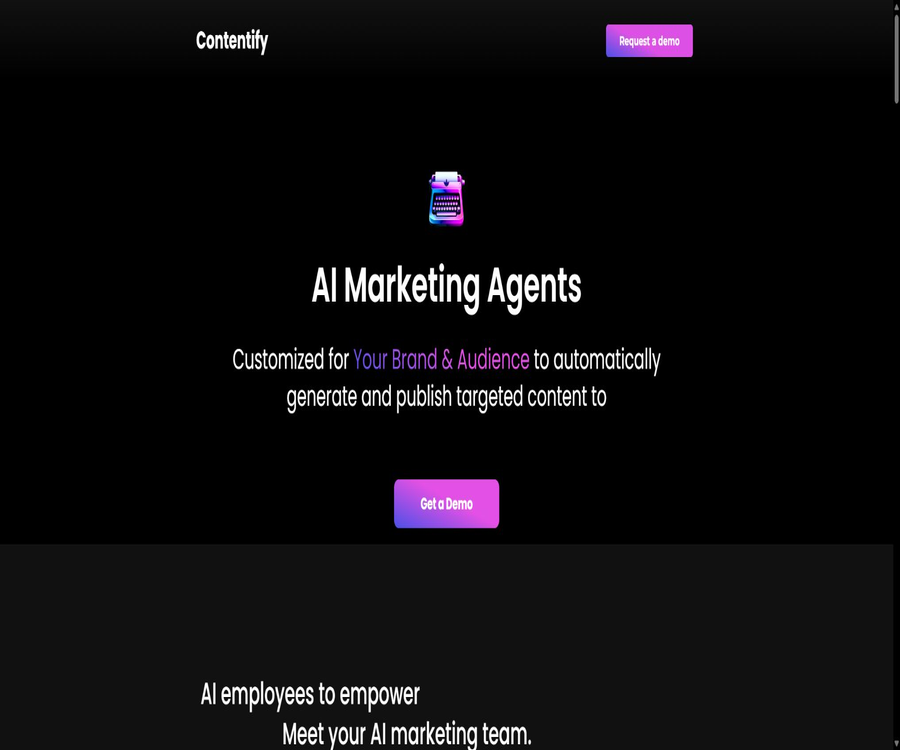
Contentify AI is an AI-powered marketing platform designed for marketers, entrepreneurs, and creators; it can generate visual content, copy, hashtags, and SEO-friendly blog posts based on brand information, and it allows for automated scheduling of these posts with user authorization or waits for manual approval.
Tool Introduction
Contentify AI is operated by Alpha Trait LLC; its focus is not on generating a piece of text once and for all, but rather on creating a continuous marketing workflow that integrates brand assets, content creation, channel integration, review feedback, and scheduling for publication.
The current official website offers Social Media Agents and Blog and SEO Agents; other types of agents are still marked as upcoming. Users should distinguish between predictive functions and the actual modules that are already available for configuration.
Main functions
Social media agents
Social media bots can generate visual content, headline texts, and hashtags based on brand assets, external content, or a specific keyword. Users can have the bots schedule posts automatically, or they can require that each piece of content first go through an approval process.
Blogs and SEO bots
Blog agents are used to create long-form content and optimize it for search; they allow the inclusion of images, summary points, external references, calls to action, related articles, as well as sections dedicated to products or services. Nevertheless, the final article still needs to be reviewed by someone with industry knowledge to verify the facts, ensure the relevance of the links, and maintain consistent brand messaging.
Brand database
Users can add brand kits to ensure that the AI uses consistent visual and textual elements across different types of content. When creating a brand kit, it is necessary to provide accurate product descriptions, target audience information, the desired tone, prohibited words, and compliance guidelines, rather than just uploading a logo.
Channel connection and publishing permissions
Contentify AI enables the connection between websites and social media platforms, allowing for the planning and publication of generated content. Before going live, it is necessary to use the manual approval mode to ensure that account permissions, page selection, and publication time are all correct.
Manual review and feedback loop
The console enables users to review, edit, or reject the generated content, and to use their feedback to adjust subsequent outputs. This mechanism is suitable for setting quality standards within a team, but it cannot guarantee that the system will automatically detect factual errors, copyright issues, or compliance risks related to the industry.
Automated permission configuration
When launching an agent, it is possible to specify skills, objectives, and permissions, and to choose between automatic publication or waiting for approval. It is recommended to restrict high-risk channels, promotional promises, and content related to sensitive industries to being published only after manual confirmation.
| Functional module | Main inputs | Main output | Key controls |
|---|---|---|---|
| Social media agents | Brand assets, external content, or keywords | Visuals, copy, tags, and scheduled posts | Automatic release or manual approval |
| Blogs and SEO bots | Theme, brand information, and content objectives | Blogs, images, summaries, call-to-actions, and related modules | Edit, reject, and provide feedback |
| Brand kit | Brand visual identity, audience, and communication rules | Brand context for cross-content reuse | The team is responsible for ensuring the accuracy of the data. |
| Channel connection | Authorization for websites and social media accounts | Scheduling and published content | Assign publication permissions based on the agent configuration. |
| Developer API | Interface keys and structured requests | Blog components, social media posts, or personalized videos | Called according to the permissions of the development account |
Working principle
- First, create a brand kit by adding in the brand positioning, target audience, tone of voice, product information, and visual assets.
- Connect to the websites or social media platforms that need to be used, and grant only the minimum permissions required to complete the task.
- Select social media or blogs as well as SEO skills for the agent, and set content objectives, frequency, and the actions that are allowed to be carried out.
- Choose between automatic publication or manual approval; manual approval should be used for the first time or for content that poses a high risk.
- Review, edit, or reject the results in the console, and include specific feedback in subsequent iterations of the content.
- By combining channel analysis with observations of performance, brand materials and publishing rules are revised on a regular basis.
Usage tutorial
Create the first social media bot
- After registering or applying for a demo and accessing the workspace, create a brand kit first and check the product facts.
- Connect a test social media account to avoid granting access to all brand channels from the very first time.
- Select social media skills, and fill in the target audience, scope of topics, posting schedule, and content to be excluded.
- Set the publishing method to waiting for approval, and create the first batch of visuals, copy, and tags.
- Check each image for its rights, tone, tags, and promotional claims; make the necessary adjustments before approving its publication.
- After running it for a period of time, assess its performance and use the feedback to adjust the next batch of content.
Creating a blog and the SEO workflow
- Identify a business-related topic and the questions posed by readers, avoiding the use of generic keywords.
- Add context such as products, services, brand tone, target pages, and call-to-actions.
- Select the desired images, key points, external references, relevant content, and product modules.
- After creating a draft, verify the facts, intent of keywords, repeated content, context of citations, and copyright.
- The editor makes adjustments to the structure and wording, after which it is published on the connected website.
- After publishing, monitor search and conversion performance, update outdated information, and improve the next task.
Access developer API
- First, apply for a Contentify developer account and obtain the available API keys from the console.
- Choose from blog components, social media images, sliders, videos, or personalized video features according to the official documentation.
- Use a dedicated key for authentication in the request headers; do not store the key in the web interface or in public repositories.
- First, use test materials to verify the request fields, error responses, content format, and generation time.
- Add permission isolation, usage tracking, failed attempt retries, and manual review to the official system.
- Rotate keys regularly, and revoke access immediately when a member leaves or the integration is discontinued.
Which users are it suitable for
- Marketing team: Bring brand materials, content creation, scheduling, and manual review together within the same workflow.
- Entrepreneurs and small businesses: Continuously prepare social media posts and blog drafts when there is a limited number of staff members.
- Content operators: Create topics, images, summaries, calls to action, and publishing schedules in bulk.
- SEO team: Create initial drafts of blogs focused on search intent, and add internal linking and conversion elements.
- Agent: Configures brand kits, permissions, and approval processes separately for different clients.
- Developers: Use interfaces to integrate blog components, social media content, or personalized videos into their own applications.
Typical use cases
- Prepare a set of social media images, captions, hashtags, and a scheduling plan for different channels in preparation for the launch of the new product.
- Convert the product information into an SEO blog draft that includes a summary, images, and a call to action.
- Establish separate tone and visual guidelines for multiple brands to reduce the risk of reusing content.
- Have the editor review all the content that has been generated first, and then release the approved version through the associated channels.
- Via an interface, marketing applications can be equipped with blog components and the ability to generate social media content.
- Create personalized videos based on the information of users or potential customers, but legal authorization must be obtained first.
Product advantages
- The workflow covers brand materials, content creation, approval, scheduling, and publishing, and is not limited to a single writing task.
- The social media module handles visuals, text, and tags simultaneously, making it easier to maintain the integrity of a piece of content.
- The blog module can combine images, summaries, external references, calls to action, and related content.
- Automatic publishing and manual approval can be selected based on the agent, allowing for a gradual expansion of the level of automation.
- The console allows for editing, rejection, and feedback, enabling the team to continuously refine the brand’s presentation.
- Developer documentation and key authentication are provided, allowing certain generation capabilities to be integrated into other marketing systems.
Usage restrictions and precautions
- The official website does not disclose the fixed prices of the packages, which can be verified directly; therefore, it is necessary to confirm the costs through demonstrations, accounts, or orders before making a purchase.
- The other agents are still shown as upcoming and cannot be considered features that are currently available officially.
- The facts generated by AI, external references, images, and marketing claims require manual verification; the platform does not guarantee that the output will be entirely accurate.
- Automatic release processes amplify the impact of errors; manual approval should be required for first-time use, in regulated industries, and for promotional content.
- Users must have the necessary rights and approvals to upload brand assets, personal information, customer content, and third-party materials.
- The terms of service permit the platform to use customer content and anonymized data to improve AI models, to a certain extent; sensitive data should be uploaded with caution.
- Connecting to websites, social platforms, and video services introduces third-party terms, permissions, and data processing risks.
- Subscriptions, trials, and enterprise orders may be automatically renewed; the cancellation rules and refund policies should be confirmed prior to payment.
Prices and packages
As of August 22, 2026, the official Contentify AI website directs users to log in or request a demonstration; it does not provide any publicly available and verifiable list of fixed pricing plans. The table below outlines the billing methods that can be confirmed from the current official page and terms, without referencing older versions or prices from third parties.
| Purchase method | Current price | Billing or renewal | Core explanation | Suitable for users |
|---|---|---|---|---|
| Marketing Agent Services | Displayed on the account or settlement page | The terms state that subscription can be automatically renewed on a monthly basis. | Specific functions, limits, and amounts need to be confirmed after logging in. | Individuals, creators, and small teams |
| Free trial | Available only when provided by the platform. | Charges may be deducted automatically after the trial period ends. | Cancellation must be completed by the deadline on the last day of the trial period. | Users who wish to verify the process first |
| Corporate orders | Contact sales for a customized quote | It is usually determined in accordance with the terms of the order; prepayment on an annual basis is the default option. | The number of people, usage amount, services, and excess rules are entered into the order. | Agents and corporate teams |
| Developer capabilities | The official party has not disclosed fixed prices for the interfaces. | Subject to the development account or business plan. | An application is required to gain access, and the call quota must be confirmed. | Developers and marketing software teams |
Renewal and Refunds
The general terms for subscriptions state that paid subscriptions are automatically renewed on a monthly basis at the rate indicated on the account or billing page; once canceled, the fee for the unused period is generally not refunded. If a trial version is offered, it may also automatically convert to a paid subscription upon its completion.
The subscription period for corporate orders, the payment methods, options for increasing usage levels, and the conditions for renewal are all specified in the order document. Before signing the contract, it is necessary to ask the sales representative to include details such as the quota, the price per extra unit, data-related terms, procedures for cancellation, and the scope of support in the order.
Supported platforms
| Platform or access method | Support status | Explanation |
|---|---|---|
| Web console | Support | Used for brand kits, agent configuration, review, and feedback |
| Website release | Supports connection | The specific compatibility range must be confirmed in the account or demonstration. |
| Social media channels | Supports connection | It can be scheduled for release or await manual approval. |
| Standalone Windows application | Not verified. | Currently, the web version is primarily used. |
| Standalone macOS application | Not verified. | Currently, the web version is primarily used. |
| iOS and Android apps | No official store app was found. | Do not download unofficial apps with the same name. |
| Developer API | Support | It is necessary to apply for a development account and use an API key. |
| Official SDK | Not verified. | The fact that the document provides examples of multilingual requests does not mean that an SDK has been released. |
APIs, SDKs, and open-source status
Developer API
The official development documentation provides features such as blog components, social media images, sliders, videos, and personalized videos. Authentication is performed using the X-API-Key field, and the documentation includes examples in command line, PHP, Python, and JavaScript.
SDK status
To date, no official independent SDK packages have been identified. The multilingual example calls provided in the documentation merely illustrate how to send requests; they do not indicate that SDKs for those languages are available.
GitHub and the open-source status
The public GitHub account associated with Contentify is maintained by members of Alpha Trait; it offers a database of 100,000 AI prompts under the MIT license. This repository contains only those prompts and related materials, and it is not the source code for the Contentify AI marketing platform.
| object | Whether to make it public | License or status | Correct understanding |
|---|---|---|---|
| Contentify AI platform | Source code not made public | Commercial online services | The product itself is not open-source software. |
| AI prompt library | Public | MIT License | The content of the prompt repository can be used in accordance with the license guidelines. |
| Developer API | Provide documents | Account authorization service | Used to invoke the capabilities of commercial platforms |
| Official SDK | Not verified. | No license could be confirmed. | Code examples cannot be called SDKs. |
Privacy and data security
Data collected and stored
The privacy policy outlines information such as email addresses, phone numbers, website names, website analytics data, website posts, and social media posts. After an account is deleted, the data related to regular accounts may be retained for 90 days; as for data related to requests for revocation or deletion of certain permissions, it is stated that such requests will be processed within 30 days.
Third-party AI and channel services
The privacy policy states that the platform uses OpenAI, Anthropic, Google, as well as services for generating images and videos to process content; it also connects to third-party interfaces such as YouTube. When dealing with data related to customers, employees, or individuals, it is necessary to verify the scope of authorization and the rules regarding third-party data.
Customer content and model improvement
The terms of service grant the platform broad rights to use the customer content, and the enterprise terms allow for the use of aggregated and anonymized customer data to train models for both the company itself and third parties. Enterprise users should confirm in the order and data processing agreements whether restrictions can be placed on such training activities.
Safety measures and user responsibilities
The privacy policy mentions role-based access control and encryption, while the terms and conditions for businesses require the establishment of information security plans. Users are still responsible for managing their account permissions, API keys, authorizations related to social media platforms, and backing up their data.
- Do not upload unnecessary customer identification information, unpublished business data, or sensitive regulated data.
- Assign the minimum permissions to each member and integration, and regularly remove channel connections that are no longer in use.
- Interface keys are stored only in the server-side key management system; they are not allowed to be included in public code repositories.
- Before automatic publication, set rules for manual review, prohibited brand terms, and blocking of sensitive topics.
- After deleting the account or revoking third-party authorization, the request records are retained and confirmation is provided that the data has been deleted.
Basic information
| Project | Content |
|---|---|
| Tool name | Contentify AI |
| Development and operation entities | Alpha Trait LLC |
| Tool type | AI marketing agents, automation of content creation and publication |
| Core module | Social media agents, blogs, and SEO agents |
| Price pattern | No verified fixed price available for subscriptions or corporate custom quotes. |
| Is registration required? | Yes, full functionality requires an account or demo access. |
| Chinese support | The official website and documentation are primarily in English; the quality of Chinese translations needs to be tested in practice. |
| API | Available; a developer account and API key are required. |
| Official SDK | Not verified. |
| Is the product open source? | No; a publicly available prompt library does not equate to an open-source platform. |
| Main platforms | Web console, connected websites and social media channels, developer interfaces |
Recommendation score
The recommendation score is 4.0 points. Contentify AI is suitable for teams that wish to integrate brand materials, social media content, SEO blogs, as well as processes for review and publication into a cohesive workflow; it is particularly appropriate for marketing scenarios where manual approval and automated handling of various channels are important.
The main drawback is that the official website does not provide the current prices of the available packages for direct comparison; other options are still in the preview stage, and the data usage terms require careful examination by enterprise users. Before making a formal purchase, it is necessary to test the functionality, the quality of the Chinese language support, the data limits, and the relevant terms through demonstration channels.
Frequently Asked Questions
Is Contentify AI free?
The official website does not currently list any verifiable permanent free plans. The terms allow the platform to offer free trials under certain circumstances, but whether such trials are available, their duration, and the limits associated with them depend on the information displayed on the account’s actual page.
What is the price of Contentify AI?
The current official website does not display the fixed price of subscription packages in a consistent manner; the price for individual subscriptions should be based on the account or billing page, while for corporate solutions it is necessary to contact sales. Do not consider the prices from previous catalogs or the prices of individually sold e-books and prompt resources as the subscription fees for the platform.
Can it publish content automatically?
Yes. After the user connects via the appropriate channel, it is possible to choose whether to publish the content automatically or to wait for manual approval; for content related to important brands, it is recommended to use manual review first.
What content types does it support?
The capabilities that are currently clearly demonstrated include visual elements and copy for social media, as well as tags; blog content that includes images, summaries, external references, and call-to-actions. More agents are still in the preview stage.
Does Contentify AI offer an API?
Available. The development documentation covers blog components, social media images, sliders, videos, and personalized videos; to access it, a developer account and an API key are required.
Does Contentify AI have an official SDK?
To date, no officially released SDKs have been identified. The documentation provides example requests in various programming languages, but these examples are not equivalent to installable software development packages.
Is Contentify AI an open-source tool?
No. The public AI prompt library is licensed under the MIT license, but the Contentify AI marketing intelligence platform does not have its source code made public.
Can the generated content be used for commercial purposes?
The platform is designed for use in commercial marketing, but users must possess the necessary rights to input materials, personal information, and brand assets, and they are responsible for checking whether the output constitutes infringement or violates the platform’s rules. For corporate projects, the rights to use the resulting content must be confirmed through actual orders and relevant terms.
Will the data be used for model training?
The terms permit the use of customer content, as well as aggregated and anonymized data, within certain limits to improve AI models; third-party model services may also be involved. Teams with strict requirements regarding data isolation should request written confirmation regarding the scope of data exclusion and processing prior to signing the contract.
Is Chinese supported?
The official website does not provide a complete Chinese interface nor any guarantees regarding the quality of the Chinese version. It is possible to test it during the demonstration or trial phase using the actual brand names, appropriate tone, and professional terminology, before deciding whether to use it for creating content in Chinese.
Summary
Contentify AI transforms AI-driven content creation into configurable marketing intelligence processes that cover brand context, social media content, SEO blogs, human feedback, and channel publishing. It is better suited for marketing teams that need to carry out ongoing operations, rather than for users who only need to generate text from time to time.
Before making a choice, it is important to verify the compatibility of the current package and channels, the quality of the Chinese translation, the permissions for automatic publishing, as well as the terms related to data training. It is recommended to start with a single testing channel and manual approval, and to expand the use of automation gradually after confirming the quality and costs.
Tools similar to Contentify AI





 Guigong Network Security Registration No. 45132202000164