






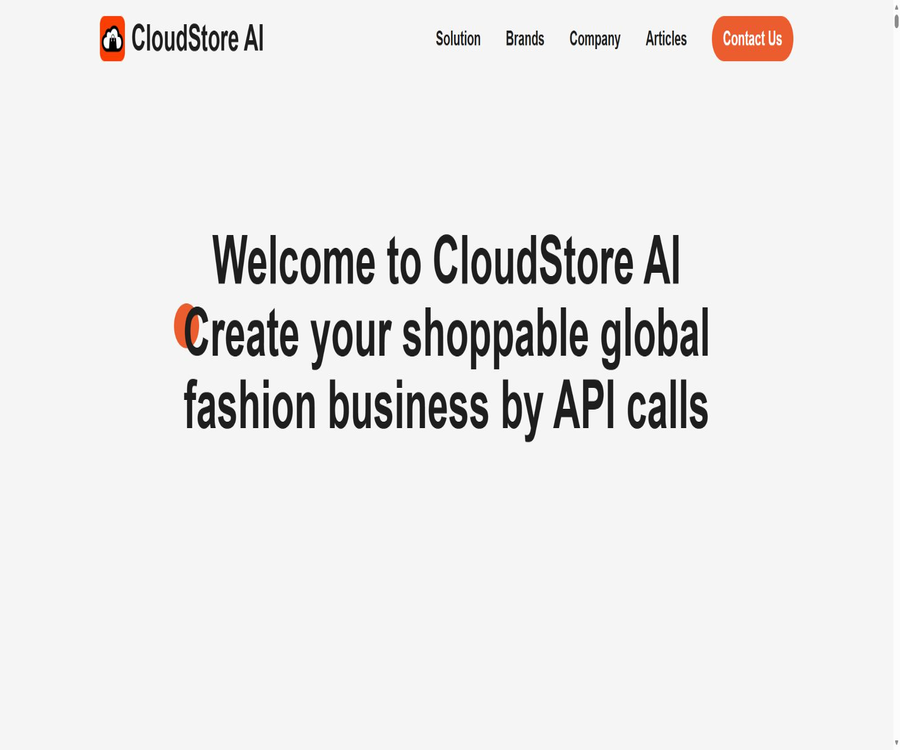
What is CloudStore AI?
CloudStore AI is an infrastructure for cross-border e-commerce and Agentic Commerce, developed by BorderX Lab Inc.; it is designed for AI shopping agents, content platforms, e-commerce markets, merchants, and developers. It integrates functions such as product discovery, real-time inventory information, pricing, shopping carts, checkout processes, order management, and logistics tracking into programmable interfaces.
On some pages, the product is referred to as CloudStore, while its official website uses the domain name NubeStore; as a result, it is easily mistaken for a cloud storage or object storage service. In reality, it focuses on fashion, beauty products, luxury goods, and cross-border transactions, and it does not provide general file storage services.
A one-sentence summary
CloudStore AI enables websites, AI agents, and Shopify stores to access global product catalogs, in-store checkout options, and logistics services, thus expanding the scope from simply displaying products to actual ordering and tracking of deliveries.
Product composition
| Products or services | Primary users | Core competencies | Payment method |
|---|---|---|---|
| CloudStore API | Developers, AI shopping agents, and platforms | Product search, details, shopping cart, placing orders, orders and logistics | Free, Developer, and Enterprise |
| Cloud Store Dropshipping | Shopify merchants | Import products, synchronize inventory prices, handle shipping on behalf of customers, and provide tracking. | Free and three monthly payment plans |
| Catalog API | Content platforms and e-commerce apps | Catalogs of fashion, beauty, and luxury goods, brands, retailers, and categories | Based on API packages and call credits |
| Checkout API | Platforms that require transactions within the platform itself | Cart pricing, payment information, and order creation | Charged based on successful calls |
| Logistics API | Businesses, platforms, and after-sales systems | Order status, package, carrier, and tracking information | By package and API permissions |
| GEO services | Brands and businesses that hope to be discovered by AI | Optimization of product data and visibility of AI recommendations | Contact sales |
| ShopGeni and Price Hunter | Retailers and shopping environments | AI shopping agents, price comparison, discount and price monitoring | Demonstrate or contact sales |
The developer API, Shopify apps, and GEO services are different products within the same ecosystem; their account permissions, pricing, and delivery methods should not be interchangeable. Before making a choice, it is necessary to determine whether what is needed is product supply, transaction interfaces, shipping-as-a-service options, or AI-related visibility services.
Core API capabilities
Catalog API product catalog
According to the official information, the Catalog API provides access to over 20 million SKUs in the categories of fashion, beauty, and luxury goods from merchants based in the United States and Europe. Product details, prices, and inventory levels are updated on a daily basis, and it is possible to search using keywords, categories, brands, merchants, and price ranges.
- Search for products and filter them by brand, seller, category, price, and sorting criteria.
- Read product details, images, colors, sizes, SKU, and available inventory.
- Obtain lists of merchants, brands, and third-level categories.
- Use the encrypted product ID generated for each account to proceed with queries and orders.
- Enterprise or Custom customers can request a batch JSON Lines product feed.
- When only keywords are provided and the number of results is low, the AI semantic search used in testing can be applied automatically.
Checkout API for unified settlement
The Checkout API first creates a shopping cart based on the SKU, quantity, and delivery address, and then returns information regarding taxes, shipping costs, merchant discounts, processing fees, and the total amount due. When placing an order, it is necessary to enter the total amount expected to be paid, in line with the contents of the shopping cart, to avoid errors in deductions due to changes in inventory levels or prices.
- A single order request can only contain products from the same merchant.
- When the shopping cart contains multiple merchants, orders need to be placed separately for each merchant in a grouped manner.
- Regular customers need to provide their bank card and billing information in their request.
- For Enterprise or Custom pre-paid accounts, the bank card field can be omitted as agreed.
- partnerOrderId can be used as an idempotent key to prevent duplicate orders from being created as a result of timeout retries.
- In the event of a timeout, the request should be retried using the same order identifier and exactly the same parameters.
Order and logistics tracking
The order interface allows querying states such as receipt, shipment, delivery, order failure, and merchant issues. After shipment, information on the package, carrier, logistics tracking number, estimated delivery time, and tracking events is also available.
Officials recommend polling unfinished orders every 5 to 10 minutes. In a real production system, it is also necessary to handle situations such as merchants cancelling orders, product shortages, partial deliveries, delays, and ensuring final consistency.
Integration, speed limits, and error handling
The CloudStore API charges based on credits for each successful call; the gateway first checks the balance before deducting fees once the request is successfully processed. The credits granted on a monthly basis are used first, with additional credits purchased serving as a backup.
- A 402 code is returned when the balance is insufficient, and the business request is not forwarded any further.
- A 401 is returned when the token is invalid or the application is disabled.
- A 403 error is returned when the interface is not authorized.
- When the QPS exceeds that of the package, a 429 response is returned along with a suggested waiting time.
- A timeout on the downstream side may result in a 502 response; order requests must use an idempotent identifier to enable safe retries.
- The unit price per interface and the QPS value may change depending on the package selected; it is necessary to check the current figures in the console.
Shopify third-party shipping app
Cloud Store Dropshipping is a dropshipping application provided by BorderX Lab Inc. in the Shopify App Store. Sellers can select SKUs from fashion products offered by suppliers in the United States, add them to their store, and synchronize the prices and inventory levels.
- Select products from over 1,000 popular fashion brands and a large range of SKUs.
- Import products, images, inventory, and product categories into Shopify.
- Synchronize real-time prices and inventory to reduce the risk of selling out-of-stock items.
- Submit the order to the supplier for shipment and receive the logistics tracking information back.
- It covers categories such as clothing and accessories, bags, suitcases, and sports products.
- The user interface and direct support are primarily in English, with no localization in Simplified Chinese.
The cost of the products is not included in any subscription fees for the app; in addition, orders may incur costs related to shipping, taxes, payments, after-sales service, and cross-border delivery. The amount of after-sales support included in a package does not equate to an unconditional refund or to the platform assuming responsibility on behalf of the seller.
Which users are it suitable for
- AI shopping agent developers: Enable agents to extend functionality from recommendations to cart management, payment processing, and order tracking.
- Fashion content platforms: Include purchasable products in articles, communities, or recommendation sections.
- E-commerce markets and shopping guide websites: Provide access to real-time catalogs from multiple merchants as well as a unified transaction process.
- Shopify merchants: They can offer US fashion products for dropshipping without having to establish their own supply chain.
- Brands and retailers: optimizing product catalogs and entering the realms of AI-driven search and shopping assistants.
- Cross-border e-commerce team: Unified interfaces for products, checkout, orders, and logistics tracking.
- Developer Platform: For teams that need a sandbox, Bearer Tokens, billing per call, and idempotent orders.
Typical use cases
- The AI assistant searches for products based on budget, brand, and size, and creates an order once the user confirms it.
- Fashion media platforms handle product discovery, the shopping cart, and checkout processes on their own pages, thereby reducing the need for page transitions.
- New Shopify stores import a small number of SKUs from their product catalog to test the ordering and delivery processes.
- Cross-border platforms display real-time inventory by brand or merchant, and track packages from shipment to delivery.
- Businesses monitor the prices of popular SKU items, determine appropriate promotional strategies, and make decisions regarding inventory levels.
- The brand organizes structured product data to improve its visibility in AI-generated answers and shopping agents.
- Companies use bulk feeds to synchronize large-scale directories and manage orders through pre-funded accounts.
API Integration Tutorial
Apply for a test key
- In the API documentation, select the option to request a test key and enter your work email address to which you want to receive emails.
- Use the sandbox key from the email, or create a proper API Key after registering in the console.
- Save the Bearer Token, which is displayed only once, and do not include it in the frontend code or in public repositories.
- First, call the merchant list to verify authentication, the network connection, and the response format.
- Use test data in the sandbox to test products, shopping carts, ordering processes, and status queries.
Complete the first test order
- Search for the desired product and retrieve the encrypted product ID corresponding to the current account from the results.
- Read the product details and select the available SKUs, colors, sizes, and inventory levels.
- Submit the delivery address and add items to the shopping cart; the cost details are recorded by merchant.
- Use the total amount returned from the shopping cart as the expected total amount in the order request.
- Create a globally unique partnerOrderId for the order, and save the complete request body.
- Submit a test order, then check the order status at the recommended intervals.
- Simulate exceptions such as timeout retries, out of stock, insufficient balance, and merchant cancellation.
Production launch inspection
- Verify the interface package, QPS, monthly points, price per call, and top-up balance.
- Store the API Token in the server’s secret management system and establish a process for its rotation.
- Apply minimal data collection and access controls to bank card details, addresses, phone numbers, and order information.
- Split orders by merchant, and implement idempotency, timeout retry, and reconciliation for the ordering interface.
- Establish processes for order creation, shipping, cancellation, refunds, returns, and customer inquiries.
- Record the request ID, order identifier, and response, but do not save the full card number in the regular logs.
- Conduct reviews regarding security, privacy, taxation, payments, and consumer protection before handling actual traffic.
Shopify installation guide
- Verify that the Shopify store meets the application compatibility requirements, and back up existing products and themes.
- Install Cloud Store Dropshipping from the Shopify App Store and review the permissions.
- Start by using the free plan and select a small number of SKUs from the available product catalog.
- Check the product title, images, description, price, profit margin, inventory level, and shipping location.
- Import the selected products into the store, and set the taxes, shipping costs, return policies, and customer notifications.
- Use test orders to verify the supplier’s capabilities in receiving orders, processing payments, shipping goods, and providing feedback on logistics.
- Confirm the after-sales responsibilities and total cost before upgrading the package and increasing the number of items.
Developer API pricing
The following are the CloudStore API packages as verified on August 21, 2026. The monthly fee and the free credits offered on a monthly basis are not the same thing; API usage consumes credits at the real-time price per successful call.
| Package | Monthly fee | Points are given free of charge every month. | Interface scope | Support and suitability for users |
|---|---|---|---|---|
| Free | $0 | $2 | 3 core interfaces: product details, discovery, and checkout | Email support; prototype and low-frequency testing |
| Developer | $ | $50 | All interfaces are publicly available; the cost per call is approximately one-fifth of that of Free. | 24/7 email support, free shipping tracking; production and development |
| Enterprise | Custom quote | In accordance with the contract | Custom orders, usage volumes, bulk product feeds, pre-paid accounts, etc. | Bulk discounts, account managers, priority support, and FDE |
Free can be started right away; the console also allows users to purchase additional credits. The credits that have been purchased do not become invalid as a result of a downgrade, while the credits offered on a monthly basis change along with the billing cycle and package updates.
Upgrades, downgrades, and refunds
The upgrade to Developer status at no cost takes effect immediately after payment, and a new billing cycle along with monthly points begin on the date of the upgrade. Downgrading becomes effective at the end of the current cycle, during which time the original plan remains available.
The console clearly indicates that no refunds are available for the current billing cycle. The pricing for Enterprise plans, SLAs, implementation services, revenue sharing, and custom interfaces are subject to the contract signed by both parties.
Shopify app prices
The following are the dollar prices displayed in the Shopify App Store; periodic fees and usage-based fees are settled every 30 days. The costs associated with purchasing products are not included in the subscription fee.
| Package | Price | Integrable products | Optional product catalog | After-sales and support |
|---|---|---|---|---|
| Free | $0 | Up to 100 items | Over 1,000 products | Basic usage |
| Basic | $ | Up to 1000 pieces | Over 5,000 products | Standard application support |
| Standard | $ | Up to 5,000 pieces | Over 10,000 products | Paid after-sales service is available. |
| Advanced | $ | No restrictions | The entire product catalog | Free after-sales support and one-on-one VIP service for 10 orders |
In addition to the subscription fee for the application, costs related to procurement, shipping, taxes, payments, refunds, returns, and advertising must also be taken into account. The specific regions where each package is available, the supplier’s terms, and any post-order fees should be checked in the backend setup area.
API endpoints and plan restrictions
| Ability | Public API | Important restrictions |
|---|---|---|
| Product search | Discover | AI semantic search is still marked as Beta; it is limited by pagination and QPS. |
| Product details | Products | The product ID is encrypted based on the account information, and it must come from the search results. |
| Merchants, brands, and categories | Merchants, Brands, Categories | The list may be paginated or hierarchical. |
| Cart pricing | Cart | It must be called before placing an order, and the total amount available in real time should be used. |
| Place an order | Orders | Only one merchant per transaction; regular customers need to provide card details. |
| Order status and logistics | Order Status | It is recommended to perform polling every 5 to 10 minutes; handle abnormal states. |
| Batch product Feed | Feeds | Only Enterprise or Custom |
| Prepaid balance | Debit Account | Only Enterprise or Custom |
| sandbox | Testing environment | Free call and test data do not reflect actual transactions. |
Transaction responsibilities and after-sales service
The terms of CloudStore AI define the actual seller as the Merchant of Record; the seller is responsible for the supply of goods, their quality, compliance, shipping, delivery, and providing any statutory consumer guarantees. CloudStore AI is not the seller or reseller mentioned in the underlying purchase contract.
Developers and businesses that integrate with APIs are responsible for handling communications with end customers, as well as dealing with returns, cancellations, refunds, and disputes. Determining, collecting, and reporting sales tax, usage fees, value-added tax, and customs duties also falls under the responsibility of these businesses or developers.
- Clearly show consumers the actual seller, price, shipping costs, taxes, and estimated delivery time.
- Obtain the user’s explicit approval for the product, total amount, address, and payment method before making the payment.
- Save the merchant, SKU, cart total, and idempotency identifier for each order.
- Establish a return address, deadlines for refunds, procedures for handling cases where the merchant refuses to process returns, and situations of lost shipments.
- Do not assume that the ability to place orders through the platform’s API means that the platform takes on the responsibilities toward consumers on behalf of the merchants.
- For cross-border operations, it is necessary to take into account product restrictions, customs regulations, tax requirements, and local consumer protection rules.
Product advantages
- A complete API chain is established, ranging from catalogs and real-time SKUs to shopping carts, orders, and logistics.
- Over 20 million SKUs cover the categories of fashion, beauty products, and luxury goods.
- The Checkout API allows transactions to be completed within the existing interface, reducing the need for external redirects.
- Sandbox environments, bilingual OpenAPI documentation, and test keys lower the barriers to getting started.
- Points are deducted upon a successful call; no charge is applied in cases of failure, exceptions, or timeouts.
- Order idempotency and clear error codes are essential for building reliable transaction systems.
- It offers both APIs and Shopify apps, catering to developers as well as code-free merchants.
- The Free API and the free Shopify plan allow for the verification of the catalog and business processes first.
Usage restrictions and precautions
- Product prices and inventory levels are updated daily, but this does not mean they are always up to date every time they are displayed.
- AI semantic search is still in beta version; the sorting and retrieval of results may change.
- A single order can only include one merchant; shopping carts with multiple merchants require separate orders.
- When placing an order through a regular API, it is necessary to handle the card number, security code, and address, and high standards are required in terms of security and compliance.
- CloudStore AI is not the actual seller; developers are still responsible for communicating with customers and handling after-sales matters.
- The Free API comes with only 2 dollars worth of monthly credits, so the available data volume for production use may be exhausted quite quickly.
- The monthly fee for developers includes 50 dollars worth of credits, but additional calls and the cost of products are charged separately.
- The monthly fee for the Shopify app does not include the cost of products, shipping fees, taxes, or payment charges.
- The official figures regarding scale and transaction volumes are disclosed by the platform itself, and should be verified as part of the due diligence process.
- The MCP server and SDK are mentioned in legal definitions, but no complete public access documentation has been found.
- No official open-source repository was found; therefore, the CloudStore project with the same name cannot be considered this product.
- The application accesses highly sensitive store data such as customers, products, orders, shipments, and backend files.
Privacy and data security
The data listed in the current API terms includes account and registration information, product and shopping cart metadata, delivery addresses, anonymized payment tokens, order numbers, IP addresses, User-Agent strings, response times, session tokens, and cookies. This data is retained only for as long as it is necessary to fulfill contractual and legal obligations as well as for legitimate business purposes; there is no fixed duration specified for its retention.
The terms prohibit the use of user prompts, transaction data, addresses, payment tokens, and order history for training, retraining, or fine-tuning public foundational large models. The platform states that it does not sell personal data, nor does it use it for behavior-based advertising across different contexts.
- Payment information may be sent to payment processors, card organizations, or the settlement systems of the merchant in question.
- The platform does not control the payment pages, security measures, or independent data retention practices of third-party merchants.
- The Shopify app also allows access to customer names, email addresses, phone numbers, addresses, device information, and activity data.
- The application allows for editing of products, inventory, product lines, orders, shipments, and backend files.
- The old Shopify privacy policy mentioned targeted advertising, while the current API terms state that cross-context advertising is not allowed.
- The products and time periods associated with the two policies are different; companies should request confirmation of the current applicable version.
- The API Token is displayed only once; the server should store only its hash or keep it in a secret manager.
- Logs must conceal bank card details, security codes, addresses, phone numbers, tokens, and session information.
- The party initiating the connection must obtain the payment authorization from the end-user as well as the necessary privacy disclosures.
- Before official launch, it is necessary to verify the PCI DSS responsibilities, data locations, sub-processors, as well as procedures for data deletion and incident response.
Secure Access Checklist
- Distinguish between sandbox and production tokens, and use different keys for each environment.
- Order and payment information are submitted only on the server, so that the Token is not exposed in the browser.
- Use secret management, least privilege, token rotation, and access logs.
- Encrypt, mask, and apply minimum retention to payment, address, and order fields.
- Verify that the partnerOrderId exhibits idempotent behavior, and that retries due to timeouts do not result in duplicate charges.
- Sign a data processing agreement and define the data responsibilities of the merchant, payment provider, and logistics provider.
- Regularly revoke unused applications, keys, Shopify permissions, and employee accounts.
API, SDK, MCP, and open-source status
CloudStore AI offers public OpenAPI 3.1 documentation, references in both English and Chinese, as well as sandbox and Bearer Token authentication. The production environment is separated from the sandbox environment, and developers can connect to it using standard network requests and JSON.
The terms of service mention SDKs, MCP servers, and developer tools, but as of the time of verification, no publicly available SDK downloads, MCP configuration tutorials, or official GitHub repositories could be found. The fact that the API is made public does not mean that the source code of the platform is also available; CloudStore AI should therefore be considered a commercial, closed-source service.
| Developer capabilities | Current status | Explanation |
|---|---|---|
| REST API | Yes | Products, checkout, orders, logistics, and account interfaces |
| OpenAPI documentation | Yes | 3.1 Standards: supports English and Chinese. |
| sandbox | Yes | Test keys, free calls, and test data |
| Authentication | Bearer Token | The token starts with csgw_ and is displayed only once. |
| SDK | The terms state that no public downloads were found. | Do not mark it as having an official SDK available. |
| MCP | The terms state that no public configuration documents were found. | Companies can confirm the scope of availability to sales teams. |
| Official GitHub | No findings were detected. | The warehouse with the same name has no reliable connection to this product. |
| Is it open source? | No | The fact that API documentation is made public does not mean that the backend source code is open-source. |
Supported platforms
| Platform or method | Support status | Explanation |
|---|---|---|
| Website and developer console | Support | Account, key, points, package, and payment management |
| REST API | Support | Any server environment that is capable of sending encrypted network requests and JSON data. |
| Shopify | Official app | Product import, synchronization, consignment shipping, and logistics |
| WooCommerce | The official website states that it is possible to connect. | The integration process usually takes between 7 and 14 days; the exact time depends on specific circumstances. |
| Custom directories or REST systems | Supports project integration | Field mapping and collaboration for deployment are required. |
| AI shopping agent | Support | Product discovery, shopping cart, ordering, and tracking |
| Content and shopping guidance platforms | Support | Add products and transactions to the existing interface. |
| Native iOS and Android apps | No findings were detected. | It’s mainly the API and the Shopify backend. |
| Chinese | The API documentation supports Chinese. | The Shopify app does not have a Simplified Chinese interface. |
Basic information
| field | Content |
|---|---|
| Tool name | CloudStore AI |
| abbreviation | CloudStore, Cloud Store |
| Operating company | BorderX Lab Inc. |
| Company location | Sunnyvale, California, United States |
| Tool type | Agentic Commerce, cross-border products, payment, and logistics APIs |
| Main Directory | Fashion, beauty, and luxury goods |
| Public SKU scale | Over 20 million |
| Coverage of publicly available merchants | Over 400 businesses in the United States and Europe |
| API pricing model | Free points, monthly Developer plans, based on successful calls and enterprise customization |
| Shopify pricing model | Free, $19.99, $49.99, and $199.99 per month |
| Main platforms | Web console, REST API, and Shopify |
| API documentation language | English and Chinese |
| Public API | Yes |
| Official SDK | No public downloads were found. |
| MCP | The terms state that no public configuration was found. |
| Official GitHub | No findings were detected. |
| Is it open source? | No |
| The Shopify app has been launched. | July 4, 2025 |
Recommendation score
It receives a rating of 4.3 out of 5 points. CloudStore AI uniquely combines large-scale fashion catalogs, shopping carts, actual ordering processes, and logistics tracking within a single API, and it also offers a sandbox environment, free credits, and Shopify integrations.
The main shortcomings are the complexity of payment and after-sales support, the lack of transparency regarding the price per API call as well as the scope of functionality provided by MCP and SDKs, and the need to verify platform-related data through procurement processes. It is suitable for teams that possess capabilities in terms of transactions, security, and compliance, but it is not appropriate for individuals who merely want to create simple online store pages quickly.
Frequently Asked Questions
Is CloudStore AI a cloud storage service?
No. It is a platform for product catalogs, checkout processes, orders, and logistics services, designed for cross-border e-commerce businesses, AI-based shopping agents, and Shopify merchants; it does not offer general file storage or object storage services.
Is CloudStore AI free?
The API offers a free plan that provides 2 dollars worth of call credits per month; the Shopify app also has a free plan that allows for the integration of 100 products. These are two separate products with different quotas.
How much is the Developer package?
The Developer version of the CloudStore API costs $99 per month; it includes 50 credits per month, access to all interfaces, and a lower fee per individual call. Additional calls, as well as fees related to products and third-party services, may still be charged separately.
What is the minimum payment amount for a Shopify app?
The Basic plan costs $19.99 per month; it allows for the integration of 1,000 products, with options available among more than 5,000 different products. The cost of purchasing these products is not included in the monthly fee.
Which products are supported?
The core catalog includes fashion, beauty, and luxury SKUs from merchants in the United States and Europe. Specific brands, regions, inventory levels, and sales rights are subject to the real-time interfaces and contracts in place.
Can an API place orders directly?
Yes, it is possible to first create a shopping cart to calculate the total amount in real time, and then submit orders for the same merchant. Regular customers need to fill in the information related to their bank cards, while corporate pre-paid accounts can follow different procedures as specified in the contract.
Can items from multiple merchants be included in one order?
No. The shopping cart can refer to multiple merchant groups, but a single order request can only include one merchant; orders must be submitted separately.
Who is responsible for returns and refunds?
The actual sellers are responsible for the products as well as for any legal guarantees; the developers or merchants who integrate the service must handle customer inquiries, returns, cancellations, and refunds. CloudStore AI is not the seller in the underlying transactions.
Is a testing environment provided?
Sandbox environments and test API keys are provided; test data is available, and calls can be made free of charge. Before going live in production, it is still necessary to obtain official tokens, set up scoring systems, and complete security reviews.
Are SDKs or MCPs available?
The legal provisions mention SDKs and MCP servers, but no complete public download or configuration documents are available. Teams that need these capabilities should consult the platform to determine the scope of availability and the contractual terms.
Is CloudStore AI open source?
It is not open source; no official GitHub repository or open-source license has been found. The availability of public APIs and OpenAPI specifications merely indicates that integration is possible, but it does not mean that the platform’s backend is accessible.
Will the platform use order data to train public large models?
The current API terms explicitly prohibit the use of user prompts, transactions, addresses, payment tokens, and order history for training public foundational large models. It is still necessary to confirm the enterprise contract, sub-processors, and specific retention periods.
Summary
The core value of CloudStore AI lies in connecting global product supplies with actual transaction interfaces, enabling AI agents, content platforms, and Shopify merchants to not only recommend products but also handle orders and provide tracking. Both API and application approaches are available to accommodate teams with different technical capabilities.
Before making a choice, it is necessary to calculate separately the monthly API fee, call credits, products, payment costs, logistics expenses, taxes, and after-sales costs. When automatic billing is involved, payment security, user authorization, order idempotency, merchant responsibilities, and privacy management must be addressed before expanding the scale of operations.
Tools similar to CloudStore





 Guigong Network Security Registration No. 45132202000164