






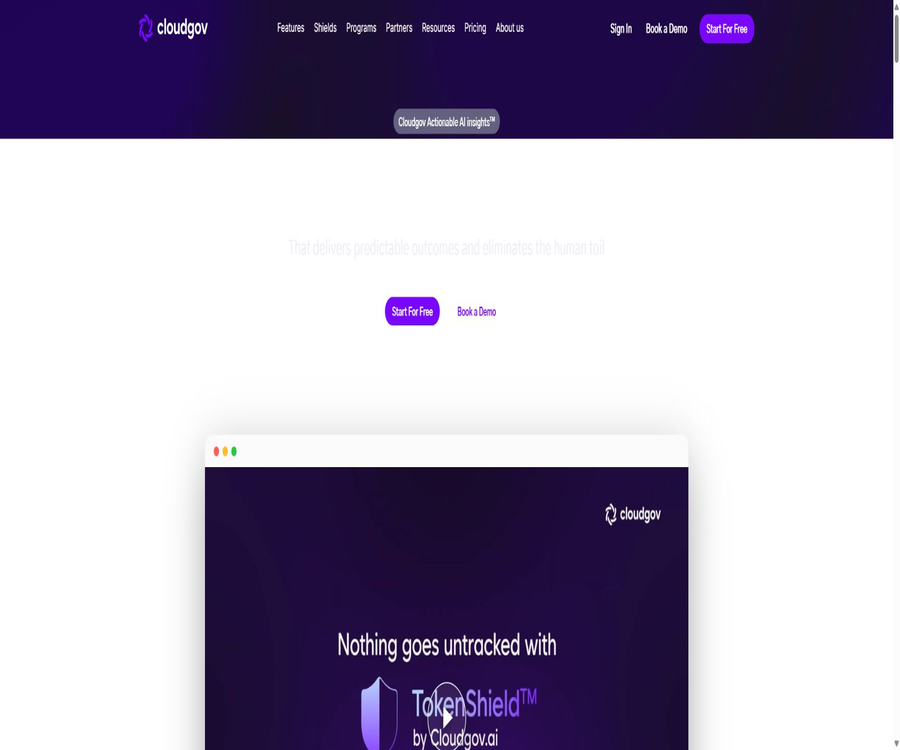
What is Cloudgov.ai?
Cloudgov.ai is a multi-cloud FinOps platform provided by Cloudgov Inc., designed to consolidate costs associated with various cloud providers, containers, data platforms, and large-model services under a single governance interface. It is intended for engineers, finance teams, cloud operations staff, and management, helping them identify waste, explain changes in costs, and turn optimization suggestions into actionable tasks.
The platform is positioned as a product based on Agentic AI, with an emphasis on continuous analysis, anomaly detection, cost forecasting, resource optimization, and automated governance. It is not a cloud service provider, nor is it an infrastructure platform for deploying ordinary websites and applications.
Distinguishing services with the same name
Cloudgov.ai is not the same product as cloud.gov, which is used by the U.S. federal government. The latter is a cloud application platform maintained by the government’s digital services team; its official GitHub repository and open-source code cannot be considered as the source code for Cloudgov.ai.
When searching for information, on GitHub, or for procurement details, it is necessary to pay attention to terms such as Cloudgov Inc., FinOps, the six types of Shield, and multi-cloud cost governance. Similarities in capitalization, hyphens, or top-level domain names in the names of various products do not indicate any connection between them.
A one-sentence summary
Cloudgov.ai accesses multi-cloud billing and resource metadata via read-only means, and continuously generates recommendations for cost allocation, identification of anomalies, forecasting, and optimization. It also connects the engineering execution process through Jira tasks, Slack alerts, and IaC fixes.
Main functions
Observable multi-cloud costs
The platform presents different accounts, cloud service providers, regions, and cost categories in a unified view, allowing users to view historical trends, current expenditures, and future forecasts. Teams can determine where the costs fall within the organization by department, project, product, or business unit, rather than relying on just one overall bill.
- Aggregates cost and resource information from environments such as AWS, Microsoft Azure, and Google Cloud.
- Filter costs by computing, storage, network, security, region, account, and business tags.
- Compare periodic changes on a daily, weekly, monthly basis, and identify cost items that are experiencing continuous growth.
- Use Cloudgov Lens to allocate shared costs to teams, projects, or business units.
- Budget forecasts and expected cost baselines are established based on historical spending patterns.
- Use the FOCUS 1.1 format to standardize the billing fields and criteria of different providers.
AI-driven savings suggestions
The system analyzes resources that are idle, underutilized, or over-allocated, and provides recommendations such as rights adjustments, shutdown periods, and discount offers. These recommendations should be considered in light of performance, availability, and business timelines, rather than being implemented solely based on potential cost savings.
- Identify computing, storage, and other resources that are idle for long periods or have a low utilization rate.
- Suggestions are made regarding adjustments to instance specifications and the scheduled start/stop of non-production environments.
- Analyze committed solutions such as Reserved Instances and Savings Plans.
- Estimate the potential costs affected and organize the tasks according to priority.
- Continuously monitor the optimized expenditures to determine whether any new cost variations have occurred.
Anomaly detection and cost impact analysis
Anomaly detection compares the current costs with historical trends and expected baselines, identifying items that show a sudden increase or deviate from the normal pattern. Alerts not only indicate these changes but also provide information on the impact on accounts, services, and costs, helping teams determine the order in which to take action.
Jira, Slack, and IaC fixes
Insights and anomalies can be converted into Jira tickets, or alerts can be sent via Slack. The platform also generates code snippets for infrastructure as code, enabling engineers to apply these suggestions after code review, testing, and approval.
Cloudgov.ai currently emphasizes read-only and non-transactional access, which is not contradictory to IaC repairs. The system provides suggestions, templates, and workflows; whether to make changes to the customer’s cloud environment is determined by the customer’s approval and deployment processes.
Unit economics and label governance
The unit economic function links cloud expenditures to customers, transactions, workloads, or other business units, enabling teams to see how much infrastructure cost is associated with each business outcome. Tag management is used to identify missing, inconsistent, or unassigned resources, thereby improving Showback and Chargeback processes.
Six categories of Shield governance capabilities
Cloudgov.ai organizes its current capabilities into six categories known as Shield, and it uses a control plane to handle matters related to billing, support contracts, multi-cloud environments, AI tokens, containers, and cloud commitments. Different Shield categories may require separate evaluation, contracting, or configuration; not all options are available by default.
| module | Primary objects of governance | Typical effect | It is necessary to confirm before making a purchase. |
|---|---|---|---|
| BillingShield | Cloud and AI billing | Centralized management of billing relationships, payment terms, and fees | Supported suppliers, discount terms, and contractual responsibilities |
| SupportShield | Cloud support and enterprise agreements | Check whether the support level and contractual costs match the requirements. | Contract scope and renewal terms that can be optimized |
| MulticloudShield | Cloud costs and policies | Unified visualization, allocation, anomaly detection, recommendations, and governance | Cloud service providers, account structure, and functional boundaries |
| TokenShield | Large model invocation and token costs | Unified AI gateway, budgeting, access control, PII masking, and safeguards | Model providers, latency, logging, and data processing |
| ContainerShield | Kubernetes and container costs | Understand resource costs by cluster, namespace, workload, and team. | Collection methods, allocation criteria, and cluster overhead |
| CommitmentShield | Reservations, commitments, and discounts | Analysis for on-demand and committed usage, to assist in managing coverage and utilization rates. | Purchase permissions, risk boundaries, and financial approval |
How does TokenShield manage AI costs?
TokenShield enables centralized management of calls to various model providers through an enterprise AI gateway; it allows users to view token costs by team, application, or model, and to set budget limits and access rules. The ecosystem partners listed by the company include OpenAI, Anthropic, Gemini, Amazon Bedrock, Azure OpenAI, and Vertex AI, among others.
- Uniformly track token consumption and costs for different models and applications.
- Set limits, budgets, and access controls for teams, projects, or models.
- Apply PII masking and content safeguards in the request pipeline.
- Reduce the fragmentation resulting from various teams managing keys, bills, and model policies separately.
- When comparing model costs, quality, latency, and context length are all taken into account.
How does ContainerShield understand container costs?
ContainerShield is designed for Kubernetes and containerized workloads; it allows the costs associated with the underlying nodes to be allocated further among clusters, namespaces, workloads, or teams. It is suitable for addressing issues such as unclear ownership of resources within shared clusters, as well as mismatches between reserved capacity and actual usage.
Complete workflow
- Confirm the cloud service provider, account, billing organization, cluster, data platform, and AI model supplier that need to be managed.
- To pilot this approach, use read-only roles or configure connections according to the official documentation, in order to avoid granting unnecessary write permissions.
- Wait for the billing statements, resource metadata, and historical records to be synchronized, then check whether the account details and the total amount due are complete.
- Set allocation rules for departments, projects, products, environments, and responsibility teams.
- Configure budget, anomaly thresholds, Slack notifications, Jira projects, and approval owners.
- Review the facts behind AI recommendations, estimation savings, performance impacts, and business risks.
- The approved recommendations will be converted into IaC changes; after verification in the testing environment, they will be deployed following the release process.
- Continuously compare cost savings, abnormal response times, commitment utilization rates, and unit economic indicators.
Getting started guide
Connect to the first cloud account
- Create an organizational account and select a trial or Starter plan that corresponds to the actual scale.
- On the connection page, select the cloud service provider and review the current permissions and data collection scope.
- Create the read-only roles required by the authorities or cross-account connections within the customer’s cloud environment.
- The platform is contacted to verify the connection status, as well as to check the account details, region, and billing cycle.
- First, use a non-production account to check the synchronization results, and then gradually add production accounts.
Establish a process for handling abnormal costs
- Establish a baseline based on historical normal expenditures, and set budgets and sensitivity levels for critical services.
- Send the alert to the relevant team’s Slack channel or Jira project.
- The ticket should include information on the account, service, region, start time, and estimated cost impact.
- Engineers determine whether it is due to business growth, price changes, configuration errors, or security incidents.
- After processing, record the root cause, the actual savings, and the governance rules to prevent recurrence.
Recommendations for secure IaC applications
- Read the recommended resources, utilization rates, costs, and assumptions.
- Have the business owner confirm the downtime window, performance targets, and recovery requirements.
- Place the generated IaC snippets in the version control repository for review by engineers.
- First, run planning, policy, and security checks, then deploy in the testing environment.
- Production release is only undertaken after verifying performance, costs, and stability.
- Retain the rollback plan and monitor costs and service metrics after going live.
Which users are it suitable for
- FinOps team: unifies multi-cloud billing, establishes allocation rules, and tracks savings achieved.
- Cloud platform and SRE team: Identify resource waste, anomalies, and configuration drift.
- Engineering team: It is recommended to incorporate cost considerations into the existing development process using Jira and IaC.
- Finance team: View budgets, forecasts, Showback, Chargeback, and unit economics.
- AI Platform Team: Centralizes the management of token costs and access policies for various model providers.
- Kubernetes team: Distribute the costs associated with shared clusters among namespaces, workloads, and responsible parties.
- Large and medium-sized enterprises that use multiple cloud service providers: standardize cost metrics and governance rules.
- Organizations that need to acquire SaaS solutions through AWS Marketplace: they enter into contracts based on their annual cloud spending levels.
Typical use cases
- At the end of the month, an increase in cloud billing was noticed, but the team was unable to quickly identify the specific accounts and services responsible for it.
- The tagging criteria in multi-cloud environments vary, which makes it impossible for the finance department to allocate costs by product or department.
- Development and testing resources run continuously at night and on weekends, so it is necessary to establish a schedule for starting and stopping them.
- There is a persistent imbalance between the coverage and utilization rates of Reserved Instances or Savings Plans.
- Shared Kubernetes clusters lack workload-level costs and clear assignment of team responsibilities.
- Multiple business teams use different large models, which results in a lack of unified management regarding token costs and key permissions.
- Abnormal costs require automatic notification and must be entered into Jira for processing and review.
- Management wishes to convert infrastructure costs into the unit cost per customer, per transaction, or per product.
Product advantages
- It covers the costs related to multi-cloud, containers, data platforms, and AI tokens, without being limited to a single cloud provider.
- FOCUS 1.1 helps to standardize the fields and analysis methods across different billing channels.
- Exceptions, cost-saving suggestions, Jira tasks, and IaC solutions form a workflow that goes from discovery to execution.
- The read-only access principle reduces the risk of the platform having the ability to directly modify production resources.
- It supports cost allocation and unit economic analysis by team, project, and business unit.
- The official website offers a free version for small-scale use, and annual contracts can also be purchased through AWS Marketplace.
- TokenShield extends traditional cloud FinOps to the rapidly growing costs associated with generative AI.
Usage restrictions and precautions
- AI recommendations rely on the quality of bills, tags, monitoring data, and resource metadata; incorrect attribution can affect the outcomes.
- The savings percentages and return on investment mentioned on the official website are marketing estimates and should not be considered as guaranteed results for each customer.
- Adjusting instances, shutting down resources, or purchasing long-term commitments can all affect performance and financial flexibility.
- IaC repair snippets still require code review, policy checks, testing, and manual approval.
- Pricing is linked to annual cloud expenses; as the scale increases, the cost of purchasing software rises accordingly.
- The official website does not specify a unified public subscription price for the Pro, Business, and Enterprise versions; a quote is required.
- AWS Marketplace uses a separate annual contract price, which cannot be directly equated to the pricing offered on the official website.
- The pricing page lists API Access, but no public interface specifications, self-service keys, or call limits are available.
- The specific packages, scope of implementation, and additional costs for the six categories of Shield need to be specified in the contract.
- The public page does not provide sufficient evidence to show that SOC 2 or ISO 27001 certification has been obtained.
- Cloud cost metadata can reveal account details, projects, resources, and the business structure, and should therefore be treated as sensitive information.
- Cloudgov.ai has no connection to cloud.gov; its documents, GitHub repository, or security statements cannot be used in conjunction with those of cloud.gov.
Official website prices and packages
The following shows the package structure available on the official website as of August 21, 2026. The Starter plan is clearly a free option; the Pro, Business, and Enterprise plans offer a 14-day free trial, but the official website does not disclose the uniform subscription costs for these three higher-tier plans.
| Package | Public price | Track annual cloud spending | Data retention | Suitable for users |
|---|---|---|---|---|
| Starter | Free | Up to $25,000 | 1 year | Small-scale environment and initial assessment |
| Pro | 14-day free trial, official price available upon request | Up to 1,000,000 dollars | 2 years | Growth team and multi-account management |
| Business | 14-day free trial, official price available upon request | Up to 10,000,000 dollars | 3 years | Medium to large multi-cloud organizations |
| Enterprise | 14-day free trial, customized quote available | Over 10,000,000 dollars | Over 5 years | Large enterprises and complex governance |
The comparison on the official website also lists features such as unlimited connected accounts, cost browsers, Cloudgov Lens, anomaly detection, Jira, IaC repair, FOCUS data, SSO, role-based permissions, and API access. It is not always clear in which tier each of these functions is available; therefore, a written list of the available functions should be obtained before signing a contract.
Free trial and ROI presentation
Starter can be registered for free, while the other three tiers offer a 14-day free trial. Whether a payment method is required for the trial, whether it automatically switches to a paid version upon expiration, the amount of data that can be connected, and the procedures for deletion are all subject to the information provided on the registration and contract pages.
The price page shows an estimated monthly return on investment of around 30% or 40%, while the home page uses figures such as savings of 20% to 30%. These numbers are estimates provided by the platform or marketing targets, and they are not fixed commitments for a specific cloud environment.
AWS Marketplace contract price
Cloudgov Inc. also offers 12-month SaaS contracts on the AWS Marketplace, with pricing based on an annual cloud spending limit set by the platform. The contract prices, the no-refund policy, and the rules regarding additional charges for exceeding that limit are different from those listed on the official website under the Starter, Pro, Business, and Enterprise plans.
| Annual cloud spending limit | Contract price for 12 months | Connect account | Excess rule |
|---|---|---|---|
| 50,000 dollars | $ | No restrictions | Additional fees are charged when exceeding the limit. |
| 100,000 dollars | $ | No restrictions | Additional fees are charged when exceeding the limit. |
| 250,000 dollars | $ | No restrictions | Additional fees are charged when exceeding the limit. |
| 1,000,000 dollars | $ | No restrictions | Additional fees are charged when exceeding the limit. |
| 3,000,000 dollars | $ | No restrictions | Additional fees are charged when exceeding the limit. |
| 6,000,000 dollars | $ | No restrictions | Additional fees are charged when exceeding the limit. |
| 10,000,000 dollars | $ | No restrictions | Additional fees are charged when exceeding the limit. |
The marketplace listing clearly states that no refunds will be provided; once the contract expires, if it is not renewed or replaced, the relevant usage rights will cease to be valid. AWS infrastructure costs, taxes, implementation services, and any expenses that exceed the designated budget may be charged separately.
Platform support and integration
| Platform or integration | Current situation | Primary uses |
|---|---|---|
| Web console | Support | Cost, anomalies, forecasting, recommendations, and governance management |
| AWS | Support | Analysis of bills, accounts, resources, and commitments |
| Microsoft Azure | Support | Multi-cloud costs and resource governance |
| Google Cloud | Support | Multi-cloud costs and resource governance |
| Oracle Cloud | Listed on the current product page | Expand coverage of multi-cloud costs |
| Kubernetes | Support | Container, cluster, and workload costs |
| Snowflake, MongoDB, and Databricks | Listed on the current product page | Governance of data platform costs |
| OpenAI, Anthropic, Gemini, and others | TokenShield support | Token cost, access, and safeguards |
| Slack | Support | Anomalies and cost alerts |
| Jira | Support | Convert insights and anomalies into trackable tasks |
| Okta | There are official OIDC guidelines. | Enterprise single sign-on |
| FOCUS 1.1 data | Support | Standardized multi-channel billing fields |
| Native iOS and Android apps | No findings were detected. | It is primarily used via the Web. |
| Native applications for Windows and macOS | No findings were detected. | It is primarily used through a browser. |
APIs, SDKs, and open-source status
The official website’s package comparison lists API Access, but as of the time of verification, no publicly available REST interface specifications, procedures for obtaining API keys, information regarding rate limits, or pricing for calls could be found. A company cannot assume that it can carry out self-service integration immediately just based on this single piece of information.
No official GitHub repository, language SDKs, platform source code, or open-source license for Cloudgov.ai was found. Cloudgov.ai should be classified as a commercial, closed-source SaaS product; the fact that it generates IaC snippets and supports the open FOCUS 1.1 standard does not mean that the product itself is open source.
- Public API: The plan page lists the access capabilities; however, no public technical documentation or self-service portal is available.
- Official SDK: No verifiable Python, JavaScript, or other language SDKs have been found.
- Official GitHub: No product repository that can be reliably associated with Cloudgov Inc. was found.
- Product source code: It is not made public, and the capability to deploy it in a private environment has not been confirmed on the public pages either.
- FOCUS 1.1: It belongs to the open billing standard; the platform merely states that it supports this format.
- IaC output: It represents repair suggestions that can be reviewed by customers; it is not equivalent to the platform’s backend source code.
Privacy and data security
The official documentation states that cloud environments such as AWS use read-only permissions by default, and it is mentioned that the platform features a non-transactional design. Read-only access reduces the risk of making direct changes to resources, but the platform still handles billing, resource metadata, account structure, tags, and usage trends.
The privacy policy states that device and IP data can be retained for up to 14 months; however, it does not clearly specify the unified retention period for cloud account data, IaC recommendations, Jira content, and TokenShield request logs on the main page. The available information also does not answer whether customer data is used to train AI models.
- Use dedicated read-only roles, rather than reusing administrator accounts or long-term personal credentials.
- Review the official role policies with the minimum level of permissions required, and conduct regular audits of cross-account trust relationships.
- Before deploying in the production environment, verify transmission and static encryption, key management, as well as the hosting location.
- Information on the current sub-processor, model provider, as well as the processes for cross-border data transfer and deletion is required.
- Verify the retention periods for bills, resource metadata, prompts, token logs, and tickets respectively.
- If SSO and RBAC are required, it is necessary to test the exit process and permission revocation in Okta or other enterprise identity systems.
- Do not consider the enterprise-level security information available on websites as proof of SOC 2 or ISO certification.
- Regulated organizations should obtain the DPA, security report, and incident response provisions prior to signing the contract.
- When requesting the TokenShield contact model, it is necessary to determine the location where PII is masked and the scope within which the original content remains visible.
- Export the necessary records before terminating the service, and request that roles, keys, and external integrations be revoked.
Secure access verification process
- List the bills, resources, tags, monitoring, and AI invocation data that the platform will read.
- Use an independent test account to verify the actual permissions of the official read-only roles.
- Check whether the platform can create, delete, start, or stop any cloud resources.
- Configure SSO, RBAC, audit logs, and minimize the number of administrators.
- Obtain from the supplier information regarding data processing, retention, deletion, subcontractors, and security incidents.
- After completing the internal security review, connect the production account to TokenShield traffic in stages.
Basic information
| field | Content |
|---|---|
| Tool name | Cloudgov.ai |
| Operating company | Cloudgov Inc. |
| Company location | Irving, California, United States |
| Tool type | Agentic AI multi-cloud FinOps and cloud cost governance platform |
| Primary target | Cloud billing, resources, containers, data platforms, AI tokens, and committed costs |
| Six types of modules | BillingShield, SupportShield, MulticloudShield, TokenShield, ContainerShield, and CommitmentShield |
| Major cloud platforms | AWS, Microsoft Azure, Google Cloud, and others |
| Price pattern | Free Starter version, 14-day trial period, corporate quote requests, and annual contracts via Marketplace |
| Minimum public price | The official website version Starter is free; the Marketplace version starts at $1,250 per year. |
| Main entrance | Web console |
| Chinese support | No complete Chinese interface instructions were found. |
| SSO | There are Okta OIDC integration guides available. |
| Public API | It is listed on the package page; however, it is not available in the public API documentation. |
| Official SDK | No findings were detected. |
| Official GitHub | No findings were detected. |
| Is it open source? | No |
| Relationship with cloud.gov | Irrelevant; it applies to different products. |
Recommendation score
Its rating is 4.2 out of 5 points. Cloudgov.ai integrates multi-cloud, containers, AI tokens, anomalies, service level agreements, Jira, and IaC governance into a single FinOps workflow; it offers a free tier for small-scale use and clear pricing tiers in its Marketplace.
The main shortcomings are that the fixed prices for the advanced packages available on the official website are not disclosed; the boundaries between the API packages and the six different Shield packages are not clear enough; moreover, security certifications and AI training processes require written confirmation. It is more suitable for professional cloud teams that are willing to carry out reviews of permissions, data, and contracts.
Frequently Asked Questions
Is Cloudgov.ai free?
There is a free Starter plan that allows tracking of annual cloud expenses up to $25,000 and stores the data for 1 year. The Pro, Business, and Enterprise versions offer a 14-day free trial; the actual prices need to be requested.
Is Cloudgov.ai the same as cloud.gov?
They are not the same. Cloudgov.ai is the commercial FinOps platform provided by Cloudgov Inc., while cloud.gov is a cloud-based service related to the U.S. government; the accounts, documentation, GitHub repositories, and security policies of these two platforms cannot be used interchangeably.
Does Cloudgov.ai automatically modify cloud resources?
The current public documentation emphasizes a read-only and non-modifying design. The platform can generate IaC patches and tasks, but any actual changes must be deployed by the customer after code review, testing, and approval.
Which cloud platforms are supported?
The core coverage includes AWS, Microsoft Azure, and Google Cloud; this page also lists Oracle Cloud, Kubernetes, as well as various data and AI platforms. The details regarding connectors and features need to be verified during the trial period.
Is it possible to manage the costs associated with large models?
TokenShield enables unified monitoring of token costs, budgets, access levels, and safeguards across multiple model providers. Before submitting a production request, it is necessary to verify latency, logging, PII masking, and data retention.
Are APIs provided?
The package comparison list includes API Access, but no information on public interface specifications, self-service keys, or call limits is available. Companies that need automatic integration should first obtain the development documentation and confirm the details of the package from sales.
Is Cloudgov.ai open source?
It is not open source; no official source code repository or open-source license has been found. The FOCUS standard and IaC recommendations call for open formats or customer-specific outputs, and therefore the platform cannot be classified as open source.
How much is AWS Marketplace?
A 12-month contract is priced based on the manageable annual cloud expenditure; for expenditures up to $50,000, the cost is $1,250 per year, while for expenditures up to $10,000,000, the cost is $250,000 per year. Additional fees apply for expenditures that exceed these limits.
Can a Marketplace contract be refunded?
The current supplier’s refund policy states that no refunds will be given. Before making a purchase, it is necessary to clarify the start and end dates of the contract, options for renewal, any additional fees, taxes, as well as the scope of implementation and support.
Is SSO and role-based permissions supported?
The price comparison shows SSO and role-based permissions; the official documentation provides guidelines for Okta OIDC configuration. The specific packages available, as well as features related to audit logs and user lifecycle management, need to be tested during a corporate trial.
Will the data be used to train AI?
The Privacy and Security page does not provide clear, unified answers in this regard. Companies should obtain written policies regarding training, sub-processors, and deletion rules before accessing billing information, resources, and models.
Is it suitable for individual users?
It is designed primarily to assist teams in managing actual cloud spending, rather than serving as a tool for personal conversations or general budgeting. Individual developers can benefit from Starter only if they have cloud accounts that require ongoing management.
Summary
Cloudgov.ai is suitable for organizations that wish to bring together the costs related to cloud services, containers, and generative AI under a single governance framework. Its value lies not only in the cost dashboard but also in the connections it provides between anomalies, recommendations, tasks, IaC, and cost per unit.
During the trial period, it is necessary to verify the completeness of the billing, the accuracy of cost allocation, and the read-only permissions, before assessing the actual savings and the level of adoption of the workflow. Before making a formal purchase, the features of the package, the APIs, security measures, data processing procedures, as well as any additional costs, must be specified in the contract.
Tools similar to Cloudgov.ai





 Guigong Network Security Registration No. 45132202000164