






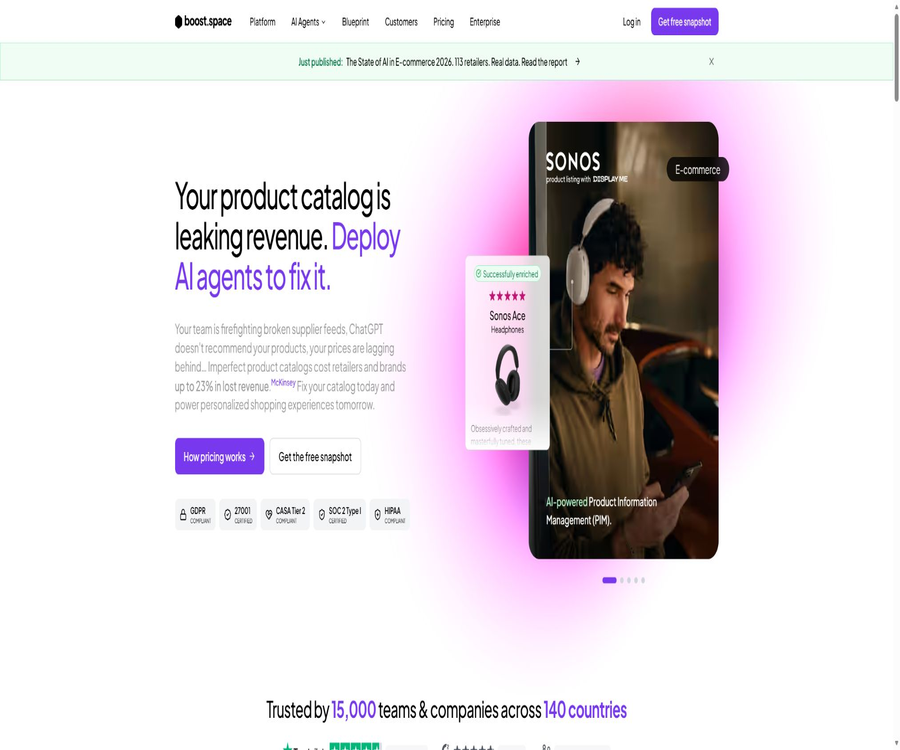
A one-sentence summary
Boost.space is a data and AI agent platform designed for e-commerce businesses, retailers, and brands; it enables the consolidation of records scattered across shopping platforms, CRM systems, ERP systems, suppliers, and advertising systems into a unified real-time data base, after which automated processes or AI agents can read, organize, and write back results within their designated permissions.
Tool Introduction
Boost.space is operated by the Czech company Boost.space s.r.o., and its official website highlights its products as being focused on e-commerce data management and deployable AI agents. It is not a single chatbot; rather, it is a business platform that offers structured databases, two-way synchronization, automation, built-in AI capabilities, remote MCP, REST APIs, and SDKs.
The platform aims to address issues such as incomplete product catalogs, chaotic formats of supplier data, inconsistencies in records across different channels, and the lack of reliable business context for AI systems. The team can first standardize the data structure, and then assign tasks such as organizing, verifying, pricing, listing products, and engaging target audiences to manual processes, automated workflows, or AI agents.
Product architecture
| Hierarchy | Function | E-commerce example | Permission features |
|---|---|---|---|
| Module | Define a data type, which is equivalent to a table in a database. | Products, orders, customers, or suppliers | Fields and visibility ranges are created and configured by the administrator. |
| Space | Divide independent data containers within the module. | Catalogs of different brands, markets, or suppliers | Members, roles, and access permissions can be set separately. |
| Record | Save a specific business record | One SKU, one order, or one customer | It can be filtered, correlated, synchronized, and updated. |
| Field | Define typed properties in the record. | Price, inventory, EAN, category, or release date | The field type determines the methods for validation, mapping, and automation. |
Typed fields, record relationships, and key fields form the basis for the reliable operation of a platform. When key fields are configured properly, external data can be used to update existing records rather than creating duplicate entries over and over again.
Main functions
Unified business data
The platform can aggregate data from e-commerce stores, CRM systems, ERP systems, suppliers, distributors, advertising platforms, and other business tools, and establish a unified structure through modules, spaces, records, and fields. The official website currently shows 2675 native integrations, but the actual status of these integrations may vary – they might be ready for use immediately, or they may require additional configuration or support from technical staff.
Two-way synchronization and deduplication
The synchronization process allows external data to be written into Boost.space, and it also enables the transmission of cleaned or updated records back to the connected system. By specifying key fields, the import process can match existing records, thereby reducing the risk of an accumulation of duplicate products, contacts, or orders.
AI mapping and import
AI Mapping can analyze upstream data, suggest appropriate target fields and field types, and assist in creating import mappings. It is recommended to manually verify SKU, price, currency, inventory levels, and primary key fields before proceeding with the actual import, in order to prevent errors in mapping from spreading to downstream channels.
AI fields and data processing
The AI field can generate or add record attributes based on prompts, while text tools enable tasks such as shortening, expanding, translating, and rewriting text. The platform also offers functions for converting and verifying entire columns of data, which can be used to standardize naming, clean up formats, check rules, or mark records that do not meet the requirements.
Agent Chat and semantic retrieval
The built-in Agent Chat enables users to issue queries in natural language or through the operating system, and it can also assist in creating automated processes. Vector databases can establish semantic representations for a given domain, allowing searches or agents to match records based on their meaning, rather than relying solely on exact keyword matches.
Automation scenarios
The team can use scenario-based connectors, triggers, searches, operations, aggregations, and iterative steps to ensure that data flows continuously, in accordance with a set plan or business events. Each action such as reading, creating, or updating is counted as an operation; when the usage reaches the limit set for the plan, synchronization may be suspended.
Remote MCP
Boost.space hosts the Remote MCP Server, allowing external AI clients to connect to business data without having to deploy their own servers. The agent can only use the permissions granted to the user it is connected to; it can search for and write records, create structures, execute AI tasks, and trigger specified automation scenarios when on-demand execution is enabled.
REST API and SDK
REST APIs provide separate base addresses for each tenant and use Bearer tokens for authentication; they cover various resources such as modules, spaces, records, fields, files, users, teams, tags, statuses, vector databases, and AI functions. Developers can utilize pagination, filtering, permission settings, and OpenAPI specifications to build internal systems or custom connectors.
Ready-made e-commerce AI agents
| AI agent | Main tasks | Typical input | Expected result |
|---|---|---|---|
| Product Enrichment Agent | Complete and standardize product attributes | SKU, title, description, specifications, and images | More complete and consistently formatted product records |
| Supplier Product Listing Agent | Convert supplier data into product information available through channels | Supplier forms, Feed, or catalog | List of products suitable for the target channels |
| Dynamic Pricing Agent | Adjust prices based on competitive prices and business signals. | Internal prices, competitive information, and rules | Reviewable price suggestions or update results |
| Marketplace Growth Agent | Seek growth opportunities on market platforms | Product catalog, channel performance, and market data | Candidate products, channels, or optimization tasks |
| GEO Optimization Agent | Improve the visibility of products in AI-generated answers | Product information, brand details, and target searches | Content gaps and optimization suggestions |
| Audience Activation Agent | Convert customer data into an available audience | Customer attributes, behavior, and permission status | Audience segmentation and activation data |
The official website describes these agents as business components that can be deployed directly, but their actual performance still depends on data quality, field coverage, permissions, region, channel rules, and manual verification. When it comes to pricing, advertising targets, or product listings, an approval process must be in place, with every change being recorded.
The process of establishing a data foundation
- Identify the data objects that need to be standardized, such as products, orders, customers, inventory, or suppliers, and determine the person responsible for managing each type of data.
- Create a Module for each type of object, and then divide Spaces by brand, market, channel, or team.
- Configure fields such as text, numbers, amounts, dates, and relationships, and select a stable SKU, order number, or customer identifier as the key field.
- Connect to the channel application or import sample data; use AI Mapping to create a preliminary mapping, and then verify each field manually.
- First, run synchronization in the test environment to check for duplicate records, null values, currency types, time zones, statuses, and relationships.
- After confirming the results, enable official synchronization and set up exception alerts, activity logs, backups, and responsible persons.
The process of deploying AI agents
- Choose a single, quantifiable issue, such as the rate of missing product attributes, the time it takes for suppliers to list their products, or delays in price updates.
- Organize the fields required by the agent, historical records, business rules, and the target areas to which writing is allowed; first delete or isolate any data that contains obvious errors.
- Only the read and write permissions necessary to complete the tasks are granted, ensuring that sensitive customer data and financial information remain as hidden as possible.
- Use small batches of representative records to test prompts, mappings, output formats, and error handling, without directly overwriting the entire directory.
- Sales staff check the facts, brand tone, classification, pricing, and compliance requirements before approving the re-entry or distribution.
- Continuously monitor the accuracy rate, manual modification rate, processing time, and business metrics; if these standards are not met, the process should be suspended and the rules adjusted.
Access via MCP or API
- Create an API or MCP token in the personal settings, and select the minimum level of permissions appropriate for the module and the operation being performed.
- MCP users copy the dedicated system connection details and complete authorization in the supported AI clients, while API users save the tenant identifier and token.
- First, run a read-only query to verify that the agent or program can only access the intended modules, spaces, and records.
- Add parameter validation, idempotent control, logging, and manual confirmation for writing, deleting, or triggering scenarios.
- Monitor rate limits, retries, operations, and AI credit consumption, and design backoff strategies for 429 errors or service failures.
- When the purpose of a token changes or there is a suspicion of leakage, a new token is created and the old one is revoked, as the permissions associated with the existing token cannot be modified directly.
Which users are it suitable for
- E-commerce and retail teams: Unify the product, order, and inventory data from multiple shopping malls, market platforms, and suppliers.
- Brand product managers: complete the product details, standardize the product catalog, and reduce the time required for listing products on various channels.
- Data and Operations Team: Cleansing, verifying, linking, and synchronizing records from CRM, ERP, and advertising platforms.
- Automation consultants and service providers: Deliver cross-application data workflows through scenarios, APIs, or SDKs.
- AI agent developers: Utilize MCP or REST APIs to enable agents to access real-time, permission-controlled business context.
- Medium to large enterprises: Organizations that require dedicated deployment environments, governance processes, support services, or customized pricing.
Typical use cases
- Supplier catalog integration: Converts various tables, Feeds, and field names into a unified product structure.
- Synchronized product updates across multiple channels: After cleaning the titles, specifications, and categories, the resulting data is written back to the target system.
- Complete product information: Identify missing colors, materials, sizes, labels, or descriptions and arrange for review.
- Dynamic pricing assistance: Recommendations are generated by combining internal rules with external signals, but the final price change is approved by the responsible person.
- Customer data activation: Organize customer attributes within the framework of legal authorization in order to create marketing audiences.
- AI discoverability optimization: Checking whether product information is sufficient to enable accurate recommendations in AI-based searches and Q&A.
- Natural language data manipulation: Enables teams to use Agent Chat to search for records, update fields, or create simple workflows.
- Internal proxy access: MCP is used to enable ChatGPT, Claude, Cursor, or other clients to query and process business data.
Product advantages
- Place databases, synchronization, automation, and AI agents on the same data foundation to reduce the need for multiple intermediate storage systems.
- Typed fields, record relationships, and key fields help improve the consistency of agent inputs.
- Two-way synchronization is supported, allowing the cleaned data to be returned to the business system through a controlled process.
- The official website currently lists 2,675 native integrations, covering common e-commerce, CRM, ERP, and marketing tools.
- Built-in Agent Chat coexists with managed MCP, serving both code-free users and external AI clients.
- REST APIs and typed SDKs enable developers to create custom interfaces, handle batch processing, and develop internal applications.
- Permissions are tied to the user and the spatial scope, allowing restrictions on the data that agents can read and modify.
Usage restrictions and precautions
- The value of a platform relies heavily on the quality of its original data; incorrect primary keys, outdated prices, or incomplete fields can affect synchronization and the decision-making processes of agents.
- Two-way writing can cause errors to spread rapidly to the e-commerce platform, CRM, or ERP; it is necessary to test such processes in advance and have approval procedures as well as rollback strategies ready.
- AI-generated completions, translations, verifications, and pricing suggestions may contain factual errors; they should not be used to bypass product, legal, or financial reviews.
- AI functions consume AI credits, and automated scenarios may also use operations; the available pages do not list all these quotas in a unified manner.
- When the limits for recording or processing are reached, it may be necessary to delete old data, increase the allocated quota, or upgrade the system; it is important to estimate the peak usage levels before making purchases.
- Some integrations require additional settings, third-party accounts, or separate fees; not all of them can be used without any configuration.
- Old self-service packages, Legacy modules, and current enterprise agency solutions may all appear in the documentation; it is not allowed to mix together the various benefits and prices.
- External AI clients create new data access paths; it is necessary to verify the clients’ own policies regarding data retention, training, and cross-border data transfers.
- Before signing a contract, enterprises should clarify the aspects related to data residency, backup, deletion, sub-processors, incident response, SLAs, and compliance certifications.
Prices and procurement options
The options listed below were verified on August 20, 2026, based on Boost.space’s current public pricing page; the currency used is the US dollar. The page outlines three phases for corporate purchases: Snapshot, Blueprint, and Platform. The final scope, taxes, and service commitments will be determined in accordance with the quotation and contract provided.
| Phase | Public price | Cycle | Main delivery | Suitable for users |
|---|---|---|---|---|
| Snapshot | Free | About 24 hours | The team manually checks the stores and provides around 2 to 3 pages of results, covering visibility checks for tools such as ChatGPT, Perplexity, and AI Overviews. | Businesses that wish to first identify issues related to their product catalogs or AI visibility |
| Blueprint | Fixed price of $5,000 | About 4 weeks | A report of around 25 to 40 pages, a workbook containing evidence at the SKU level together with a roadmap; a product feed is required, as well as approximately 2 hours of customer collaboration. | Retailers or brands that need to quantify opportunities and define the scope of implementation |
| Platform | Custom quote | Determined based on the Blueprint results. | Starting with an agent, define the scope based on data volume, channels, markets, and 90-day metrics. | Companies that are preparing to deploy AI agents and continuously monitoring their business outcomes |
A Snapshot is a manual assessment of the store’s conditions, and it does not equate to a permanent, free access to a full platform account. Once a Blueprint is completed, the client can retain the resulting deliverables, and there is no obligation to purchase the Platform. There is no fixed price for the Platform, as implementation costs vary depending on the type of agent, the volume of data, as well as the channels and markets involved.
The older pricing information may still list options such as Free, Pro, Business, and Enterprise, along with limitations related to the number of records, AI credits, and operational capabilities associated with each self-service plan; however, the current public pricing page no longer presents these fixed amounts as the main options for purchase. Existing customers should refer to their account’s billing page and contract, and should not use the old prices to estimate the costs for new customers.
The current terms also mention a temporary 14-day free license, as well as monthly, quarterly, annual payment options or custom contracts; however, these should not be confused with the free Snapshot service. It is necessary to verify whether a full trial period is automatically provided upon registration, at the time of account creation or after sales confirmation.
AI credits and usage volume
| Quantity items | Common consumptions | The effects of reaching the upper limit | Check before purchasing |
|---|---|---|---|
| Number of records | Save products, orders, customers, and other records. | Old records need to be deleted or upgraded. | Current volume, growth rate, historical retention period |
| AI credits | AI fields, text processing, conversion, validation, and other AI functions | Some AI operations may not be able to proceed. | Monthly limit, single-use amount, whether to carry over |
| Operations | Operations such as reading, creating, and updating in the scenario | Synchronization may be paused or may require scale-out. | Operation frequency, number of records per session, retries, and third-party fees |
| Administrators and permissions | System configuration and governance roles | Subject to specific plans or contracts | Team roles, minimum permissions, and audit requirements |
The official documentation states that AI credits are provided on a monthly basis and are not carried over to subsequent months; however, the current public pricing page for enterprises does not specify a fixed amount. Customers should request a quote that clearly outlines the AI credits, operational costs, user or administrator fees, storage costs, support services, as well as the rules regarding usage beyond the allocated limit.
Platform support and integration
| Platform or interface | Support status | Primary uses |
|---|---|---|
| Web applications | Support | Management module, space, records, permissions, synchronization, and built-in Agent Chat |
| Native integration | 2675 official websites are currently displayed. | Connect e-commerce, CRM, ERP, suppliers, advertising, and other tools |
| Make automation | Support | Scenarios for triggering, searching, writing, aggregating, and iterating are created; the old approach may require separate accounts. |
| Remote MCP | Support | Connect to ChatGPT, Claude, Cursor, VS Code, and general MCP clients |
| REST API | Support | Use programs to query, create, and update structured business data. |
| TypeScript SDK | Publicly installable | Typed API client |
| Python SDK | Publicly installable | Synchronous and asynchronous clients are provided; Python 3.11 or a higher version is required. |
| PHP and Go SDKs | The document states that the status of public packages needs to be verified. | The official SDK overview includes these two languages, but the installation page indicated that it was still in preparation. |
| Standalone desktop or mobile app | The public location is not clear. | The main ways of use are via web platforms, as well as integration and development interfaces. |
API, SDK, and MCP capabilities
The permissions of an API token must not exceed those of its creator, and restrictions can be applied at the module and operation level. When developing applications, it is advisable to avoid using global administrator tokens; instead, different tokens should be used for testing, production, and personal use.
| Ability | Authentication and usage methods | Suitable for tasks | Important restrictions |
|---|---|---|---|
| REST API | Tenant address and Bearer token | System integration, batch processing, and custom applications | Pagination, permissions, rate limiting, retries, and idempotency must be handled manually. |
| Remote MCP | Dedicated system connections and user authorization | Allow external AI agents to search for, write to, and execute scenarios as needed. | The proxy capabilities are controlled by the user’s permissions, and the client itself also has privacy rules. |
| Agent Chat | Use it directly within the Boost.space app. | Natural language queries, data modification, and assistance in creating automation. | The results still need to be reviewed and correspondingly consume AI resources. |
| TypeScript SDK | Install the official typed client. | Integration with Node.js or front-end services | Version compatibility and release status should be checked according to the SDK documentation. |
| Python SDK | Install boostspace-sdk | Data pipelines, scripts, and backend services | The currently available package is in Beta version and requires Python 3.11 or higher. |
Data security and privacy
The official website currently provides information on compliance with GDPR, ISO 27001, CASA Tier 2, SOC 2 Type I, and HIPAA. When making purchases, companies should request reports or certifications that are specific to the actual products, the location of deployment, and the contracting party; it is not sufficient to rely on website badges to assume that all workloads meet the compliance requirements automatically.
The Privacy Policy explains that Boost.space can act as either a controller or a processor in different scenarios; the customer determines the purpose for which the business data submitted is to be processed. When connecting with third-party components such as Make, cloud environments, or external AI clients, it is necessary to clarify the data roles of each party, any sub-processors involved, and the arrangements for cross-border data transfer.
- Before signing the contract, confirm the data storage location, backup location, retention period, deletion process, and data export capabilities.
- A data processing agreement, a list of sub-processors, security reports, and guidelines regarding the timing of incident notifications are required.
- Sensitive fields are collected only to the extent necessary, and access to them is restricted through space, role, and token scope.
- AI agents are first tested using masked samples; in the production environment, writes, deletions, and price changes require manual approval.
- Regularly check activity logs, synchronization errors, abnormal batch modifications, token usage, and third-party connections.
- When ending the collaboration, export the necessary records, revoke the connections and tokens, and verify the deletion schedule in the backup.
Open-source status
The Boost.space platform is not an open-source product; there is no evidence indicating that its database, synchronization engine, AI agents, or hosted MCP services can be deployed as a complete open-source system. The open-source status listed for it should be marked as non-open source.
The official Python SDK package is licensed under the MIT license, and source code versions of it are also available; however, the corresponding GitHub repository is not currently accessible to the public. The SDK license applies only to the client-side code, and it does not mean that commercial platforms, user data, or the content generated use this open-source code.
Basic information
| field | Content |
|---|---|
| Tool name | Boost.space |
| Development company | Boost.space s.r.o. |
| Location of the company | Czech Republic |
| Tool type | E-commerce data platforms, AI agents, data synchronization, and automation |
| Current focus | Product operation, catalog management, supplier data, dynamic pricing, GEO, and audience activation |
| Data model | Module, Space, Record, and Field |
| Number of integrations | The current official website displays 2,675 native integrations. |
| Usage method | Web applications, automation, Remote MCP, REST APIs, and SDKs |
| Price pattern | Free Snapshot, $5,000 for Blueprint, customized quotes for Platform |
| Free platforms | The current public procurement page does not consider Snapshot to be an equivalent to a complete, permanently free platform. |
| Chinese support | The official website and documentation are primarily in English; no complete official Chinese interface instructions were found. |
| API | Provides REST API |
| MCP | Provides hosted Remote MCP Server |
| SDK | TypeScript and Python can be installed publicly; the status of PHP and Go needs to be checked. |
| Is it open source? | The platform is not open-source; the Python SDK package is licensed under the MIT license. |
Recommendation score
The recommendation score is 4.2 out of 5. The main advantage of Boost.space is that it first organizes products, orders, and customer data into a structured, interconnected, and synchronized database, after which built-in or external AI agents can operate within the same permission framework.
It is more suitable for e-commerce teams that have data from multiple sources, clear business metrics, and strong governance capabilities; it is not a simple chat tool that can resolve all catalog-related issues without any cost once registration is completed. Customized procurement processes, usage tracking, data quality, and the risks associated with two-way data updates all need to be tested during the pilot phase.
Frequently Asked Questions
What is Boost.space?
It is a business platform that integrates structured data, application synchronization, automation, and AI agents; it currently focuses on supporting the product management activities of e-commerce companies, retailers, and brands.
Is Boost.space free?
The current public procurement page offers free diagnostic services through the Snapshot store, but this does not mean that the entire platform will be available for free indefinitely. The deployment of the platform is based on customized quotes; it is necessary to confirm at the time of registration whether the old self-service packages or the 14-day trial period are still applicable to new accounts.
What will a snapshot deliver?
The official website states that the team will conduct an inspection of the store within approximately 24 hours and provide a report of about 2 to 3 pages, covering issues related to AI visibility and the product catalog. Users only need to submit the store’s information; there is no need to consider it as a software subscription service.
Why does Blueprint charge $5,000?
Blueprint is a diagnostic and design project that lasts around four weeks; the final deliverable includes a report of 25 to 40 pages, a workbook with evidence at the SKU level, and a roadmap. It is used to quantify opportunities and define the scope of subsequent implementation, rather than simply involving the purchase of an account.
Is it necessary to purchase the Platform after buying the Blueprint?
The current public FAQs indicate that there is no obligation to make a purchase; customers can keep the Blueprint deliverables. If deployment is carried out, the scope and price of the service will be determined based on the type of agent, the amount of data, the channel used, the market, and various metrics.
How many application integrations are supported?
The official website currently shows 2,675 native integrations, and the official documentation lists a large number of third-party applications as well. Different integrations may be ready for use immediately, require additional setup, or need contact with support; it is not possible to determine their availability based solely on the total count.
How does Boost.space avoid duplicate records?
Administrators can set key fields for a Space; when data is imported and matches these fields, the existing records are updated. If these key fields are unstable or mismapped, it can still lead to duplicates or overwrites, so it is necessary to conduct tests using samples first.
Can it automatically adjust product prices?
The platform offers dynamic pricing agents and two-way write-back capabilities, but the fact that these features are mentioned publicly does not mean that all customers should have their prices adjusted automatically. Before using them in practice, it is necessary to define price limits, approval processes, anomaly detection mechanisms, and procedures for rapid reversal of changes.
How is the pricing for AI features?
Operations such as AI field processing, text processing, conversion, and validation consume AI credits; automated scenarios also incur operations costs. The current enterprise pricing page does not provide a unified and public indication of the specific quotas, so it is necessary to request a quote that specifies the usage limits and rules for exceeding them.
Are API and MCP provided?
Available. The REST API is suitable for programmatic integration, while Remote MCP enables ChatGPT, Claude, Cursor, and other compatible clients to access business data within defined permissions.
Which SDKs are supported?
The official overview lists TypeScript, Python, PHP, and Go, but the available installation information shows that TypeScript and Python have the clearest details; the release status of PHP and Go needs to be verified at the time of installation. The Python package requires version 3.11 or higher and is labeled as Beta.
Is Boost.space open source?
The platform itself is not open source. The Python SDK package is licensed under the MIT license, but the SDK is only used to make calls to the commercial platform; it cannot be used as a basis to classify databases, AI agents, or hosting services as open source.
Will the data be used to train AI models?
The privacy statement specifies that certain Google API data will not be used for training general-purpose models, but this provision should not be interpreted as applying to all customer data or to all external AI clients. Companies should clarify the mechanisms related to training, storage, and deletion in their contracts and in the terms provided by each model supplier.
What is the most important preparation before going live?
First, establish a stable data model, key fields, permissions, and audit processes, and then start with a low-risk, measurable proxy task. Without reliable data and manual verification, automation will only lead to the faster spread of errors.
Tools similar to Boost.space





 Guigong Network Security Registration No. 45132202000164