






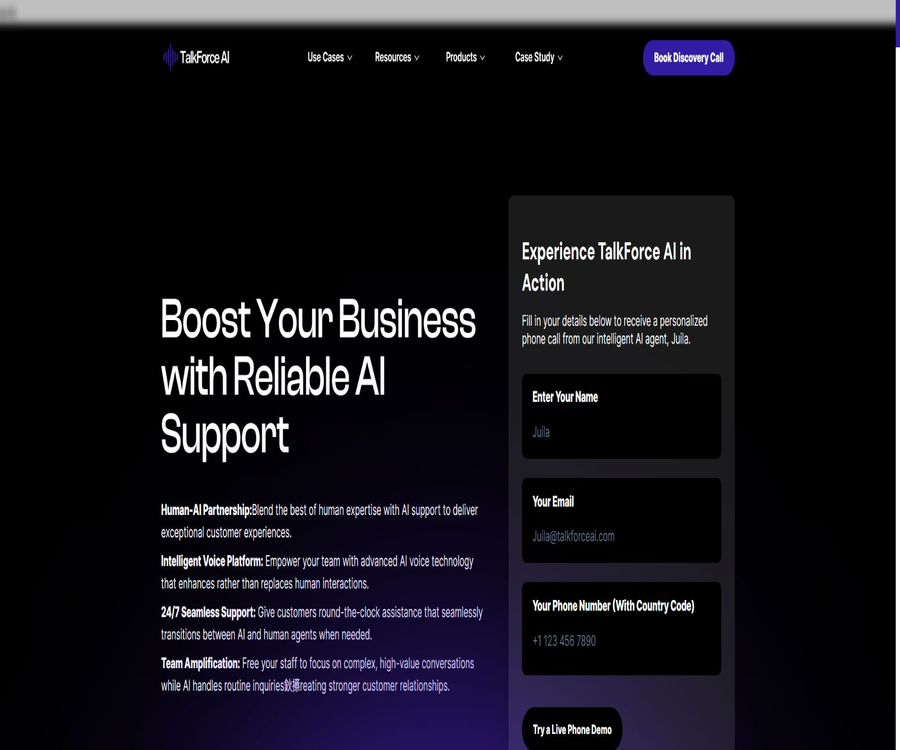
What is TalkForce AI?
TalkForce AI is an AI-powered voice agent service designed for corporate customer service and outbound calling tasks. It makes use of speech recognition, natural language understanding, and enterprise knowledge management to handle incoming inquiries; it can also carry out outbound tasks such as appointment reminders, lead filtering, and customer follow-ups.
The product is delivered through a approach that combines strategic design with ongoing maintenance, rather than simply involving the purchase of a self-service software account. The team evaluates the business requirements, creates a knowledge base, sets up the necessary processes, integrates the system with existing ones, and checks the recordings after it goes live, making continuous adjustments as needed.
Core functions
- 24/7 answering: Handles basic calls during off-hours and peak times.
- Frequently Asked Questions: Explains the product, services, prices, business information, and procedures.
- Reservations and bookings: Collecting information, checking available resources, and confirming arrangements.
- Cancellation and refund process: Retrieve the reservation, explain the policies, and handle it within the authorized scope.
- Manual transfer: Escalate to a higher level when encountering complex, sensitive issues or those beyond the scope of knowledge.
- Emotion recognition: Identifying dissatisfaction based on tone and wording, and adjusting the response accordingly.
- CRM integration: Reading or writing customer, order, reservation, and communication data.
- Smart outbound calls: Handle reminders, lead screening, sales outreach, and customer reactivation.
- Call analysis: Provides text and audio recordings to assist in reviewing business outcomes.
- Customer satisfaction survey: CSAT or NPS feedback is collected after the call.
How do AI-powered phone customer service systems work?
- First, the company should analyze the frequent calls, business objectives, existing customer service processes, and potential risks.
- TalkForce AI uses this information to design agent roles, conversation pathways, and system integration solutions.
- Both parties organize knowledge bases, scripts, policies, prompts, and real-time data that can be accessed.
- Complete the configuration of sound, tone, transfer conditions, and business actions.
- It is first tested internally by the service team, and then sent to the client team for testing with suggestions for improvements.
- Enter a two to four-week testing phase to collect real feedback and cases of anomalies.
- After going live, continuous checks are carried out on recordings, metrics, and system performance to enable optimization.
Incoming customer service
Inbound agents are suitable for handling a large volume of calls whose answers are relatively standardized and for which it’s clear what criteria apply for escalation. AI should be used to collect basic information and provide routine services, while leaving complex decisions and high-value conversations to human agents.
- Answer questions regarding business hours, location, and the range of products and services offered.
- Confirm the basic information of the reservation, itinerary, appointment, or order.
- Collect names, contact information, as well as a summary of requirements and issues.
- The available options are explained according to the cancellation policy.
- Handling lost items, service progress, and general after-sales inquiries.
- Identify urgent, high-risk, or complaint calls and route them to a human agent.
Smart outbound calling
TalkForce AI also offers outbound call centers for sales, reminders, and follow-ups, and it can be integrated with an enterprise’s existing outbound call systems. The official use cases include appointment reminders, assessment of lead eligibility, basic sales introductions, customer reactivation, and certain collection processes.
- Reach out to new leads and confirm their requirements, budget, timeline, and intention to purchase.
- Remind customers about appointments, payments, renewals, or event times.
- Reach out to past customers and introduce new products or offers.
- Collect service feedback, satisfaction levels, and willingness to recommend.
- Send follow-up messages based on intent or arrange for a sales representative to get in touch.
- Carry out reminders for outstanding payments and communications regarding repayments within the limits permitted by law.
How to design an outbound calling project
- First, determine the legitimate basis for contact, the target area, the permitted time periods, and the rules for cancellation.
- Clean the list by removing duplicate numbers, users who refuse calls, and individuals whose contact is prohibited.
- Different messaging approaches and goals are defined based on the customer’s origin, needs, and stage.
- It stipulates the requirements for disclosing the AI identity, providing alerts for call recording, and enabling manual transfer.
- Use internal numbers to test for interruptions, silence, rejections, complaints, and error messages.
- Run small batches first to check the connection rate, complaint rate, conversion rate, and accuracy of the records.
- Expand the scale only after verifying compliance and quality, while retaining the ability to pause at any time.
Knowledge base and business customization
The platform creates specialized knowledge bases based on the company’s scripts, common questions, policies, and business scenarios. For tasks that require real-time data, additional efforts can be made to integrate with order management, booking systems, customer databases, or other business systems.
- Product name, functions, scope of application, and listed price.
- Location of services, hours of operation, and rules for making reservations and canceling.
- Conditions for refunds, exchanges, upgrades, and manual approval.
- Different question-and-answer approaches, tones, and authentication processes for various customer types.
- Sensitive questions that require a refusal to answer or an escalation to a human agent are explicitly prohibited.
- Contacts, queues, business hours, and alternative routes in case of transfer failures.
Manual transfer and human-machine collaboration
The authorities position this product as a tool to enhance human teams, rather than a substitute for employees. AI can handle repetitive tasks and calls that come outside regular working hours, while humans are responsible for dealing with complex issues, building relationships, making exceptional decisions, and handling sensitive complaints.
| Situation | AI is suitable for execution. | It is recommended to switch to a human agent. |
|---|---|---|
| Common inquiries | Answer based on the approved knowledge | Data conflicts or customer doubts regarding the answers |
| Make a reservation | Collect information and schedule standard time periods | Special needs, group conflicts, or resource conflicts |
| Cancel refund | Explain the policy and collect applications | Over-authorization refunds or dispute resolution |
| Sales leads | Qualification screening and arrangement of follow-up contacts | Quotation negotiations, contracts, or high-value clients |
| Customer complaints | Identify emotions and record a summary. | Strong dissatisfaction, legal threats, or security incidents |
| Sensitive industries | Provide approved general information. | Medical, legal, financial, and compliance judgments |
Emotion recognition and empathetic response
TalkForce AI claims to be able to analyze customers’ tone and language in order to detect feelings of frustration or anger and adjust the response accordingly. However, emotion recognition can be affected by accents, culture, background noise, and individual differences in expression; it should not be used as the sole basis for refusing services or making important decisions.
- Use emotional signals as cues for decision-making, rather than as the final determinant.
- Fast escalation for repeated interruptions, volume increases, and clear complaints.
- Do not infer health, identity, or credit status based on assumed emotions.
- In the review, compare the conclusions of system tags with those obtained from manual listening to the recordings.
- Provide customers with a way to directly request a human agent.
Integration of CRM with existing systems
Officials state that it is possible to connect to common CRM systems and enterprise infrastructure, and custom integrations can be provided. Which systems are supported, which fields can be read or modified, as well as whether sandbox environments and interface documentation are available, all need to be determined during the planning phase.
| Integrated objects | Possible uses | Check before going live |
|---|---|---|
| CRM | Query customers, create leads, and record calls | Field permissions, duplicate records, and identity matching |
| Reservation system | Query period, create and modify appointments | Time zones, concurrent bookings, and cancellation rules |
| Orders and POS | Check order, reservation, and service status | Authentication, refund permissions, and logs |
| Telephone system | Answering calls, making outbound calls, waiting in queue, and manual transfer | Numbers, recordings, faults, and alternative routes |
| Message channels | Send confirmation or follow-up messages | User consent, templates, and cancellation |
| Analysis system | Summary results, satisfaction, and conversion rates | Indicator definition and data de-identification |
Implementation process
| Phase | Main tasks | Key deliverables |
|---|---|---|
| Needs assessment | Understand incoming calls, pain points, systems, and business objectives | Use case scope and success metrics |
| Plan design | Design integration, dialogue flow, knowledge, and prompts | Implementation plan and agent workflow |
| Configuration setup | Establish a knowledge base, agent positions, and system connections | Testable AI agents |
| Internal and customer testing | Covers normal, abnormal, and risky conversations | List of defects and results of corrections |
| Test run | Run it for two to four weeks and collect feedback | Real-world performance and readiness assessment |
| Ongoing operation | Check recordings, reports, maintenance, and optimization. | Periodic review and improvement plan |
Testing and Quality Assurance
- Create test sets for real-world problems, boundary conditions, malicious inputs, and system failures.
- Confirm that AI uses only the currently valid prices, policies, and business data.
- Check that the name, number, date, amount, and reservation details are correctly repeated and confirmed.
- Test the handling of situations where clients request a real person, demand silence, or keep interrupting.
- Simulate situations where CRM, scheduling systems, and call forwarding are unavailable.
- Sales staff review each test recording, transcription, and result individually.
- It is necessary to determine which criteria need to be met before proceeding to real customer testing.
Ongoing monitoring and optimization
The services include continuous performance monitoring, system maintenance and optimization, and regular review meetings can be scheduled every two weeks or on a monthly basis. A dedicated account manager is responsible for following up on issues, but the specific response times and service levels must be specified in the contract.
- Randomly check the recordings and transcripts to ensure that the responses are consistent with the knowledge base.
- Statistically analyze the transfer rate, first-resolution rate, average handling time, and reasons for failures.
- Monitor successful reservation bookings, the quality of leads, refund errors, and customer complaints.
- Check whether new products, prices, and policies are updated in a timely manner.
- Adjust the prompts, knowledge retrieval, and routing thresholds based on real-world cases.
- Regularly retest the high-risk errors that have occurred previously.
Customer satisfaction survey
TalkForce AI allows for the collection of CSAT and NPS feedback from pre-trained agents after calls are completed. The results of these surveys should be analyzed in conjunction with factors such as the sample size, completion rate, and feedback obtained through manual channels; a single score alone cannot be used as evidence of improvements in service quality.
| Indicators | The questions answered | Precautions |
|---|---|---|
| CSAT | Is the customer satisfied with this service? | Affected by the difficulty of the questions and the timing of the survey |
| NPS | Are customers willing to recommend the company? | A sufficient number of samples is required, and the wording of the questions must remain consistent. |
| Resolution rate | Was the issue resolved during this contact? | Distinguish between AI-based solutions, redirection, and subsequent processing. |
| Transfer rate | How many calls require a human to take them? | Redirecting to high-risk scenarios is not necessarily a bad thing. |
| Complaint rate | Customers’ complaints regarding AI, content, or outbound calls | It should be handled according to type and severity. |
Pricing method
TalkForce AI offers customized quotes; according to its official website, the cost for a fully functional AI-driven conversational customer service assistant is typically between 50 and 100 dollars per month for most customers. The final price depends on the features, level of customization, number of agents, number of minutes used, and system integration required.
The AI answering service page also presents a reference rate of $29 per month plus $0.30 per minute. This price does not apply to all customer service, telemarketing, or custom business solutions; it is necessary to verify the specific products, included services, and any additional costs before making a purchase.
| Services or fees | Public price information | Explanation |
|---|---|---|
| Custom AI customer service assistant | Most customers pay between 50 and 100 dollars per month. | Quotations are provided based on function, customization, seats, and scope of business. |
| AI call answering service | $ | Suitable for call-handling service plans to be displayed separately on the official website |
| Use minutes | Charged by plan or per minute | The region, inbound and outbound calls, as well as phone costs need to be confirmed. |
| Custom integration | A separate fee may apply. | It depends on CRM, reservations, orders, and data interfaces. |
| Training for complex tasks | Additional investment may be required. | Real-time data, transactions, and advanced scenarios incur higher costs. |
| Implementation and continuous optimization | Subject to the quote and contract. | Confirm the testing period, frequency of meetings, and customer manager services |
What should be confirmed when requesting a quote?
- The monthly fee covers the number of seats, numbers, minutes, concurrent connections, and business use cases.
- How are inbound calls, outbound calls, transfers, recording, and text messages billed separately?
- Setup fees, customization fees, integration fees, and overuse fees.
- Whether there is a fee during the two to four-week testing phase and the conditions for exiting it.
- How many man-hours are involved in updating the knowledge base, adjusting prompts, and conducting random audio checks?
- Account managers, technical support, and fault response times.
- Contract duration, renewal, cancellation, data export, and deletion procedures.
Which companies are suitable?
- A customer service center that receives a high volume of calls and many repeated inquiries.
- Service companies that require responses and appointments outside regular business hours.
- Small businesses that wish to delegate basic telephone tasks to AI.
- Organizations that need customized CRM, reservation, or order system integrations.
- The team responsible for filtering leads, sending reminders, following up, or reactivating customers.
- Companies that are willing to improve quality through continuous audio review and operational optimization.
Common use cases
- Travel and hotels: reservations, cancellations, confirmation of itineraries, and inquiries regarding lost items.
- E-commerce and retail: order inquiries, basic after-sales support, and customer feedback.
- Catering: Reservations by phone, business hours, and common questions regarding the menu.
- Professional services: Answering calls from potential clients and scheduling consultations.
- Education: Course introductions, reactivation of former students, and appointment scheduling.
- Automobile business: lead screening, test drive appointments, and after-sales follow-ups.
- Finance and debt collection: general reminders and information gathering; key decisions are made by human staff.
- Customer experience: Collect CSAT and NPS feedback after the call.
Product advantages
- It covers the entire delivery process, from requirement assessment and configuration testing to continuous optimization.
- It emphasizes collaboration between AI and humans, and allows for the referral of complex issues to human agents.
- It covers inbound customer service, outbound sales, reminders, and satisfaction surveys all at once.
- It can be customized based on corporate knowledge, scripts, and actual processes.
- Exclusive account managers, performance reviews, and periodic assessments are provided.
- Suitable for companies that lack an in-house voice AI engineering team.
Usage restrictions
- Pricing is mainly based on customized quotes; public information is not sufficient to accurately determine the total cost of complex projects.
- The official website does not specify the limits regarding the number of seats, minutes, concurrent connections, and features for the standard package.
- No fully available developer API or technical documentation was found.
- The effectiveness of implementation depends heavily on the quality of knowledge, integrated data, and ongoing operations.
- Errors may still occur in emotion recognition, accent understanding, and handling complex problems.
- It requires a certain period of testing and optimization, and is not suitable for teams that need to replace human workers immediately in their entirety.
- Scenarios such as healthcare, law, finance, refunds, and debt collection require strict access controls and compliance measures.
Privacy, Security, and Compliance
Telephone systems may handle recordings, transcriptions, contact information, orders, appointments, and customer identity data. The public pages of the website do not provide sufficient details regarding data security and retention policies; companies should request information on privacy, security, and data handling terms before entering into a contract.
- Confirm that the recording and the disclosure of AI identity comply with the laws of the caller’s location.
- Specify the location where the data is stored, the encryption method, access controls, and retention period.
- Verify the model suppliers, telephone service providers, and other subcontractors.
- Restrict AI access to sensitive data such as refunds, payments, health information, and identity details.
- Establish processes for data access, correction, deletion, and export.
- Requests for notifications of security incidents, as well as backup and business continuity plans, are needed.
- Before making outbound calls, maintain the consent records, unsubscribe lists, and allowed contact times.
API, GitHub, and open-source status
As of this verification, no developer API documentation made available by TalkForce AI, no official SDKs, and no GitHub repositories that can be linked to it have been found. The product relies primarily on custom hosting services and enterprise integrations; voice projects with the same name or similar names cannot be considered as the official source code.
| Development projects | Status | Explanation |
|---|---|---|
| Public API documentation | No findings were detected. | The integration capability needs to be confirmed in the project plan. |
| Official SDK | No findings were detected. | There are no public installation packages or developer tutorials available. |
| Official GitHub | No findings were detected. | The similar voice entries found in the search have no clear connection to the product. |
| Core platform | Closed-source services | Configured, operated, and continuously optimized by the supplier. |
| Custom integration | Available for provision | The specific systems, scope, and costs are specified in the project quote. |
Basic information
| Project | Content |
|---|---|
| Product name | TalkForce AI |
| Tool type | AI phone customer service, voice agents, and intelligent outbound calling services |
| Service method | Needs assessment, customized implementation, testing, and continuous optimization |
| Key capabilities | Answering calls, making outbound calls, scheduling appointments, placing bookings, transferring calls, conducting analysis, and carrying out satisfaction surveys |
| Main integration | Custom integrations such as CRM, scheduling, orders, POS, and telephone systems |
| Reference price | Custom customer service typically costs between 50 and 100 dollars per month. |
| Reference for answering services | $ |
| Is it necessary to request a quote? | Most enterprise solutions require |
| Whether a public API is provided | No findings were detected. |
| Is it open source? | No |
Recommendation score
The comprehensive recommendation score is 3.9 out of 5 points. TalkForce AI is suitable for companies that seek customized implementation and ongoing operational support; however, there are limited public technical documents, standard packages, and information regarding data governance. It is necessary to conduct a detailed cost inquiry and security review before signing a contract.
Frequently Asked Questions
What is TalkForce AI mainly used for?
It offers customized AI-based phone customer service and outbound call centers to handle common inquiries, appointments, lead screening, and follow-ups.
Can I be connected to a human agent?
Yes, complex, sensitive, or outside the scope of knowledge questions can be forwarded to a live agent.
Is outbound calling supported?
Supported; it can be used for appointment reminders, lead filtering, basic sales outreach, and customer reactivation.
How much is TalkForce AI?
Custom customer service services cost approximately $50 to $100 per month; the actual fee depends on the features, number of minutes, number of agents, and level of integration required.
How much does it cost to use AI-powered call answering services?
The reference price for the call-taking service, as listed on the official website, is $29 per month plus $0.30 per minute.
How long will it take to implement?
Depending on the complexity, the official process includes configuration, customer testing, and a testing phase that lasts two to four weeks.
Can it be connected to CRM?
The authorities state that they support common CRM systems as well as custom integrations; the specific systems and fields to be used need to be determined as part of the proposal.
Can it analyze customers’ emotions?
Emotion or tone analysis is supported, but the results should be used as supplementary signals and reviewed manually.
Is a public API available?
No complete and publicly available API documentation was found; development integration requires confirmation from the team.
Is TalkForce AI an open-source tool?
No, the core product is custom hosting services; no official open-source repository has been found.
Tools similar to Automate Customer Service with AI-Powered Virtual Agents





 Guigong Network Security Registration No. 45132202000164