






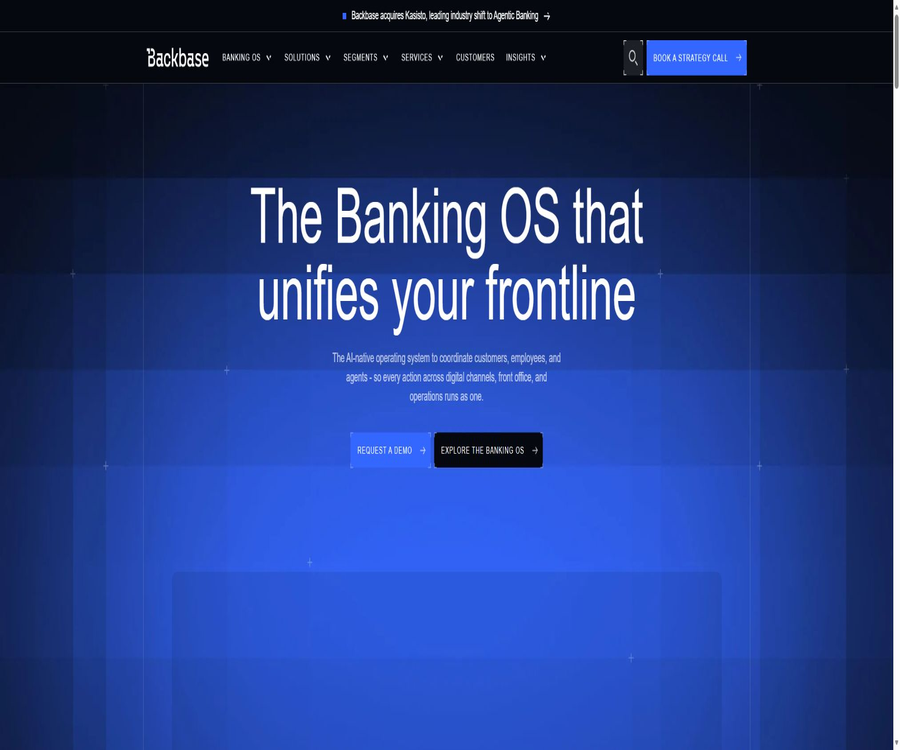
What is Backbase?
Backbase is a bank software company founded in 2003; its products are positioned as AI-native bank operating systems. This platform operates on top of core banking systems, CRM systems, and data platforms, and it uses unified contexts, processes, and authorization mechanisms to coordinate customers, employees, and AI agents.
A one-sentence summary
Backbase helps banks to gradually unify digital channels, front-office workspaces, business processes, and governed AI capabilities, without the need to replace their core systems in their entirety.
Product positioning
- The target clients are banks, credit cooperatives, and financial institutions.
- It is not a personal accounting or online banking application.
- It is not a complete banking core that can replace the core accounting system.
- It is primarily responsible for the control and coordination of front-office and operational tasks.
- Place customers, employees, workflows, and Agents within the same model.
- It supports gradual transformation based on business domains, rather than a one-time large-scale migration.
Core functions
- Create a digital experience tailored for individual, corporate, and high-net-worth clients.
- Provide employees with service workspaces organized by role.
- Organize the processes for acquiring customers, opening accounts, providing services, handling payments, and offering credit.
- Use AI Agents to handle complex situations and assist in decision-making.
- Describe customers, accounts, products, and cases using a unified semantic model.
- Policy checks and authorization are performed for each action.
- Connects core systems, CRM, data platforms, and third-party services.
- The process is continuously optimized through monitoring, feedback, and manual intervention.
Unified Front
Backbase refers to digital channels, front-line staff, and operational processes as a unified front. Requests made by customers via mobile devices, websites, call centers, or physical locations can be processed within a shared context, thereby reducing repeated inquiries and the need to switch between different systems.
- The customer journey shares the same business status.
- The agent can view the pre-summarized customer information.
- AI Agents use the same processes and permissions as employees.
- Actions at the front end can trigger cases and tasks at the back end.
- Sessions and processing progress are retained when switching channels.
- In case of an anomaly, the process proceeds along a controlled upgrade path.
Six-layer technical architecture
| Hierarchy | Main function | Problems solved |
|---|---|---|
| Interaction layer | Customer applications, employee workspaces, and conversational banking | Unified user entry point |
| Orchestration layer | Execute journeys, cases, rule-based processes, and Agent processes | Coordinate end-to-end execution |
| Intelligent layer | Combining large models, domain-specific models, machine learning, and risk models | Provide governed intelligence. |
| Semantic layer Nexus | Standardize definitions for customers, accounts, products, and cases. | Reduce conflicts in data meaning |
| Authorization layer Sentinel | Issue decision tokens in accordance with policies and retain evidence. | Controlling the actions of humans and AI |
| Connection layer | Connect existing systems through standard contracts and events | Avoid completely replacing the core component. |
Interaction layer
- We offer customers mobile banking and online banking services.
- Adjust the visible content and next steps dynamically based on the customer’s status.
- Provide employees with role-based operational workspaces.
- Reduce the number of systems that need to be switched between to complete a service.
- It supports converting natural language intents into authorized bank actions.
- Maintain consistency in the business context of the interface between customers and employees.
Orchestration layer
- Execute deterministic business rules and standard processes.
- Route complex exceptions to the appropriate AI Agent or employee.
- Coordinate cross-system processes such as customer acquisition, service delivery, dispute resolution, and lending.
- Record every handover and action in the process.
- It supports both automated and manual processing.
- Reduce isolated process tools through a unified engine.
Intelligent layer
The intelligent layer can combine large language models, domain-specific models, machine learning techniques, and risk models; however, the outputs of these models are still subject to the constraints imposed by business policies and the authorization layer. Manual corrections, as well as the outcomes of various processes, can be incorporated into the feedback loop.
- Select a general or domain-specific model based on the task.
- Understand the customer’s intentions by using the banking context.
- Provide recommendations and next steps for complex cases.
- Use human intervention as a signal for improvement.
- Audit trails are maintained for model actions.
- Configure the scope of revocable automation by business domain.
Nexus semantic layer
Nexus is used to establish a unified meaning for customers, accounts, products, cases, and business status. It does not involve simply copying all data to a new repository; instead, it enables workflows, employees, and Agents to use shared business semantics.
- Reduce inconsistencies in the meaning of fields across systems.
- Provide the Agent with understandable customer context.
- Ensure that different channels access the same business status.
- Unified objects are supported for cross-domain workflows.
- Reduce manual reconciliation and repeated explanations.
- Banks still need to establish responsibilities for data quality and master data.
Sentinel authorization layer
Sentinel emphasizes that any employee, system, or agent must have explicit authorization before taking any action. Decision tokens record the person who carried out the action, the applicable policies, and the relevant evidence, enabling AI-driven automation to be controlled on a per-domain basis and revoked at any time.
- Check permissions and policies before performing an action.
- Record who makes a decision and under what conditions.
- Retain evidence and execution trails for auditing.
- Different levels of autonomy are set according to the risk level.
- Supports manual review and cancellation of automation.
- Prevent the Agent from directly performing sensitive operations based solely on text generation.
Connection layer
- Connects to the core banking system, CRM, and data platforms.
- Information is exchanged through standard interfaces and event streams.
- Coordinate external identity, payment, and risk services.
- Introduce a unified process while retaining the existing systems.
- It supports the phased replacement of old point-based applications.
- Engineering governance is required for interfaces, latency, and fault recovery.
Banking OS Factory
Factory is an environment in which the capabilities related to configuring, building, testing, deploying, and monitoring banking operating systems are managed. Product, engineering, analysis, and risk teams can manage processes, agents, policies, and connectors under the same governance framework.
- Use pre-defined banking business logic and implementation blueprints.
- Configure workflows, semantic models, policies, and integrations.
- Build processes and Agents using low-code tools.
- Use version control, continuous integration, and release pipelines.
- Simulate processes and policies in a sandbox.
- Monitor production performance, service levels, and Agent impact.
- Rollback is available in case of problems.
Digital banking experience
- Provide account and transaction services to retail customers.
- It supports personal financial management and personalized interactions.
- Design exclusive experiences for small and medium-sized enterprises as well as business clients.
- Covers private banking and wealth management touchpoints.
- Maintain a consistent experience on mobile and web platforms.
- Integrate content, products, and service actions into the journey.
Customer acquisition and account opening
- Steps for organizing clues, submitting applications, performing authentication, and opening accounts.
- Adjust form and documentation requirements dynamically based on the customer type.
- Services for identity verification, anti-fraud, and compliance checks.
- Let employees handle exceptions and replacements.
- Track application progress and points of loss.
- Promote cross-selling while ensuring compliance.
Customer Service and Operations
- Aggregate customer information, cases, and historical interactions.
- Coordinate disputes, payments, account maintenance, and service requests.
- Leave the standard tasks to rules or agents to handle.
- Upgrade high-risk and complex exceptions to the employees.
- Reduce duplicate data entry and transfers between departments.
- Maintain the complete sequence of actions and evidence chain.
Dialogic banking
Dialog-based banking connects natural language requests to authorized business actions, rather than merely providing generic chat responses. The actual scope of what can be done depends on the data, tools, policies, and approval processes available to the bank.
- Understand the service intentions expressed by the customer.
- Ask for necessary information within the shared context.
- Use restricted tools to query accounts or cases.
- Select the executable action based on permissions.
- Additional verification is required for sensitive steps.
- If it cannot be handled safely, it is handed over to the employees.
Which institutions are suitable?
- Large banks that possess multiple core and channel systems.
- Retail banks that aim to transform their digital experience in phases.
- Financial institutions that serve small and medium-sized enterprises as well as business clients.
- Institutions that need to standardize the experience offered by private banking and wealth management services.
- Banks that plan to expand the use of AI from pilot projects to their production processes.
- Regulated organizations that place emphasis on authorization, evidence, and auditing.
- A team is needed to add a modern control layer on top of the existing core.
Typical use cases
- Unify the mobile version, web version, branch locations, and customer service center.
- Restructure the digital account opening and customer acquisition processes.
- Automatically routes service requests and operational cases.
- Assist in handling payment disputes and abnormal processes.
- Summarize the customer context and next steps for employees.
- Use an Agent to handle controlled repetitive tasks.
- Gradually replace the disparate front-end and process applications.
- Create a side-platform for new businesses or new customer segments.
It’s not very suitable for which situations
- Individuals are looking for apps for daily financial management.
- Just a single chatbot or text generation tool is needed.
- Small teams that lack the capability for core system integration.
- Developers who wish to download the open-source banking system directly for self-deployment.
- Organizations that lack resources for long-term product management, risk management, and data governance.
- Projects that require a single purchase in order to completely replace the core accounting system.
- Organizations that are unable to afford the implementation of enterprise software as well as its ongoing maintenance.
Prices and procurement models
Backbase does not disclose fixed prices for specific seats or standard package costs; its official documentation describes it as a subscription-based licensing model, and customers are required to contact sales for customized quotes. The total cost is typically influenced by factors such as the business domain, the number of users, the method of deployment, the number of integrations, the scope of implementation, and the level of support required.
| Cost items | Public information | It should be confirmed at the time of purchase. |
|---|---|---|
| Platform subscription | Custom quote | Scope of license, duration, and measurement method |
| Business modules | As determined by the plan | Retail, business, wealth, or operational scope |
| AI and Agents | Determined by project | Models, call volume, governance, and environment |
| Implement services | Determined by project | Responsibilities for design, configuration, migration, and testing |
| System integration | Determine by range | Number of interfaces, connectors, and custom development |
| Infrastructure | Determined based on deployment. | Cloud resources, environment, regions, and disaster recovery |
| Support for training | Determined based on service level | Response time, upgrades, and authentication |
How to evaluate quotes
- Compare software licensing and implementation services separately.
- Clarify the number of production, testing, and disaster recovery environments.
- List the core, CRM, and data systems that must be connected.
- Estimate the usage levels for customers, employees, transactions, and agents.
- Confirm whether upgrades, maintenance, and long-term support are included.
- It is required to specify the ownership of the custom code and configurations.
- Include migration, training, compliance assessment, and exit costs in the budget.
Deployment method
Backbase emphasizes cloud-native approaches and progressive modernization, but the specific hosting locations, cloud service providers, self-hosting options, and data residency requirements need to be determined on a project-by-project basis. Regulators should include the deployment model in contracts and architecture reviews.
Pre-deployment preparations
- Identify the customer journey or operational area that requires priority transformation.
- Inventory core, CRM, identity, data, and payment systems.
- Standardize the definitions of key customer and product data.
- Establish joint teams for business, products, engineering, risk, and compliance.
- Define the AI autonomous boundaries and the human approval points.
- Prepare for non-functional requirements, data residency, and disaster recovery metrics.
- Set quantifiable business objectives and exit criteria.
Gradual rollout tutorial
- Choose a single business domain with clear value and well-defined boundaries.
- Document the current processes, systems, data, and handovers by personnel.
- Establish the required business semantics in Nexus.
- Access the test environment of existing systems through the connection layer.
- Rebuild journeys, cases, and exception paths at the orchestration layer.
- Configure Sentinel policies, permissions, and evidence requirements.
- Complete performance, security, compliance, and user acceptance testing.
- Launch on a small scale and expand gradually based on the metrics.
Tutorial for launching an AI Agent
- Choose tasks that are low-risk and whose results can be verified.
- Limit the data that the Agent can read and the tools it has access to.
- Define the business policies corresponding to each action.
- Set decision tokens and manual confirmation for sensitive actions.
- Prepare tests for normal, abnormal, fraudulent, and prompt injection scenarios.
- Simulate peak loads and system failures in a sandbox.
- Go live in grayscale and monitor overwrites, failures, and customer complaints.
- Regularly review models, knowledge, policies, and permissions.
Supplier Selection Tutorial
- Define requirements in terms of desired business outcomes rather than a list of features.
- A demonstration of the actual end-to-end process as well as system anomalies is required.
- Verify the existing integration solutions between the core system and CRM.
- Check permissions, auditing, data, and AI governance capabilities.
- Involve business staff in usability testing.
- Compare the total costs of licensing, implementation, cloud resources, and exit.
- Decide on the scope for expansion after conducting a controlled proof of concept.
Security and AI Governance
- A unified authorization principle is applied to employees, systems, and Agents.
- Keep the policies and evidence for each key action.
- Configure revocable AI autonomy levels by business domain.
- Integrate model risk into the existing banking risk framework.
- Monitor for deviations, errors, drift, and manual overrides.
- Conduct due diligence on third-party models and data flows.
- Ensure that high-risk decisions comply with local regulatory and appeal requirements.
Data and Privacy Considerations
- Clarify the responsibilities of data controllers and processors.
- Restrict the Agent’s access to unnecessary account and identity data.
- Determine whether training, logging, and monitoring data will be reused.
- Configure retention, deletion, access, and portability processes.
- Conduct a legal assessment of cross-border data transfers and data regions.
- Sensitive fields should be masked in non-production environments.
- Before leaving the platform, prepare a verifiable data export plan.
Product advantages
- Designed specifically for banking operations and regulated processes.
- There is no requirement to replace the existing core systems all at once.
- Unify the context of customers, employees, and AI Agents.
- Place deterministic processes and intelligent processes in the same orchestration layer.
- Sentinel emphasizes action authorization and audit evidence.
- Nexus reduces semantic conflicts in cross-system operations.
- Factory covers configuration, testing, deployment, monitoring, and rollback.
- It supports retail, commercial banking, private banking, and wealth management.
Product restrictions
- The official website does not disclose standard prices.
- The procurement and implementation cycle is usually longer than that of generic SaaS.
- Complex system integration and data governance are required.
- Value realization depends on ongoing cross-departmental effort.
- AI’s native positioning is relatively new, and its specific capabilities need to be verified through projects.
- It cannot replace all core accounting and data platforms.
- High customization can increase the costs of upgrading and exiting.
- Making GitHub code public does not equate to open-sourcing on a commercial platform.
- It is not suitable for individual or light-level customer service needs.
GitHub and the developer ecosystem
Backbase has a verified official GitHub organization that makes available OpenAPI tools, sample applications, command-line tools, and integration accelerators. Different repositories use various licensing agreements, and some of the samples rely on commercial components and libraries that are available only to customers.
- OpenAPI tools assist in managing large-scale API projects.
- Example applications demonstrate front-end practices such as Angular.
- Stream Services are used to connect digital banking services.
- Mobile and cross-platform warehouses focus on examples and exploration projects.
- Before use, verify the license and support status for each warehouse.
- The commercial Banking OS is not an open-source product.
Open-source status
The Backbase business platform should be classified as closed-source enterprise software. The official public repositories can assist with development, integration, and learning, but they do not provide access to the full source code of Banking OS nor allow one to bypass the commercial licensing requirements.
Implementation risk
- An overly large scope can lead to loss of control over timelines and budgets.
- The quality of the interfaces in the old system can limit the real-time nature of the processes.
- Inconsistent data definitions can reduce the reliability of Agents.
- Excessive customization may hinder upgrades to subsequent versions.
- The lack of human oversight can amplify errors caused by automation.
- Focusing only on going live while neglecting operations will reduce long-term profits.
- Regulatory changes may require a reevaluation of models and processes.
Basic information
| Project | Content |
|---|---|
| Tool name | Backbase AI-Native Banking OS |
| Company | Backbase B.V. |
| Date of establishment | 2003 |
| Tool type | AI-native bank operating system |
| Key customers | Banks and financial institutions |
| Deployment strategy | Located on top of the existing core and data systems |
| Price | Subscription model, customized quotes |
| Official GitHub | Yes |
| Open-source status | Commercial platforms are not open-source; some tools are. |
Recommendation score
Recommendation score: 4.5 / 5. Backbase is suitable for large and medium-sized financial institutions that wish to maintain their core systems while standardizing front-office operations and deploying AI Agents in a controlled manner.
The final selection should be based on actual process validation, regulatory assessments, integration complexity, and the total cost over several years, rather than relying solely on the manufacturer’s descriptions of the architecture.
Frequently Asked Questions
What is Backbase used for?
It provides banks with an AI-native operational layer that unifies the digital experience, employee workspaces, processes, data semantics, authorization, and system connections.
Will it replace the core banking system?
It will not replace core systems, CRM platforms, or data platforms directly; rather, it operates above these systems to coordinate their functions.
What is the price of Backbase?
The official website does not specify a fixed amount; instead, it offers quotes based on a subscription model.
Is AI Agent supported?
It provides support, and through orchestration, semantics, and the Sentinel authorization layer, it controls the actions that agents can perform.
Can it be deployed gradually?
Yes, the authorities emphasize a gradual modernization across different business areas, in order to avoid a complete replacement all at once.
Is it suitable for individual users?
It’s not suitable; it is an enterprise platform designed for banks and financial institutions.
Is Backbase open source?
The commercial platform is not open source, but the official GitHub provides some tools, accelerators, and example projects.
Can a public warehouse run a complete platform directly?
No, as some examples rely on customer-specific products and commercial components, a license is still required for the complete platform.
What should be given the most attention when making purchases?
Special attention should be paid to evaluating the scope of services, system integration, data governance, AI licensing, implementation responsibilities, and the total cost over several years.
Tools similar to the AI-Native Banking OS





 Guigong Network Security Registration No. 45132202000164