






What is IONI?
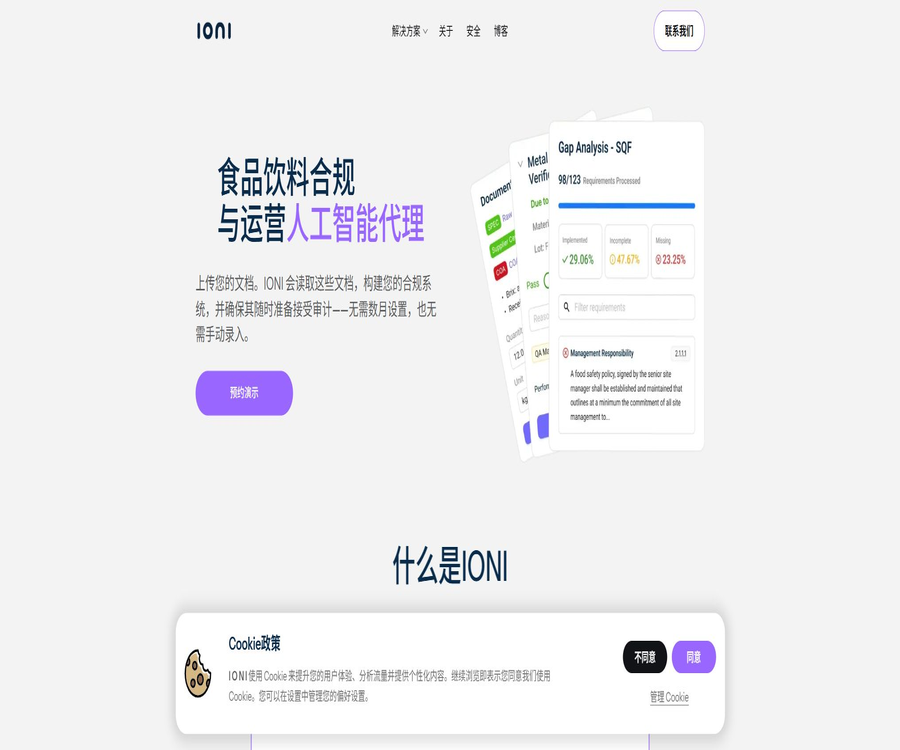
IONI is an AI-driven platform for food safety and compliance management, designed for companies in the food and beverage industry. It retrieves a company’s existing SOPs, HACCP plans, recipes, material specifications, supplier certificates, and COAs, and converts these documents into an executable digital compliance system.
The platform covers HACCP plans, monitoring of critical control points, on-site inspection forms, supplier certificates, corrective and preventive actions, as well as audit reports. Its goal is not merely to generate a document, but to ensure that compliance requirements are consistently linked to daily production records.
A one-sentence summary
IONI uses AI to convert existing documents from food companies into HACCP procedures, on-site tasks, supplier tracking information, and audit evidence – making it suitable for manufacturers who wish to rapidly digitize their food safety systems.
Core functions
- HACCP plan development: Hazard analysis, CCPs, monitoring requirements, and verification procedures are established based on the product, raw materials, and manufacturing processes.
- Intelligent document parsing: Extracts SOPs, recipes, processes, and supplier information from Word, PDF, and Excel files.
- On-site digital checklist: Converts paper-based CCP records, temperature checks, and hygiene tasks into mobile forms.
- Real-time deviation alerts: Notify the supervisor when any limits are exceeded or something is missed, thereby preventing issues from being discovered only after the shift is over.
- AI CAPA: Develops root cause analysis, corrective actions, and subsequent preventive measures in response to deviations.
- Supplier certificate tracking: Centralized management of COAs and certification documents, with alerts for expirations or non-compliance with specifications.
- Compliance gap analysis: Examine missing, expired, and unfinished items against the target standards.
- One-click audit report: aggregates inspection records, deviations, CAPAs, certificates, and verification evidence.
- Raw material and traceability management: Link raw materials, products, batches, suppliers, and production records together.
- API and CSV connection: Exchanging batch and tracking data with ERP, production, or inventory systems.
HACCP Plan Generator
Companies can upload existing files, or they can start by providing descriptions of the products, raw materials, and production processes. IONI will identify the various process steps as well as any potential biological, chemical, and physical hazards, and then suggest appropriate control points, monitoring parameters, and corrective actions.
- Establish the relationships between products, raw materials, and production processes.
- Generate recommendations for hazard analysis and critical control points.
- Configure the monitoring frequency, responsible person, and recording method for each CCP.
- Automatically creates flowcharts and related SOP drafts.
- Provide hints regarding missing verification programs or support files.
- It supports reviewing, modifying, and exporting the complete HACCP package.
- When there is a change in the process, affected CCPs and SOPs are prompted to be reviewed again.
The process from documents to a compliance system
- Organize the existing SOPs, HACCP documents, recipes, flowcharts, raw material specifications, and supplier certificates.
- Upload Word, PDF, or Excel files, or describe the product and production process from scratch.
- During the 30-minute consultation, the actual processes, target standards, and scope of the audit are determined.
- AI extracts information on products, raw materials, process steps, hazards, and existing control measures.
- Review the HACCP structure, CCPs, checklists, and supplier tracking items generated by the system.
- Assign on-site tasks to the operators and start recording on a tablet or smartphone.
- Ongoing handling of deviations, CAPAs, and reminders for expiring certificates.
- Summarize the records prior to review and generate a complete compliance package.
On-site operation and CCP monitoring
The operator can only see the tasks that need to be completed during the current shift, and can submit inspection results using a tablet or smartphone. The records include time information, allowing supervisors to instantly identify any omissions or deviations.
- Digital checks of temperature, hygiene, equipment, and critical limits.
- Display tasks based on position, shift, and production tasks.
- Simplify the login process to lower the barriers for front-line employees.
- Immediately alert the quality supervisor when a deviation occurs.
- Retain the completion time, personnel involved, and processing results.
- It reduces the problems associated with the loss of paper records, the need to fill them in manually, and difficulties in tracking them.
Supplier COA and certificate management
IONI enables centralized management of suppliers’ COAs, certification documents, and raw material specifications, while also monitoring their expiration dates and compliance with specified standards. Companies can identify any missing documents, expired documents, or abnormal test results before the raw materials are used in production.
- Store proof documents related to suppliers and raw materials in one place.
- Track certificate expiration and send renewal reminders.
- Check the COA data according to the product specifications.
- Link batch, raw material, and supplier records.
- To quickly retrieve evidence for a specific batch for auditing purposes.
AI CAPA and deviation handling
When there are discrepancies in the on-site records, the platform can assist in drafting corrective and preventive actions, as well as suggest directions for root cause analysis. Quality officers are still responsible for verifying the facts, assessing the impact on food safety, and approving the final measures to be taken.
- Record the deviation, location of occurrence, batch, time, and actual measured value.
- Assess the affected products and take immediate actions such as isolation, retesting, or shutting down the production line.
- Review the root cause analysis suggested by AI; do not accept conclusions that lack evidence.
- Determine the corrective actions, responsible persons, deadline, and verification methods.
- Check whether the measures truly prevent similar problems from occurring again.
- Keep records of approval, execution, and effectiveness verification for audit purposes.
Audit preparation and gap analysis
- Check whether the HACCP structure and supporting documents are complete.
- Uncompleted, expired, or unverified compliance items were identified.
- Compile CCP records, corrective actions, and supplier evidence.
- Generate traceable data packages in batches.
- Reduce the time required to manually assemble records from papers, emails, and forms before review.
- Organize audit materials in accordance with the target standards.
Supported food safety systems
The frameworks listed on the official website include SQF, BRCGS, FSMA, CFIA, FSSC 22000, ISO 22000, and Codex Alimentarius, among others. Individual companies should still have qualified personnel determine the regulations applicable in their region, as well as the requirements of their customers and the relevant certification standards.
| Systems or requirements | Tasks that IONI can assist with | Usage notes |
|---|---|---|
| HACCP | Hazard analysis, CCPs, monitoring, correction, verification, and documentation | The critical limits and control measures must be verified by the enterprise. |
| SQF and BRCGS | Gap analysis, on-site records, CAPA, and audit evidence | The applicable version and the requirements of the certification body should be confirmed. |
| FSMA | Prevention and control, documentation, and organization of supply chain information | It cannot replace the regulatory judgments made by qualified professionals. |
| CFIA and SFCR | Documentation and traceability management in Canadian food companies | The scope of the license and specific obligations need to be verified separately. |
| FSSC and ISO 22000 | Link HACCP, procedure documents, and operation records | The scope of the enterprise management system still needs to be established manually. |
| Codex Alimentarius | Organize the plan structure in accordance with HACCP principles. | Additional requirements may vary by industry and region. |
Which users are it suitable for
- Small and medium-sized food and beverage manufacturers.
- Joint producers that need to serve multiple brands at the same time.
- Manage the suppliers of raw materials and ingredients, as well as the certifications provided by those suppliers.
- Food brands prepared for retailer audits or third-party certification.
- Companies in which a small number of employees are responsible for quality, production, and compliance tasks.
- Factories that wish to move paper checklists and spreadsheets to digital systems.
- Teams that already have HACCP and SOP documents but lack tools for their ongoing implementation.
- Manufacturing companies that need to link ERP systems, batch data, and compliance evidence.
Typical use cases
- Establishing a system for the new factory: Creating the first version of the HACCP plan based on product and process descriptions.
- Old plan update: Read existing files and identify gaps resulting from changes in the process.
- Routine CCP monitoring: Assign the checking of temperature, time, and critical limits to various shifts.
- Supplier onboarding: Management of certificates, COAs, specifications, and expiration reminders.
- Audit preparation: Quickly gather complete evidence for a specified period or batch.
- Deviation closed-loop: Identifying the root causes of anomalies, taking corrective actions, and verifying the effectiveness of those actions.
- Multi-product line management: Maintain separate or shared control procedures for different products.
- System migration: Rebuild the digital compliance framework using existing SOPs and HACCP documents.
Complete usage tutorial
- First, determine the factories, product lines, regulatory regions, and certification standards that need to be covered.
- Clean up file versions by marking documents as approved, under revision, or obsolete.
- Upload SOPs, HACCP plans, recipes, process flows, specification sheets, COAs, and certificates.
- Confirm with the setup personnel the products, equipment, shifts, roles, and existing critical limits.
- Review each piece of data extracted by AI to correct product names, process sequences, and units.
- The person in charge of food safety reviews the hazard analysis, CCPs, and monitoring requirements.
- First, select a product line to test the on-site inspection form and deviation notification system.
- Check employee permissions, mobile operations, timestamps, and approval processes.
- Simulate a deviation, certificate expiration, and export of audit documents.
- Expand the deployment only after confirming data retention, backup, exit procedures, and contract terms.
Pricing
IONI currently offers a combination of free demonstrations or trials, one-time HACCP plan services, and full platform subscriptions. The starting price for the complete food safety platform is $199 per month; the actual cost may vary depending on the number of facilities, the modules used, and the specific needs of the enterprise.
| Plan | Public price | Main content | Suitable for |
|---|---|---|---|
| Set up demos and trials | Free of charge, no credit card required | Use actual company documents to demonstrate the configuration effects. | Team responsible for assessing the suitability of products and processes |
| Generation of HACCP plan | $ | A complete HACCP plan, hazard analysis, CCPs, flowcharts, SOPs, and PDF export options | Manufacturers who can quickly create or update plans are all that’s needed. |
| Comprehensive food safety platform | Starting at $199 per month | HACCP, on-site inspections, supplier certificates, CAPA, and audit management | Enterprises with a single factory that need to maintain a compliant system in operation continuously |
| Multi-site or enterprise deployment | It needs to be confirmed based on requirements. | Multiple factories, integration, permissions, and customization scope | Companies with complex organizational structures and the need for system integration |
Pricing considerations
- A one-time HACCP plan and a subscription-based platform are not the same type of purchase option.
- $
- Multiple factories, API connections, the scope of implementation, and data migration can affect the quote.
- Subscriptions are usually renewed automatically; once canceled, access remains valid until the end of the paid period.
- Taxes and fees may be charged separately; the official contract and the settlement page shall have final authority.
- If no purchase is made after the trial period ends, the trial data may be deleted.
Data security and privacy
IONI ensures that data is encrypted both during transmission and when stored statically, and it makes use of role-based permissions, authentication, access logs, and continuous monitoring. Its infrastructure relies on Azure and AWS, and some of the data may be processed in the United States.
- Customer data is not used to train AI models by default, unless the customer gives explicit consent.
- AI service providers are bound by data processing agreements and contractual obligations.
- Provide explanations regarding the data processing protocols related to GDPR and the mechanisms for cross-border data transfer.
- Use standard contract clauses and conduct a cross-border transfer impact assessment.
- The official website states that SOC 2 Type II and ISO 27001 are still in the implementation phase.
- Before uploading sensitive production materials, it is necessary to verify the sub-processor, region, and retention policy.
Pre-deployment checklist
- Verify the version, approval status, and data ownership of all uploaded files.
- Verify that the AI-generated results retain the correct units, limits, and process sequence.
- It specifies who is authorized to modify the HACCP plan, approve CAPAs, and export audit documents.
- Test the on-site recording methods and supplementary rules in weak network environments.
- Verify the mapping of API fields to CSV fields in ERP, inventory, or production systems.
- Verify the location where data is stored, the retention period, backup procedures, and data export after the contract ends.
- Maintain independently accessible key records for regulatory inspections and product recalls.
- Have personnel with expertise in food safety approve the final control plan.
Product advantages
- It is possible to build the system using the company’s existing documents, thereby reducing the need for repeated data entry.
- Link HACCP documents, on-site implementation records, and audit evidence on the same platform.
- Its functions are designed around the actual processes of food manufacturing; it is not a general-purpose document or chat tool.
- The operator interface is designed to simplify tasks and reduce the difficulty of implementation on site.
- Supplier COAs, certificate expiration dates, and batch documentation can be tracked in a centralized manner.
- AI can assist with hazard analysis, gap identification, and the drafting of CAPAs.
- Monthly starting prices and one-time HACCP plan prices are made available publicly.
- New customers can use their own files to conduct a free setup demonstration.
- It can be connected to existing business systems via API or CSV.
Usage restrictions and precautions
- The hazards posed by AI-generated content, as well as the CCPs and corrective actions, cannot replace the approval of professionals.
- Incorrect or outdated source files have a direct impact on the results generated by the system.
- Food safety regulations, certification standards, and customer requirements are constantly changing.
- Public information does not provide a complete list of the various quotas and functional differences across different subscription tiers.
- Multi-site, complex integration, and migration projects may still require additional implementation work.
- The platform is primarily aimed at manufacturers; the working methods suitable for food service establishments may not be entirely appropriate.
- SOC 2 Type II and ISO 27001 have not yet been marked as completed on the official website.
- Cloud processing involves third-party infrastructure and possible cross-border data transmission.
- Automatically generating audit documents does not guarantee passing regulatory or certification audits.
- In the event of a recall, a significant deviation, or a legal decision, it must be handled by qualified personnel.
GitHub and open source
The IONI official website does not provide any links to official open-source repositories for its core platform, nor does it make the food safety models, training data, or platform licenses available to the public. Its complete product should be classified as a commercial, closed-source SaaS solution.
The platform mentions API and system integration capabilities, but making the API available for public access does not equate to open sourcing. Before integrating such systems, companies should consult the vendor regarding the interface documentation, authentication methods, rate limits, and costs.
Differences from general AI document tools
| Comparison items | IONI | Universal AI document tool |
|---|---|---|
| Core object | Food safety system, products, raw materials, batches, and control points | Text, file, and general knowledge Q&A |
| Main output | HACCP, checklists, CAPA, certificate tracking, and audit packages | Abstracts, answers, and general documents |
| On-site execution | Supports shift tasks, CCP records, and deviation notifications. | There is often a lack of workflows for food handling on-site. |
| Regulatory context | Regarding food manufacturing standards and preparation for audits | Users need to establish industry rules on their own. |
| Responsibility requirements | It must be verified and approved by the person in charge of food safety. | The results also require manual verification. |
Basic information
| field | Content |
|---|---|
| Tool name | IONI |
| Development company | IONI AI INC. |
| Headquarters | Barnaby, Canada |
| Tool type | AI food safety, HACCP, and compliance management platform |
| Key customers | Food and beverage manufacturers, co-producers, brand and ingredient suppliers |
| Enter data | Word, PDF, Excel, SOPs, formulas, specifications, certificates, and COAs |
| Price pattern | Free trial, one-time services, and subscription pricing |
| Whether API is provided | Integration capabilities are available; specific permissions and costs need to be confirmed. |
| Is it open source? | No; the official core code repository and licenses are not made public. |
Recommendation score
4.3 / 5. IONI is suitable for small and medium-sized manufacturers that already possess food safety documentation and wish to establish a digital system for implementation and auditing quickly; it combines document reading, on-site inspections, and supplier management effectively, but decisions regarding key controls still need to be reviewed by professionals.
Frequently Asked Questions
What problems does IONI mainly address?
It transforms the SOPs, HACCP protocols, recipes, and supplier information of food companies into actionable processes for inspection, tracking, CAPA, and auditing.
Can IONI create an HACCP plan from scratch?
Yes, a company can describe its products, raw materials, and production processes; it can also upload existing files so that the system can read them and make updates accordingly.
How much is IONI?
The starting price for the full platform is $199 per month, while the cost for generating a complete HACCP plan on a one-time basis is $500.
Is there a free trial available?
The official website offers free demonstrations or trials using real company documents, and no credit card is required.
Which files are supported?
The official website currently lists Word, PDF, and Excel as formats that can be used to import SOPs, HACCP data, recipes, and supplier information.
Can it be used for SQF or BRCGS audits?
The platform can organize gap assessments and relevant evidence using these frameworks, but companies still need to determine the applicable version and have control measures approved by qualified professionals.
Will IONI use customer data to train AI?
According to the official safety guidelines, customer data is not used for training models by default, unless the customer gives explicit consent.
Can it be connected to ERP?
Batch, inventory, production, and tracking data can be connected via API or CSV; the specific range of interfaces must be confirmed prior to deployment.
Is IONI open-source software?
No, the official core code, models, training data, or open-source licenses are not currently available publicly.
Tools similar to the AI Food Safety Software for Manufacturers





 Guigong Network Security Registration No. 45132202000164