






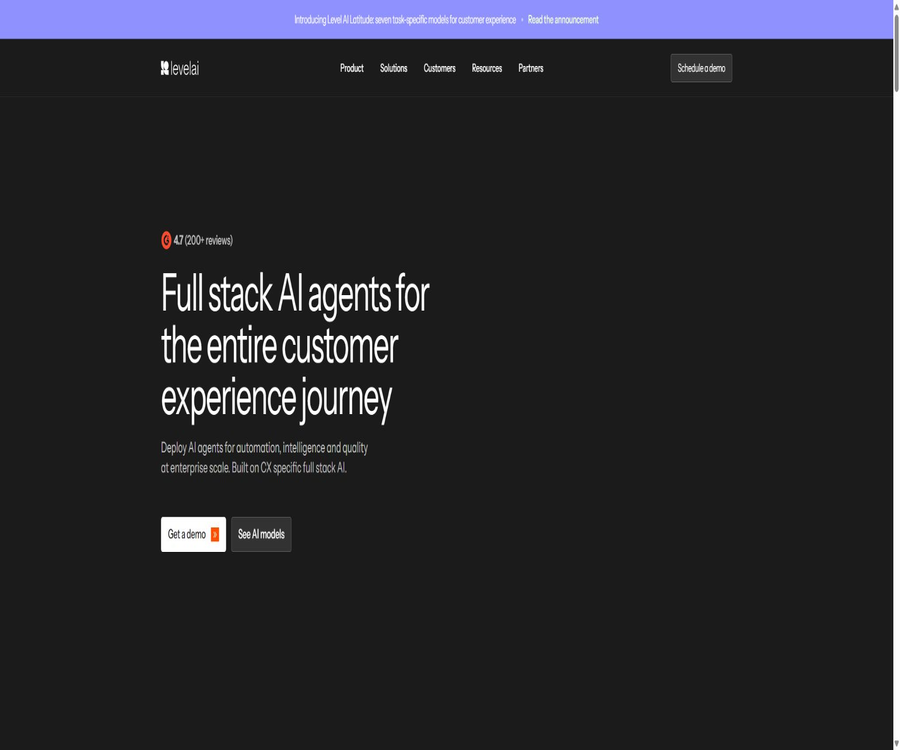
What is Level AI?
Level AI is an intelligent platform for customer experience, designed for corporate contact centers; it integrates the interactions between human agents and AI-powered customer service systems in order to enable automation, quality management, and business analysis. It covers voice calls, chats, emails, and robot conversations, rather than offering just a single chatbot solution.
The platform is operated by Ujwal, Inc., and it serves primarily customer service, sales, collection, and patient care teams that require high levels of traffic handling and compliance. Procurement processes usually start with demonstrations, data integration, and pilot projects.
A one-sentence summary
Level AI analyzes each customer interaction using dedicated CX models, and utilizes the results for virtual customer service, comprehensive quality assessment, real-time assistance, agent training, and customer insights.
Core product portfolio
| module | Main function | Typical user |
|---|---|---|
| AI Virtual Agent | Automatically handle customer requests via voice and chat. | Customer Service Operations and Automation Team |
| Quality Assurance | Automated verification of interactions based on the company’s scoring system | Quality inspection and compliance team |
| Agent Assist | Provide real-time suggestions to agents during the session. | Front-line agents and supervisors |
| Agent Coaching | Identify key areas for coaching and track improvements. | Team leader and training team |
| Voice of Customer | Identify themes, trends, and root causes | CX, product, and operations teams |
| Analytics and iCSAT | Analyze performance and infer satisfaction levels | Management and data team |
| Screen Recording | Link screen actions to customer conversations | Quality control, process, and security teams |
| AI Workers | Execute complex CX workflows across systems | Operations and Automation Team |
Level AI Latitude model
Latitude is a set of seven specialized models developed by Level AI for use in scenarios related to customer experience. According to the company, these models are optimized based on numerous real-world customer interactions; however, the performance data provided is based on their own benchmarks, and businesses should still verify the results using local voice recordings and rating scales.
| Dedicated model | Process tasks | Business output |
|---|---|---|
| Transcription | Identifying voice in contact centers | Text and timeline can be searched. |
| Redaction | Identify and remove sensitive information. | Desensitized audio and text |
| Intent Detection | Understand the customer’s true intentions | Classification, routing, and automated signaling |
| Summarization | Summarize problems, actions, and results | Structured session summary |
| Inferred CSAT | Estimate the satisfaction level of customers who did not complete the questionnaire | iCSAT per interaction |
| Quality Assurance | Evaluate interactions according to corporate rules. | Scores, evidence, and reasons |
| Voice of Customer | Categorize sessions into hierarchical topics | Trends, root causes, and opportunities |
AI virtual customer service
The AI Virtual Agent supports voice and chat interactions, and can provide 24/7 service in over 50 languages. The platform places emphasis on context understanding, handling of interruptions, clarification of intentions, adherence to business rules, and handover to human agents when necessary.
- Extract solution approaches from real, high-quality agent workflows.
- It supports both natural dialogue and deterministic workflows.
- Handling interruptions, pauses, and additional information in voice conversations
- Perform authentication, queries, updates, and subsequent actions
- Transfer to a human agent when it cannot be resolved safely.
- Use the same quality assessment standards to evaluate AI and human conversations.
- Continuous calibration based on failed cases and feedback
Automatic quality management
Quality Assurance allows companies to use their own scoring systems to evaluate calls, chats, emails, and interactions with robots, while also providing evidence to support those scores. Fully automatic scoring helps to reduce the limitations that arise from examining only a small number of conversations.
- Covers more sessions rather than relying on manual sampling
- Processing open-ended assessment items that require semantic understanding
- For each score, display the relevant session evidence and reasons.
- Unify the quality standards for human agents and AI customer service.
- Supports calibration, dispute resolution, and review workflows.
- Identify differences in policies, sales scripts, and compliance implementation.
- Transfer the problematic session to a coach or the operational process.
Agent Assist real-time assistance
Agent Assist displays relevant information, suggestions for the next steps, and summaries to the agent during the customer conversation. Managers can also monitor the situation in real time and intervene or provide remote guidance during complex conversations.
- Retrieve the most relevant knowledge based on the current intent.
- Guidelines for process steps, policies, and compliance statements
- Automatically generate session summaries and subsequent records
- Reduce the need for agents to search for information across multiple windows.
- Help new employees get to know complex business processes more quickly.
- Allow the supervisor to identify sessions that require immediate assistance.
- Reduce the average processing time and increase the rate of issues being resolved in a single attempt
Agent coach
Agent Coaching identifies opportunities for coaching based on actual interactions, quality inspection results, and performance trends, and it stores the action items along with the history of follow-ups in one place. Managers can view progress by agent, team, or supervisor.
- Recurring issues with phrasing and procedures were identified.
- Explain performance changes using real conversation excerpts.
- Generate personalized guidance priorities and recommended actions.
- Record coach meetings, commitments, and follow-up tasks
- Tracking skill improvements and recurring issues
- Reduce the time managers spend manually organizing tables and samples
Voice of Customer
The Customer Voice module identifies new topics, trends, and root causes from all interactions and surveys, and converts these conversations into actionable business insights. Teams can use natural language to ask about the reasons behind a decline in satisfaction.
- New issues and topics that were not configured in advance were identified.
- Compare trends by product, region, channel, and time.
- Further break down the primary themes into their deeper underlying causes.
- Use AI summaries to explain charts and abnormal changes.
- Linking customer emotions, effort level, and resolution outcomes
- Forward the issue to the product, process, and training teams
iCSAT satisfaction estimation
iCSAT determines satisfaction levels based on the content of the conversations, emotions expressed, the efforts made by the customers, and the way issues were resolved; it also includes in its analysis those customers who did not fill out surveys. It is useful for expanding the scope of observation, but it cannot completely replace formal questionnaires or business metrics.
- Generate satisfaction signals for a large number of unresponded surveys.
- Provide the basis for the rating and relevant conversation evidence.
- Identify the main factors behind low satisfaction levels
- Compare differences in teams, locations, channels, and products
- Cross-verification with traditional CSAT, complaint, and churn data
Contact center analysis
Analytics aggregates call, chat, email, quality inspection, and customer data into a unified analysis interface. The chart builder allows for filtering, grouping, and customizing metrics, making it suitable for teams to create operation dashboards.
- View quality trends for agents, teams, and channels
- Analyze topics, emotions, intentions, and customer outcomes
- Create custom reports and set up common filters.
- Link session metrics with CRM or ticket data
- Identify the causes of long processing times, transfers, and repeated contacts.
- Provide management with a consistent definition of the customer experience.
Screen recording and process diagnosis
Agent Screen Recording links the actions on the agent’s screen to the conversations with customers, enabling managers to identify process issues that cannot be detected by merely listening to the recordings. When it is deployed, it is necessary to strictly control the scope of recording, sensitive fields, and access rights.
- Processing delays caused by the switching between systems for locating agents
- Identified missing knowledge, complex steps, and tool limitations.
- Verify whether the prescribed procedures and compliance steps have been carried out.
- Provide screen operation evidence for personalized coaches
- Review marked suspicious or high-risk interactions
- Payment and identity information are masked in accordance with privacy rules.
AI Workers
AI Workers are used to carry out more complex tasks based on customer interactions and operational signals, such as identifying opportunities for guidance, generating plans, or initiating further actions. Companies should place high-risk actions under controls related to permissions, approval processes, and auditing.
- Identify the agents who need coaching from all interactions.
- Convert quality inspection failures into responsible persons and action plans.
- Workflow triggered by complaints, refunds, or upgrades
- Sync customer issues to tickets and CRM
- Aggregate information from multiple sources and generate recommendations for the next steps.
- Verify permissions, data, and business rules before execution.
Humans and AI learn together
Level AI focuses on creating a continuous learning loop that connects human agents, AI-powered customer service, quality assessment, and customer feedback. After changes in new policies, products, or regulatory requirements, the models and scoring criteria need to be calibrated regularly.
- Use the same rubric to evaluate human-AI interactions.
- Extract automated processes from excellent manual solutions.
- Identify gaps in knowledge and rules from AI failure cases
- Re-calibrate the scores using the results of manual verification.
- Convert new topics into processes, training, or product improvements.
- Continuously compare the level of automation, quality, and customer outcomes.
Integration capability
Level AI can be integrated with existing phone systems, customer service tools, CRM systems, knowledge bases, identity management solutions, data management systems, and collaboration tools. Companies do not need to replace the entire technology stack of their contact centers at once; instead, they need to establish a stable data mapping mechanism.
| System type | Examples listed by the authorities | Primary uses |
|---|---|---|
| Telephones and contact centers | Five9, Twilio, Amazon Connect, Genesys, Talkdesk | Access to voice, events, and agent status |
| Customer Service and CRM | Zendesk, Salesforce, Intercom, Freshworks, Kustomer | Synchronize customers, tickets, and results |
| Identity and Single Sign-On | Okta, OneLogin, Azure, Auth0, Google SSO | Login, seat, and permission management |
| Knowledge and collaboration | Guru, Slack, Microsoft Teams | Retrieve knowledge and send notifications |
| Data platform | S3, SFTP, Snowflake | Batch data, analysis, and archiving |
| Other CX tools | Medallia, Calabrio, Sprinklr, Gorgias | Expanding experiences and operational processes |
Applicable scenarios
- Large customer service centers carry out comprehensive quality inspection of calls, chats, and emails.
- Financial institutions monitor authentication, disclosure, and compliance procedures.
- The medical service team handles prescriptions, appointments, and common requests automatically.
- Retail and e-commerce use voice or chat AI to handle order-related issues
- Insurance companies identify the underlying causes of claims processing issues and customer dissatisfaction.
- The collection team monitors the quality of communication and the outcomes of actions in a unified manner.
- BPO manages the quality of agents in different locations in accordance with customer standards.
- The sales team identifies behaviors that lead to high conversion rates and methods for dealing with objections.
Which teams are suitable?
- Medium to large enterprises that have a large amount of data on customer interactions available for analysis
- Organizations that need to manage the quality of both human and AI-based customer service in a unified manner
- Teams that wish to upgrade from sample-based quality inspection to large-scale automated assessment
- Companies that have integrated tools for telephony, CRM, ticketing, and knowledge bases
- Industry clients that require strict security, access control, and audit mechanisms
- An operational team capable of continuously maintaining scorecards, knowledge bases, and business rules
Level AI pricing
The official website of Level AI does not specify a fixed monthly fee; instead, pricing is based on the number of agents or on standard packages, and quotes for businesses are provided after scheduling a demonstration. The total cost generally depends on the modules chosen, the level of interaction required, the distribution channel, the language used, as well as integration and implementation services.
| Product range | Public price | Key points of the quote |
|---|---|---|
| AI Virtual Agent | Corporate customization | Volume of voice or chat, language, processes, and call costs |
| Quality Assurance | Corporate customization | Interaction volume, rating forms, channels, and review seats |
| Agent Assist | Corporate customization | Number of seats, real-time concurrency, knowledge base, and integration |
| Coaching and Screen Recording | Corporate customization | Manager position, amount of recording, storage, and retention period |
| VoC, Analytics, and iCSAT | Corporate customization | Data volume, reports, historical data, and number of users |
| AI Workers and enterprise services | Corporate customization | Number of workflows, action permissions, and professional services |
Purchase cost list
- Platform licensing is billed based on the number of agents, the volume of interactions, or specific modules.
- Charges for voice minutes, transcription, storage, and data retention
- Costs related to concurrency, language support, and telephone infrastructure for virtual customer service.
- Fees for historical data migration, integration, and implementation services
- Custom scoring sheets, model calibration, and range of professional services
- Sandboxes, testing environments, support levels, and service commitments
- Minimum contract duration, renewal, excess usage, and termination clauses
Quick Start Tutorial
- Identify the most critical business objectives, such as quality inspection coverage or automated processing.
- Inventory data from calls, chats, emails, CRM, and knowledge bases.
- Select a channel and a high-frequency process to carry out a pilot.
- Prepare desensitized samples, existing rating scales, and manual benchmark results.
- Connect to the testing environment and verify fields, identities, and timelines.
- Have quality control, operations, security, and legal teams conduct the inspection together.
- Evaluate the pilot based on accuracy, customer outcomes, and manual workload.
- Gradually expand to more queues, languages, and automation actions.
Tutorial on Automatic Quality Inspection Configuration
- Break down the existing scoring sheet into clear and evidence-based criteria.
- Distinguish between mandatory compliance items, service quality items, and business outcome items.
- Prepare pass, fail, and boundary samples for each standard.
- Establish a baseline using the results of manual audits and calculate the consistency rate.
- Configure the processes for evidence presentation, review, dispute resolution, and calibration.
- Run it in shadow mode first; it has no immediate impact on performance or salary.
- Analyze misjudgments and revise rules, knowledge, and samples.
- Once stability is achieved, the results can be used for coaching and operational actions.
Tutorial for launching virtual customer service
- Choose customer intentions that are frequent, well-defined, and involve low risk.
- Document the actual steps taken to resolve issues successfully as well as the abnormal paths encountered.
- Connects knowledge, identity, CRM, and business execution systems.
- Configure authentication, privacy, compliance, and non-executable boundaries.
- Set up conditions for manual transfer, timeout, and recovery in case of failure.
- Tests using authentic accents, interruptions, noise, and vague expressions.
- Launch with a low volume of traffic and monitor the resolution rate, complaints, and erroneous actions.
- Continuously calibrate using manual and AI quality inspection results.
Safety and compliance
The Level AI security page lists the controls related to ISO 27001, SOC 2 Type II, HIPAA, PCI DSS, HITRUST, and GDPR. The specific scope of certification, applicable regions, and contractual responsibilities should be verified through its Trust Center and corporate agreements.
| Security sector | Public availability | Key points for enterprise verification |
|---|---|---|
| Identity and permissions | SSO, FIDO2 multi-factor authentication, SCIM, and role-based permissions | Boundaries for administrators, agents, and auditors |
| Sensitive information | Automatically mask names, card numbers, social security numbers, etc. before AI processing. | Language, entity types, and error rate |
| Encryption | Static AES-256, transmission via TLS 1.2 or higher, internal two-way authentication | Keys, backups, and regions |
| Tenant isolation | Inference is isolated according to the customer’s environment. | Cross-tenant testing and logging |
| Use of AI data | Third-party AI processors: no retention and training is prohibited. | Contracts, subcontractors, and exceptions |
| Audit | AI decision-making, access, and system event logging | Retention period, export, and alerts |
Effect evaluation
| Indicators | Meaning | Evaluation recommendations |
|---|---|---|
| Automatic resolution rate | Percentage of customer requests that do not require manual handling | Exclude incorrect terminations and duplicate contacts |
| Quality inspection consistency rate | Degree of agreement between AI scores and those of experienced auditors | Layer by scoring criteria and language |
| Average processing time | Time taken by an agent to complete one interaction | Observe quality and transfer at the same time. |
| One-time resolution rate | Does the customer not need to get in touch again? | Analysis by intent and channel |
| iCSAT correlation | Determine whether the inferred satisfaction level matches the actual result. | Related to questionnaires, complaints, and churn verification |
| Coach closure rate | Does the problem lead to action and improvement? | Track by agent and manager |
| Compliance non-detection rate | Have high-risk issues gone unnoticed? | Manually review high-risk samples. |
Product advantages
- A unified platform that integrates virtual customer service, quality inspection, assistance, and insights.
- Human agents and AI customer service can adhere to the same quality standards.
- Seven types of CX-specific models cover transcription, data masking, intent recognition, and quality inspection.
- Automatic scoring includes supporting evidence, facilitating review and calibration.
- It can analyze various channels such as voice, chat, emails, and robots.
- Real-time assistance, coaching, and customer feedback create a loop for continuous improvement.
- Integrates mainstream phone, CRM, customer service, and identity systems
- The enterprise security page provides comprehensive information on compliance and governance.
Usage restrictions and precautions
- The official website does not disclose the standard packages; a quote must be obtained from the company first.
- The platform is intended for corporate contact centers; the implementation cost may be high for small teams.
- The official data on accuracy and efficiency need to be verified using actual company samples.
- Accents, noise, industry jargon, and multiple languages can affect transcription and intent recognition.
- Misjudgments in automated quality inspection can affect employees’ performance; therefore, a review mechanism must be provided.
- iCSAT is an inferred signal and cannot be considered as a rating given directly by the customer.
- Screen recording involves sensitive data, employee privacy, and regional laws.
- Strict safeguards are required when virtual customer service agents handle refunds, account management, or medical-related tasks.
- Integrating old telephone systems with CRM systems requires the use of resources for data governance.
- The core platform is closed-source; long-term use relies on commercial hosting services.
GitHub and open source
No official core open-source repository for the Level AI enterprise platform was identified in this investigation. The Latitude model, virtual customer service, automatic quality inspection, Agent Assist, AI Workers, and analysis systems are all offered as commercial services.
On code hosting platforms, there may be LevelAI accounts or projects with similar names, but they lack the organizational verification corresponding to that of the company’s official website; therefore it is not possible to consider such products as open source. The availability of APIs and integration options does not mean that the core source code is made public as well.
| Components | Status | Explanation |
|---|---|---|
| Level AI platform | Commercial closed-source | SaaS for corporate customer experience |
| Latitude model | Proprietary models | Unpublished model weights and training code |
| AI Virtual Agents and Workers | Hosting capabilities | Deployed through the enterprise platform |
| Integrated connection | Ability to maintain open connections | It is not the same as open-source products. |
| Official core repository | Not verified. | Projects with the same name cannot be used as a basis. |
Basic information
| field | Content |
|---|---|
| Tool name | Level AI |
| Operating entity | Ujwal, Inc. |
| Product type | Corporate contact centers and AI platforms for customer experience |
| Core model | Level AI Latitude: seven dedicated CX model categories |
| Primary channels | Voice, chat, email, and robot interactions |
| Primary users | Customer service, quality control, operations, compliance, CX, and data teams |
| Price pattern | Custom quotes for businesses |
| Deployment method | Commercial hosting platforms and enterprise integration |
| Is it open source? | No, neither the core platform nor the models are open source. |
Recommendation score
4.7 / 5. Level AI is suitable for large contact centers that seek to integrate virtual customer service, comprehensive quality assessment, agent assistance, and customer insights; it offers well-developed specialized models, evidence-based scoring, and security mechanisms. However, its price is not transparent, and its performance depends heavily on the quality of the data, proper integration, and ongoing calibration.
Frequently Asked Questions
What is Level AI mainly used for?
It integrates AI virtual customer service, automated quality inspection, real-time agent assistance, coaching tools, and customer insights into a single enterprise platform.
Can Level AI automatically check all calls?
The goal of this platform is to carry out large-scale automated scoring of voice interactions, chats, emails, and robot interactions, though human verification is still required to ensure accuracy.
Does Level AI support voice robots?
Supported. The AI Virtual Agent can handle voice and chat requests, and it can transfer such tasks to human agents in complex or high-risk situations.
What is Latitude?
Latitude is its family of seven dedicated CX models, covering transcription, data masking, intent detection, summarization, iCSAT, quality inspection, and customer voice analysis.
How much does Level AI cost?
The official website does not list any fixed packages; a quote from the company is required, taking into account factors such as modules, seats, level of interaction, channel used, and scope of implementation.
Can Level AI replace manual quality inspection?
It cannot completely replace manual review. It can expand the scope of coverage, but high-risk assessments, disputes, and rule changes still require human verification.
What integrations does Level AI support?
It can be connected to various telephone systems, CRM platforms, customer service tools, knowledge management systems, identity management solutions, and data platforms; the specific availability depends on the enterprise’s technical infrastructure.
Is Level AI safe?
The official website lists various corporate security and compliance controls; nevertheless, the purchaser should still verify the scope of certification, the location of the data, and the contractual responsibilities.
Is Level AI open source?
It is not open source; no official open-source repositories for its core platform or the Latitude models were found this time.
Tools similar to AI + human intelligence throughout the entire customer journey





 Guigong Network Security Registration No. 45132202000164